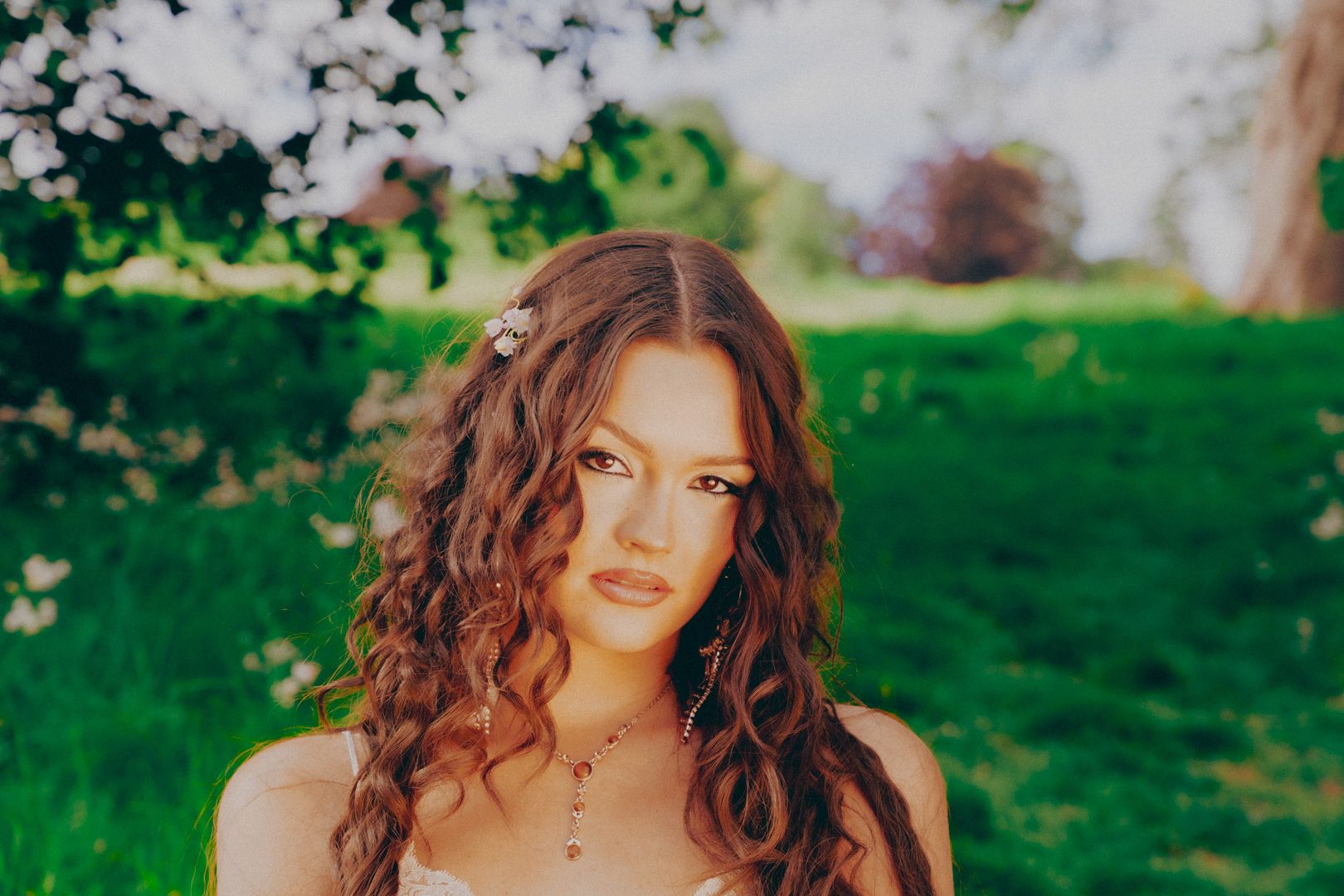
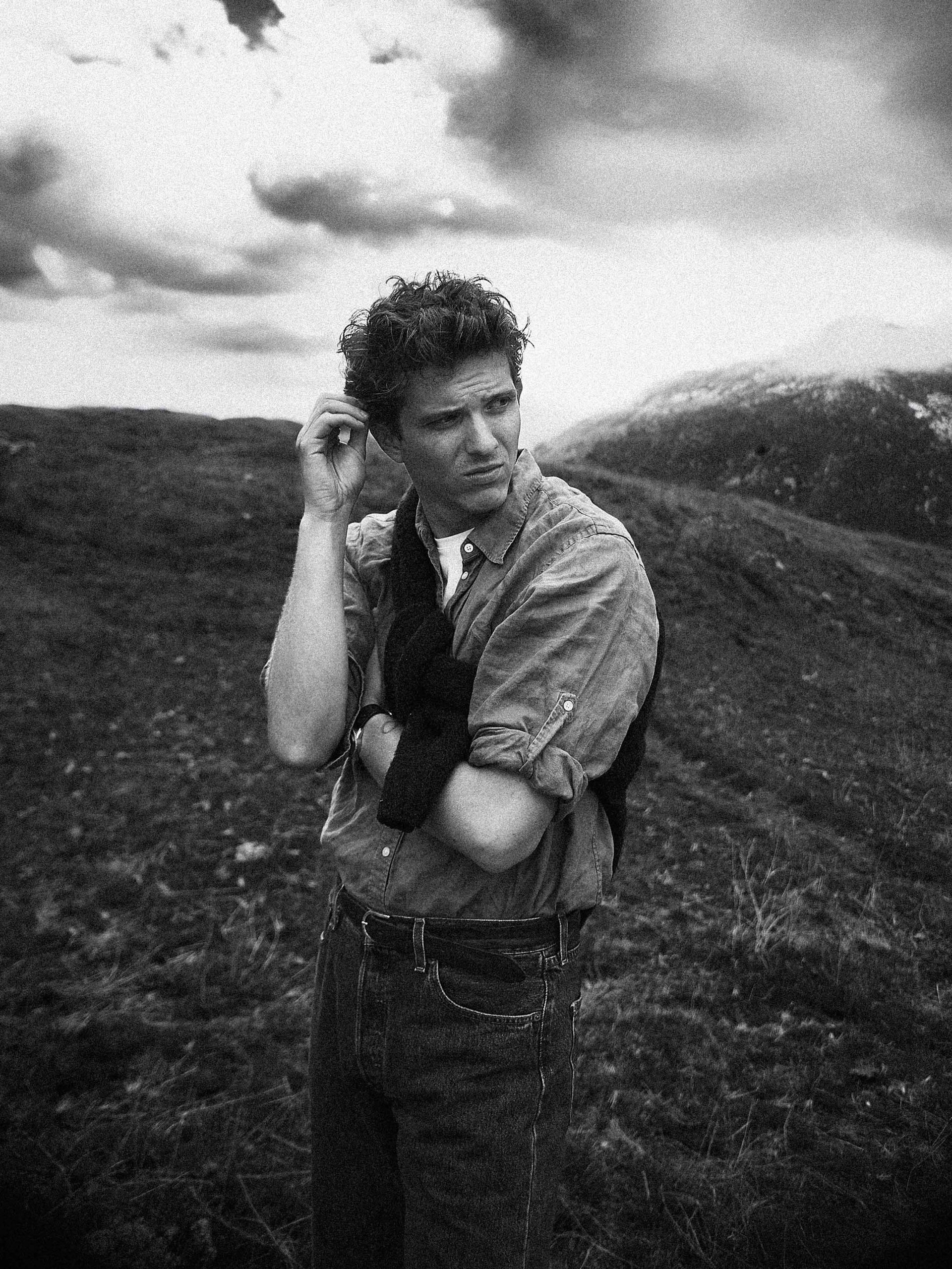
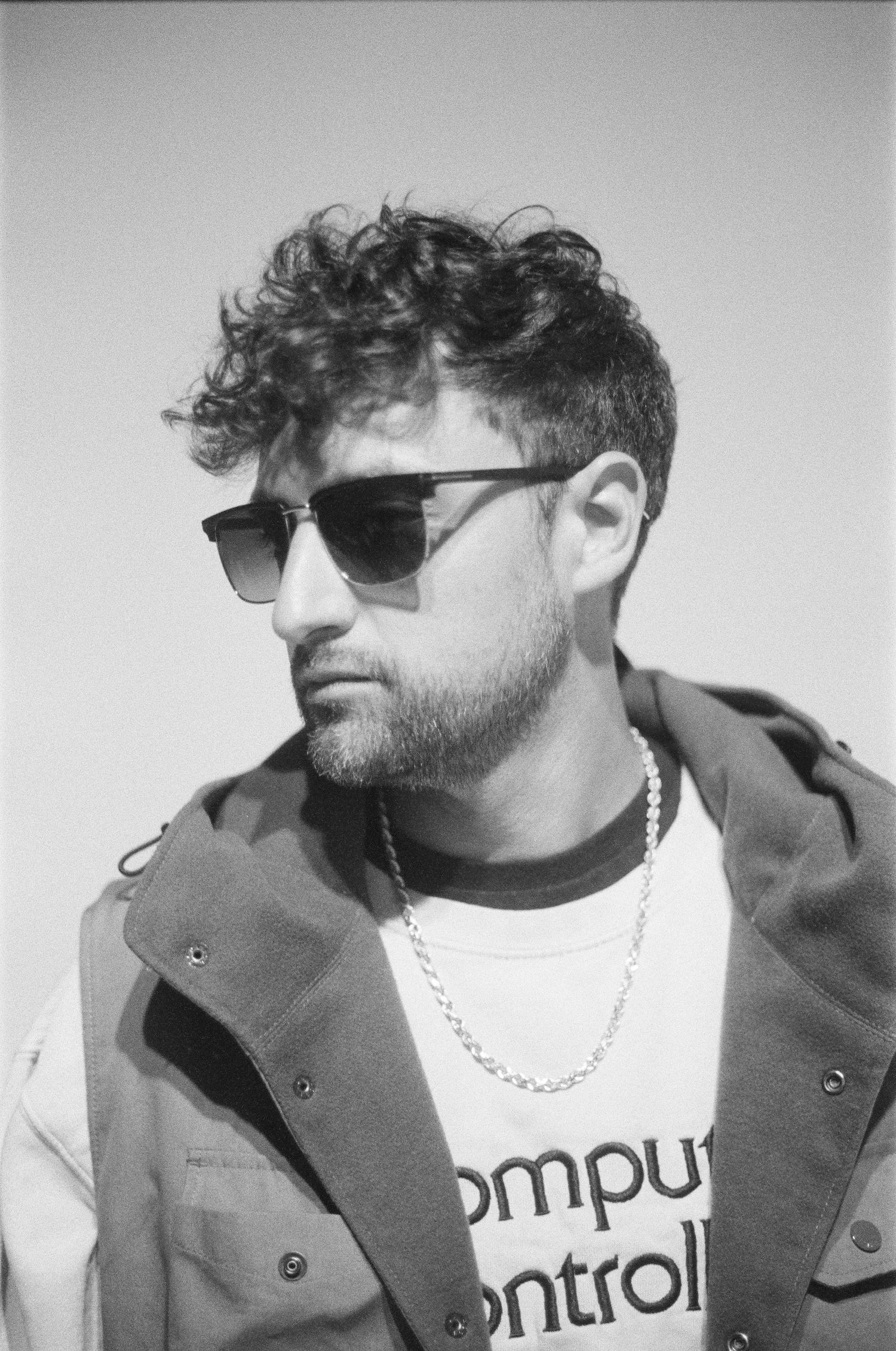
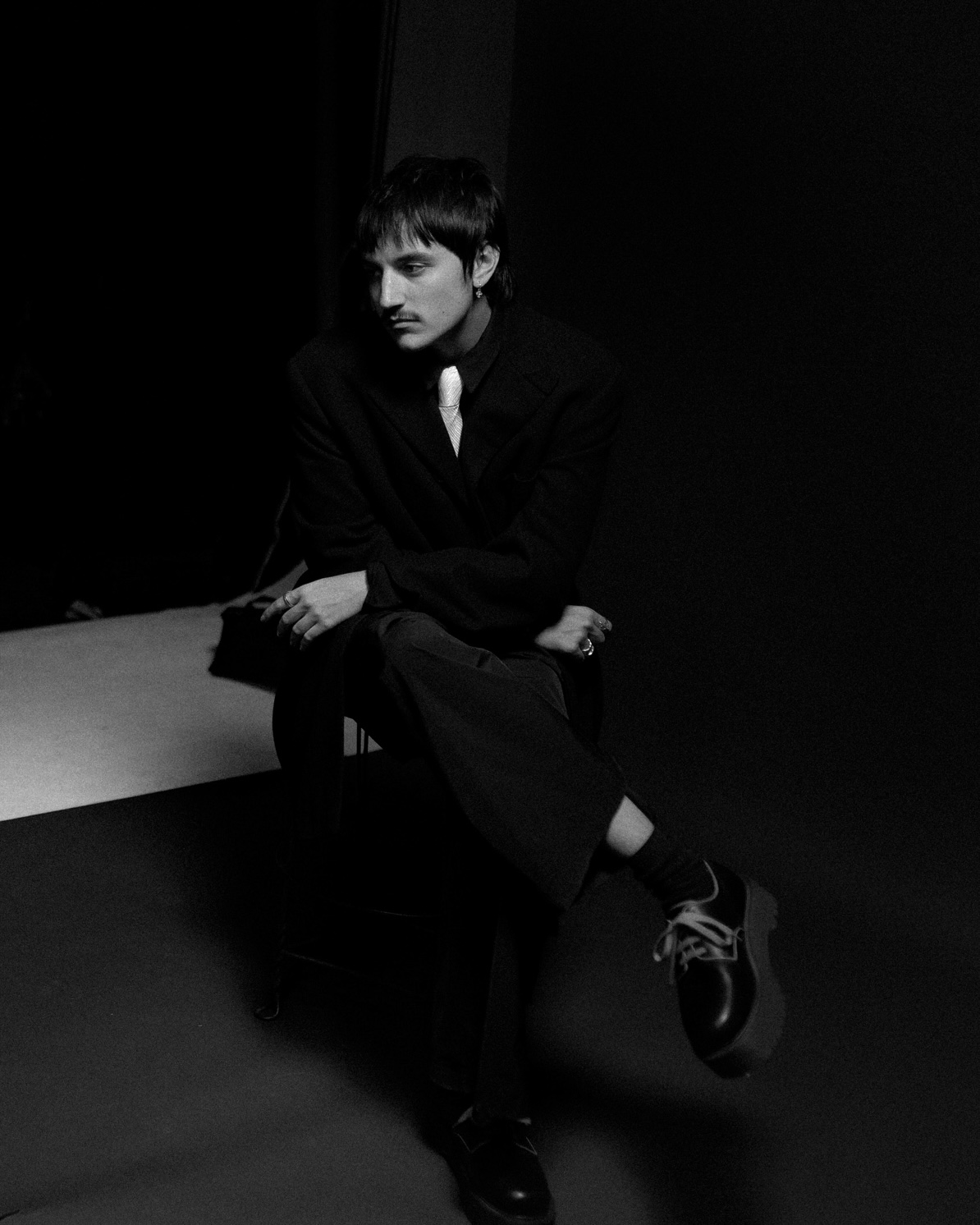
Sat outside a pub in the countryside near his parents’ home, Artemas appears worlds away from the whirlwind year he’s just experienced.
At only 26, the “i like the way you kiss me” and “if u think i’m pretty” singer has reached heights that artists chase for decades, from performing at Coachella, to amassing billions of streams on Spotify and touring worldwide. It’s the mischievous air of confidence he carries, combined with a sheer determination to succeed, that positions him as a force to be reckoned with.
Artemas’ newly released mixtape, Lovercore, is undeniably provocative, inviting both loyal fans and curious newcomers alike to embrace what they feel. This desire for a reaction is central to Artemas’ musical process, from sporadically teasing snippets of unreleased songs on TikTok to the seductive and even challenging lyrics he’s become synonymous with. Far from being afraid to be polarise, he instead leans into the noise it generates.
Through both his songs and his growing online presence, Artemas candidly brings his audience along for the journey in an honest dialogue that includes the messy parts, perhaps even placing them at the forefront. Throughout our conversation, he speaks to the value of imperfection, both musically and in reality. For the singer, it’s not about being the finished, polished product; it’s about the late-night ideas, the experiments and the self-doubt along the way.
With plans to tour Europe and the USA in 2026, he shows no intention of slowing down. 1883 Magazine’s Bex Whitley speaks with Artemas about navigating sex, judgment and social media.
For those who don’t know you, how would you describe your music?
I guess the umbrella term for it would be alternative pop. I’m inspired by so many different genres, decades and artists, so it’s a real blend of different stuff. It’s also quite dark, and the themes are melodramatic and about love. If I’m being self-deprecating, I just call it horny pop music.
I can’t lie, I’ve had “i like the way you kiss me” on repeat since it was released in 2024. This year’s been a big year for you, too. Tell me your highlights.
Coachella and Lollapalooza were really cool. I wasn’t expecting to fill out the areas, and I was really nervous for them. It was wicked to be included. You’re there amongst what the Zeitgeist is right now, and that was pretty surreal for me. Then I did this festival slot in Paris – I’d been touring non-stop for a year and a half, and it was the last show of the run. Usually, I have a couple of beers before I go on stage, but I had started experimenting, so I went on stage stone-cold sober. I wasn’t expecting the whole festival to show up; it was crazy. I love playing live.
Then there’s the music I made for Lovercore, and I’m making now, that moment where songs are conceived and that special feeling when you make a song. Nothing beats that. Oh, and Dolly Rotten in my music video, that’s got to be a highlight.

Amidst all that chaos, which obviously must be wonderful, how do you look after yourself? I’ve seen a lot of young stars recently who are burning out.
Look, it’s difficult not to. If you’re an artist and you’re putting out content on the internet, your social media algorithm becomes this bubble that feeds you stuff about yourself. People can be rude. When it first happened to me, I was like, “What’s wrong with me?” Now I’ve realised that basically every new artist that blows up or has a viral song gets some kind of pushback online. I feel I’m in a pretty stable mental space, but it definitely thickens your skin. Maybe how I grew up meant that my skin was already pretty thick. I don’t really care that much if I read something negative about me anymore. I’m living my dreams.
What do you think made that skin of yours so thick?
You know how teenage boys can be – the internet is the same. Often, I’d go to reply to a negative comment, click on the profile, and see “Kaylee, 14.” They’re just young, you can’t deep that stuff too much.
It’s interesting that you touch on that emotional difficulty with teenage boys, because themes in your music seem to touch on male vulnerability.
Potentially. There’s a lot of stuff that I find easier to say in my music. In real life, I’m actually quite English – I don’t really like to talk about my feelings. When I’m at my best creatively, I’m fearless with the stuff I’m making and the lyrics.
I remember there’ve been moments in the studio where I’m like, “That should be the lyric,” and people don’t agree. I mean, I remember saying, “Hit it from the back so you don’t get attached,” and the other people were looking at me like, “That’s not it,” and I was like, “I’m telling you, this shit is going to connect with people.”
What emotional response did you want that music, and your new album generally, to have?
I’ve always loved artists who are unafraid. We’re living in a time where it feels like lots of big pop acts are presenting this image of themselves as these untouchable, perfect people. I love artists who unapologetically tell you about their flaws and show the fucked up parts of themselves. I want my lyrics to be honest, not necessarily presenting this perfect picture of myself. I think it’s refreshing for some people to see this guy showing what he’s actually thinking.
I get it, it’s that whole fatigue people are having from seeing the showreel of people’s lives all the time.
Right? I’m not the only person doing this; there are definitely some great acts who are too. Look at Charli XCX over the last few years. She’s absolutely got that similar kind of mindset. I love that, and I like singing about messy stuff.
How would you describe the response to the album?
I think it’s been great. I tease a lot of music, and there are a lot of songs that people wish had come out. When I’m excited about a song, I just can’t help myself, and I’ll share it with my fans. There’s probably another album’s worth of songs. So they’re pissed they’re not on this project.
I woke up in the middle of the night after the tour, and I couldn’t go to sleep. I just had this concept for Lovercore, and I needed to get these super-new-wave synth-pop songs out of my system. Otherwise, I wasn’t going to be able to move forward with my discography. I wanted to prove to myself and my audience that I can make a cohesive body of work, because everything I put out before this had been very much like, “oh shit, this is blowing up, I need to get this song out, I need to get a project out very fast.” I handed this project in three months before it came out. Usually, I upload the song the day before, and it comes out.
Social media has been such a big part of your career. Knowing firsthand how it can catapult an artist’s career nowadays, how does it play a part in your process?
It’s part of everyone’s career nowadays; it’s where the people are. If it wasn’t necessary to be posting your music on social media to have an audience, I probably wouldn’t even have TikTok or Instagram downloaded. But it’s such a good way to find your people, and it’s a cool diary entry for myself at this point in my life.
I really tried with this project not to focus too much on it, because in the past I very much was. For this album, I wanted to make a project for the first time that was for me.
I guess that’s the strange world we’re living in, you’ve got the duality going viral and being grateful for that reach, whilst not letting it distort the art or who you want to be.
People are so precious about their music, and everyone feels they need the finished article. If I had always had that mindset and been too over-analytical, I might not have put myself out there. Less than two years ago, I had less than 100 fans. Last year, I had over 2.5 billion streams from winging it, being in the moment, and being present with my audience. It’s important to just get it out there and not be afraid of making mistakes. If people don’t like the music, they’ll listen to something else, so just enjoy it.
That’s a really interesting point for people listening to your music with that in mind. There’s always that temptation to wait to be your best self and maybe not to enjoy the journey.
Completely. You know that feeling when there’s an artist you’re really excited about, but then it feels like a lot of their decisions are becoming quite label and industry-run? I never, ever want that. I’ve completely ignored that side of it and have managed to do some really cool things, so why would I ever cave to that?
It’s clear in the way you speak how grateful you are and how much you’re enjoying the journey.
It’s fucking cool. Sometimes, I forget that two years ago I was really just shouting at the clouds in frustration, putting out music and putting in all this effort, and no one was listening. I constantly remind myself that I’m getting a really fucking privileged, cool experience that people would kill for, that I would have killed for two years ago. But there’s definitely work that goes into that.
Has there been any part ‘blowing up’ that’s really shocked you?
The immediacy of it. I had an epiphany one day that I needed to put out a song every three weeks and post on social media every day, even if it was just a snippet of the music I was working on. Every time I put a song out, it got a little bit more traction. Then I put out a song called Cross My Heart and it went completely crazy.
A month later, I had “if you think i’m pretty”, and then at the end of six months, I had “i like the way you kiss me”.That song wasn’t even three weeks old, and it became the biggest song in the world. It definitely altered the wiring of my brain because it felt so casual. That’s probably what shocked me – just how quickly the internet can latch onto something. That was something I hadn’t experienced before.
How do you feel about being described as a ‘breakthrough artist’?
I’ve been making music obsessively for almost 10 years now, and it’s only in the last couple of years that it’s really worked. It would be insulting to other artists not to describe myself as one, but I think there’s always the imposter syndrome after you feel you’ve broken through, and the knowledge that there are levels to this. I haven’t even put out a debut album yet, I’m not in arenas yet, I’m just making music and figuring it out as I go.
And as a person, do you think you’re always wanting more, or are you able to celebrate where you are now?
I think it’s impossible to get to this stage without being one of those people who want more. I’m in the studio basically every day, I make six songs a week, and I’m trying to get as big as I possibly can. Ninety per cent of the time, that’s what it takes to actually get anywhere in the first place.
Do you have anyone whose advice you go to, any kind of mentor, someone you trust?
I’ve got my guy who co-produces a lot of our songs, Kev White. He found my music when I was 19, and we were working on and off. Then, when I properly started gaining a following, we started working again, and we made “i like the way you kiss me” together. He’s been in the industry for 10 or 15 years and has seen all the bullshit. He produced “Mine” by Bazzi; he’s always a great support.
I get the feeling that if you want to do something, no one’s going to get in your way.
Absolutely. I’m often doing exactly the opposite of what the label is telling me to do. I’m very sceptical , because I had two or three years of listening to the music industry and it being very wrong, then my whole life changed when I started ignoring them.
So how much of Artemas the person makes it into Artemas the artist, and what parts of yourself stay off the record?
It took years of not really having a life to actually make this shit work. You listen to one of my songs, and you’re like, “This guy is a freak, he sounds intense,” but it’s more that, I don’t really like singing about low-stakes situations. I try to keep it super dramatic, looking at the things your brain thinks but doesn’t let you say out loud, because everyone is flawed. It’s definitely not 100% autobiographical, maybe more like 75% or 80%. I’m being hyperbolic, and sometimes it’s about satirising how people are in modern relationships.
Do you find yourself chasing a particular emotion in your music? If so, why do you think you’re drawn to it?
I don’t want to write about soft emotions; I want the parts where you’re obsessed, those impulsive and extreme emotions. I want people to feel that.
If you had a dream scenario that your music was being listened to, what would it be?
There are two places. I love the idea that someone who wants to be creative, who wants to make music, is listening. Maybe they’re on the bus to school, just getting into writing songs, and it’s making them want to get Ableton or FL Studio or get a guitar. I always love it when a nerdy seventeen-year-old comes up to me after the show and asks, “What plugin do you use for your vocals?” and shit like that.
Then I was at a Halloween party in LA recently, and someone came over and was like, “I really like the album, but I don’t want to fuck to this like I did the previous project.” So… I guess you know what I’m implying there. Oh God, my mum is standing right next to me!
Don’t worry, I can read between the lines. With that in mind, what do Mum and Dad think of the music? Do they listen carefully to the lyrics?
They do, they’re pleased, and my mum loves it. She got me into really cool music when I was young. My first favourite band was Red Hot Chilli Peppers, and that was all her. I had a song called Southbound that was particularly freaky, and when I started teasing it, I got a text from her saying how much she loved it. I was like… really?
Sounds like they’re your biggest supporters. Finally, do you have advice for anyone trying to make it in music?
People hold on to music early in their career as if it’s their magnum opus, spending money on marketing it and doing music videos. Just get it out there, don’t be precious with it. You’re probably not at the point yet where people really connect with your music, and the only way you’re going to get there is by being forward-thinking. Don’t overthink it, and write as much as you can.
Interview Bex Whitley