For Callum Beattie, the long road matters. It’s there in the songs, in the stories he tells, and in the way he talks about success not as an end point, but as something to be built carefully and shared. Now 36, Beattie has spent years grafting, busking, playing pubs, navigating record deals that never quite fit, before stepping fully into independence on his own terms.
That decision has paid off. Fresh from selling out Glasgow’s OVO Hydro and preparing to release his third album, INDI, Beattie sounds more settled, more confident, and more clear-eyed than ever. There’s pride in how far he’s come, but no sense of arrival. Instead, he talks about creative freedom, live instrumentation, and the responsibility that comes with being heard, not only by fans, but by people who genuinely lean on his music.
In this conversation, Callum opens up about writing songs that dig into childhood, mental health, and working-class life, the surreal moment he realised Salamander Street had taken on a life of its own, and why success only really means something if it can be used to help others. It’s an interview rooted in honesty, empathy, and the belief that music still has the power to change lives, not just for the artist.
How are you feeling heading into this new chapter of your career?
It feels amazing. I’m 36 now and I’ve been grafting for a long time. Busking, playing bars, doing whatever I could. To finally be in a position where I can properly try to make a career out of music feels huge, and emotional.
I’d had record labels earlier on, when I was younger, and it didn’t work out the way I’d hoped. They started taking control of how the music sounded, and that never sat right with me. Since going fully independent, everything’s stepped up. It finally feels like things are moving in the right direction.
I’m doing things my own way now, and that makes all the difference.
You hear so much about artists trying to break away from label control these days. Was that the main driver for you, to call your own shots?
Definitely. If a label is putting £20 million behind promo, maybe you’re more flexible. But that wasn’t my reality.
I didn’t get into music to put out songs I don’t believe in. I love live instrumentation and I’ve always wanted that at the core of what I do. Being independent means I can protect that and make music that actually feels like me.
What’s life looking like right now, between touring, writing and everything else?
It’s exciting. We’re playing stages we could only dream of before. The new album, INDI, is out in January, so there’s touring, in-store shows, and getting out across the rest of the UK.
Scotland’s been incredible. Playing the Hydro in Glasgow last week was surreal. Fourteen thousand people. I used to busk on the streets, so walking out onto a stage like that was overwhelming. Elsewhere, it still feels like we’re building, which I love. We get to bring new people into the journey and play some beautiful places.
Have you felt that connection coming back from fans? Any great stories in particular?
(TW: suicidal ideation)
Yeah. I hear a lot through charity work, but one message really stayed with me. A radio station got in touch about a listener who’d reached a point where he couldn’t go on. He was planning to end his life, heard one of my songs on the radio, pulled over, cried, and decided to keep going. He contacted the station because he just wanted me to know.
Was there a moment where things really started to shift for you?
My dad phoned me to say one of my songs had been on the radio. It was Salamander Street, which I’d written twelve years earlier. At the time, I was living in Europe and had more or less given up on music.
I didn’t believe him. The song’s about the red-light district in Edinburgh. Then I flew home, walked down Princes Street, and saw a guy busking it. I told him it was my song, and he asked me to sing it with him.
A small crowd gathered, and that was the moment I thought, maybe I’ve got a chance here. I’m going to see how far I can take this.
You’ve talked about feeling freer now you’re independent. What does that look like day to day?
It’s about control. Before, every song went off to a label, and if it wasn’t poppy enough, the response was basically that it wouldn’t make money.
That never inspired me. I love live instrumentation and storytelling, and that’s why I got into music.
What felt like the biggest change when you stepped away from that system?
Trusting myself. Realising I don’t need industry executives to tell me whether a song is good or not.
And do you feel like you’ve finally found your sound?
Absolutely. Especially on the new record, INDI. Every song has a story, and I can imagine myself playing these songs for the rest of my life. This feels like the closest I’ve ever been to who I am as an artist.
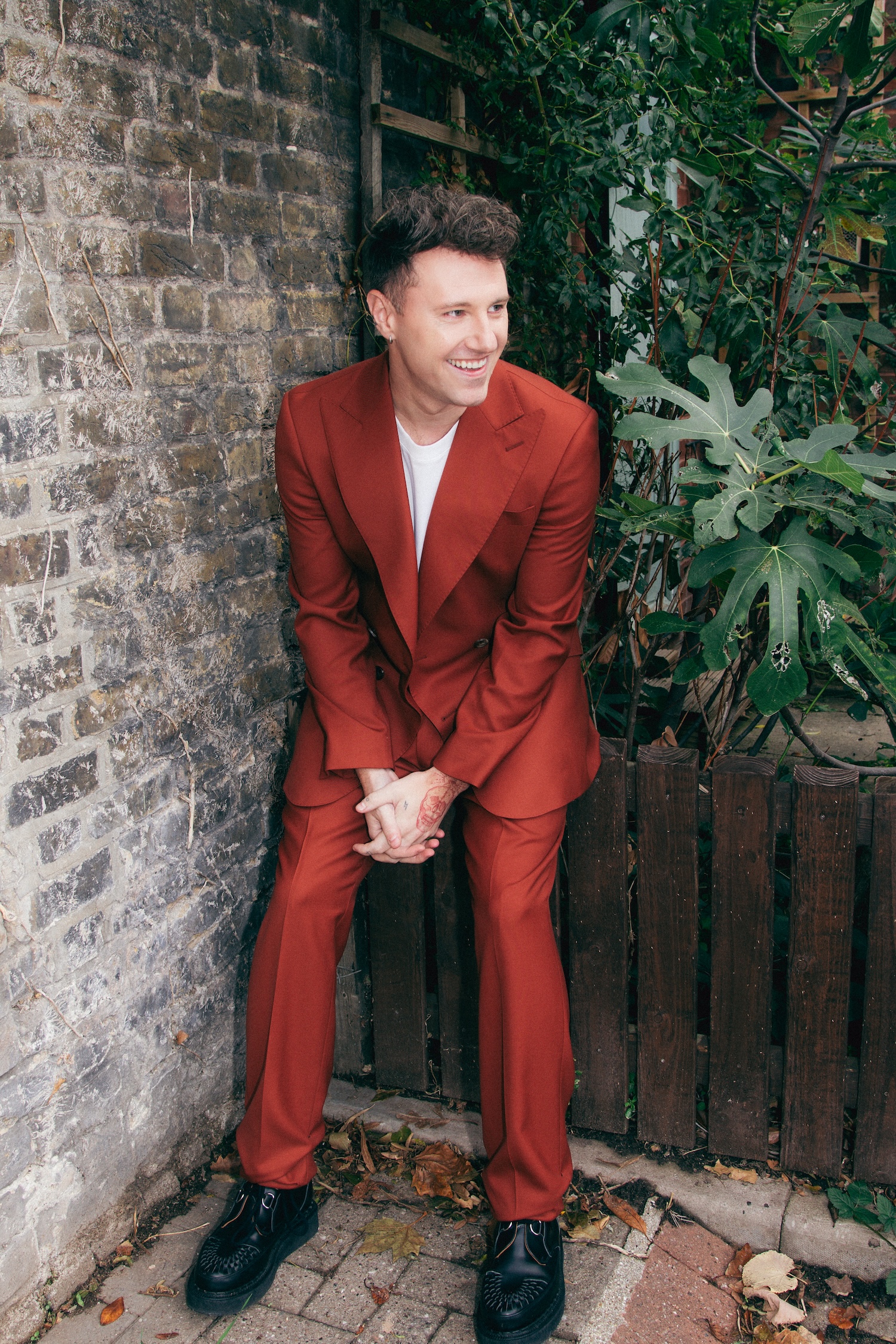
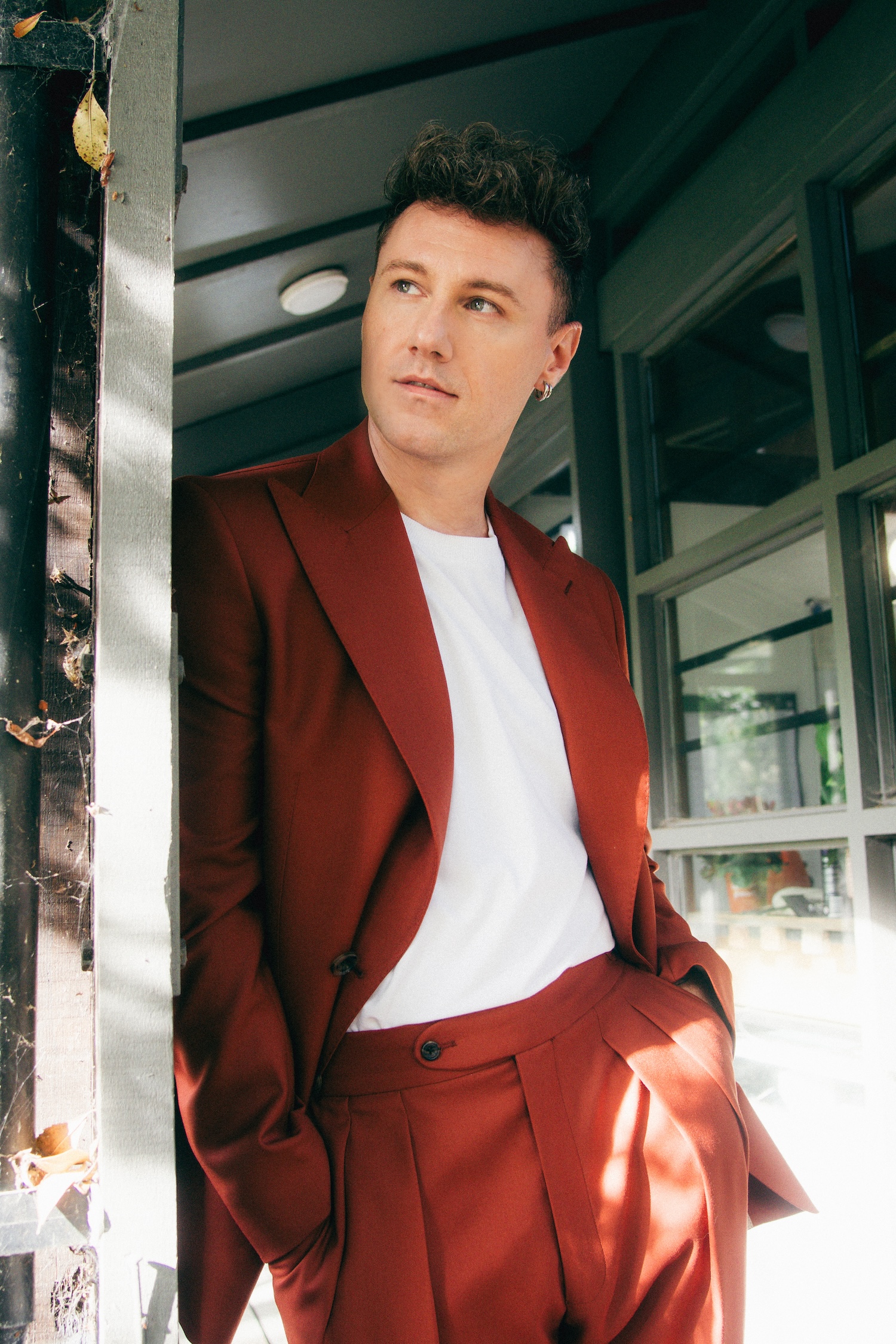
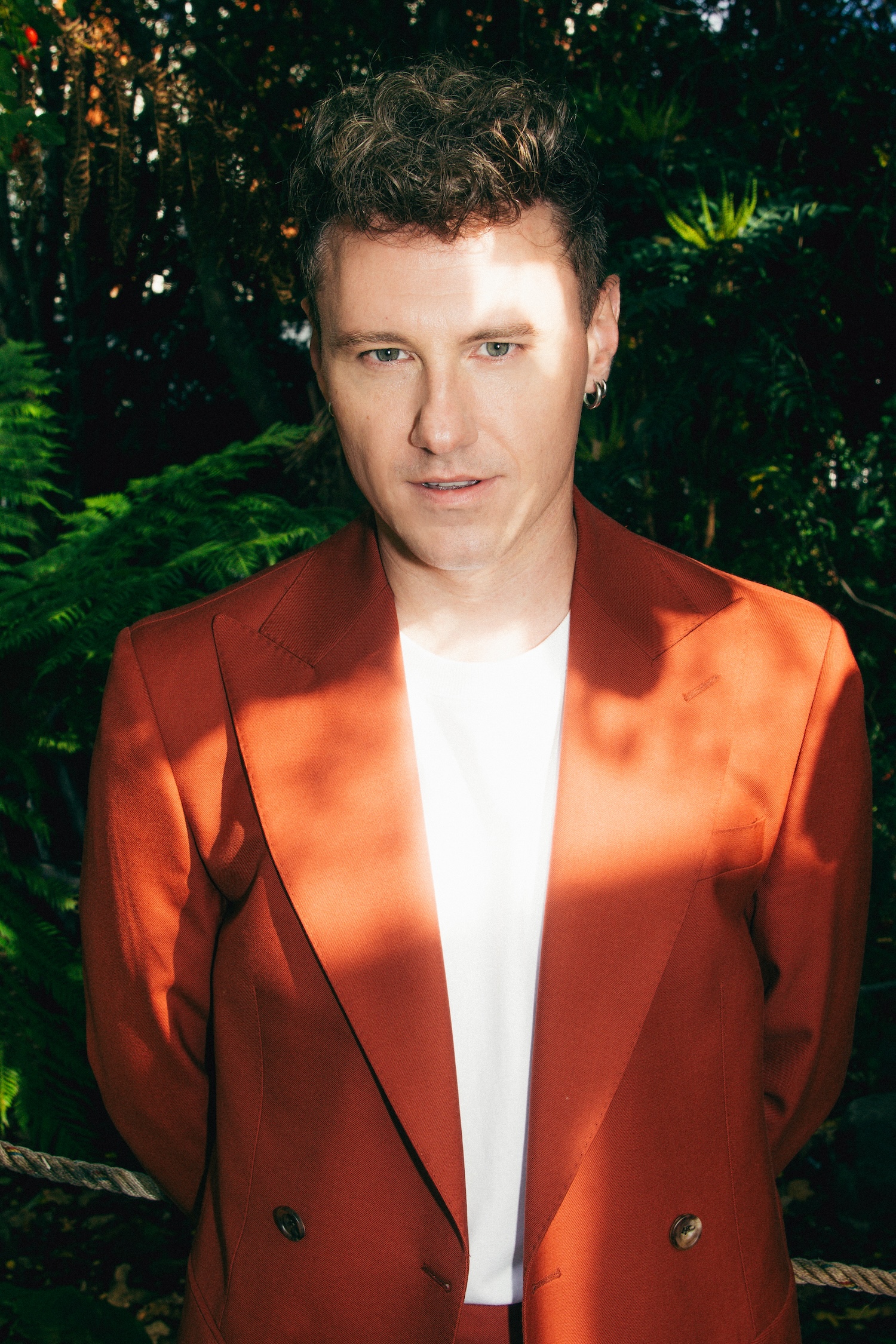
Red suit Richard James White t-shirt Colourful Standard Shoes George Cox
The album feels very personal. Is that fair to say?
Yeah. I know everyone says that, but for me it really is. Childhood, trauma, heartbreak, mental health – it’s all in there. It’s basically a snapshot of my life, and I think people can relate to that more than we sometimes realise.
You’ve said the studio was full of love and no stress. What difference did that make?
A massive one. You can express yourself without fear. The guitarist from The Cortinas produced the record and we just clicked. There was no pressure, just a great energy.
I’ve always thought that a bit of chaos helps in the studio. You end up going to places you might not if everything’s too controlled.
You’ve already released ‘Two Pretenders’ from your new album, and it seems to be hitting people quite emotionally. What was happening in your life when you wrote it?
A lot, really. I was in a long-term relationship at the time. She’s originally from Venezuela and had seen a lot in her life, things that started to catch up with her during lockdown. She became quite unwell, and I couldn’t get to her.
I was worried about her, and I was in love with her, so I felt like I had to be there. Travel was restricted, only medical staff were allowed to fly, so I put my name down as Doctor Callum Beattie and somehow managed to get on a plane. No one questioned it until I landed in Hungary, where I was arrested.
Her daughter wrote to the police station explaining that I needed to be there for her wellbeing. They eventually agreed I could stay, but I wasn’t allowed to leave until travel opened up again.
You definitely get songs out of situations like that.
Are there any songs on the album that felt almost too personal to put out there?
There’s not much I hold back, if I’m honest. I don’t really think anything’s too personal. But Lanterns probably comes closest.
I don’t give too much of the story away in the lyrics, but I know what it’s about. It goes back to childhood and things that can still be quite painful to revisit.
Your songs have a very visual storytelling quality. Where does that come from?
It’s just real life. I’d find it hard to write a song about shaking your arse on a Saturday night, if I’m honest. I could do it, but would I love the song? Probably not.
I think honesty is what makes things relatable. People are going through the same things. Life’s complicated, and songwriting helps you dissect all of that.
You write a lot about working-class life, home and growing up. Why is that such a big anchor for you?
It helps me get things off my chest. It’s like therapy, really. You’re talking to the world instead of one person in a room, and in some ways that’s easier. There’s a bit of distance.
Salamander Street really connected with people. Why do you think that is?
It’s about the red-light district, but it’s a story. I wanted it to feel almost like a strange fairy tale. The chorus has that sense of everything being all right, which is what a lot of people need to hear.
The song came from seeing a girl I went to school with working there. I went home and wrote it in ten minutes. That’s genuinely what happened.
I’d been playing pubs around that area seven nights a week from a very young age, probably before I was even legally allowed to. I saw a lot early on. It definitely helps with songwriting.
Did you ever tell her about the song?
No. I never sought her out. I was just driving past with a friend and saw her. I’ve always tried not to make it about one specific person in the lyrics. It was more about the hardship and the idea that there are people out there who want to help, without it becoming patronising.
As the venues get bigger, how do you stay grounded?
I do a lot of charity work. I work with homeless charities, and I’m the patron of a mental health charity in Inverness called Mikey’s Line, which operates in an area with one of the highest suicide rates in the UK.
We’ve raised nearly £900,000 over the past four years for various charities, including those supporting children with terminal illnesses. We’re hoping to hit a million soon.
Music gives you an opportunity to help, even if it’s just encouraging people to put their hand in their pocket.
When did that side of things really start for you?
During lockdown, I got invited to play at a soup kitchen. I brought my guitar along, and it ended up being one of the best nights they’d had. That really stuck with me.
I’m quite an empathetic person anyway, so it just felt obvious that this would be part of my life. It can be incredibly difficult, playing in hospitals or in people’s homes when families are going through awful situations, but if music can help in any small way, it feels important to do it.
My album launch is going to be a charity event for Mikey’s Line and a couple of others. We’ll be auctioning house concerts, so people can donate to the charities and I’ll come and play a private show. That’s how we try to do it.
Where’s the album launch going to be?
It’s at the Hilton Hotel in Glasgow. It’s a sit-down meal, so you get dinner with your ticket. It feels a bit different, which is exciting.
What does your writing process actually look like day to day? Are you notebooks, voice notes, random ideas at 2am?
Everything. I’m always writing. Someone could say something to me in a café and it sparks an idea. Most of it goes straight into my phone, lyrics, melodies, whatever it is.
I’ve got thousands of voice memos. I listen back later, mark the ones that still feel good, then come back to them when I pick up the guitar and see what happens.
Who are the artists that shaped you most, the ones in your musical DNA?
Springsteen, Elton John. My dad loved Led Zeppelin, so I grew up on that. Rod Stewart, Faces, Fleetwood Mac. Those older, iconic bands are what I was brought up on.
You’re known for being very honest. Have you always been that way, or did you grow into it?
I’ve always been like that, apart from a short period when I moved to London and signed to a label. They were trying to mould me into a kind of poster-boy pop star. I understand why they do it, because that’s how the industry thinks money is made, but it’s often to the detriment of the artist.
Outside of that, I’ve always worn my heart on my sleeve. I’m not outspoken or controversial, I just don’t hold things in. That never does me any good. If I feel something, I say it. Sometimes that surprises people, but it always comes from a place of honesty.
What still surprises you about the music industry?
That creators are expected to give their music away. You spend months, sometimes years, writing and recording something, spend a fortune making it, then just hand it over.
Streaming has made that normal. If someone like Taylor Swift puts a song on Spotify, it’s instantly pushed onto hundreds of thousands of playlists. That support comes from the platform itself.
I get why that happens, but it doesn’t filter down. I’ve sold out every show I’ve played for the past two years and just sold out an arena, yet I couldn’t get a single playlist of support from Spotify.
At the same time, I know artists with tens of millions of streams who can’t sell ten tickets in a pub. That tells you something’s broken. I don’t believe for a second that the biggest artists couldn’t do more to push for fairer distribution. They’re just not the ones affected by it.
You were saying earlier that the industry could work better if those at the very top pushed for change. Do you think that responsibility ever really kicks in?
If it was me, I’d expose everything. I’d be very public about it. I’d say, this isn’t working because of this. But that’s just who I am.
I’m not complaining. I’ve got a great life. I don’t need riches. I just want to help keep the creative arts in the UK healthy, because the healthier the system is, the better the music becomes. And we already punch well above our weight in this country.
What I find frustrating is how quickly the government celebrates our music when there’s a jubilee or a big national moment. They’re very proud of our cultural heritage then. But when it comes to actually funding it, there’s no interest.
Other countries handle it differently. Ireland gives tax relief to artists. It’s not perfect, but it’s a recognition that the industry is difficult and worth protecting. I can’t really see the UK doing that, but you never know.
At the end of the day, this is the career I chose. I’m not bitter about it. But it’s important people are aware of what’s happening. If we’re not careful, we lose the grassroots, and without that, there is no music industry to speak of.
So what’s the dream for you now? What’s the next mountain to climb?
To play the biggest stadiums I possibly can. I genuinely believe that’s achievable, especially in Scotland. And with that comes the ability to change lives.
People might laugh when I say this, but I really believe I could make a serious dent in things like homelessness. I could support charities properly, continue the work I’m already doing, and also look after the people who’ve believed in me from the start, my band, the people around me. Give them a leg up, make them comfortable. That matters to me.
It’s interesting that your mind goes straight there. A lot of people would just say, ‘I want to make loads of money.’
Yeah. I know some people won’t believe me, but it’s genuinely the truth.
You’ve mentioned Hampden Park before. At what point does a dream like that start to feel genuinely achievable?
I think it starts to feel achievable when you stop thinking about it as a fantasy and start looking at what’s already happening. We’ve gone from pubs to theatres to arenas, and each step has felt impossible until it suddenly wasn’t.
Whether Hampden happens comes down to the music and whether I can keep building the fanbase. If it does, I hope it shows other musicians that there’s a path there. You can build it yourself, step by step, without waiting for permission.
Final question. What do you want people to feel when they press play on INDI for the first time?
I want it to feel authentic. Like the artist genuinely loves every chord, every piano note, every drum beat. Nothing’s there by accident. Nothing’s manufactured.
It’s all live instrumentation. It’s self-funded, self-written. It’s honest.
That’s what INDI is. Be more indie.
INDI, the new record from Callum Beattie, will be released on January 23, 2026.
To pre-order INDI and live dates go to @callumbeattieofficial for details.
Interview Nick Barr
Photography Jack Alexander
Fashion Ella-Louise Andrew
Grooming Sara Bowden
Top image credits
Red suit Richard James White t-shirt Colourful Standard