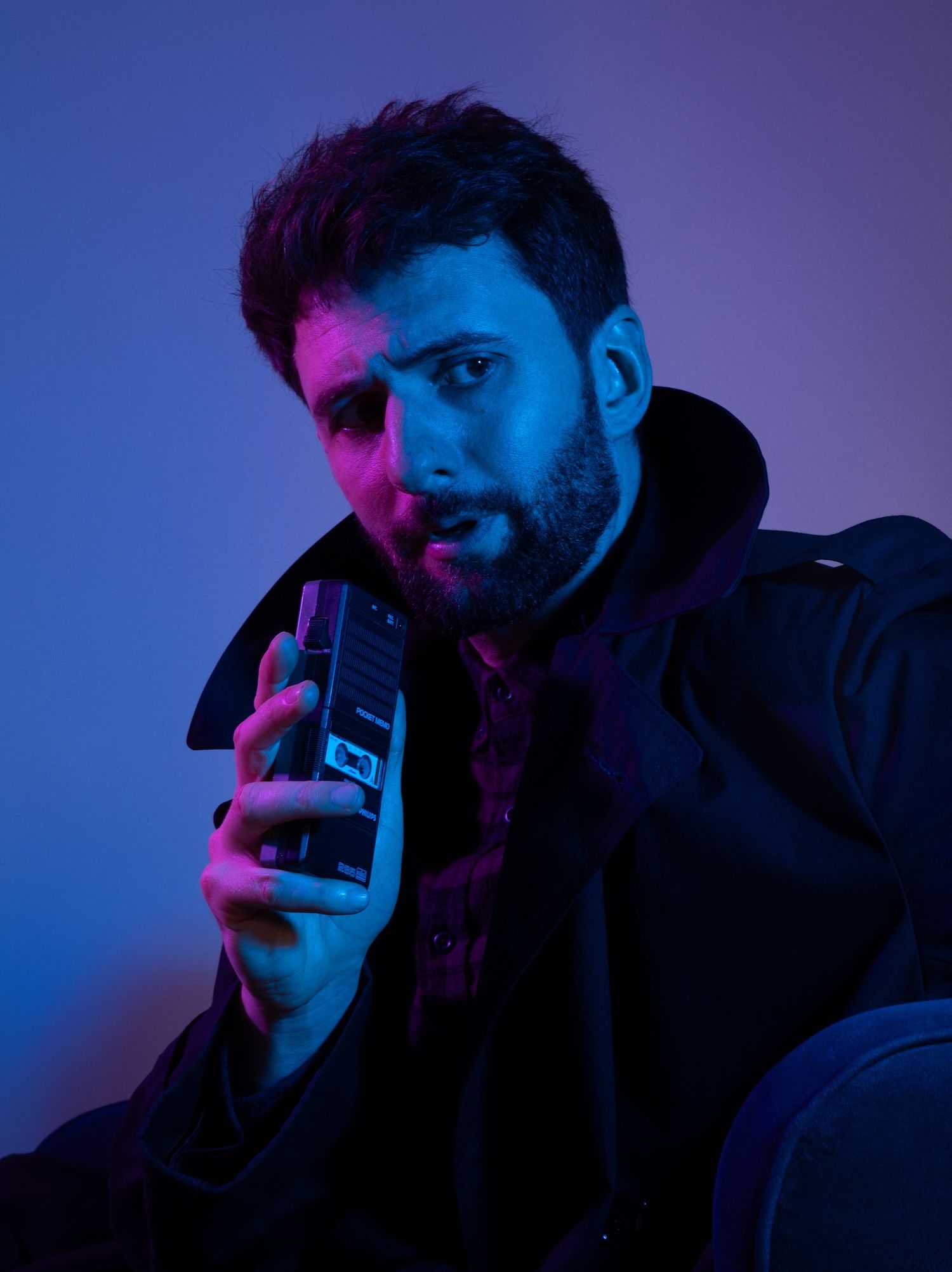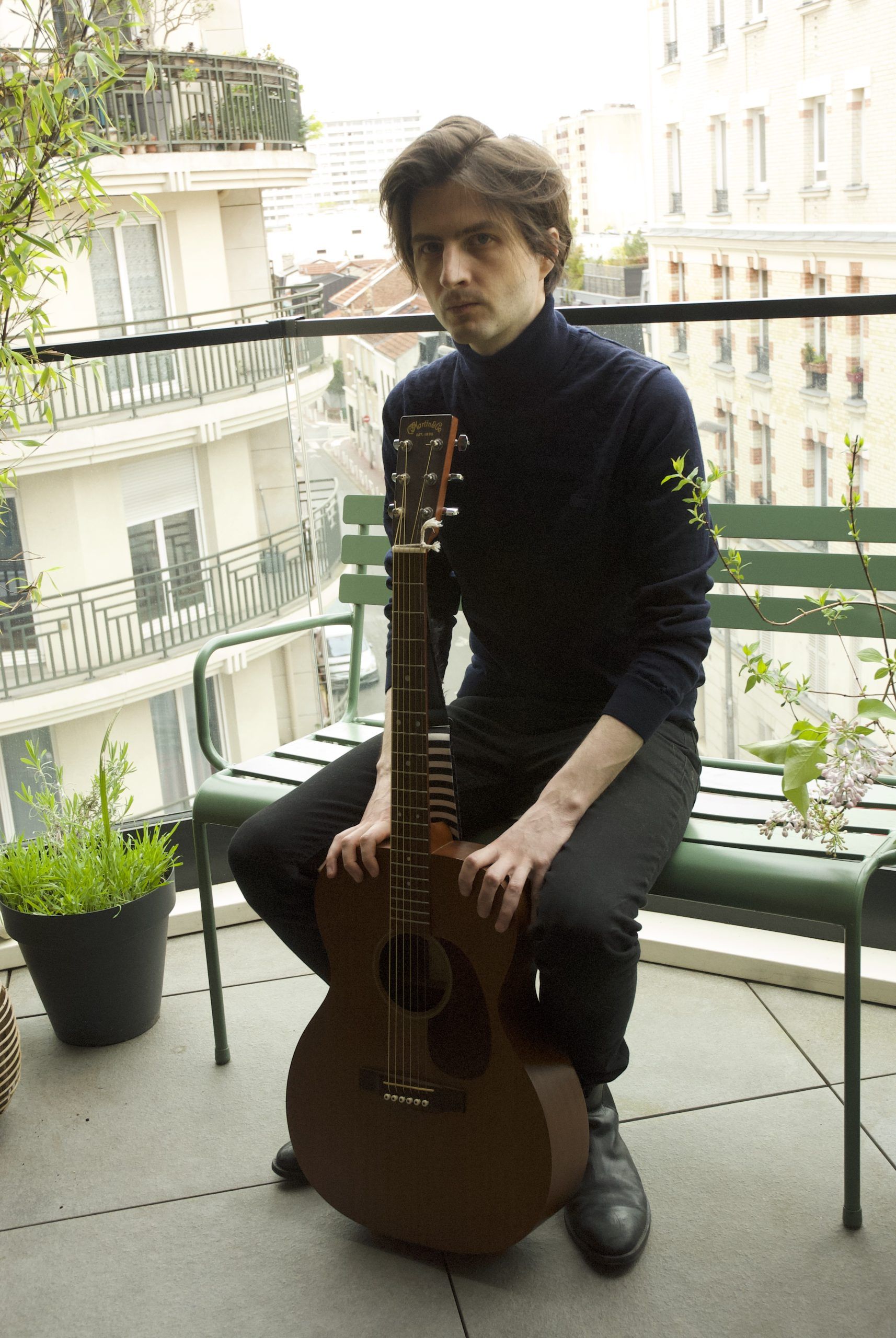
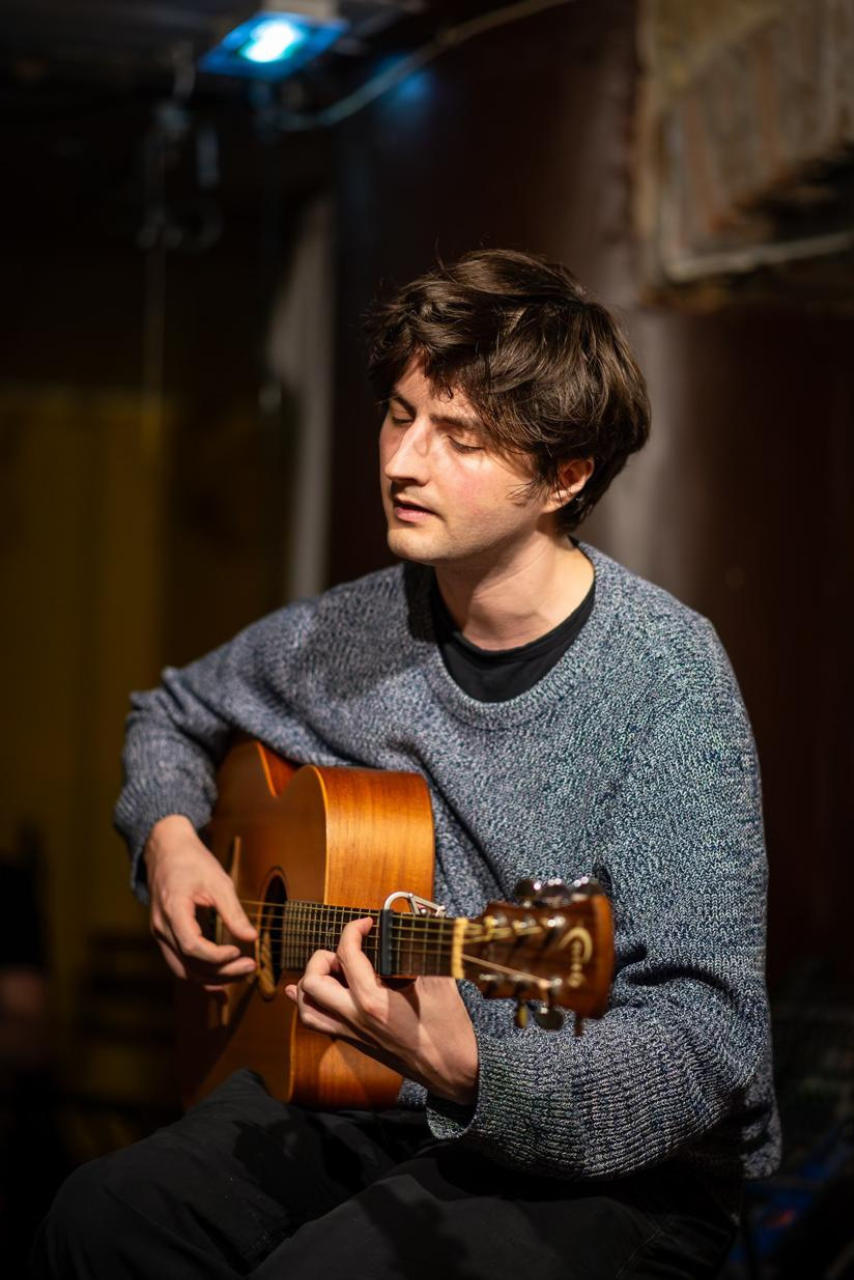
Newcastle-born, Paris-based songwriter Tom Hancock introduces his debut album Innate Subjects, a record that expands the boundaries of contemporary folk through a blend of intimate lyricism and atmospheric production. Created alongside Saving Felix, the project reflects Hancock’s immersion in the city’s creative scene and his role within the Listen Marianne Collective, a community that has helped shape the album’s collaborative spirit.
Spanning eight tracks, Innate Subjects moves through themes of love, loss, and personal reckoning, grounded in a songwriting approach that draws from artists such as Nick Drake, Elliott Smith, and Sufjan Stevens. While these influences are evident in the album’s emotional directness, Hancock pushes beyond traditional folk frameworks, incorporating ambient textures, subtle electronics, and cinematic arrangements.
Tracks such as ‘Skin on Skin’ and ‘Signs of Change’ establish the record’s tonal range early on, shifting between intricate guitar work and more expansive, rhythm-driven moments. Elsewhere, songs like ‘I Could Have Run’ and ‘Nothing’ lean into quieter introspection, reflecting on regret, distance, and unresolved emotion.
Across Innate Subjects, Hancock balances restraint with experimentation, creating a debut that feels both grounded and exploratory.
To celebrate the release, Tom Hancock has penned an exclusive track-by-track for 1883 Magazine, offering insight into each song and the stories behind them.
‘Skin on Skin’
When assembling the track listing for Innate Subjects there was absolutely no question as to which track would open. Skin on Skin wasn’t the first track that I started writing for the album but it was the first to truly embody the theme of Innate Subjects. Each song on the album is intended to represent a singular experience (or innate subject) that most people have some inherent understanding of.
Skin on Skin came together in a single day, capturing the strange emotional contradictions of the first moments of intimacy in what would become a pivotal relationship. Composed in an unusual tuning (E-A-C#-F#-A-B) that was invented by friend and collaborator Shakkalo, the harmony of chords reflect both the beauty of that connection and the darker undercurrent of vulnerability that comes with truly opening yourself up to another person. What is an undeniably joyful experience is tempered by the acknowledgement that something powerful is taking place that is now outside of our control: “You can listen to my pulse as our paths start to merge, I can listen to your voice as our demons become one, and I’ll listen to your breath and hold you to my chest as you let me in”
This song is also crucial in announcing the sonic trajectory of the record as a whole. The intricate folk guitar parts and soft vocals could have easily made for a comfortable acoustic track but from the second section of Skin on Skin my producer, Saving Felix, takes us somewhere outside the realms of typical folk music, a place the record keeps returning to.
‘My Love’
Probably the happiest sounding song on the album but also the most bitter. My Love can be understood as a howl of frustration at the carelessness of a lover who doesn’t understand how fragile their emotional bond is. For some reason it felt natural to juxtapose this sentiment with a jaunty and upbeat instrumental driven by the banjo/guitar riffs and underscored with the driving beat and McCartney style bass. Typically, with my songs I am trying to create music that reflects the emotional core of the story I am telling but, in this instance, I think I was afraid of the bitterness that runs throughout the lyrics and didn’t want them to be amplified any more than they already were.
‘Nothing’
One of the most meaningful things that ever happened in my life was to meet likeminded songwriters and build long lasting friendships through the joy of making music together. I met Shakkalo in September 2021 and I wrote Nothing in the summer of 2022 whilst visiting my family in rural Northumberland. From the very beginning I wrote the song as a duet with only her voice in mind.
The song is intended as a meditation on love, loss, and emotional distance. The lyrics unfold as a conversation between two former lovers lamenting the end of their relationship while confronting its shortcomings — the unanswered questions, the shared history, and the ache of realising how little remains to hold onto.
Nothing had the longest journey to completion of any song on the album that in some ways mirrored my nomadic lifestyle at that time. Conceived in rural Northumberland, developed in Istanbul and finally produced in Paris. In fact, much of the post-apocalyptic soundscapes that are threaded throughout the track come from a demo made with my oldest friend Joe Conchie whilst I was visiting him in Istanbul and then sampled by Saving Felix when producing in Paris.
‘Sycamore’
I am less connected to the place that I grew up than most people that I know, there are a myriad of reasons for this but that’s not what this song is about. Despite that disconnect there are particular aspects to the Northumbrian landscape and history that I am still very attached to. It was a devastating blow when I heard the news that vandals had destroyed the Sycamore Gap tree (fittingly I was on the other side of the world when the news broke).
Sycamore is at its core a song about loss. It was inspired simultaneously by the felling of the tree at Sycamore Gap and the fraying of a significant relationship. The two events became intertwined in my mind and reflected a simple yet devastating question: why would someone destroy something so beautiful for seemingly no reason?
I visited the gap again in December to shoot the video, which was directed by one of my dearest friends Taryn Everdeen who also features on the song. We were both deeply moved by the stories we heard from other visitors as to what the tree meant to them and how they had coped with that sense of loss.
‘Signs of Change’
If Skin on Skin is about opening a door, Signs of Change is about watching one close behind you. It’s a meditation on acceptance and surrender in the face of seismic, uncontrollable shifts — the kind of change that doesn’t ask permission. I tried to keep the vocal performance raw whilst it sits atop the high-tempo fingerpicking, capturing the sensation of being pulled in two directions at once: toward what must be let go, and toward what must be lived.
The image that anchors this song, for me, is someone standing on a shoreline watching the tide come in and slowly realising the ground they’re standing on is already gone. “My kingdom gone with the wind, brushed aside as the waves crashed in.” There’s a specific kind of grief in recognising, too late, that you’d been hiding from something you always knew was coming. The first two verses are written from inside that denial — the running, the holding on, the quiet insistence that if you just don’t look, it won’t arrive.
Saving Felix defies expectations here by threading a techno pulse underneath the fingerpicking, and the tension between those two worlds — the intimate acoustic guitar, the insistent electronic heartbeat — is the whole point. Change, in my experience, never arrives politely. It arrives with a rhythm of its own, whether you’re ready or not. Letting the production embody that felt truer than any lyric could manage alone.
The final chorus captures the central message of acceptance. The line shifts from “I cry for what I lost” to “I’ve learned to love those signs of change,” and it’s meant to land not as triumph but as a quieter, harder-won kind of peace. The acceptance that seasons will keep changing, that paradise was never meant to be permanent, and that there’s a strange freedom in stopping the fight.
‘I Could Have Run’
The refrain came to me first: “I could have run, I could have run.” There was just one problem — I didn’t really feel like I was running from anything. But the words fit the melody so perfectly there was no way they could be changed. I put the guitar down and went to cook lunch. A few hours later, the news broke that Alexei Navalny had died, and I knew immediately who it was that could have run.
The song is written from his perspective in the moments before his death — not the dissident, not the symbol, but the man. The husband and father who chose to board a plane back to Russia knowing, almost certainly, what would be waiting for him. I wasn’t interested in writing a political song. What I kept returning to instead was the human question underneath it: what does it feel like, in the final moments, to have known all along that this was coming? To have had a choice, and to have made the one that cost you everything?
Production-wise, this is the track that best captures the fusion at the heart of Innate Subjects. Saving Felix lets the song begin as something that could almost be a folk ballad — acoustic guitar, close vocal — and then slowly introduces an electronic pulse beneath it, swelling synths, layers of distortion and sound design that build across the track until the ending arrives as something genuinely overwhelming. The sonic escalation mirrors the emotional one and is supported throughout by the voice of Shakkalo.
‘She’s Happier Now’
This is a song about the guilt of leaving someone behind that ultimately can’t be saved. The refrain — “she’s happier now” — is the kind of thing we tell ourselves when the alternative is unbearable. A small, flickering hope, offered up against the evidence.
The chorus lists all the things the narrator couldn’t be for the person they lost — lover, keeper, martyr, father, north star — and the quiet admission underneath that list, that despite trying, they couldn’t promise to stay. I wrote it as a catalogue of failures, but what I hope comes through is that none of those failures were for lack of love.
The final section is the reckoning. “Time has left us all in no doubt / that I must carry much of the blame.” The song doesn’t ask for forgiveness, exactly. It just names what happened, and acknowledges that some hearts break in peculiar ways that don’t resolve.
Sonically, this track is one of the more restrained moments on Innate Subjects. Some songs earn their weight through production; this one needed air around it.
‘Does It Matter What I Am?’
A conversation song, written as an exchange between two people who aren’t quite saying the same thing. One is pushing the other to address something about themselves that they’ve never quite let themselves look at directly. The other is resisting, not because the pushing is unkind, but because the very premise of the question feels like a trap. Why should I have to name this? Why does it matter that I define myself? Both voices are right. The song doesn’t try to choose between them.
The first two verses are the most confrontational: “so you think I’m a liar”. It is an indignant response to gentle questioning. The second verse articulates the first point of view best: “I just think it would be sad / to get through life and then look back / at something you did not explore / that could give you so much more.” The idea that parts of ourselves — parts we already half-know are there — can quietly go unlived if we never find the courage to meet them. It’s offered as love. But it’s also, unavoidably, a judgement.
The end section holds the counter-argument, which I think is equally important: that nobody should have to define themselves in these terms in the first place. “Does it matter what I am? / Will it give you peace of mind?” By the final lines, almost all of the instrumentation drops away, leaving the voice exposed: “Should it matter if I say / what it is that makes me this way / but who am I speaking for? / Why must I play their game tonight?”.
The song doesn’t resolve, by design. Both positions are true at once. In my mind, it is the most ambitious track on Innate Subjects, and it was always going to be the closer. The interaction between the layers of banjo, steel-string guitar, and nylon-string guitar is the most intricate writing I’ve done, and getting those parts to interlock the way I’d heard them in my head took longer than any other song on the record. For the outro, Saving Felix and I wanted to create a sense of finality, and we built it by layering dozens of distorted, delayed guitars — a technique I’d never tried before. The result is something that we felt to be both overwhelming and quietly inevitable.
Listen to Innate Subjects below.