For organizations dealing with an expanding pool of recorded conversations, the shift from audio to structured text has become more than a convenience—it has turned into a requirement for operational clarity. Teams now manage hours of meetings, expert interviews, training content, research recordings, and customer insights that rarely get revisited unless they exist in a reliable textual form. AudioConvert enters this environment with a restrained design philosophy built around precision, workflow stability, and predictable output rather than spectacle. This article examines how the tool performs across real production environments and why it increasingly becomes the first layer in modern documentation pipelines.
Why the transcription layer is becoming a foundational part of digital work
Predictability outperforms complexity when recordings vary widely
Teams rarely work with controlled studio-quality audio. They deal with real-world conditions—background chatter, unstable online calls, uneven pacing, and mixed accents. Under these inconsistencies, AudioConvert positions itself as an audio to text converter that values predictable accuracy over experimental features. The engine maintains coherence across diverse inputs, which reduces the manual effort typically required to clean transcripts before distribution. The benefit becomes particularly obvious in organizations with high meeting volume, where teams depend on stable text to back decisions, document processes, and move projects forward.
Timestamps act as structural anchors that guide team navigation
Time-linked text does more than reflect what was said; it constructs a map that teams can follow with precision. When transcripts contain second-level timestamps, cross-referencing becomes immediate. AudioConvert uses these markers to support workflows in editing, quality assurance, internal reviews, and product documentation. Instead of scanning through audio, users jump directly to critical segments, verify statements, and build summaries with confidence. This small feature impacts the entire chain of work by reducing the friction between interpretation and verification.
When a transcript becomes a functional asset instead of a by-product
Content creators gain a repeatable structure that speeds editing
Creators often operate under tight publishing cycles. They need a systematic way to extract themes, identify usable quotes, and map narrative flow. AudioConvert produces transcripts that behave like structural blueprints. With clean formatting and sensible segmentation, creators can evaluate multi-hour recordings without replay loops. The process improves further once the transcript is refined using an ai checker, which polishes language, spots inconsistencies, and prepares material for scripts, captions, or on-screen text. The combination helps creators maintain a professional output rhythm without increasing workload.
Research teams depend on uniformity to synthesize insights
In research-heavy environments, ten interviews can quickly turn into fifty. Without consistent transcription standards, synthesis becomes messy and unreliable. AudioConvert’s uniform formatting ensures that every transcript aligns structurally, allowing researchers to categorize themes, extract patterns, and identify insight clusters with fewer disruptions. This consistency is especially valuable in comparative studies or long-running research cycles, where the ability to merge insights across time influences the accuracy of conclusions.
Academic users gain a competitive advantage through searchable knowledge
Students and researchers often build their understanding by reprocessing dense material. Recordings of lectures, discussions, or seminars become far more usable once converted into searchable text. AudioConvert supports this learning pattern by producing clear transcripts that students can annotate, reorganize, and integrate into their study workflows. For field researchers who collect spontaneous recordings, the tool provides an essential transformation step that turns fragmented audio notes into coherent textual evidence.
Why operational simplicity matters more than feature volume
An interface designed to eliminate unnecessary decision points
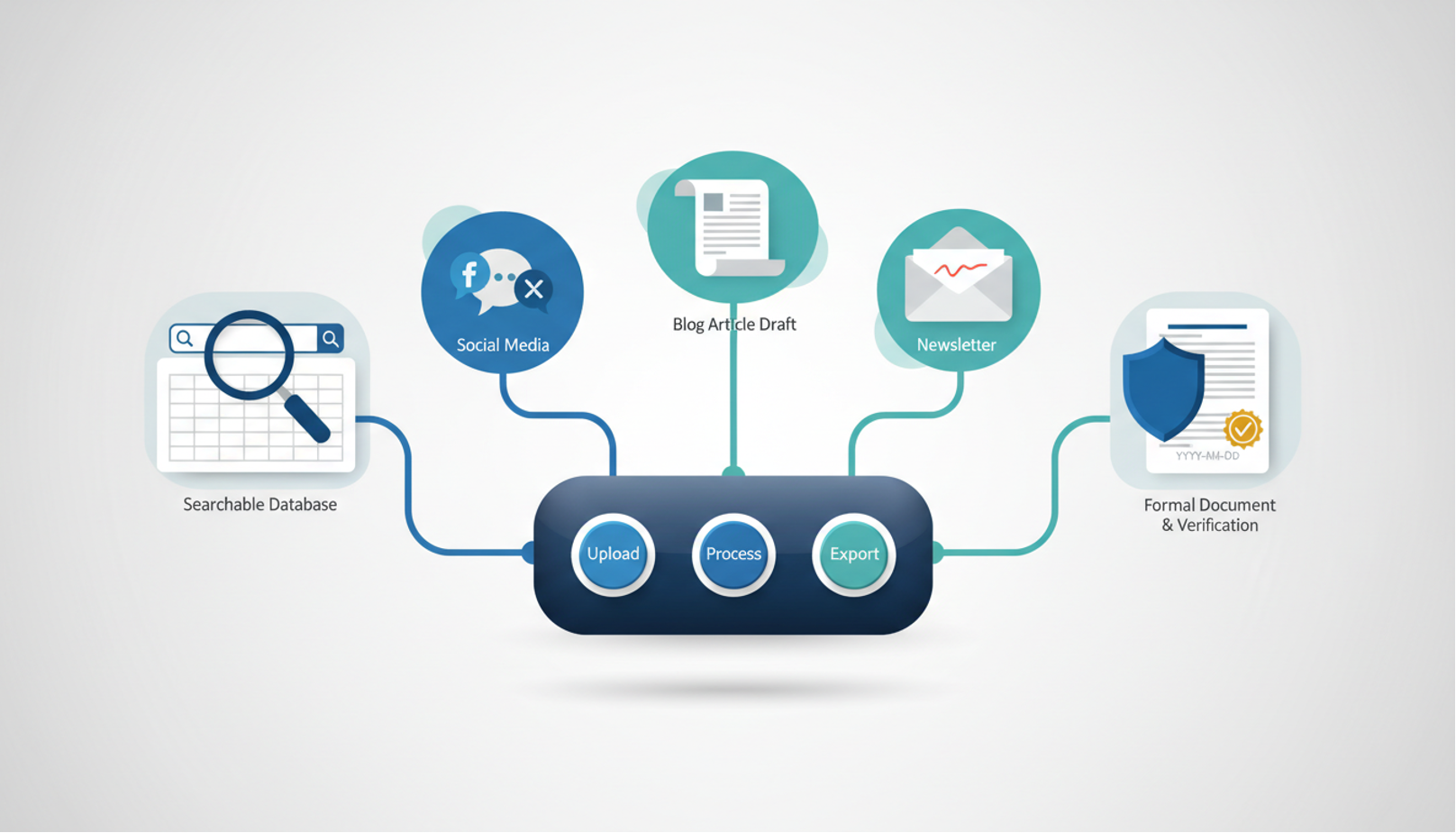
Many transcription platforms focus on presenting a wide set of features, but complexity often slows teams down. AudioConvert’s interface avoids multipage configurations or deeply nested settings. Upload, process, export—the sequence is direct and requires minimal training. The design reduces onboarding friction when new collaborators join a team or when departments share responsibilities. Over time, this simplicity becomes a strategic advantage; fewer missteps occur, and teams maintain momentum even when working with tight deadlines.
Export formats that integrate smoothly into downstream systems
After transcription, text travels through multiple systems: content editors, compliance tools, analytics platforms, documentation hubs, and publishing pipelines. AudioConvert supports this movement by offering export formats that behave predictably across environments. Whether a team needs a lightly formatted version for drafting or a timestamp-aligned version for editing, the tool maintains structural integrity. This stability prevents unnecessary cleaning work and ensures that each transcript can continue its journey without bottlenecks.
Reliability becomes a multiplier when scaled across departments
A single accurate transcript is helpful; hundreds of structurally consistent transcripts shape an entire organization’s information architecture. AudioConvert’s reliability allows downstream tools—search engines, tagging systems, data repositories—to interpret the text with fewer errors. As organizations accumulate more recordings, a stable transcription layer becomes essential for long-term knowledge management. AudioConvert provides precisely that: predictable text that scales without degrading in utility.
How structured text expands the usefulness of recorded content
Search unlocks the hidden value inside large audio archives
Audio, in its raw form, is nearly opaque. It resists quick scanning, indexing, and referencing. Once converted into structured text, archives acquire searchability. Teams can retrieve insights, compare discussions, and resolve uncertainties by locating specific passages. AudioConvert strengthens this capability through clarity and formatting consistency, ensuring search engines interpret transcripts effectively. Over time, previously dormant audio libraries become accessible knowledge bases that support strategic decision-making.
Marketing teams transform recordings into multi-channel assets
A single long-form conversation often generates ideas for social posts, blog content, newsletters, and product narratives. The limiting factor is extraction time. With AudioConvert, marketers can review transcripts, pull standout lines, and repurpose them across formats without revisiting raw audio. The workflow accelerates significantly and reduces ideation fatigue. Shared transcripts across departments also improve alignment, so messaging remains consistent even when different teams handle different channels.
Compliance and recordkeeping benefit from verifiable text
Organizations operating under strict documentation standards rely on precise textual records. Timestamped transcripts from AudioConvert contribute directly to compliance workflows by ensuring that each passage can be traced back to the original audio. During audits or internal reviews, this level of traceability reduces ambiguity and strengthens confidence in the accuracy of records. The tool becomes part of the organization’s compliance backbone, supporting transparency without requiring additional manual oversight.
Conclusion
AudioConvert distinguishes itself not by overwhelming users with features, but by establishing a dependable transcription foundation across varied professional environments. Its strength as an audio to text converter lies in consistent accuracy, structured clarity, and export flexibility—qualities that matter most when transcription becomes part of a larger operational system. The tool supports creators, researchers, academic users, and organizations with workflows that depend on high-quality text. As recorded content continues to grow, AudioConvert offers a stable, scalable solution that turns spoken information into actionable, searchable, and lasting knowledge.