The internet has become a noisy place. Every day, millions of gigabytes of content flood our feeds, creating a chaotic stream of information where only the loudest or most visually arresting elements survive. For creators and brands, this presents a stark reality: the static image, once the king of digital media, is losing its grip on the human attention span.
We scroll past photos without thinking. The brain processes them instantly and discards them just as fast. In an era dominated by TikTok and Instagram Reels, movement is no longer just an aesthetic choice; it is the currency of engagement. However, the barrier to creating compelling motion graphics has always been daunting—requiring expensive production teams, complex animation software, and hours of rendering time.
This is where the paradigm shifts. The emergence of generative technology has introduced a new capability: the power to transform Image to Video instantly. This isn’t just about adding a filter; it is about resurrecting a still moment and giving it a future.
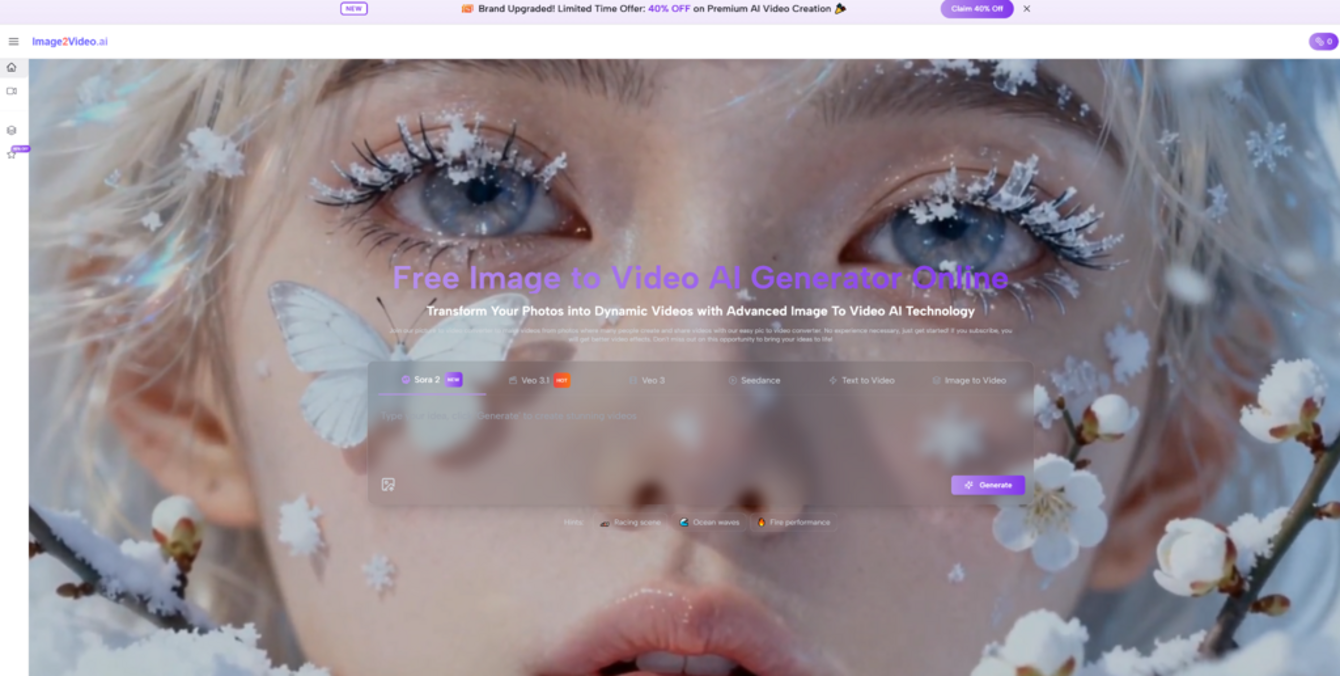
The Engine of Imagination: How It Works
Unlike traditional video editing, which relies on cutting together existing footage, Image to Video AI operates on the principle of prediction. It analyzes the pixels of a source image—the lighting, the texture, the depth—and hallucinates what should logically happen next based on real-world physics.
Step 1: Contextual Understanding
The process begins with the source material. Whether it is a product shot, a landscape, or a digital painting, the AI maps the geometry of the scene. It distinguishes the foreground subject from the background environment, establishing a virtual 3D space from a 2D plane.
Step 2: Linguistic Direction
This is where human intent steers the machine. By inputting a text prompt, the user acts as a director. A prompt like “camera pans right, leaves rustling in the wind” tells the AI not just to move pixels, but to simulate specific physical interactions. It bridges the gap between static photography and cinematic storytelling.
Step 3: Frame Interpolation and Generation
In a matter of minutes—typically around 5 minutes depending on server load—the system generates new frames that never existed. It creates a seamless flow of time, usually resulting in a high-definition MP4 file that loops perfectly for social media consumption.
Analyzing the Output: A Technical Perspective
Having observed the capabilities of this technology across various subjects, several patterns emerge regarding its strengths and its current boundaries.
The Physics of Fluids and Light
The technology excels remarkably when dealing with natural elements. Water flowing, clouds drifting, or fire crackling are rendered with near-photorealistic accuracy. The AI seems to have a deep understanding of fluid dynamics, making it an exceptional tool for creating “Cinemagraphs” or atmospheric motion posters where the mood is more important than complex action.
Camera Movement and Depth
One of the most powerful features is the ability to simulate camera movement. The AI can generate a “Dolly Zoom” or a “Truck Left” movement from a completely still photo. This adds a layer of cinematic production value that usually requires a physical camera crew, instantly elevating the perceived value of the content.
The Engagement Shift: Static vs. Dynamic
To understand the value proposition of this technology, it helps to compare the impact of traditional static assets against their AI-enhanced counterparts.
| Metric | Static Image Strategy | AI Video Strategy |
| Viewer Retention | Low. The brain processes the image in milliseconds and moves on. | High. Motion triggers the brain’s “alert” system, holding the gaze longer. |
| Information Density | Fixed. Can only convey a single moment in time. | Expanded. Can reveal more context (e.g., a panning shot showing more of a room). |
| Platform Favorability | Declining. Algorithms on IG/TikTok deprioritize photos. | High. Video content is currently boosted by almost all social algorithms. |
| Production Cost | Low. Requires only photography. | Efficient. Reuses existing photos to create video assets at zero extra shooting cost. |
| Emotional Impact | Passive. The viewer observes the subject. | Active. The viewer experiences the atmosphere and mood. |
Recognizing the Boundaries
While the potential is vast, it is crucial to maintain realistic expectations. This technology is in a state of rapid evolution, but it is not without its quirks.
- The 5-Second Window: Currently, the sweet spot for generation is short-form content, typically around 5 seconds. This is by design, as keeping consistency over longer durations is computationally difficult. It is best suited for loops and intros rather than full narratives.
- The Stability Factor: In complex scenes with many overlapping objects (like a crowd of people), the AI may occasionally struggle to keep every face consistent as the camera moves. Users might notice subtle “warping” artifacts in the background.
- Prompt Sensitivity: The output is only as good as the input. A vague prompt yields vague motion. Mastering the descriptive language required to get the exact result takes a bit of practice and experimentation.
New Frontiers in Digital Marketing
The ability to turn Image to Video opens up specific opportunities for industries that rely heavily on visual aesthetics.
Real Estate and Architecture
For real estate agents, a static photo of a living room is standard. But an AI-generated video that slowly pans across the room, with sunlight shifting across the floor, creates a feeling of “being there.” It transforms a listing into an experience.
E-Commerce and Advertising
In the crowded world of e-commerce, a product photo is often ignored. By adding subtle motion—steam rising from a coffee cup, or a glimmer of light on a piece of jewelry—brands can increase click-through rates significantly. It turns a catalogue into a showcase.

The Future of the Frozen Moment
We are entering a time where the definition of a “photograph” is becoming fluid. The line between a still image and a video is blurring.
For content creators, marketers, and artists, this technology represents a new set of brushes. It does not replace the photographer; it extends their vision. It allows the capture of a moment to be just the beginning of the creative process, rather than the end. By embracing these tools, we move beyond simply documenting reality—we begin to animate it.