Cable Street at Marylebone Theatre is an ambitious new musical with its heart firmly in the right place and its voices firing on all cylinders. With a book by Alex Kanefsky, music and lyrics by Tim Gilvin, and direction by Adam Lenson, it tackles the charged history of 1936’s Battle of Cable Street, with its uncomfortable echoes of today and with undeniable commitment, energy, and a cast that sings the roof off.
Framed by a modern-day walking tour, we have an American visitor (Debbie Chazen) trading stories with local tour guide Steve (Jez Unwin) in the streets of the East End, before the show slips back 90 years into a neighbourhood brimming with struggle, deprivation and fear.


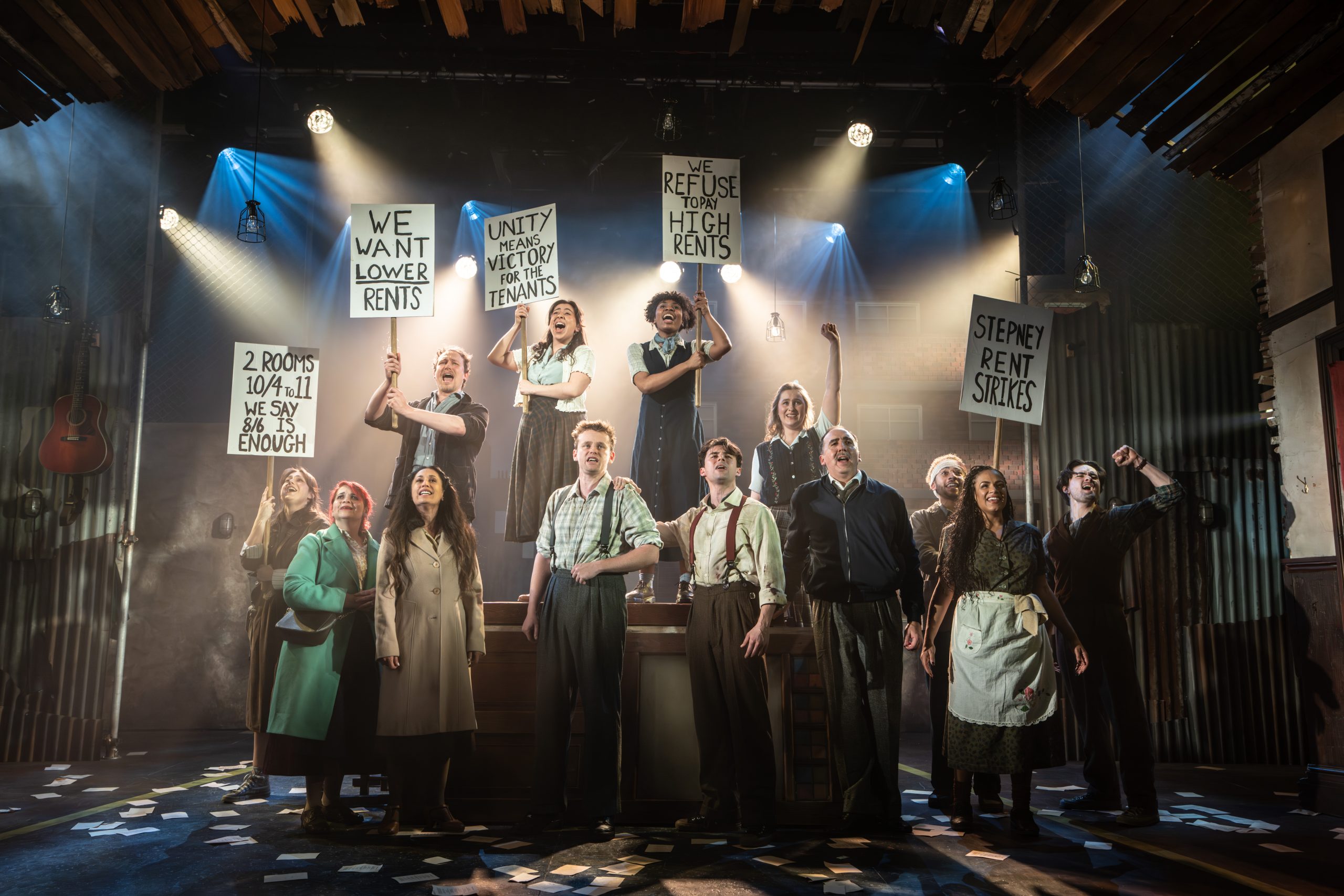
We meet a cross-section of communities; English working-class Ron (Barney Wilkinson), desperate for work and overwhelmed by his mother’s alcoholism; Irish matriarch Kathleen (Debbie Chazen again), running a local bar with her daughter Mairead (Lizzy-Rose Esin-Kelly), a local baker; and Sammy (Isaac Gryn), a young Jewish man searching for a job and a future. Rent hikes, exploited labour, and scapegoating create a perfect storm which leads to the radicalisation of young Ron. He is drawn into Oswald Mosley’s Blackshirts (the BUF – British Union of Fascists) by promises of work and a way out. As the Fascist thugs permeate the East End, the local Communist Party, with Mairead at the helm, rallies the community to put aside their differences and fight their common enemy, the Blackshirts, on home turf, inspired by the Spanish anti-General Franco movement.
Musically, Cable Street is at its most persuasive when it channels the community’s collective roar. No Pasaran lands as the show’s thundering anthem, a galvanising statement of resistance delivered with spine-tingling conviction by Natalie Elisha-Welsh. Bread and Roses has warmth and dignity, while Let Me In gives Ron a showcase that Wilkinson handles with a terrific voice and a burst of raw urgency, with more than a hint of menace in the background. Jez Unwin’s Only Words, sung as Yitzhak, Sammy’s Orthodox father, is tender and thoughtful. Across the board, the vocals are faultless: strong, expressive, and at times spine-tingling. That sheer musical prowess is Cable Street’s ace.


The cast’s agility is another big positive. With a relatively small ensemble covering multiple roles (except Isaac Gryn as Sammy), rapid transformations keep the stage lively. Ethan Pascal Peters slides between Moishe, Sol, and other parts with crisp, distinct characterisations and accents to match, and is one of the evening’s sharpest movers. Jez Unwin shifts from genial tour leader to threatening Blackshirt to peace-loving Jewish patriarch with nuanced depth. Isaac Gryn anchors the show as Sammy, consistent and centred both dramatically and vocally. And Lizzy-Rose Esin-Kelly, as Mairead, delivers standout singing and characterisation as Sammy’s somewhat militant love interest.
Design-wise, the set conjures the grit and bustle of Cable Street convincingly, giving a textured backdrop to the community’s push and pull. The lighting is serviceable rather than striking, but the physical world feels lived-in. If anything, you wish the production had more levels to play with and more movement vocabulary to match its musical strengths.
The piece has three interludes featuring singing newspaper sellers, giving us much needed historical context and real headlines from the different newspapers of the day. It’s a device that clarifies the moment’s stakes and gives the audience some light relief. However, these comedic segments jar against the surrounding scenes stylistically. In fact, stylistic variety is the evening’s double-edged sword: while the score’s range shows its ambition, too many musical flavours and a muddled storyline create an uneven experience. There is a point where we have a dramatic resolution and just when you think the show is finishing, we get another act.


Cable Street’s relevance is undeniable. Its portrait of communities pitched against each other by economic strain, political opportunism and media manipulation feels painfully current. The show argues for solidarity over othering, and its best moments make that case well. Audiences responded enthusiastically on the night I attended, and it’s easy to see why: the spirit, the message, and the singing are potent. If you can look past the messy book and stylistic sprawl, there are genuinely moving passages and rousing numbers worth your time.
In the end, Cable Street is imperfect but important: an earnest, energetic musical that elevates a vital story and showcases a cast whose voices could power a revolution. It can take a decade for a new musical to reach the West End stage. We’re 9 years down the line with this one, but I hope it grows into something much stronger and longer-lived. For now, it’s a heartfelt rallying cry and even when the storytelling wobbles, Cable Street’s vocals soar.
Cable Street runs at Marylebone Theatre until 28 February 2026.
Book tickets now at marylebonetheatre.com
Words by Helen Keegan
Photos by Johan Persson