Mia Carragher has just stepped into the arena. The Liverpool-born actor makes her stage debut as Katniss Everdeen in The Hunger Games: On Stage, an exciting new adaptation of Suzanne Collins’ story that’s set to shake up London theatre. Staged in a purpose-built venue at the Troubadour Canary Wharf, the production is packed with dramatic flying sequences, moving seats, and jaw-dropping technical design.
At just twenty, Carragher leads a show of enormous scale with quiet confidence and striking presence. She’s thoughtful, focused and completely at home in the world she’s helping to create.
Hi Mia, how have the previews been going?
They’ve been really good! The first night was chaotic, but now everything’s finding its rhythm. The show’s so technical, with loads of elements that have to work perfectly together, but it’s been great to keep running it, getting it into our bodies, and watching the relationships between characters grow each night.
Playing Katniss must be incredibly physical. Is it exhausting doing that every night?
Yeah, it’s intense. I think I leave the stage maybe three times, and never for more than a minute. Act 2 is especially physical. We did circuit training in rehearsals, and now it’s getting easier – you start learning where you can breathe for a second before jumping back in.


Let’s talk about your acting beginnings – you trained at Tring Park in the UK and later at the Lee Strasberg Institute in New York. What was the biggest difference between the two?
At Tring Park, because we were doing A levels too, it felt like a proper school environment. Our acting teachers also taught academic subjects, so there was that teacher–student structure. It was relaxed sometimes because we were all so young, but still quite formal – like sixth form with acting on top.
When I moved to New York at 18, it couldn’t have been more different. I was the youngest there – some people were in their 60s or 70s – and suddenly I was treated exactly the same as everyone else. The teachers were more like mentors than authority figures and spoke to us as equals, which I loved. The training was very method-based: lots of sensory and emotional-memory work, long sessions focused purely on connection rather than performance.
That approach has helped me loads as Katniss. When a scene feels tough or I’m physically exhausted, I go back to those Strasberg techniques. Because I’m on stage almost the entire time, I don’t get to step off and reset, so those sensory tools keep me grounded. Smell is a big one for me – it can trigger a memory or emotion instantly – and sometimes I’ll swap people in my head to find the connection. In the scenes with Rue, I imagined my little cousins, because that bond felt so similar. It’s something that really deepened the performance and still helps every night.
So, growing up in Liverpool, what first got you into performing?
My mum took me to dance classes when I was really little, and I just loved it. I’ve been dancing since I can remember. Then I went to a school in Liverpool called Rare Studios, and that’s where I started acting. I did a few plays there and absolutely loved being on stage – it was where I felt most alive. When I turned sixteen, I decided I wanted to take it seriously, so I auditioned for Tring, and honestly, those two years were the best of my life.
Were you a fan of The Hunger Games before you auditioned?
Yeah, I’d seen all the films before the audition. Then once I got the audition, I read the book – and when I got the part, I read it again and again. I also rewatched all the films and just tried to take in as much as I could about the world and the story.
Since you rewatched the films, did Jennifer Lawrence’s performance influence your version of Katniss?
She’s amazing. It’s actually been really nice having the films as a reference point – for all of us in the cast, they’ve been a source of inspiration. But what’s cool about our production is that it’s its own thing. The play takes a lot from both the book and the film, but it’s told entirely from Katniss’s perspective. She narrates the whole story, which makes it feel a lot more personal and introspective – closer to how it’s written in the book. That’s helped me find my own version of her.

What was it about Katniss that made you excited to play her?
She’s just such an amazing character – such a powerful role model for young girls. The things she does, what she stands for, and how much she achieves, it’s incredible. I was really excited about the role because it’s not just emotional, it’s also so physical. Coming from a dance background, I loved that I could bring all that training into it – the movement, the stamina, everything. It honestly felt like the perfect part for me, like everything I’ve learned up to now could come together in this one character.
It’s amazing to see how excited you are by this role. I can see how it lights you up, talking about how much of a challenge it is.
Yeah, it’s such a gift.
What was it like when you found out you’d been cast as Katniss? Where were you? How did you react?
It was about two weeks after the final audition. I remember Matthew Dunster, our director, suddenly followed me on Instagram, and I completely freaked out. I was like, oh my God, but I told myself not to read into it. I didn’t even tell my mum or dad – I just kept it to myself. Then the next day he messaged me saying, ‘Give me a call later,’ and I was like, what is happening?
I hadn’t heard from my agents yet, so I just went out for a walk to calm down. Then my agents rang and told me the news – and apparently Matthew had already spilled the beans to them. I ran straight home, called my mum and dad, and we were all crying. It was one of those surreal moments where it just hits you all at once.
And your dad, former Liverpool footballer Jamie Carragher, posted such a proud message when the news came out.
Yeah, he did! He and my mum have both been amazing. They’ve already been to see the show three times. It means the world having that kind of support from them.

Matthew Dunster said you showed both Katniss’s charisma and combat skills. How did you demonstrate that in the auditions?
The first round was a movement call – there were maybe twenty of us in the room – and a lot of what we did that day actually ended up in the show. Then I got a call asking me to come back and read for Katniss the next morning. It was such a quick turnaround that I didn’t overthink it; I just trusted my instincts and went with what felt right for her in those scenes.
A week or two later, I had a combat audition. I tried not to just perform the fight choreography, but to fight as Katniss – to think about how she’d move, how she’d react. Then they brought us in for some harness work at a stunt studio, climbing and rigging to make sure we weren’t scared of heights. That part was intense, but it was also when I started to realise how physical and cinematic the production was going to be. Two weeks later, I got the call.
So you’re not scared of heights yourself, or are you just channelling Katniss, who definitely isn’t? Because I’ll be honest, I hate heights.
At first, yeah, it was a bit terrifying! In rehearsals we were just in a normal studio, so it didn’t really hit me. But when we got to the theatre and I looked up, I thought, oh my God, that’s high. Once we’re actually in the scenes though, there’s so much going on that I don’t even think about it.
Right – when you’re in Katniss mode, your brain’s more like “stay alive” than “this is really high.”
Exactly. It’s all about survival.
Did you have much training or experience in stage combat before this?
Yeah, when I was at Lee Strasberg I took stage-combat classes for about eight weeks, so I was quite familiar with it. But it’s nothing compared to what we do in this show. Here we’re using weapons, blood bags, and have to stay aware of all of that.
I also did some archery training to get comfortable with the bow and know what I’m doing, because the way we use it in the show is really clever. It’s a little trick designed by our Head of Illusions, Chris Fisher, and it’s so cool.
I can’t wait to see it in action!
I’ve heard so much about this purpose-built theatre that’s been created especially for the show – what’s it actually like performing in a space designed entirely around The Hunger Games?
It’s amazing. The early stage of the play takes place in the round, but then the seats actually move into traverse – seats along either side of the stage – and it suddenly feels like we’re in the Capitol – the whole atmosphere changes. It can shift from being in the round to a long, open space, and that completely alters how we play the scenes. During moments like the chariot sequence, it honestly feels like we’re riding straight through the arena.
Because I narrate the story, I spend a lot of time speaking directly to the audience, so I’ve had to learn how to keep that connection across every side of the space. In rehearsals, it was tricky to remember to include everyone, but once we started previews and there were real faces out there, it completely changed the energy. It makes it so much easier to connect emotionally when you can actually see people reacting right in front of you.

What’s one element of the staging or set design that completely blew you away the first time you saw it?
The cornucopia – 100%. It’s unbelievable. We’ve got lots of traps built into the stage, and in the middle there’s this huge one where the cornucopia rises up from the floor. We first saw it during rehearsals in this big warehouse, and it’s this massive gold structure.
When we get to that part in Act 2, it just appears out of nowhere, and everyone’s climbing all over it. It’s so physical. Felipe Pacheco, who plays Cato, literally falls off the back of it and gets caught by the others, playing mutts [muttations] – it’s incredible to watch. That moment honestly blew me away.
You’re the first person to play Katniss on stage and you’re leading such a beloved franchise into theatre for the first time. Do you feel pressure from that, or how have the fans responded?
Yeah, definitely a bit of pressure. You just want everyone to love it, because The Hunger Games means so much to so many people. There are a lot of superfans out there, and we really want them to be proud of what we’ve created.
But I’ve had to remind myself that this is my version of Katniss. Not everyone in the world is going to see her the same way, and that’s okay. As long as I’m happy with what I’m doing, and people are connecting with it, that’s what matters.
Someone I spoke to recently said originating a role should almost earn you a creative credit because of how much input you have. Would you agree?
Yeah, I actually do. Even now in previews, we’re rehearsing every day, we’ll hit a tricky section and someone in the cast will throw out an idea that ends up working perfectly. Because we’re the ones doing it in real time, we know what feels natural and what’s sustainable eight shows a week. So, in a way, we’re helping build the show from the inside out.
Eight shows a week! That’s intense – and this is basically a full-on workout of a show. I take it you’re not hitting the gym on top of that?
No chance! We’re still rehearsing during the day, so that’s enough of a workout. Maybe once we settle into just doing the show I’ll think about Pilates again, but right now I’m way too tired to even try.
Was there any specific direction Matthew gave you that really stuck – something that changed how you saw Katniss?
Yeah, definitely. He reminded us that, at the end of the day, these are terrified children. Because a lot of us are dancers or physically trained, our fight scenes were looking a bit too good at first – too slick. He pushed us to strip that back and remember the fear behind it.
It’s easy to get caught up in the spectacle, especially with the amazing costumes and the humour in the Capitol scenes, but it’s still a horrific story. Remembering that truth – that these are kids forced to survive – really helped ground the whole thing and make the audience feel it.


What’s been the most surprising reaction from people who’ve come to see the show?
Definitely from my mum and dad. They knew it was the lead role, and I kept telling them I barely leave the stage, but I don’t think they really believed me. After they saw it, my mum was like, ‘Are you OK?’ She couldn’t believe how physical it was.
There are moments where we look genuinely terrified or in pain, and she said she honestly thought I’d hurt myself. Some of the fights are so full-on that even the cast sometimes check afterwards – like, ‘Did you actually get hurt, or were you just that convincing?’
With such an emotional and sometimes traumatic story, what kind of mental health support do you have behind the scenes?
We’ve got a mental health team who check in with us now and then, which is great. And as a cast, we really make an effort to keep things light outside of the show – to have a laugh and keep morale high.
There have been moments where it’s hit me how heavy the story is, and you can definitely get wrapped up in it. During the first few rehearsals, I’d even have nightmares about it. Now that we’re in previews, I’ve learned how important it is to decompress after a show – just switching off and doing something completely different before bed helps me reset.
Are there any moments in the play that hit you emotionally every single time, even in rehearsal?
The Rue scene, definitely. When Rue dies, it gets me every single night. There’s also the moment when Katniss comes face to face with Thresh and he lets her go because of Rue – because she’d been allies with her. That always hits hard.
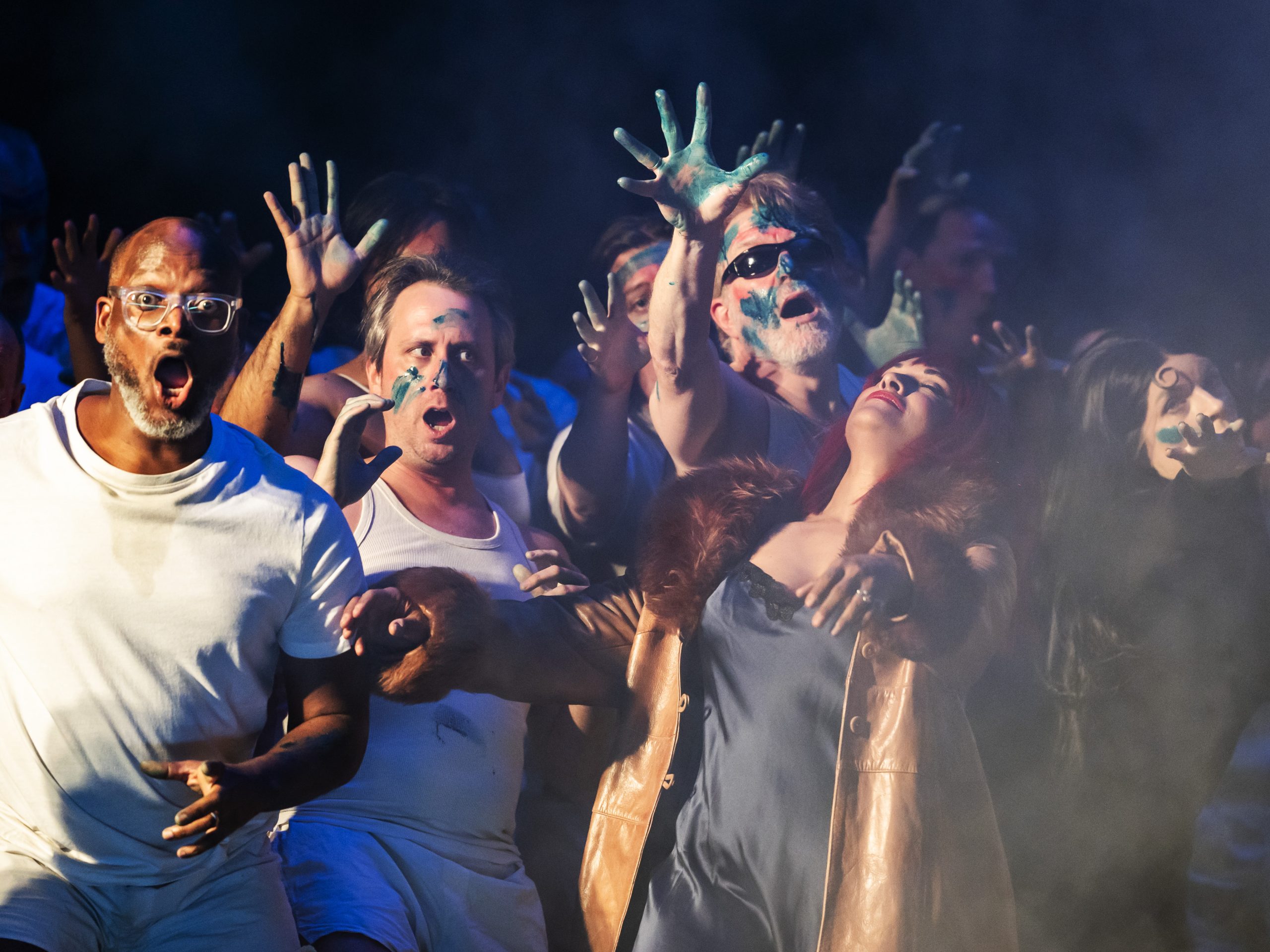
And then there’s this beautiful movement sequence where all the tributes who’ve died up to that point come back on stage. They use special effects to show the wounds from how each one died, and the music with it is just haunting. It’s honestly harrowing to watch, every time.
If you were thrown into The Hunger Games arena yourself, what would be your survival strategy?
Oh my God, I’d run away immediately! I think I’d hide for as long as possible – a bit like Fossa [Foxface in the book] – sneaking around and following everyone from a distance.
But eventually you’d have to go for it. When you’re that thirsty or hungry, you can’t just hide forever. I actually realised how real that feels during previews – there was a water bottle left on stage as a prop, and it wasn’t scripted for me to drink from it, but by the third show I was so thirsty I just grabbed it mid-scene and started drinking. So yeah, I think I’d end up doing the same in the arena – hide for as long as I could, then go hunting for food and water when I couldn’t take it anymore.
What would you like audiences to take away at the end of each show?
I hope people leave feeling something real. It’s a powerful, heartbreaking story, but underneath it all it’s about inequality – the huge divide between the Capitol and the districts. Matthew always reminded us that those themes aren’t fantasy; they reflect the world we live in now. If people walk out thinking about that, then we’ve done something worthwhile.
The Hunger Games: On Stage is at The Troubadour Canary Wharf Theatre, currently booking until October 2026.
Get your tickets now at thehungergamesonstage.com
Words by Nick Barr
Production photography by Johan Persson
‘Katniss’ headshot by Seamus Ryan
Mia Carragher portrait by Kyle Galvin