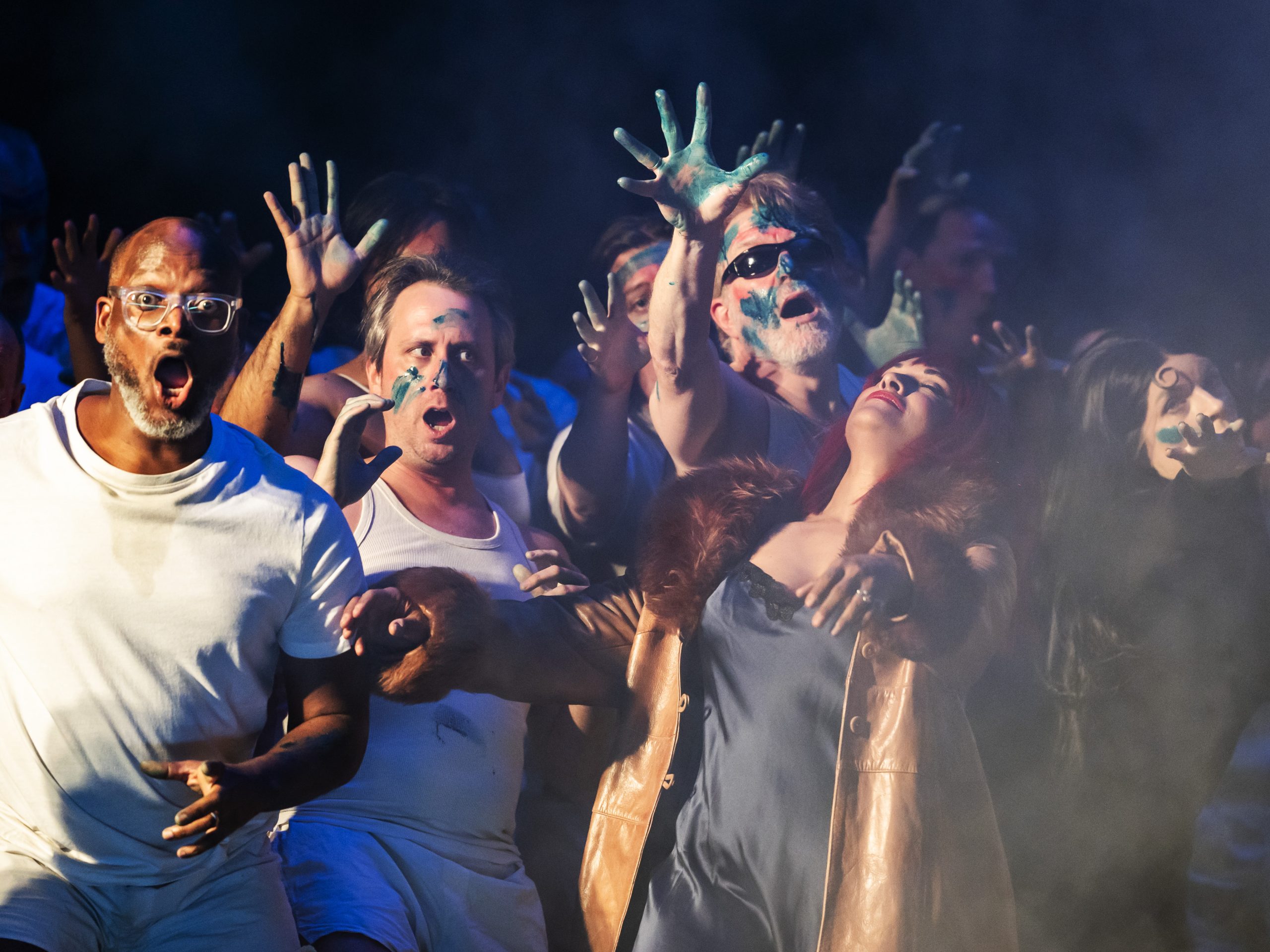
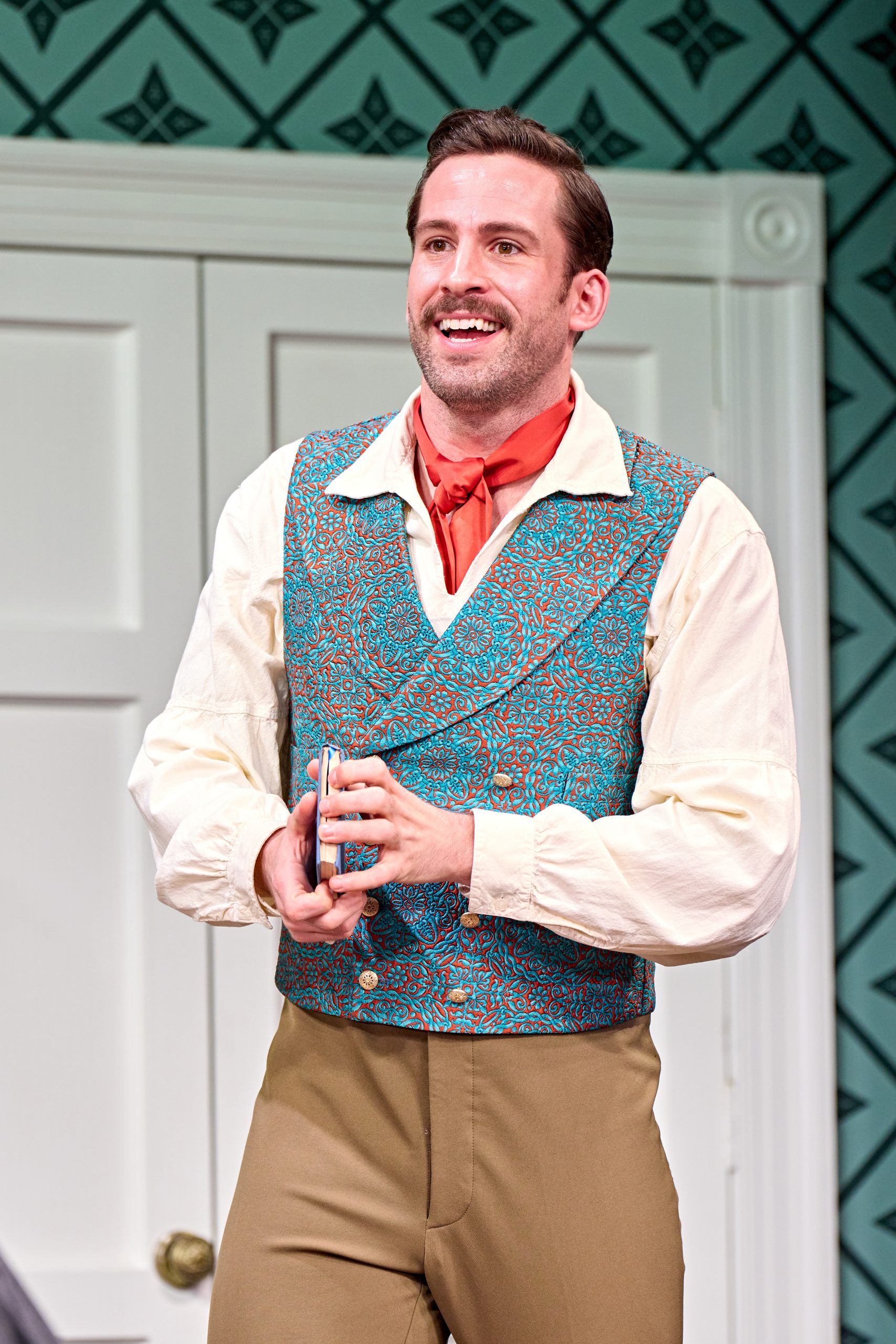
Dino Fetscher is having the time of his life in Oh, Mary!, so much so that he can’t wait to get on that stage each night. He plays Mary’s Teacher: a devoted acting coach caught in the orbit of a very theatrical First Lady. The show, a huge hit in New York, has exploded onto the West End with camp, chaos, and absolute batshit joy-driven madness!
Fetscher, best known for intense, grounded theatre work like The Normal Heart and Years and Years, brings passion and heart to the role, and gets to unleash his full comic potential in the process.
We spoke about absurd theatre, corpsing on stage, queer joy, the importance of visibility, and why Oh, Mary! might be one of the most ridiculous and joyful things he’ll ever do.

So, this play is absolutely batshit crazy. I mean, it’s mad. When did you first read the script – and did you immediately think, I have to do this, or did it take a minute to process what the hell was going on?
Well, I first heard about the script through Josh Seymour, who was associate director on The Normal Heart, which I did at the National. He messaged me one and said, ‘Have you heard of this play? There’s a part in it you might be great for.’
Something about it just clicked. I looked it up straight away and tried to get hold of a copy, but couldn’t find one here. So I ordered it from New York, and within a few pages, I was like, wow – I have to do this play.
I hadn’t read anything like it before. It’s such a unique piece, and I think that’s why it hit me so hard. It’s this mash-up of genres and tones. Like you said, it’s absolutely batshit – but it’s also really clever and brilliantly structured. The writing is incredibly sharp.
At drama school, comedy was a strength of mine. Being silly is a big part of who I am. But I’m usually cast in drama – which I also love – and I’ve never really had the chance to do something like this. I’ve come close on a few comedy projects, but this is the first time I’ve actually got to dive in. So when it came along, I just thought: this is it. I get to let my freak flag fly.
I was completely in from the start. It just made sense to me.
It’s all kinds of unhinged. And yet a lot of the play – and this is ironic – you seem to be playing it completely straight. Though “straight” might be the last word anyone would associate with this show. Are you trying to ground it emotionally, or are you always tuned into the absurdity underneath it all?
Yeah. It’s very inherently queer.
What I love about Mary’s Teacher is that he’s someone who gets swept up in the drama and romance of everything. He really commits. He’s not cynical – he loves love. That’s the headspace I stay in. He doesn’t see the absurdity – he just feels the stakes.
I’m just fully loving Mary.
Which can’t be easy, considering the way she treats him.
Exactly – and that’s part of the fun. So much of the comedy is in the dynamic between them. She’s often pretty hateful and vicious towards him, but he takes it. He listens. He finds her fascinating. He’s patient. He finds her funny, even when she’s being monstrous. That tension is great to play with.
This isn’t really a question, but I remember being genuinely moved when you recite Shakespeare to her. It cuts through all the chaos.
Thank you. That’s one of the brilliant things about the play – it’s this relentless comedy, but then suddenly it lands somewhere honest and emotional. Every character is striving for something. They all have depth and desire. There’s heart in the madness.
That balance has been key in shaping Mary’s Teacher – finding truth inside the ridiculous. It catches people off guard, and that’s what I love. You can’t quite define this show. And that’s what makes it so special.
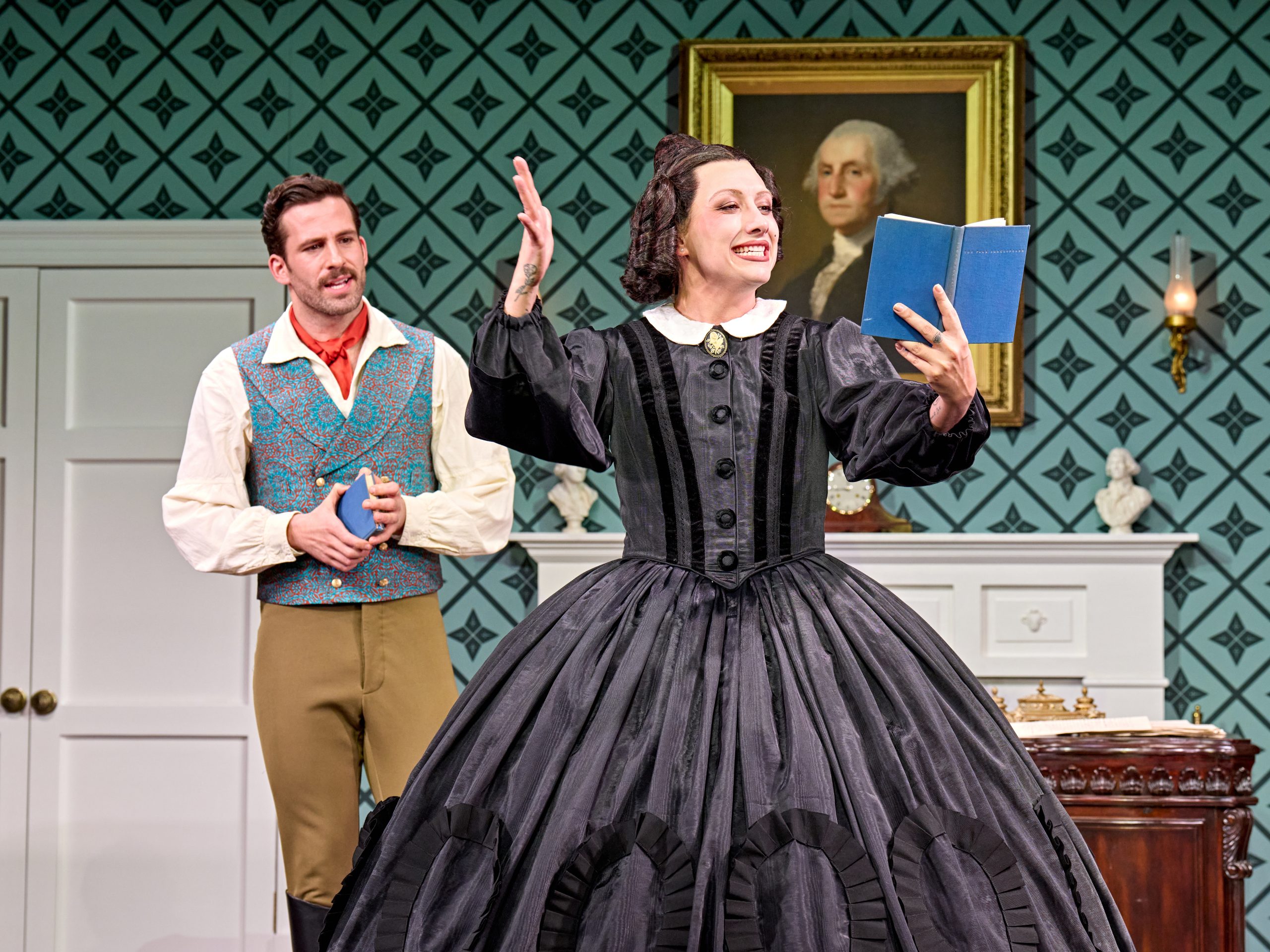
It’s really hard to define. I’ve tried explaining it to people and always end up saying, “You just have to see it.” Mason Alexander Park as Mary is just extraordinary. What’s it like watching them work?
Oh, she’s phenomenal. She brings such a level of mischief and play. From the very first table read, I was completely transfixed and enamoured. She has this sense of joy and levity that’s just infectious.
She never holds anything too heavily – and what she’s crafted is extraordinary. It’s always shifting, always alive. Every night is slightly different, and I trust her implicitly. We’re really able to play. The text is dense, and sometimes she’ll throw something totally fresh into a scene, and as an actor, that’s just thrilling – to respond in real time and see what happens. I know she’ll catch me.
It’s a real privilege to work with someone who’s such a master at what they do, but also so kind, so present, and so up for taking risks. You feel safe to go for it.
You look like you’re having the time of your life up there. It feels like total chaos, but also pure joy. Is it as fun as it looks – or is it actually exhausting?
Oh my God, I sweat through my costume every single night. It’s so insanely physical. It is a lot of work – but you’ve hit the nail on the head. It’s joyful.
Even on days where I come in thinking, oh, I’ve got this going on, I’ve got that to sort out… as soon as we start, I’m backstage buzzing. I can’t wait to get on again. It’s just so joyful.
How wonderful to feel that way about your work!
Mary’s Teacher sometimes feels like the calm centre in the middle of all the madness. Do you see him that way – or is he just as mad as the rest of them, in his own way?
I see him as someone who genuinely loves what he does. He loves acting, he loves the craft, he loves Shakespeare and poetry. And when he meets Mary – this person who’s yearning for creativity, who wants to return to the stage – I think he sees himself in her.
He recognises that yearning. He feels that same desire to become something bigger, to reach for something more. Mary’s Teacher is an actor too, but he’s not as famous as his family, who are also actors. So I think there’s a kind of unspoken recognition between them.
But yeah, a big part of the comedy is that he’s the mast in the storm. Everything’s going mad around him, and he’s not perturbed. He’s very earnest – and he reacts to Mary as if she’s being completely reasonable, even when she absolutely isn’t. That dynamic is such a big part of what makes the scenes land. He meets the madness with sincerity.
Absurdist comedies like Oh, Mary! and Titanique seem to be striking a real chord with audiences right now. Why do you think that is?
I think in this current climate, with everything going on in the world, things can feel really heavy. The way we consume news – especially through social media – can be a constant barrage. It’s overwhelming.
So when people come to a show like ours, where they can be transported for 80 minutes on this ridiculous, hilarious, joyful ride – it’s a real escape. And I think people are really craving that. You have to let go to enjoy it. You have to fully release and dive in. You’ve got to engage with your inner child – that innately silly part of yourself – to really get on board. And once you do, it’s such a release.
Audiences have been amazing. The response has been overwhelming – raucous laughter, people on the verge of crying. But every now and then you’ll spot someone in the second row, arms crossed, looking absolutely furious. It’s rare, but it happens. Some people are just not ready to go there – which is fine. That’s what good art does, isn’t it? It divides a bit.
But yeah, ultimately, I think people want to laugh. They want to escape the madness with a bit of well-crafted madness of their own.
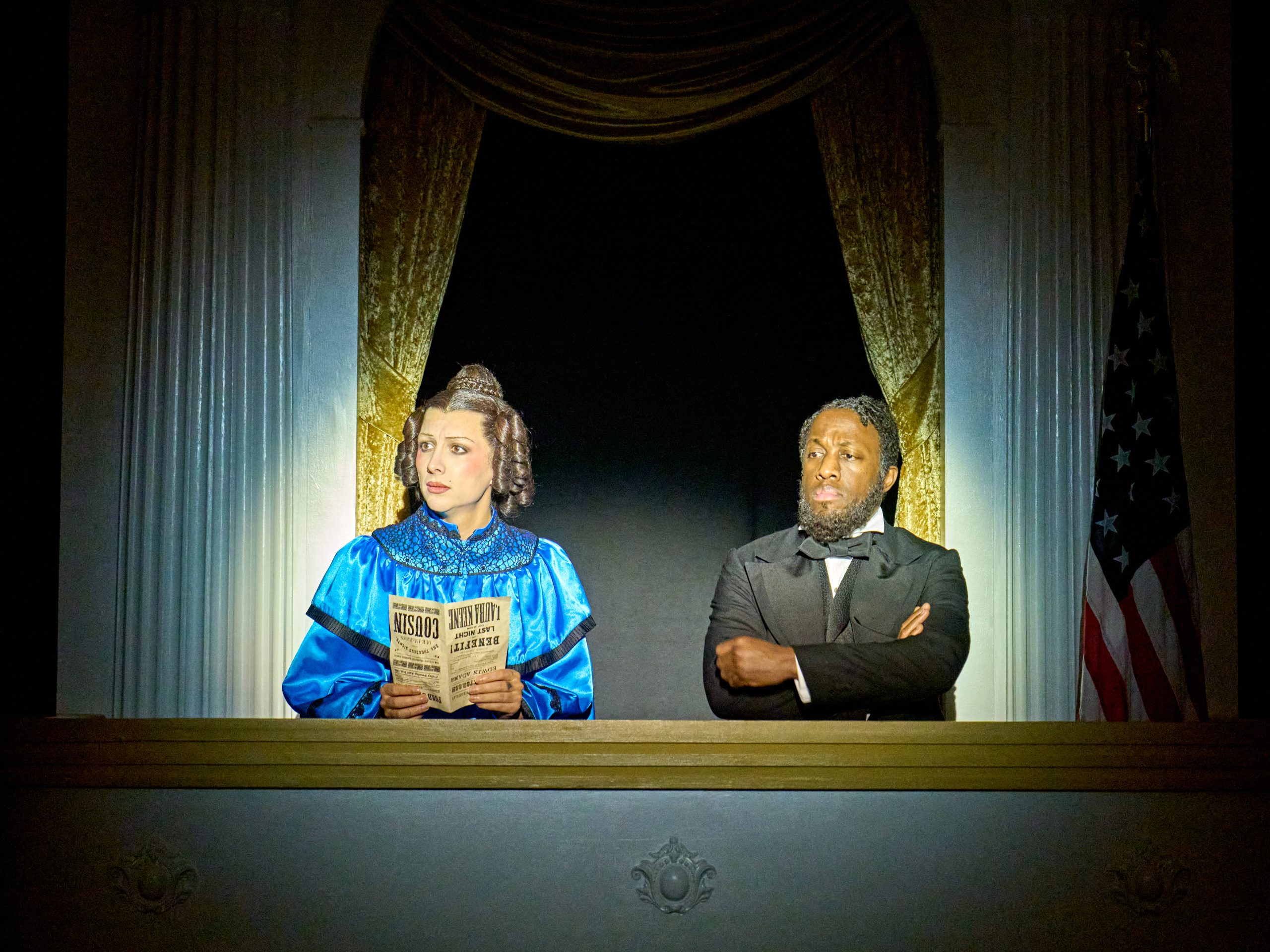
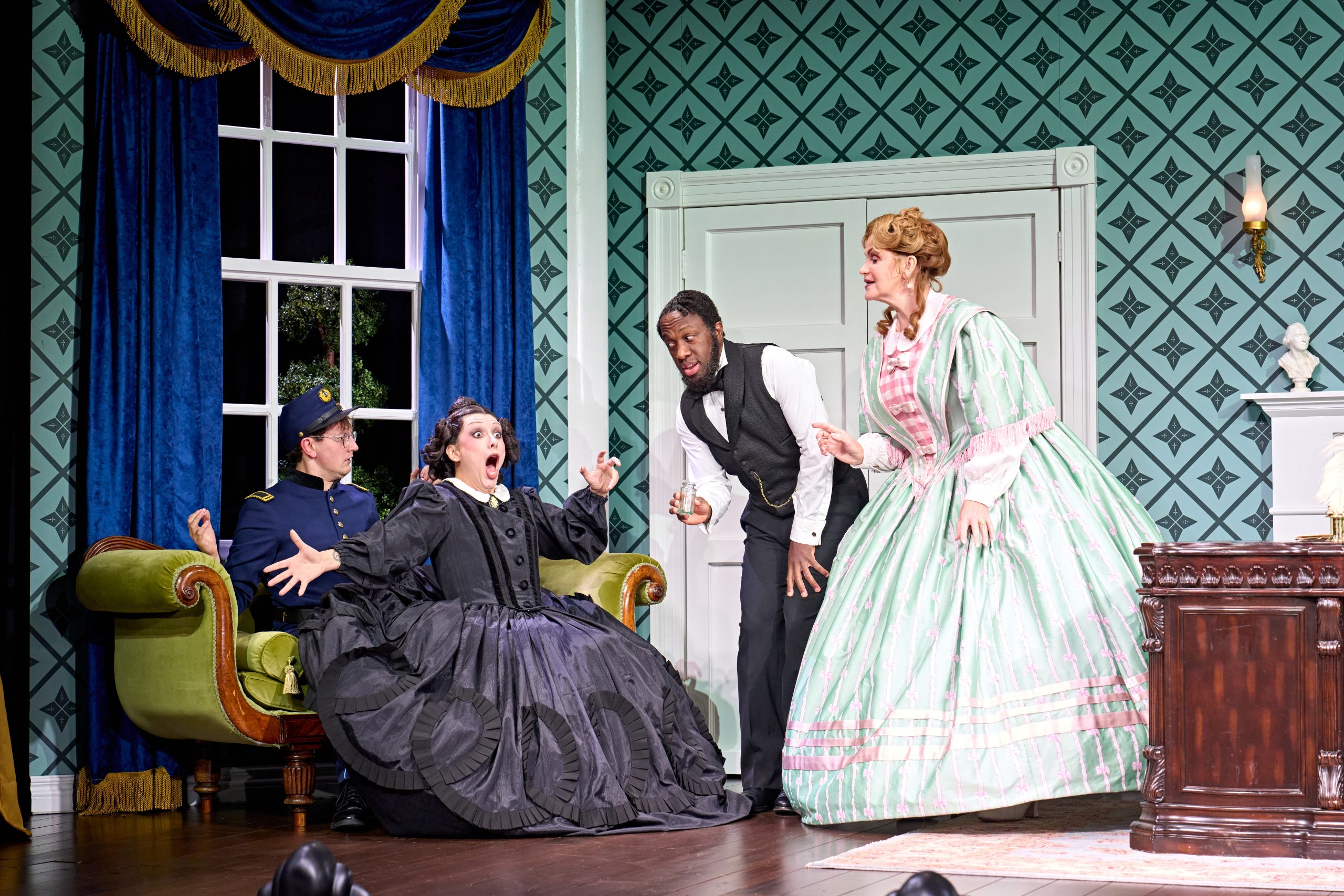
Many people still think of Giles Terera as Burr from Hamilton – that’s the role he’s best known for. Now he’s playing Mary’s Husband in something totally wild. What’s it like acting opposite that kind of energy in a show this off the wall?
It’s wonderful. I’d only ever seen Giles in more serious roles, so watching him sink his teeth into something this comedic has been a joy. His Mary’s Husband is phenomenal – earnest and ridiculous at the same time. It’s hard to describe. You just have to see it.
He really cracks me up. Working with him has been amazing – he’s so generous, so playful, and honestly, so mischievous. There’s a real glint in his eye. He, Mason, and I have all corpsed a few times – it’s that kind of show.
It’s fun acting with someone where you’re right on the edge. You trust each other completely, and you know that whatever happens – even if something goes wrong – it’s going to be fine. But there’s also this unpredictability to it. What’s he going to do? That danger makes it thrilling. He’s an incredibly exciting actor to work with.
Have there been moments where you’ve come close to corpsing on stage?
Oh, definitely. There are so many physical bits – books flying, people getting shoved, leaping onto tables – and things go wrong. I’ve slipped on the carpet, Mason’s pushed me over, and we’ve completely lost it.
There was one time Mason dropped the book and it slid under her dress, and I just started laughing. Then you’re trying to pull it back and stay with the scene…
Luckily, it’s the kind of show where – not that we encourage it – but if someone does corpse, it’s not the end of the world. You desperately try not to, but it’s not the worst play for it.
You mentioned earlier that you’ve done a lot of serious drama – The Normal Heart, Years and Years, Torch Song. Was part of the appeal here just getting to dive into the chaos?
Absolutely. That was a massive part of it for me – just being able to let go and do something completely different.
One of my favourite things about this career is the variety. I love stepping into different shoes, different worlds, different people – building those characters, experiencing what they experience, and hopefully reaching into people’s hearts and minds. Sparking conversations. That’s what it’s all about for me.
And this play does that too – just from a totally different angle.
It was a combination of wanting to work on this phenomenal piece, and also getting the chance to really let my inner idiot loose. I’m a proper goof with my mates – I’m silly, always messing around – and this was a chance to bring that side of me on stage.
It just called to me. I felt it really strongly, like I had to do it. So I made it my mission. I read the script before I’d even auditioned – I was manifesting it. And luckily, it happened.
You’ve spoken before about how much representation matters – not just that queer stories are being told, but that queer actors are visible. Do you feel like the tide is finally shifting in British theatre?
There are definitely more queer actors in the spotlight doing amazing work, which is exciting. And I think it’s moving in the right direction. But I also think there’s still a way to go.
It’s not a simple conversation. Sometimes the discourse around it gets flattened – made black and white – and it’s more nuanced than that. If we’re talking about queer actors playing queer roles, that’s something we have to approach with care and respect, for everyone involved. Because it matters not just to the performers, but to the audiences. Visibility is huge – seeing yourself on stage matters.
So yes, it’s encouraging to see progress, but I’m always cautious about saying, “It’s great now.” There’s still work to do – especially around trans and non-binary representation. That’s where the industry really needs to do better.
And that’s something I love about this play. Yes, it’s absurd, and it’s comedic, and there are queer elements – but at its heart, it’s about a woman striving for something. And in this production, that story is being told by a predominantly queer cast. Mason Alexander Park, Kate O’Donnell, myself, Giles – it’s powerful.
To see a play like this succeed, with that cast, in the West End… I hope it’s inspiring. I believe it is. It’s a reminder of what we can do, and the power we hold when we’re given the space.

What’s the key to keeping it fresh every night, especially with the energy so heightened?
The play is so dense and specific – there’s always something new to try. Every audience is different, and that feeds the show. I get something different from them each night, which shifts how I play a moment or where I put the energy.
It’s so wild and fast-paced, you don’t have time to get bored. You’re moving at 1,000 miles an hour, hitting beats that have to land in a very particular rhythm. It energises you. The audience energises you.
I keep a journal after every show – what I discovered, what surprised me – because I always want to keep digging. For me, the work is never finished. As soon as you think it is, it stagnates.
And what’s your process like for a show this chaotic? Are you building a backstory, or just holding on and hoping for the best?
Usually, I build meticulous backstories. On The Normal Heart, and the TV series I’ve just done – Under the Salt Marsh – I did loads of research. But this was different.
Because the history isn’t really the point, I imagined a backstory that made sense for this version of Mary’s Teacher – in this very specific, surreal world. And a lot of it came to life in rehearsal. We were up on our feet quickly. It’s a play that lives in the space, with the company.
So I did a lot of work – just from a different angle.
I’m a huge sci-fi nerd, and I really enjoyed your performance in Foundation. Glawen and Bel Riose had some of the most emotional scenes in season two. What was it like stepping into that kind of epic world – and working so closely with Ben Daniels?
It was wonderful. As an actor, getting to walk into a fully built world is a gift. There was barely any green screen – apart from the flying – because most of it was purpose-built. You’re actually stepping onto a spaceship. You’re walking through desert landscapes that feel like another planet. The scale of it, the detail, the budget – it all fuels your imagination.
And working with Ben was amazing. We’d done The Normal Heart together, so we already had a deep trust and intimacy. That made a big difference. We could just dive straight into those scenes.
The world of Foundation is so rich. Glawen isn’t in the original books, so I had real freedom to build him from scratch – which was great. Plus, he’s a master of martial arts, so I got to train, learn fight choreography, do stunts, pyrotechnics – all the stuff I love. It was so much fun.
But it was also a huge learning curve. Post-production took about a year, and a lot of the time we were acting with nothing. You’re told, “Look at the thing,” and you’re like, “What thing?” and they’ll say, “We’re not sure yet. Maybe it’s a gold ship.” So you’re trying to commit to something that doesn’t exist yet. It really pushed me in new ways.
So finally – when you’re 80, what’s the story you’ll tell about doing Oh, Mary! on the West End?
I think I’ll be really proud to have been part of the original West End cast. And I’ll say it was one of the most wonderful, stupid periods of my career – in the best possible way. I got to be a complete idiot every day, and it was pure joy.
I’ve already made so many friends for life on this job. You can feel it when it’s a special one – I had that with The Normal Heart, and I have it again here.
I’ll look back with so much joy. And I really believe this play will go on to more places, reach more people. I’m so excited to see where it ends up – and to have been part of its beginning in London.
It’s been such a pleasure to talk to you, Dino. I can’t wait to come back soon and see Oh, Mary! again soon.
Oh, Mary! is playing at the Trafalgar Theatre until 25 April 2026.
Get your tickets now at trafalgartheatre.com
Interview Nick Barr
Production photos by Manual Harlan
Portrait Photography by David Reiss
Styling by Steven Huang
Grooming by Terri Capon