Vietnamese human hair has become a strategic material choice because origin now shapes product identity, and a defined source gives a brand something specific to stand behind. Shoppers see a finished bundle or a styled wig. Brands see every decision behind it. Where the hair grew, who sorted it, whether the cuticle stayed aligned in one direction, and which factory built the weft all affect how a product wears after six months in a client’s hair. Origin, material foundation, manufacturing control, and product range now sit at the center of how global hair businesses build collections.
Hair Origin Is Becoming Part of a Brand’s Product Story
Origin has moved from a back office detail to a front facing part of the product story. Buyers once shortlisted suppliers on four points: Length, texture, color, and price. Those still matter. They no longer decide the shortlist on their own.
Brand founders now ask where the hair grew, who handled it before it reached the factory floor, and whether next quarter’s order will match this quarter’s. Their customers ask the same questions in comment sections and DMs. A stylist who has watched a client’s extensions turn brassy after two washes wants to know what changed.
A stated origin answers part of that. It gives a collection a narrative that competitors cannot copy with a photo, and it lets a brand explain its sourcing choices in plain language. Origin also separates one line from another on a shelf where every listing claims premium quality. The story starts with the material, which is why more founders trace supply back to one region.
Vietnamese Human Hair Offers a Defined Material Foundation
Vietnamese human hair gives manufacturers a narrow and traceable starting point instead of a mixed pool of unknown material. That narrowness is the practical value. It makes specifications possible.
Sourcing runs through four stages: Collection, sorting, classification, and quality evaluation. Workers group by length band. They check texture against reference samples. They read natural color depth, which in Vietnamese hair sits mostly in the dark brown to natural black range. They confirm cuticle direction, since cuticles that face the same way keep a bundle from tangling. They record the processing history, because hair that has already been bleached behaves differently in a dye vat.
None of this makes Vietnamese hair automatically better than hair from another region. It makes the material predictable, and predictability is what a specification sheet needs. A manufacturer who knows the input can promise a repeatable output.
APOHAIR builds its production on Vietnamese-origin human hair for that reason. The material defines the specification, and the specification defines what a partner brand can safely promise its own customers.
Turning Material Origin Into Consistent Beauty Products Requires Expertise
Raw material sets the ceiling on quality. Production decides whether a brand reaches its goal. Good hair handled badly still sheds, tangles, and dulls within weeks.
The work between sourcing and shipping is where consistency is won or lost. Sorters group strands into 2-inch (5 cm) length bands, then pull short pieces from a double drawn batch so the weft holds thickness to the ends. Washing and conditioning remove residue without stripping the cuticle layer. Weft construction, knotting, and sewing determine whether a weft lies flat against the scalp. Quality control teams pull samples, tug for shedding, comb for tangling, and check color against the swatch before packing.
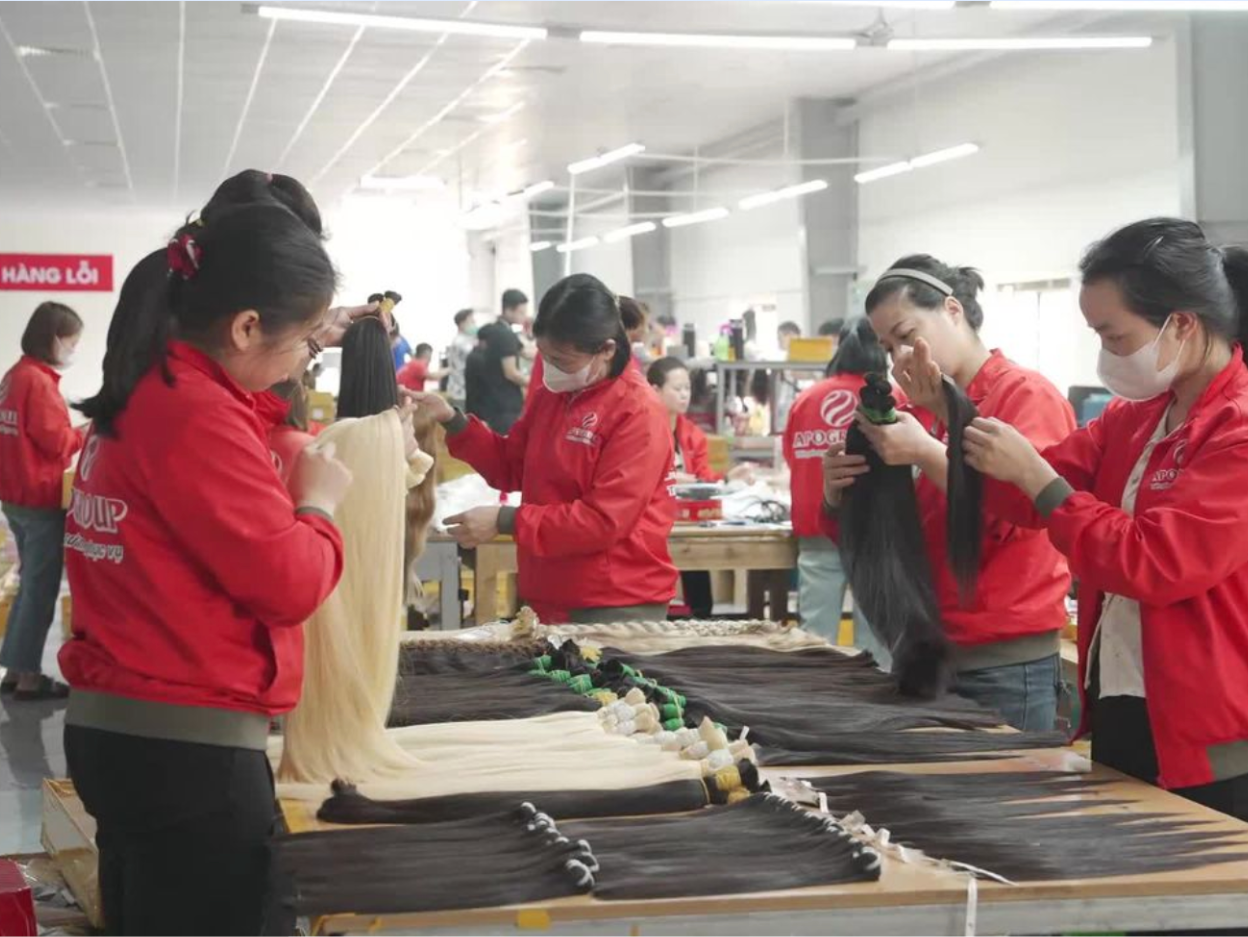
Consistency carries commercial weight. Repeat orders depend on it. So does a brand’s reputation, since a salon owner who reorders a shade and receives a slightly warmer version will not reorder twice. At APOHAIR, Vietnamese human hair sourcing and factory production answer to the same specification sheet. Buyers do not take in material the floor cannot hold to spec, and the floor never takes hair it has no process for.
From Extensions to Wigs, Vietnamese Hair Supports Diverse Product Development
One material stream feeds several finished formats, and each format asks something different of the factory. Wefts, tape-ins, keratin tips, clip-ins, lace closures, and full wigs all start from the same sorted hair and end up built by different hands.
Construction is where they diverge. A wig cap needs ventilation work, strand by strand, along a lace base. Different product formats, including wholesale tape-in hair extensions, require manufacturers to hold consistent construction and adhesive standards across every batch. A machine weft answers to speed and stitch strength instead.
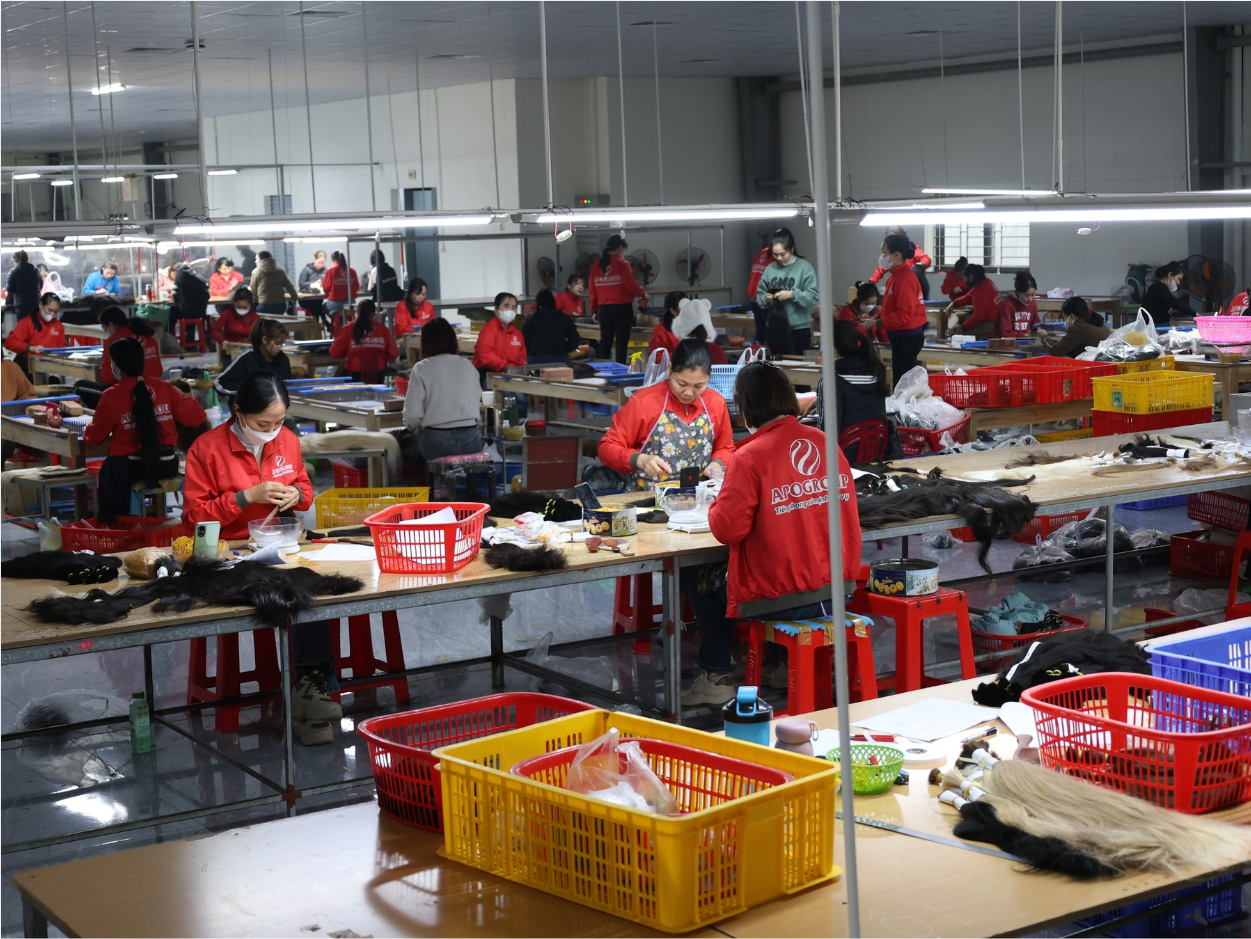
Product development sits on three supports: Consistent specifications, manufacturing flexibility, and quality control that catches problems before packing. Miss one and the other two stop mattering. Brands that want a signature texture or a custom color blend need a partner who can adjust one variable without disturbing the rest. That flexibility comes from knowing the material well, not from adding more machines to the floor.
APOHAIR Connects Vietnamese Hair Heritage With Modern Manufacturing
APOHAIR works as a Vietnamese human hair manufacturer that keeps sourcing and production under one roof. The company has spent more than two decades on this material, and its factory sits in Ninh Binh Province in northern Vietnam.
Vietnamese origin anchors the operation. Every product line starts from 100% Vietnamese human hair, sorted and classified in house before production begins.
Manufacturing runs factory-direct, which shortens the distance between a brand’s specification and the people who execute it. Teams handle product development for partner labels, adjusting length, texture, color, and construction to a brief. Quality control checks run at multiple points rather than only at the end.
The commercial side serves hair brands, salon businesses, distributors, and professional buyers who need volume they can plan against. Those partners tend to care less about a catalog and more about whether order twelve matches order one. That question comes up in almost every first conversation with a new brand, and answering it well takes records, not adjectives.
Origin Is the Beginning of the Story, Not the Whole of It
Vietnamese human hair carries more than a geographic label. It represents a traceable origin, the craft of sorting and construction, the manufacturing knowledge that turns strands into products, and the identity a brand builds on top of all three.
Hair businesses looking for a production partner need suppliers fluent in both halves of the work, material and manufacturing, and able to prove it. APOHAIR shows one way that fluency supports beauty brands working across global markets.