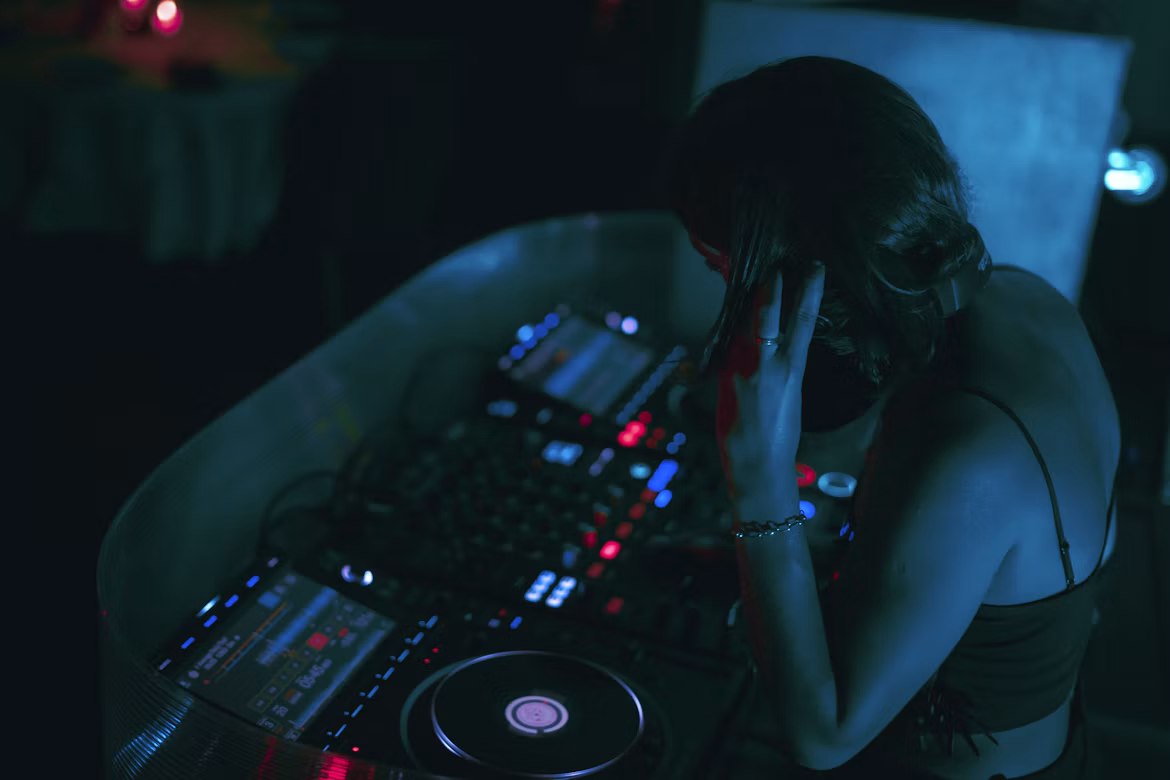
It’s two in the morning, down in a basement club. The DJ yanks the bass, lets one percussion loop wobble solo for a few bars, then hits them with something out of nowhere. Phones go back in pockets. That’s the moment people remember, not the tracklist.
More women are the ones behind the decks now — whether it’s a tiny back-room night or a festival stage. Yet most coverage still treats their presence as the story, as if standing at the decks were the achievement.
Where the numbers actually sit
Progress is real but patchy. 29.8% of bookings went to female acts — that’s what the female FACTS 2024 report found after analysing 175 editions of 110 electronic music festivals held in 2022 and 2023. That’s better than earlier years and still nowhere near even.
Festivals are only the top layer, though. Most DJs get started in small clubs, on community radio, in local collectives where nobody expects a polished “festival sound.” That freedom matters. Sisu, in London, hosts DJ workshops and events for women, trans and non-binary artists, with a focus on connections that last past the first gig. Some of its members have gone from beginner workshops all the way to festival stages and international bookings.
No single sound
There’s no such thing as a “female DJ sound,” and anyone claiming one is squashing a huge range of people into a handy label. But a few names show how open club music has become.
Chicago house raised Honey Dijon — and she moves through disco, techno and fashion-world parties without breaking stride. TSHA writes melodic, emotional tracks that are almost like songs, and they still hold their own at 3 a.m. As for HAAi? Psychedelic textures, breakbeats, strange rhythmic left turns.
What links them? Just one thing: a refusal to treat a set as a row of tracks at matching tempos. A few things that give a set its pulse:
- Slow blends
- Genre jumps
- Silence
Men do all of this too, obviously. The point is that a wider pool of people brings more instincts into rooms that used to reward a narrow idea of what counts as credible.
Minimal tech house hides more than it reveals
To a first-time ear, minimal tech house can feel almost empty — nothing but a kick, a bassline and some small percussion ticking away. But when there’s so little going on, every decision shows.
Run a bass note a hair too long and you muddy the groove. Drop a clap a fraction late, and the entire track feels looser. It’s a slow craft — automating filters, reverb tails, every individual drum hit — all to keep the track shifting without ever seeming to change.
That restraint is also how newer artists get noticed. With no wall of sound to hide behind, small habits like where a hi-hat sits or how slowly a filter opens start to work as a signature. Redhead Queen is a good example of this approach, and if you want to explore Redhead Queen’s minimal tech house production style, her artist site shows how those details add up and where they fit in the wider minimal, deep tech and house scene.

Why indie dance keeps sneaking into underground sets
Borrowing from post-punk, synth-pop, disco and house, indie dance never quite settles into one box — an awkward spot to be in. You might hear a driving four-on-the-floor kick alongside a gritty synth bass, a melancholy vocal and some guitar in a typical track. It does the job in a warehouse no less than in a late-night alternative bar.
It also pays off for DJs with a sense of pacing. Stamina is mostly what a peak-time techno set demands. An indie dance selection can travel between hypnotic, stripped-back stretches and bigger melodic moments, giving the crowd space to react rather than just endure.
If that crossover appeals to you, these indie dance sets by Redhead Queen show how alternative influences carry over into live DJing.
There’s a real difference between the two jobs. In the studio, you control every element and can fiddle with a bassline for hours. Behind the decks you’re reading a room of people who all react differently, and sometimes you get eight bars to decide.
The boring stuff that makes it work
Talent doesn’t keep a scene healthy by itself. Give people cheap places to practise, promoters who’ll gamble, and audiences curious enough to hear an unknown name.
Useful change, for the most part, happens far from the spotlight:
- CDJs, mixers, music libraries — community workshops let beginners get to grips with all of it before their first public set.
- Independent radio and local residencies give DJs time for a consistent voice, replacing the chase for isolated viral clips.
Plenty of adventurous selectors have found new listeners thanks to NTS and Rinse — and Keychange, for its part, keeps pushing the wider industry toward better gender balance.
What comes next
The next big thing probably won’t show up under one tidy genre label. It might start in a small club where somebody mixes an unfamiliar indie dance record into a minimal house groove and realises it works.
If you want to be there for it, get in early and actually listen to the support DJs. Follow artists beyond the big festival posters. Watch how someone builds a set instead of just waiting for the track you know.
Women behind the decks shouldn’t have to carry a whole movement every time they play. They need room to experiment, get it wrong now and then, and find their own sound. That’s what keeps underground music interesting: not a perfectly predictable line-up, but people willing to play something different.