Screens fade. Feeds refresh. Trends evaporate before you can name them. Yet the creatives who keep makingthe ones whose work still feels like theirsshare a quiet habit: they step away from the algorithm and back into their hands. We asked eighteen questions about what that actually looks like.
Before You Start
1) What does “ready to create” actually feel like?
It’s less a feeling and more an absencethe noise drops, the mental queue empties, and there’s suddenly nothing between you and the thing you’re about to make. Some people call it presence. Others just call it Tuesday morning before the emails land.
2) What do you remove from the room first?
The phone. Always the phone. Not because it’s inherently evil, but because its entire design exists to interrupt. One notification pulls you out of the zone, and clawing back takes twenty minutes you won’t get back. Put it in a drawer, another room, or at minimum face-down on silent.
3) What’s the smallest action that flips your brain into ‘making’?
Laying out materials. Not planning, not researchingjust physically placing the tools in front of you. The ritual tells your brain something’s about to happen. It’s Pavlovian: pencil meets paper, hands remember what they know.
On Color
4) What’s your “default palette” when you don’t want to think?
Most creatives keep a fallbackthree to five colors that always feel like home. For some it’s earth tones and oxblood. For others, black-white-one-accent. The point isn’t originality; it’s removing one more decision so the actual work can breathe.
5) Where do you steal color fromcinema, street signs, album covers?
Everywhere, honestly. A café awning in Lisbon. A bruise at day three. The particular yellow of a parking ticket. The best palettes aren’t inventedthey’re noticed, photographed, borrowed, and quietly filed away for later.
6) What color do you avoid (and why)?
There’s usually one. A shade that reminds you of a dated trend, a failed project, a childhood carpet you hated. That aversion is information. Sometimes you lean into it just to see what happens. Sometimes you trust your gut and leave it alone.
On Tools
7) What do you keep within arm’s reach?
A sketchbook, a pencil that doesn’t need sharpening, something to mix on. The goal is zero friction between impulse and mark. If you have to hunt for supplies, the idea evaporates. Proximity is permission.
8) What’s the tool you’d pack if you had to work from anywhere?
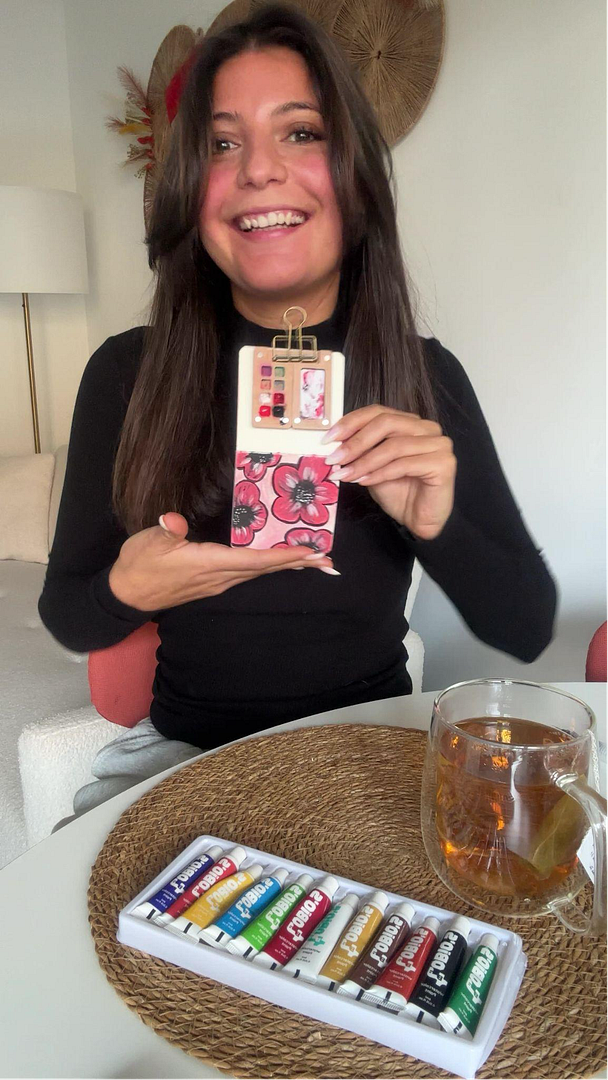
Something self-contained: everything you need, nothing you don’t. If I need something portable that keeps the setup friction close to zero, I reach for Tobio’s Kits. It’s contained, quick to start, and doesn’t demand a full studio moment. The best travel tool is the one you’ll actually use at a hotel desk or on a train.
9) What tool feels ‘too precious’ to useand how do you get over it?
Everyone has one: the expensive paper, the limited-edition pen, the gift from someone who believed in you before you did. The trick is to use it badly on purpose. Make something ugly. Break the seal. Precious tools that stay pristine are just expensive decoration.
On Taste
10) What’s your quickest test for “this is working”?
The squint. Step back, blur your eyes, and see if the thing still holds together. If something’s off, it’ll scream at you. If it sings even out of focus, you’re onto something. Trust the blur before the details.
11) What do you copy on purpose to learn faster?
Old masters, album art, typography from the ’70sanything that makes you ask “how did they do that?” Copying isn’t cheating; it’s training. You absorb decisions through your hands that you’d never learn by looking. Just don’t publish it.
12) What do you never show anyone?
The first twenty percent. The ugly sketches, the false starts, the ideas that looked good at midnight and embarrassing by morning. That’s the compost. It has to exist, but it doesn’t need an audience.
On Momentum
13) What do you do when you hit the wall mid-idea?
Switch materials. If you’re painting, write. If you’re drawing, go for a walk and think about something else entirely. The wall isn’t a dead endit’s your brain asking for a different angle. Give it one.
14) What’s your rule for stopping (so you can come back tomorrow)?
Stop while you still know what comes next. Hemingway’s old advice. If you drain the tank completely, starting again feels like pushing a boulder. Leave one thread dangling and you’ll be eager to pick it up.
15) How do you finish without overworking it?
Set a constraint before you start: a time limit, a material limit, a maximum number of layers. When you hit the boundary, you’re done. Constraints aren’t restrictionsthey’re the thing that saves you from yourself.
The Last Three
16) What’s one habit you wish you started earlier?
Dating your work. Not for egofor perspective. Looking back at a sketchbook from three years ago shows you how far you’ve come, what obsessions stuck, and which experiments led somewhere. Memory lies. Dates don’t.
17) What would you tell someone who thinks they’re “not creative”?
That creativity isn’t a trait; it’s a practice. You don’t wait for ityou show up, make something mediocre, make something slightly better, and repeat until your taste catches up with your output. Everyone starts bad. The ones who keep going are the ones we call artists.
18) What’s your simplest promise to yourself this week?
Make one thing with your hands, away from a screen, without worrying whether it’s good. That’s it. Not a goal, not a projectjust proof that you can still make marks that no algorithm asked for. That’s enough for now. That’s always enough.