
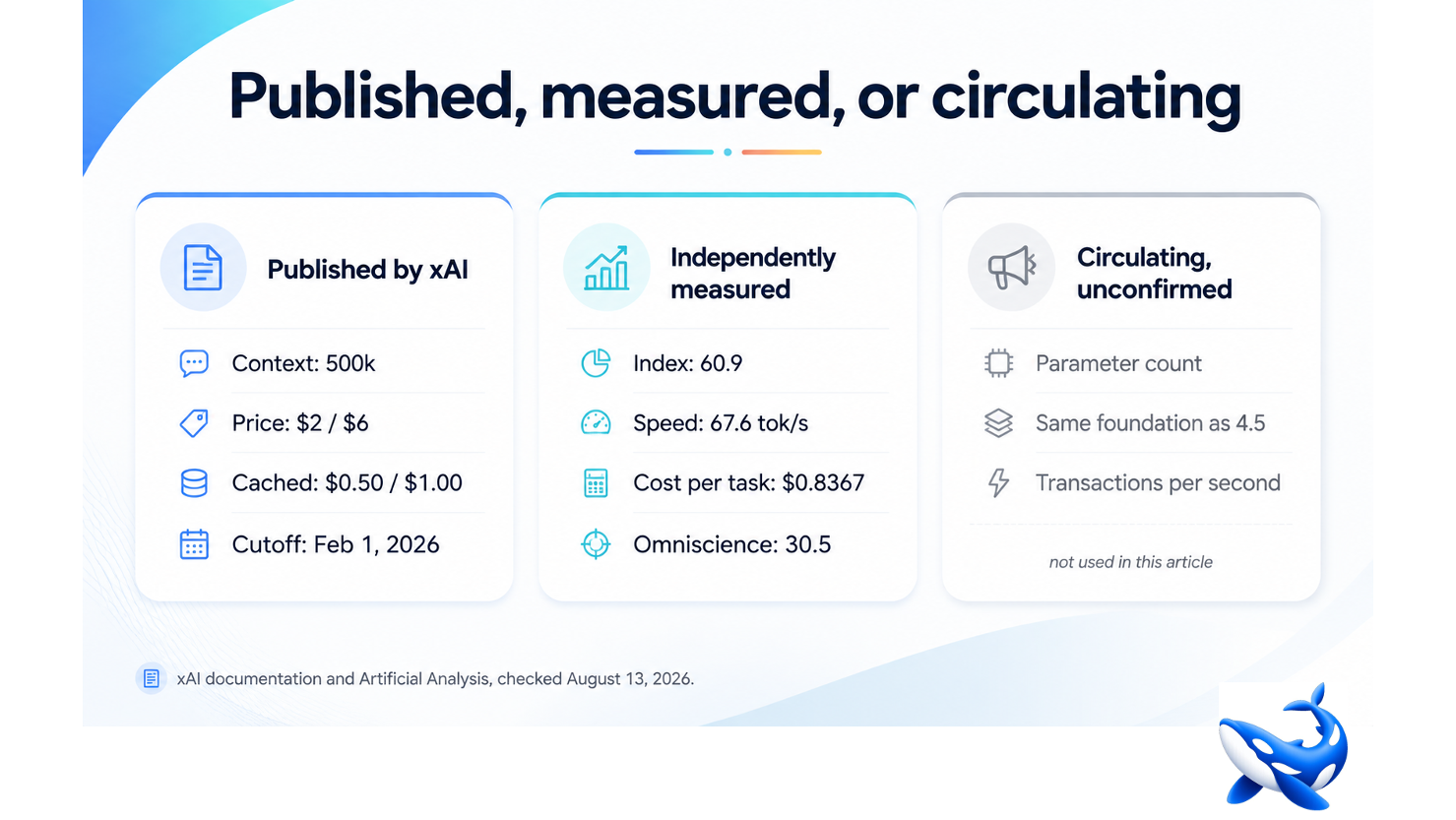
Search for Grok 4.6 specifications and you will find a parameter count stated confidently in most results. xAI has not published one. What it has published is four numbers, all of which change how you’d budget and none of which is the number everyone repeats — the same situation that applied to Grok 4.5 before it. Our Grok 4.6 release notes track what shipped, when, and what it replaced.
Separating the three tiers of evidence is worth ten minutes, because two of them are actionable and one isn’t.
Published by xAI
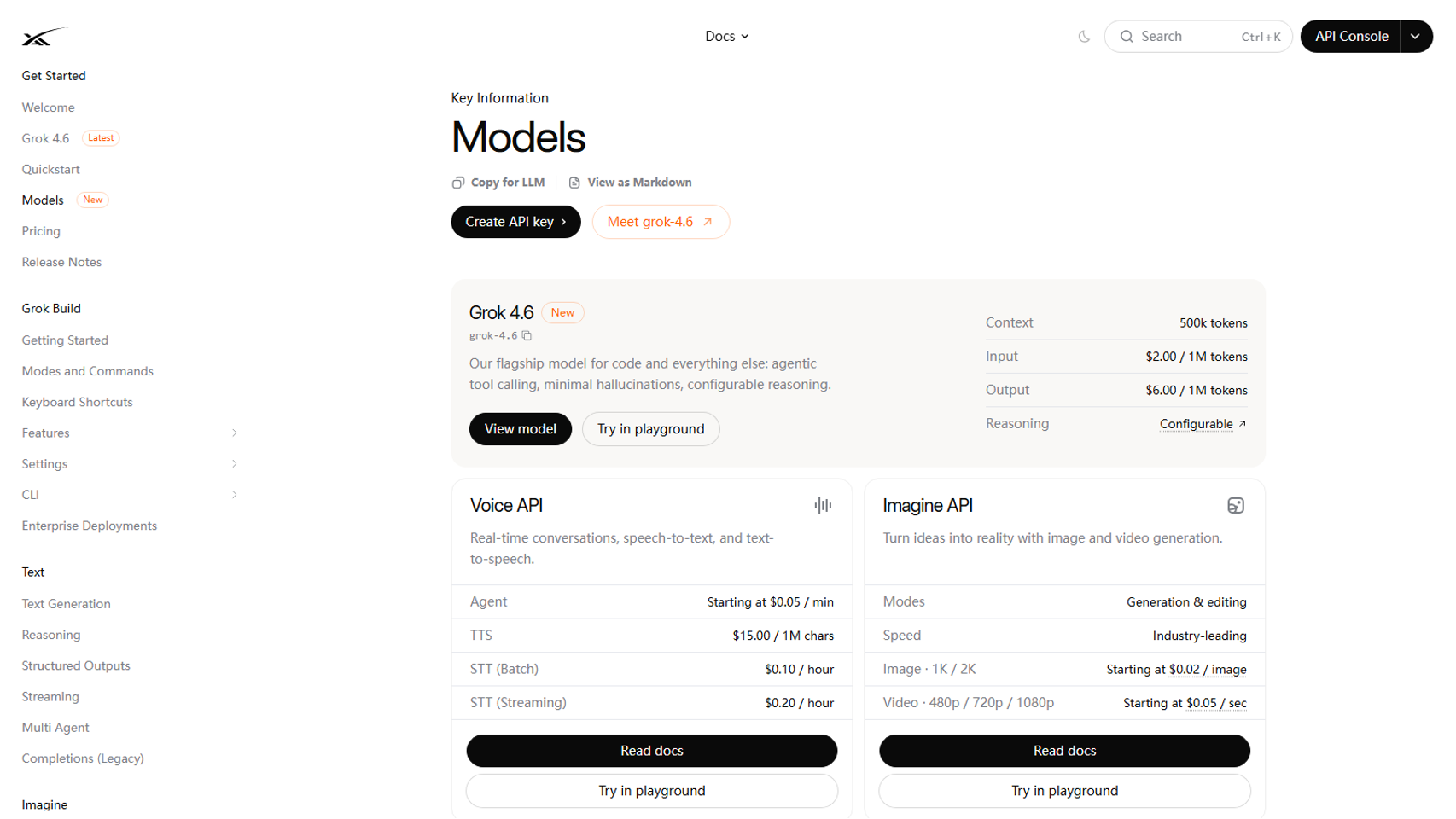
From its model documentation, checked August 13, 2026, where `grok-4.6` is described as *”the most intelligent and fastest model we’ve built”*:
| grok-4.6 | |
| Context window | 500k |
| Input / output, under 200k | $2.00 / $6.00 |
| Input / output, 200k and above | $4.00 / $12.00 |
| Cached input | $0.50 / $1.00 |
| Knowledge cutoff | February 1, 2026 |
Four things that matter, in decreasing order of how often they’re omitted elsewhere:
Cached input rose 67% from Grok 4.5’s $0.30 / $0.60. It is the only cell on the card that changed between the two models, and it is the one place this upgrade costs more.
The price doubles at 200,000 tokens — applied to the whole request, not the excess. A 500k window therefore has 60% of its range in the expensive tier.
Per-token pricing is otherwise identical to 4.5. Same $2 / $6, same $4 / $12.
The knowledge cutoff didn’t move. February 1, 2026, same as its predecessor.
Independently measured
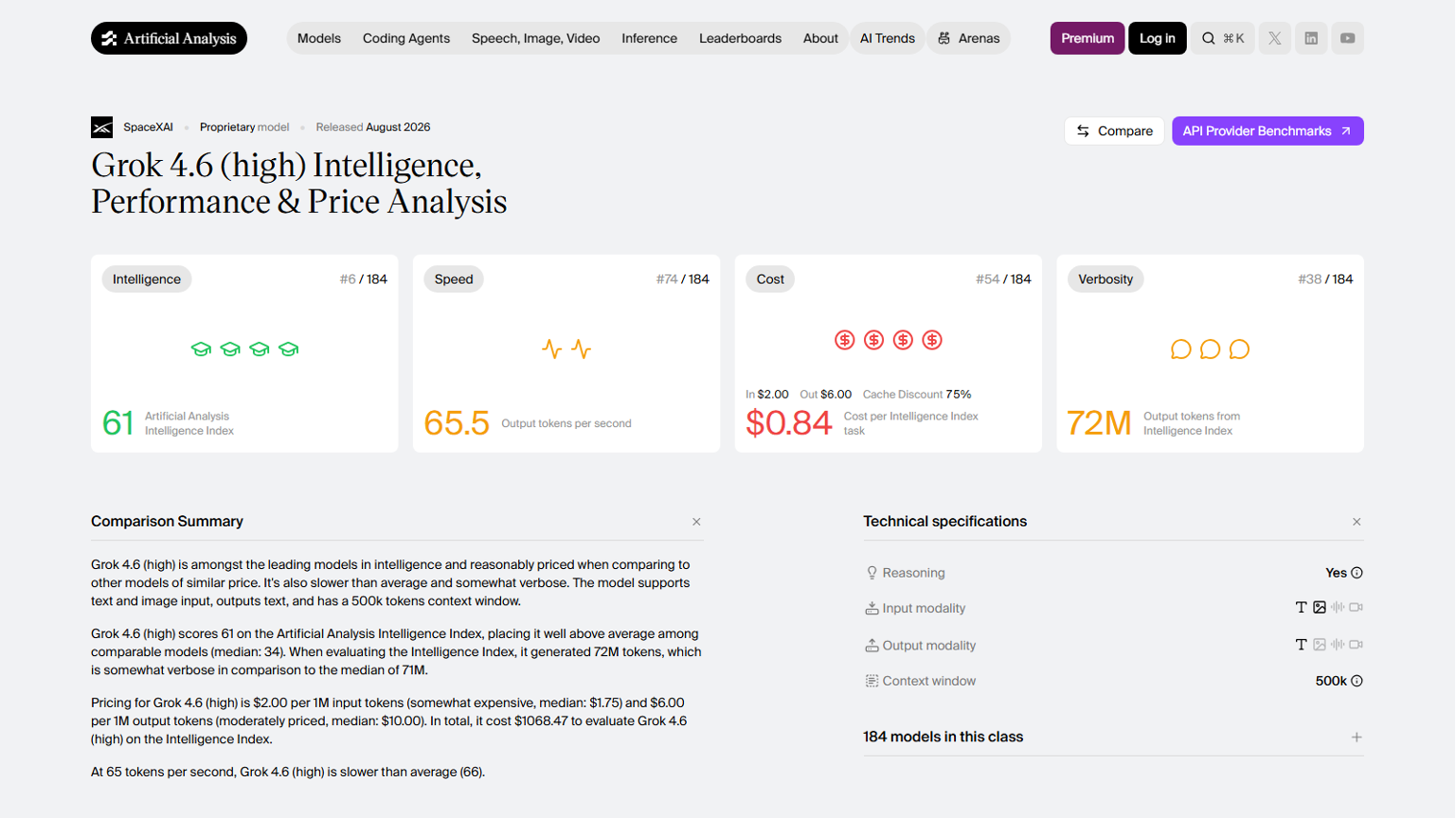
Artificial Analysis, checked the same day, configuration “high”:
| Grok 4.5 | Grok 4.6 | |
| Intelligence Index | 55.8 | 60.9 |
| Median output speed | 56.9 tok/s | 67.6 tok/s |
| Answer time | 8.79 s | 7.40 s |
| AA-Omniscience | 25.3 | 30.5 |
| Cost per index task | — | $0.8367 |
These are usable for the same reason the documentation is: someone with no stake in the answer ran the model under a stated configuration and published what it cost.
The cost-per-task figure in particular is the one that predicts an invoice, because reasoning models bill thinking as output. On the same board GPT-5.6 Sol scores an identical 60.9 at $1.2312 — 47% more — and Claude Opus 5 scores 63.1 at $2.3369.
Circulating but unconfirmed
Three claims appear widely and none is published by xAI.
A parameter count. Coverage consistently attaches a figure and describes the model as reusing the same foundation as 4.5, with gains from post-training rather than scale. xAI’s documentation publishes context windows, prices and a cutoff — not a parameter count. No figure is stated in this article for that reason.
Worth adding: the measurements are at least *consistent* with the post-training account. A scale increase would normally show up as slower generation and higher cost per task. Instead throughput rose 19% and the price held. That is what a post-training improvement looks like from outside — evidence for a reading, not confirmation of a number.
“Transactions per second.” This unit circulated before launch and is not a standard. Throughput is reported in tokens per second and varies with prompt length, effort and batching. The measured figure is 67.6 tok/s.
Pre-launch benchmark figures. A spec sheet circulated before August 12 with agentic scores attached. Now that an independent evaluation exists, there is no reason to quote unverified numbers — and the pre-launch material compared against a rival’s previous flagship rather than its current one, which is a pattern worth recognising generally.
Why the missing number doesn’t matter here
Parameter counts are the specification people use to reason about self-hosting: how much VRAM, what quantisation, which GPU.
Grok 4.6 is an API-only model. You cannot download it. So even a confirmed parameter count would tell you nothing you could act on, while the four documented figures translate directly into a cost model and a capacity plan.
That asymmetry is the useful lesson. When a specification is missing, ask what decision it would change. If the answer is “none”, its absence is not a gap — and chasing it is how unverified numbers end up in decision memos.
The same test, applied to the next release
This will happen again within weeks, so the habit is worth more than the specific answer.
When the next model lands, the vendor’s documentation page will fill in first — an identifier, a context window, a price. That page is operationally binding in a way marketing material is not, because customers bill against it. An independent index and cost-per-task figure follow within days. Everything in between is other people’s summaries of those two sources, plus whatever circulated before launch and never got retracted.
The specific failure to watch for is a pre-launch spec sheet outliving the launch. Numbers that circulated before August 12 are still being repeated for Grok 4.6 even though real measurements now exist — which is a strictly worse source with no compensating advantage. Once a third party has run the model, unverified figures have no remaining use.
A four-line filter
Is it on the vendor’s documentation page? That page has to be operationally correct because customers bill against it.
Did a third party measure it, at a stated configuration? Effort level unstated means uncomparable.
Would it change a decision you’re making? If not, it doesn’t need to be resolved.
Is a cost attached to the score? A benchmark number without a cost is half a result.
Applied to this release, that filter leaves you with nine numbers — five from xAI, four from an independent evaluator — and every one of them is actionable. Everything else is decoration.
The takeaway
xAI publishes five things about Grok 4.6 — a 500k context window, $2.00 / $6.00 per million tokens under 200,000, $4.00 / $12.00 above it, cached input at $0.50 / $1.00, and a February 1, 2026 knowledge cutoff — and an independent evaluator adds four more: index 60.9, 67.6 tokens per second, 7.40-second answer time and $0.8367 per completed task. It does not publish a parameter count, the circulating figure is unconfirmed, and since the model is API-only that number would change no decision even if it were. Budget from the nine that exist, and note that cached input is the only rate that rose from Grok 4.5.
Sourcing note: context windows, per-token prices, cached-input rates, tier thresholds and knowledge cutoffs for grok-4.6 and grok-4.5 are from xAI’s own model documentation, checked August 13, 2026. Intelligence Index, output speed, answer time, Omniscience and cost per index task are from Artificial Analysis, checked the same day, at the configurations labelled. The account of how the gains were achieved is as publicly reported; xAI has published no architectural details or parameter count for Grok 4.6, and none is asserted here.



