
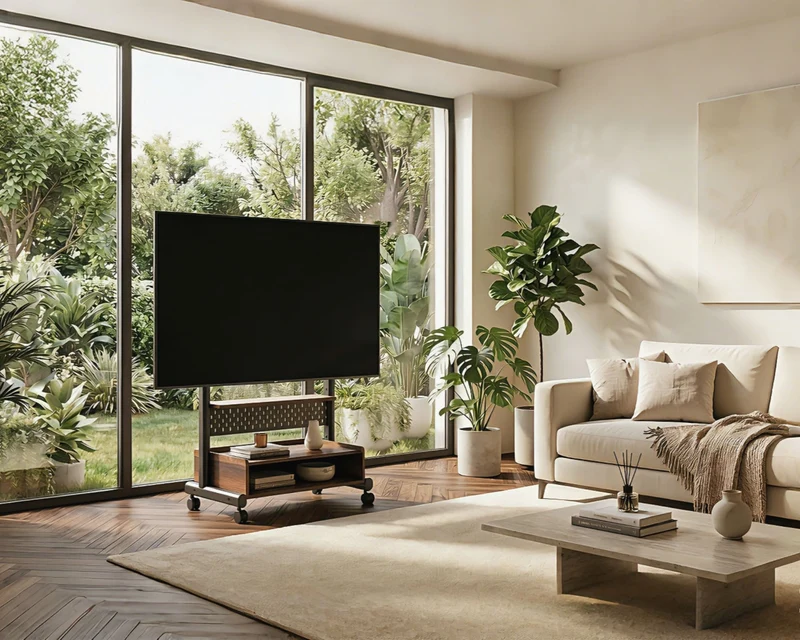
A TV stand with a mount is usually better when the screen needs to turn, move, or remain independent from a large cabinet. A media console makes more sense when the TV area also needs substantial enclosed storage and a larger surface for equipment or décor. The better option is the one that matches both the viewing setup and the storage demands of the room.
What Is the Main Difference Between a TV Stand With Mount and a Media Console?
The main difference is how each piece handles the relationship between the television and the furniture around it.
A TV stand with mount supports the television on its own vertical structure, so the screen does not need to rest on a wide cabinet. A media console usually combines TV support and storage in one larger piece of furniture.
| Comparison Point | TV Stand With Mount | Media Console |
| TV support | Mounted to a vertical support | Usually rests on the cabinet top |
| Floor space | Usually smaller footprint | Usually wider and deeper |
| Storage | Limited or optional shelving | Strong enclosed storage |
| Viewing adjustment | May support swivel or repositioning | Usually fixed once positioned |
| Layout flexibility | Easier to reposition | More dependent on furniture placement |
| Device storage | Usually open or limited | Can conceal more devices and accessories |
| Surface space | Limited | Larger usable top surface |
| Best suited for | Flexible, lighter TV layouts | Storage-focused media areas |
The practical question is therefore simple: does the room need more flexibility around the screen, or more storage around the TV?
When Does a TV Stand With Mount Work Better?
A TV stand with mount is most useful when the television does not need to be tied to a large cabinet.
This can work well in smaller living rooms, open-plan spaces, or rooms that already have enough storage elsewhere. If there are only a few connected devices, using a large media console just to support the TV may take up more floor and wall space than the setup actually needs.
A mounted stand also becomes more valuable when the screen needs to face more than one viewing position. For example, a sofa and dining area may share the same TV but sit at different angles. A stand with swivel adjustment can change the screen direction without requiring the rest of the furniture to move.
The same applies when the room may be rearranged later. Renters, people who prefer not to drill into the wall, or households that regularly change furniture placement may benefit from keeping the TV independent from a permanent mounting position.
In rooms where the television needs that kind of flexibility, different TV stands with mount can support anything from a relatively fixed setup to swivel or more mobile configurations.
That flexibility matters less, however, if the television is always watched from the same seat and is unlikely to move. In that case, adjustment features may add little practical value.
When Is a Media Console the Better Choice?
A media console is the stronger option when the TV area also needs to handle significant storage.
For households with several game consoles, controllers, streaming devices, routers, remotes, AV accessories, or other media equipment, enclosed cabinets can keep these items together instead of spreading them across shelves or nearby furniture.
The advantage goes beyond simply organizing cables. Many TV stands can route or conceal wiring along their support structure, but a media console can also hide the devices themselves, along with adapters, power strips, spare accessories, and excess cable length.
A console can also make sense when the living room already needs a substantial storage piece. In that situation, combining TV support, enclosed storage, and usable surface space into one item may be more efficient than introducing several separate pieces of furniture.
The wider top surface can also hold speakers, lighting, décor, or small media equipment. If the room has enough space and storage is already a priority, the larger footprint is not necessarily a disadvantage.
Which One Fits Your Living Room Better?
Instead of comparing individual features, look at how each option responds to the same room condition.
| Living Room Condition | TV Stand With Mount | Media Console | Better Fit |
| TV needs to face different seating areas | Swivel models can change the screen angle without moving large furniture | Usually remains fixed in one viewing direction | TV stand with mount |
| Room layout may change over time | Easier to reposition or relocate | Larger size makes frequent repositioning less practical | TV stand with mount |
| Limited need for media storage | Keeps the TV setup relatively compact | May provide more storage than the room actually needs | TV stand with mount |
| Several consoles, devices, and accessories need storage | Shelving is usually more limited or exposed | Enclosed cabinets can organize and conceal more equipment | Media console |
| A large surface is needed below the TV | Usually offers limited shelf or surface area | Provides more usable surface for speakers, décor, or equipment | Media console |
| The room needs both flexible TV placement and substantial storage | Handles screen positioning well but may need separate storage | Handles storage well but keeps the TV more tied to the furniture | TV stand + separate storage |
Two questions usually narrow the decision quickly: does the television need to change direction or position, and does the TV area need substantial enclosed storage?
If screen flexibility is the main concern, a TV stand with mount usually provides the more direct solution. If storage and equipment concealment matter more, a media console is often more practical. When both needs are important, separating the two functions can work better than forcing one piece of furniture to handle everything: a freestanding TV stand can manage screen placement while a separate low cabinet provides storage.
Choose the Setup Around the Room, Not the Product
Modern living rooms do not all need the same type of TV furniture. A mounted stand is useful when screen positioning and layout flexibility matter more than extensive storage, while a media console works better when the TV area needs to function as a storage center as well.
FITUEYES offers freestanding TV solutions for rooms where flexible screen placement or a lighter furniture footprint is more important than large built-in storage.
The better choice is the one that solves the room’s actual viewing and storage needs without adding functions the space does not use.