Tired of sterile corporate muzak and algorithmically generic pop? This masterclass reveals how bedroom producers can debug prompts like code, sculpt dynamic acoustic tension, and reclaim creative agency.
Every contemporary producer experimenting with generative audio has confronted the exact same creative impasse: you pour your soul into what feels like an evocative description, only for the machine to spit out sunny, toothless elevator background music. The knee-jerk reaction is to blame the underlying algorithm, yet seasoned sound designers know that the root bottleneck almost always traces back to the text itself. In the emerging discipline of modern sound design, prompts are never written flawlessly on the first pass—they are systematically debugged.
Much like a programmer tracing a compilation error or a mixing engineer isolating phase cancellation on a drum bus, shaping algorithmic audio requires treating descriptive syntax as modular sonic architecture. When creators approach an ai music generator with vague emotional aspirations rather than tangible acoustic instructions, the engine defaults to safe probabilistic compromises, generating bland, predictable melodies.
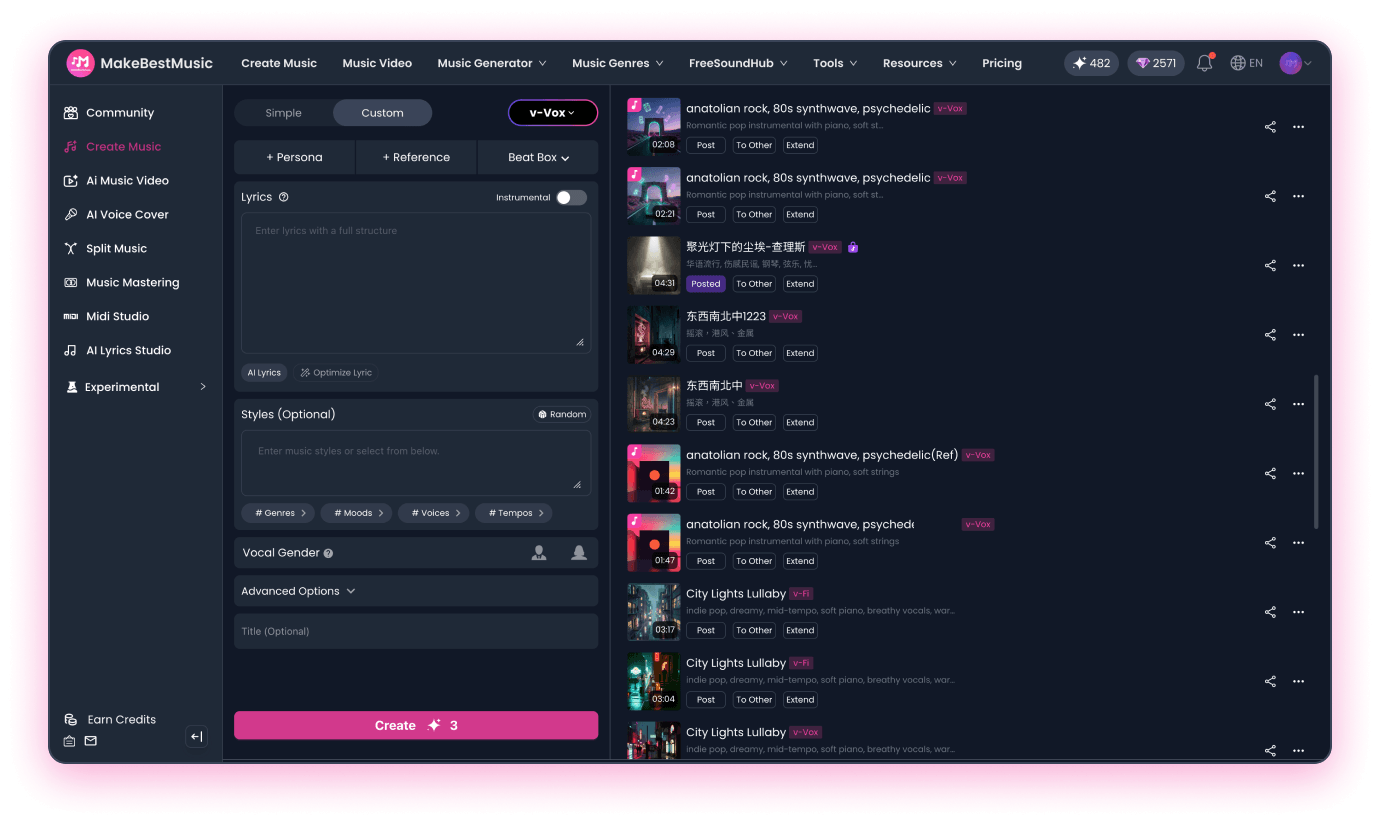
Calibrating the soundscape: Transitioning from abstract descriptors to architectural prompt engineering in the MakeBestMusic (Melox.ai) studio.
The Anatomy of Semantic Drift in Generative Audio
Generative neural networks do not possess creative intuition; they parse linguistic tokens against acoustic training weights. When an artist prompts for something “epic,” the model faces a catastrophic ambiguity fork: does the user intend cinematic Wagnerian brass, thunderous Hans Zimmer percussion, or neoclassical blackened metal? Lacking concrete parameters, the network averages these possibilities, yielding muddy, synthetic arrangements devoid of human intimacy.
Achieving authentic analog warmth demands that producers deconstruct their musical intentions across an unyielding hierarchy: Genre → Tempo → Instrumentation → Arrangement → Dynamic Contour. If the foundational genre descriptor is ambiguous, every subsequent musical layer drifts further away from the artist’s original vision. Learning how to write effective ai music prompts is less about poetic flair and far more about establishing explicit frequency boundaries and rhythmic constraints.
“The greatest misconception surrounding generative audio is that artists must surrender their creative agency to a black box,” explains Alex Morgan, Head of Audio Intelligence at MakeBestMusic (Melox.ai). “True artistry does not vanish when algorithms compose; it shifts toward curatorial direction. By debugging prompts through iterative testing, producers transform a raw 70-percent sketch into a striking, broadcast-ready record.”
Four Critical Sonic Bugs and Their Acoustic Fixes
Drawing from studio test sessions, modern producers can diagnose four recurring errors when debugging ai music generation prompts:
- The Vague Sentiment Bug: Relying on subjective tags like “beautiful” or “emotional” produces washed-out ambient clichés. Replace them with tactile physical characteristics: exchange “sad” for “felt upright piano, subtle tape hiss, unhurried 76 BPM, single-note cello countermelody.”
- The Clashing Aesthetic Bug: Forcing contradictory emotional directives (such as “dark, cheerful, lo-fi, aggressive trap”) confuses the model’s latent space. Establish a singular primary mood supported by a coherent tonal counterpoint, such as “melancholic verse opening into an expansive, hopeful chorus.”
- The Overcrowded Arrangement Bug: Stuffing fifteen competing instruments into a single sentence eliminates dynamic headroom. Instead, dictate instrument priority: specify which voice carries the primary melodic motif and which elements remain recessed in the stereo field.
- The Static Progression Bug: Prompts lacking temporal milestones yield flat tracks with no energy arc. Guide the arrangement explicitly by defining section evolution from sparse intro to harmonically dense crescendo.
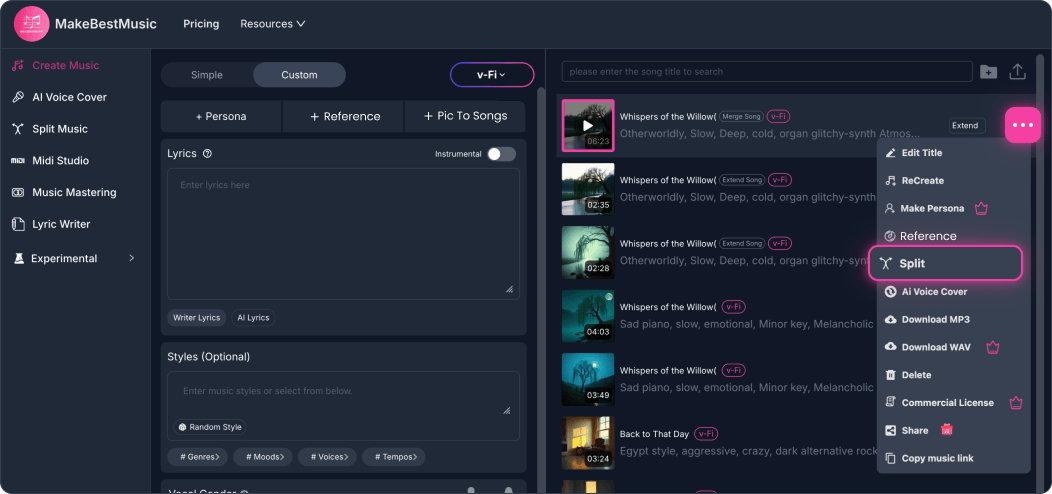
Isolating stems: Deconstructing multi-track arrangements via MakeBestMusic (Melox.ai) for surgical post-production.
The Iterative Producer Workflow: Beyond One-Click Generation
Rather than treating generative composition as an all-or-nothing lottery, forward-thinking producers operate an iterative loop inside a modern text to song workspace. When an initial render misses the mark, seasoned creators resist the urge to discard the entire prompt. Instead, they isolate a single variable—adjusting the drum velocity or swapping the vocal timbre—before initiating a second generation.
Crucially, not every musical flaw belongs in the prompt editor. When an arrangement is structurally captivating but requires surgical melodic fixes, starting over is counterproductive. Utilizing a audio splitter to execute ai music stem separation for indie producers allows artists to export clean vocals, basslines, and drums straight into third-party DAWs like Ableton Live or Logic Pro for bespoke mixing.
Furthermore, taking advantage of a browser based midi studio for ai tracks empowers musicians to manually nudge off-grid rhythmic transients, alter harmonic chord extensions, and sculpt vocal vibrato by hand. By bridging architectural prompt syntax with tactile post-production editing, this comprehensive ai music prompt guide proves that the future of sound belongs not to passive automated algorithms, but to deliberate sonic architects.