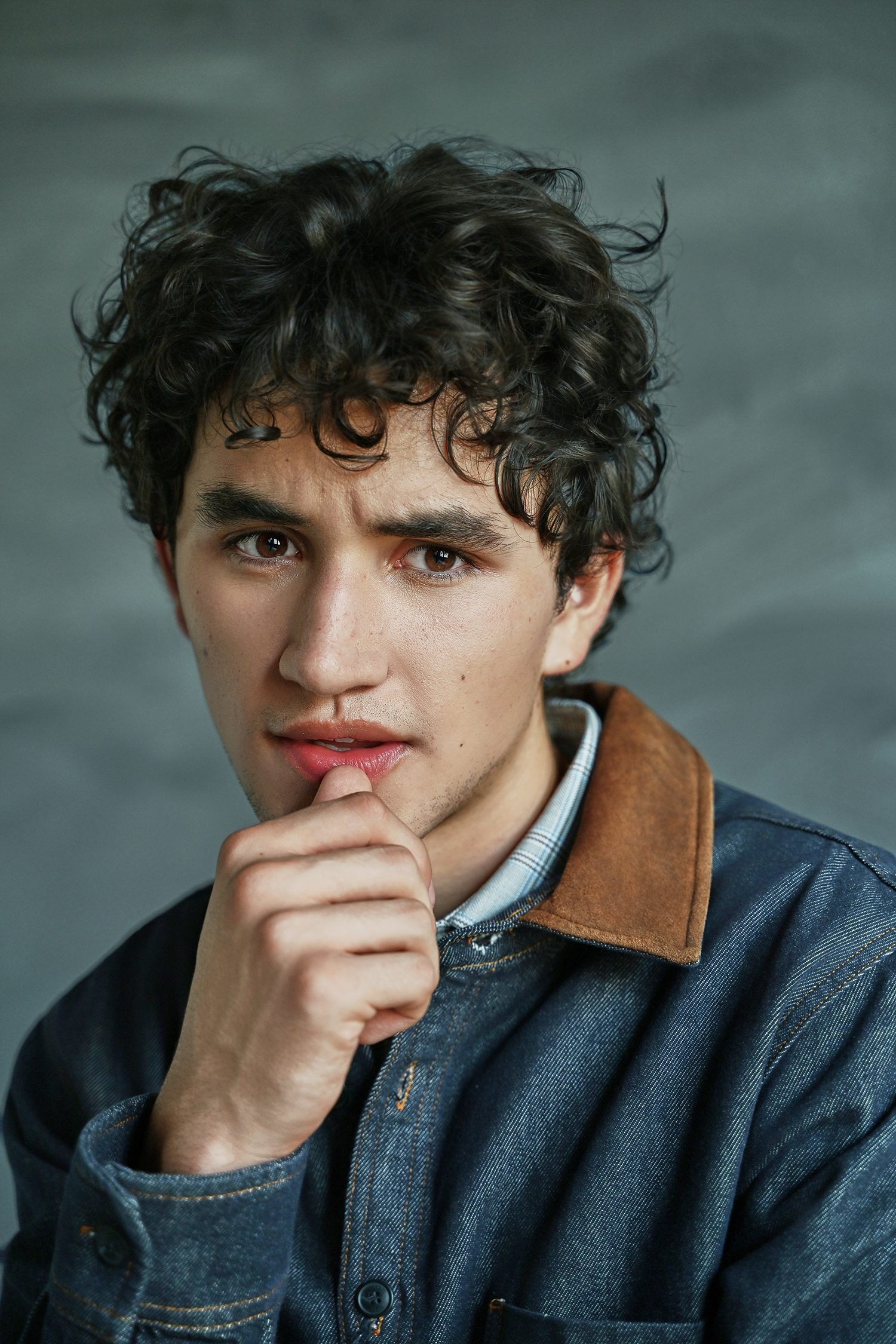
Gavin Goudey began training as an actor at 13, but even after booking his first commercial in 2023, he hesitated to describe himself that way. The confidence arrived later, after filming his first feature, James Gray’s Paper Tiger, while sitting at the first table read for Christian Durso’s play Skynight. Surrounded by the cast, something finally clicked: acting was no longer a distant ambition. It was his life.
The journey from that first commercial to the international film circuit happened remarkably quickly.
In Paper Tiger, Goudey plays Scott, the eldest son of Irwin and Hester Pearl, portrayed by Miles Teller and Scarlett Johansson. Set in 1986 Queens, the crime drama follows a family whose pursuit of the American Dream begins to collapse after Irwin and his brother Gary, played by Adam Driver, become entangled with the Russian mafia.
For Goudey, joining that family meant learning to trust stillness. Gray taught him that the camera could capture a character’s thoughts through their eyes, freeing him from the need to manufacture emotion. His job was to remain present, listen and allow Scott’s unease to surface naturally. The film premiered at Cannes in May 2026 before opening the New York Film Festival in September and arriving in US cinemas on November 13. Standing onstage at Lincoln Center beside Gray, Johansson, Teller, Driver and Roman Engel remains difficult for Goudey to put into words.
It is a considerable leap for an actor at the beginning of his career. Alongside Paper Tiger and Skynight, Goudey’s early credits include an appearance in CBS’s FBI, the independent feature The Good Dark and national campaigns for Honda, Toyota, Cheerios and Chegg. His work already stretches across film, television, theatre, voice-over and modelling.
Born and raised in Southern California, Goudey is of Latin American heritage and a member of the LGBTQ+ community. He understands what it means to grow up feeling that part of your identity should remain unspoken. That experience now shapes the stories he hopes to tell and his desire to create characters who feel complex, human and impossible to reduce to a label. He is still paddling towards the next wave.
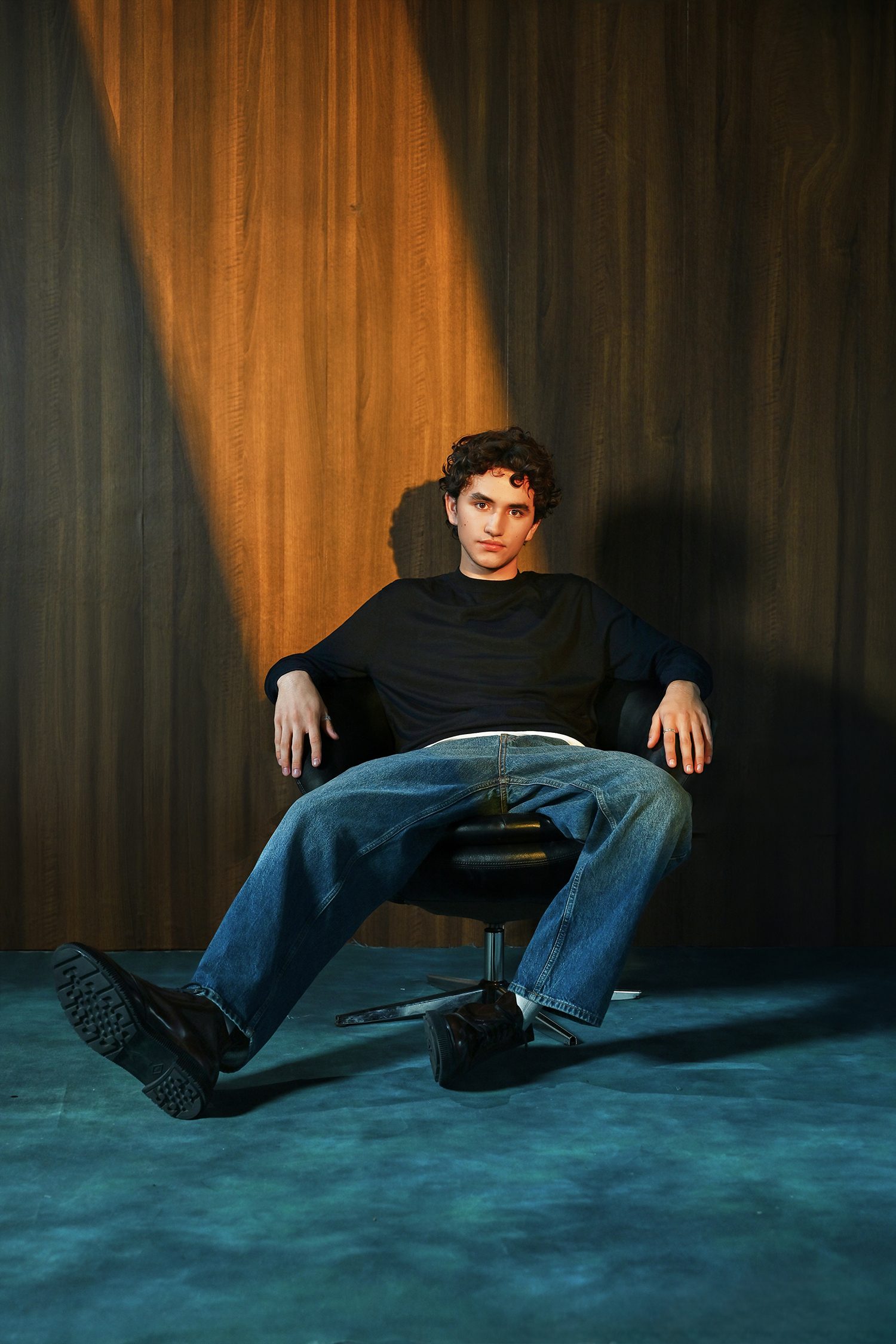
In 1883’s 18 Questions, Gavin Goudey discusses his rapid rise, entering James Gray’s world, what Scarlett Johansson and Miles Teller taught him, finding freedom in nature and the moment he realised acting was no longer simply a dream.
1. What’s the first thing you usually do when you wake up in the morning?
Usually, I feed my cats. Most mornings, they’re the ones waking me up anyway. Then I get started with my morning routine and get ready for the day.
2. Where do you feel most connected to yourself creatively?
I think anywhere I’m surrounded by like-minded individuals, other artists and creatives who share that same passion for what they do. Spaces where I feel free to explore, collaborate and just play.
Whether that’s on set, in class or working on an audition, those are the environments where I feel most connected to myself creatively and where the creativity really starts to flow.
3. What’s something people often misunderstand about you?
I think I’m actually quite different from how people initially perceive me. I think I can come across as a little introverted, maybe even shy, when you first meet me. But once I get comfortable with someone, I think I’m really quite the opposite.
I just need a little time to open up and let that side of myself come out.
4. Are you someone who likes to be in control, or do you work better when you embrace the unexpected?
I think I work better when I embrace the unexpected. I’m definitely more of a go-with-the-flow kind of person, and I don’t particularly love planning everything in advance.
Especially with acting, I think it’s important to remain open to whatever happens in the moment. Sometimes you can become so attached to what you’ve prepared that the work starts to feel almost mechanical or manufactured rather than truthful.
That’s not to say preparation isn’t important, because it absolutely is. But I think the key is preparing in a way that allows you to remain flexible and spontaneous when the time comes. So I try to stay loose, relaxed and present, ready for whatever comes my way.
5. What’s one film, television series or piece of theatre you’ve returned to throughout your life?
I think I’d have to say Hamnet, directed by Chloé Zhao. It’s a fairly recent film, but I’ve already seen it a handful of times, and every time I revisit it, I’m reminded of just how remarkable it is. And I bawl my eyes out every single time!
It’s one of those films that has really stayed with me. I find myself thinking about it at random moments throughout my day, particularly Jessie Buckley’s performance, which I think is just extraordinary. Ever since I first saw it, I haven’t been able to get it out of my system.
6. When do you feel most free?
Whenever I’m surrounded by nature. I’m a big believer in the power nature has to ground us and help us heal, and I always feel most free when I’m immersed in it.
There’s this practice called forest bathing, which is essentially about slowing down and connecting with nature through your senses. I think that’s very much what I’m describing.
For me, it can be something as simple as floating in the ocean and letting the waves move my body, or going on a hike and stopping for a moment to take in the scenery, listen to the birds and just breathe. Those are the moments when I feel most free.
7. If you could relive one moment from your career simply to experience it again, what would it be?
I’m still in the very early stages of my career, but I’ve already been incredibly fortunate to have some wonderful experiences, particularly working on Paper Tiger. It’s difficult to pinpoint just one moment because there have been so many throughout this whole journey.
But I think I’d choose standing onstage at Lincoln Center on the opening night of the New York Film Festival, alongside James, Scarlett, Adam, Miles and Roman. That was such an incredibly surreal moment for me.
It’s honestly difficult to put into words what I was feeling standing there with all of them, celebrating something we’d created together. I think I’d love to experience that feeling all over again.
8. What’s something you’ve learned about yourself over the last few years that genuinely surprised you?
This might sound a little silly, but I think it’s the realisation that I am an actor. For the longest time, whenever someone asked me what I did, I would feel a little strange telling them I was an actor.
At that point, I’d only done a handful of commercials, and although I was training, auditioning and dedicating so much of my life to the craft, there was still a part of me that wasn’t entirely convinced I could call myself one.
My teachers always instilled in me that even if you’re only acting in class, you’re still an actor. You’re doing the work. I understood that, but I think I needed to come to that realisation on my own.
I remember it finally clicking after I’d filmed Paper Tiger, while working on a play called Skynight, written by one of my teachers, Christian Durso. We were sitting at our first table read, surrounded by this incredible group of actors, and I remember looking around and suddenly thinking, “I’m an actor. This is my life now. This is what I do.”
I just felt so incredibly happy. It was a really fulfilling and reassuring moment, realising that something I’d spent years dreaming about had actually become my life.
9. You booked your first commercial in 2023 and, within a few years, found yourself appearing in a James Gray film alongside Scarlett Johansson, Miles Teller and Adam Driver. Has your mind caught up with how quickly your life has changed?
I don’t know if it has, really. It’s all happened fairly quickly, and if you’d told me two years ago that I’d be where I am today, I probably wouldn’t have believed you.
Paper Tiger has opened the door to so many wonderful opportunities, and I’ve met some incredible people along the way. It’s been incredibly fulfilling and rewarding, and in many ways, it’s been the gift that keeps on giving.
But there’s still so much work to do. If anything, I think there’s even more work to do now. I’ve certainly come to understand the significance of what’s happened, but I’m not entirely sure it’s all sunk in yet.
I think part of that is because this is my job. This is what I’ve been training for and working towards for years. I might not have expected these opportunities to come so soon, but they’re here, and I’m ready to keep putting in the work.
Someone once shared an analogy with me about how the entertainment industry is a lot like surfing. You paddle out, putting in all this work just to get yourself into position, and then you wait for the right wave. Some waves might come along, but they aren’t necessarily the right ones for you.
When the right one finally does come, you have to give everything you’ve got to catch it and ride it as far as you can. But once you reach the shore, you have to paddle back out and do it all over again, because ultimately, that’s what you love to do.
I really like that way of looking at it. I certainly don’t intend to stop paddling anytime soon.
10. In Paper Tiger, you play Scott, the eldest son of Irwin and Hester Pearl, who is approaching adulthood just as his family’s pursuit of the American Dream begins to unravel. What did you understand about Scott that may not be immediately apparent on the page?
I think Scott is a very intelligent and perceptive kid, perhaps more aware of what’s happening around him than his parents realise. He’s at that age where he’s beginning to establish his independence, preparing to leave for college and figure out who he is outside of his family.
But at the same time, he’s still dependent on them. He’s still their kid. As everything begins to unravel, he finds himself in this difficult position of knowing that something is deeply wrong, but not necessarily knowing what to do about it.
I think one of the most important parts of Scott’s journey is that he begins to see his parents for who they really are. Not these perfect, infallible figures he might have imagined growing up, but flawed human beings who are doing the best they can under incredibly difficult circumstances.
He begins to understand why they make the choices they do. Everything they do comes from a place of love, even when those choices aren’t necessarily the right ones. I think that’s something Scott comes to recognise as the story unfolds.
In a way, I think that realisation is part of him growing up. He’s learning to see his parents as people, and that understanding brings him closer to them. He develops a deeper appreciation for his family and realises just how much they mean to him.
11. The film is loosely inspired by James Gray’s own family and places a great deal of importance on the relationships inside the Pearl household. How did you build a believable family history with Miles Teller, Scarlett Johansson and Roman Engel?
I think a lot of that comes down to James’s writing and the incredible cast we had. We all meshed really well together, and there was something very intimate about the environment James created on set. It was truly a labour of love.
I think we fell into that family dynamic fairly naturally, not only because of the writing, but because of James’s direction as well. He gave us so much freedom and trust to explore these characters, make bold choices and just play. I think that openness allowed the relationships to develop in a really organic way.
Miles and Scarlett were also incredibly generous, both as actors and as people. They made it very clear that they were there for Roman and me, and that we could look to them as resources throughout the process. That kind of support was invaluable, especially with this being my first feature.
We really had such a wonderful group of people on that set. James described it as a “nauseatingly happy set,” which I think is the perfect way to put it.
12. James Gray is known for performances built around emotional restraint rather than obvious dramatic gestures. What did working with him teach you about how little an actor sometimes needs to do on camera?
Working with James taught me a tremendous amount. Whether I was watching him work, receiving direction from him or listening to him speak with the other actors, the entire experience was a masterclass.
One of the most valuable things he taught me was about the power of the camera. He explained that the camera is so powerful, it can capture your thoughts through your eyes. So all I have to do is think, and the camera’s got me.
I think that was the moment something really clicked for me about what film acting is and what it means to work with the camera. I realised that I don’t have to worry about manufacturing an emotion or getting in my head about whether what I’m doing is believable.
I can let go of all of that and simply be present, open, relaxed and listening. To live truthfully in the moment and have thoughts as the character. The camera will capture that.
It really is as simple as that, but I found it incredibly beautiful, and it’s something I’ll carry with me throughout the rest of my career.
13. You draw inspiration from transformative actors such as Joaquin Phoenix and Daniel Day-Lewis. How deeply did you immerse yourself in Scott’s world, and where do you draw the line between commitment to a character and losing yourself inside one?
I’m incredibly inspired by actors who can make me forget that I’m watching someone act. Their characters feel so completely alive that you stop seeing the performer altogether, and that’s something I aspire to achieve in my own work.
With Scott, I knew that Paper Tiger was a deeply personal story for James, drawing a great deal of inspiration from his childhood, and that Scott was inspired by his older brother. So I felt a responsibility to honour that.
But I also understood that James wasn’t interested in simply recreating his childhood. He wanted us to live as truthfully as possible within the circumstances of the story and bring our own interpretations to these characters.
I did quite a bit of research on the period. I made a point of listening almost exclusively to music released before 1986, and I spent time studying James’s filmography to better understand his storytelling and the worlds he creates.
I was also staying in Sheepshead Bay, Brooklyn, during production, which gave me an opportunity to experience the neighbourhoods and communities that were so integral to the world of the film.
As for where I draw the line, something my teachers have always instilled in me is that you can’t take the character home with you. When you’re on set, that’s your time to work, to immerse yourself in the character’s world and live truthfully within it. But at the end of the day, you have to return to your own life, ground yourself and be ready to do it all again the next day.
I think that’s a balance you have to nurture. Of course, I’m still very early in my career, so I haven’t necessarily encountered a role that has required an enormous transformation. Scott and I shared quite a few similarities, which made connecting with him feel very natural.
But as I continue exploring more demanding characters, I think that distinction between commitment to the work and maintaining a sense of self will become even more important.
14. Paper Tiger is set in Queens in 1986. Beyond the costumes and production design, what helped you understand how a teenager from that period would move, speak and imagine his future?
We had an incredible costume designer, Amy Roth, and production designer, Happy Massee, who did such a remarkable job bringing that world to life. Their work made it so easy to immerse ourselves in the period.
But something that was particularly helpful was James’s direction. He has this wonderful way of using stories to communicate an idea or a feeling he’s trying to capture. He’s always got a great story in his back pocket.
Because so much of the film is inspired by his own childhood, hearing about his experiences growing up during that time was invaluable in helping me understand Scott and the world he inhabited.
I also think there’s something universal about being a teenager, regardless of the decade. Of course, so much has changed culturally and socially, but those feelings of wanting independence, discovering who you are and imagining your future are things that young people have experienced across generations. I tried to find those similarities rather than focusing entirely on what made the period different.
Music was another big part of it. Scott is a huge music lover, and although we don’t see much of it in the film, his bedroom was impeccably designed. It was filled with records, cassettes, album posters and all these wonderful little details that told you so much about who he was.
I’m a huge lover of music myself, including music from that era, so that was something I could really connect with.
I think it was the combination of all those things—the world Amy and Happy created, James’s stories, the music and finding those universal experiences of being young—that helped me understand Scott as a teenager living in 1986.
15. The film received a ten-minute standing ovation at Cannes before opening the New York Film Festival. What was it like watching something you helped create receive that level of attention on the international stage?
It’s all been incredibly surreal, almost difficult to comprehend at times. This is my first feature film, so much of this has been completely new to me.
Making the film itself was already such an extraordinary experience, and I honestly had no idea what to expect afterwards or what the next steps would look like for a project of this calibre.
Learning that we’d be premiering at Cannes, then opening the New York Film Festival, and seeing the film travel around the world and connect with so many different audiences has been incredible to witness.
More than anything, it’s made me so happy for James. I think he deserves all the love and more. He’s an incredible human being, and he’s made something really special here.
Seeing the film receive that kind of recognition has been so rewarding. I’m just immensely grateful and honoured to have been a part of it.
16. Your work already spans film, television, theatre, voice-over and modelling. Does moving between those different disciplines make you a more instinctive performer, or does each one require you to rebuild your approach completely?
I think it absolutely makes me a more instinctive performer. I’m still in the very early stages of my career, and so much of what I’m doing, I’m experiencing for the first time.
Because of that, I’ve really had to learn to trust my instincts and rely on the training I’ve received from so many wonderful teachers and mentors.
When I first started auditioning and navigating this industry, everything felt so new and confusing. I don’t think it necessarily gets any easier, but you begin to understand how things work. You learn to adapt, trust yourself and become more comfortable embracing the unexpected.
Of course, each discipline requires its own unique set of skills. There are certainly similarities between them, but film, television, theatre, voice-over and modelling all present different creative challenges.
I think there’s something incredibly exciting about that, because each new experience gives me another opportunity to learn and grow. I try to remind myself that at the heart of all of it is art and expression.
Regardless of the medium, I think the most important thing is to remain present, open and truthful in whatever it is you’re creating.
17. As an actor of Latin American heritage and a member of the LGBTQ+ community, how important is it that the roles you pursue reflect the full complexity of who you are rather than placing you inside a convenient industry label?
It’s incredibly important to me. I want to have the opportunity to play characters who reflect the full spectrum of who I am, but I also want the freedom to explore characters whose lives and experiences are completely different from my own.
That’s one of the things I love most about acting. We get to step into the shoes of other human beings, understand their circumstances and experience the world through their eyes. At the heart of that is empathy.
But representation is something that means a great deal to me personally. Growing up, there was a part of myself that I was afraid to acknowledge or express because I felt it was something taboo, something I wasn’t supposed to talk about.
That’s such a difficult thing for a kid to experience, feeling as though something about who they are might be wrong. I understand how powerful it can be to see yourself reflected on screen, to recognise your own experiences in someone else’s story and realise that you’re not alone. I know what that would have meant to me growing up.
So if I can be part of telling stories that help another young person feel seen, understood or a little less afraid to be themselves, that would mean the world to me.
I think that’s why it’s so important that we continue creating space for authentic, multifaceted characters. Our identities are part of who we are, but they don’t define the entirety of our humanity.
I want to explore all of that complexity in my work, both in characters who share my experiences and in those who couldn’t be more different from me.
18. You have spoken about wanting the work to speak for itself. When audiences leave Paper Tiger, what do you hope they understand about you as an actor that they could not have known before?
I think, more than anything, I hope they’re intrigued. This is my first film, and for most audiences, it’ll be their introduction to me as an actor. So I hope that what they see makes them curious about what else I might have to offer.
But while they’re watching the film, I don’t necessarily want them to be thinking about me at all. I want them to see Scott as a real human being, someone who’s living and experiencing these circumstances, rather than an actor performing them.
That’s what I mean when I say I want the work to speak for itself. I know that I gave everything I could to this role at that point in my life, and I’ve already grown and learned so much since then.
I’m still at the very beginning of my career, and there’s so much more I want to explore and discover about what I’m capable of.
So I guess I hope audiences walk away feeling that there’s someone new on the scene, someone they’re excited to see more of. Because I’m here, I’m ready to keep working, and I don’t plan on going anywhere anytime soon.
Follow via @thegavingoudey