Singer-Songwriter NISHIOKA Connecting Family History and War Memory
His grandfather served aboard the Japanese aircraft carrier Zuikaku.
The memories of war that were never spoken eventually found another form—music.
Japanese singer-songwriter NISHIOKA creates music that connects family history with the broader history of war, carrying the theme of memory and inheritance to listeners around the world.
As 2026 marks the 80th anniversary of the end of World War II, the number of people who can share firsthand experiences of the war continues to decline.
Across the world, a growing question emerges: How should memory be passed on to future generations?
For NISHIOKA, this question lies at the center of his artistic work.
Based in Osaka, Japan, he is one of the rare artists who approaches the theme of historical memory through music.
At the heart of his story is his own family history.
His grandfather, Minoru Nishioka, served in the Imperial Japanese Navy aboard the aircraft carrier Zuikaku during the Pacific War.
Yet his grandfather rarely spoke about the war.
From that silence came a question that would shape NISHIOKA’s creative path:
How can unspoken memories be carried forward?
That question gave birth to the requiem song “Unbreakable Bond.”
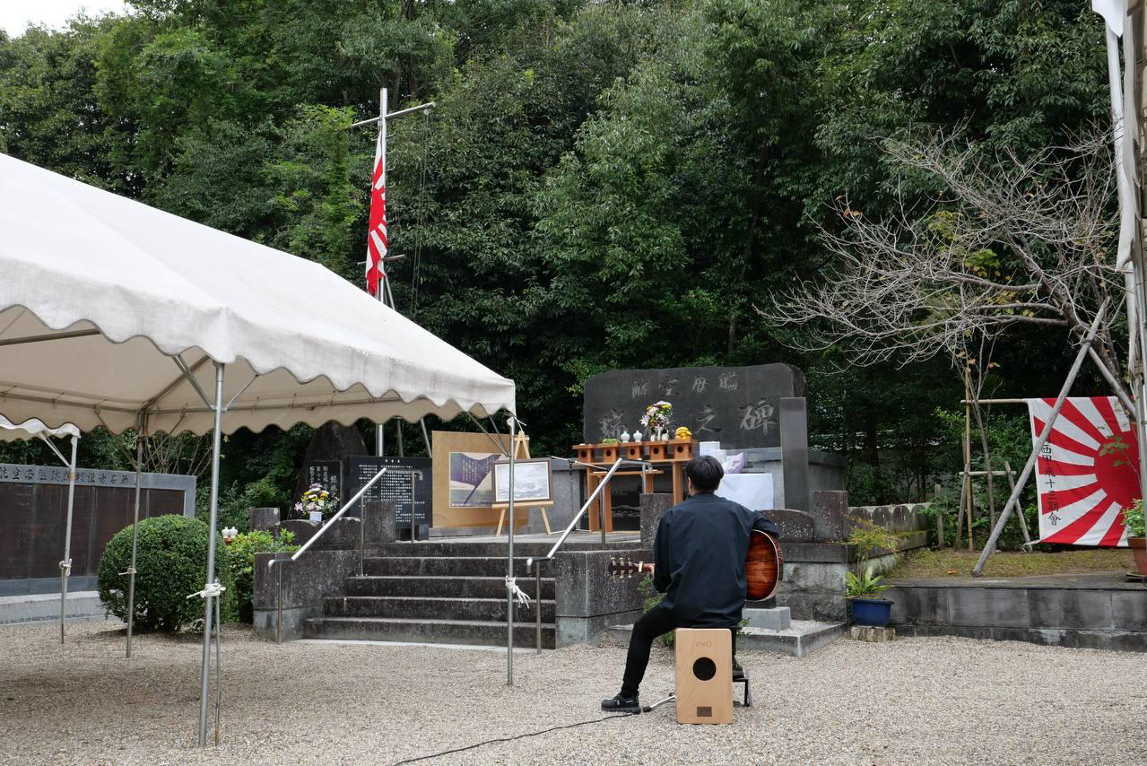
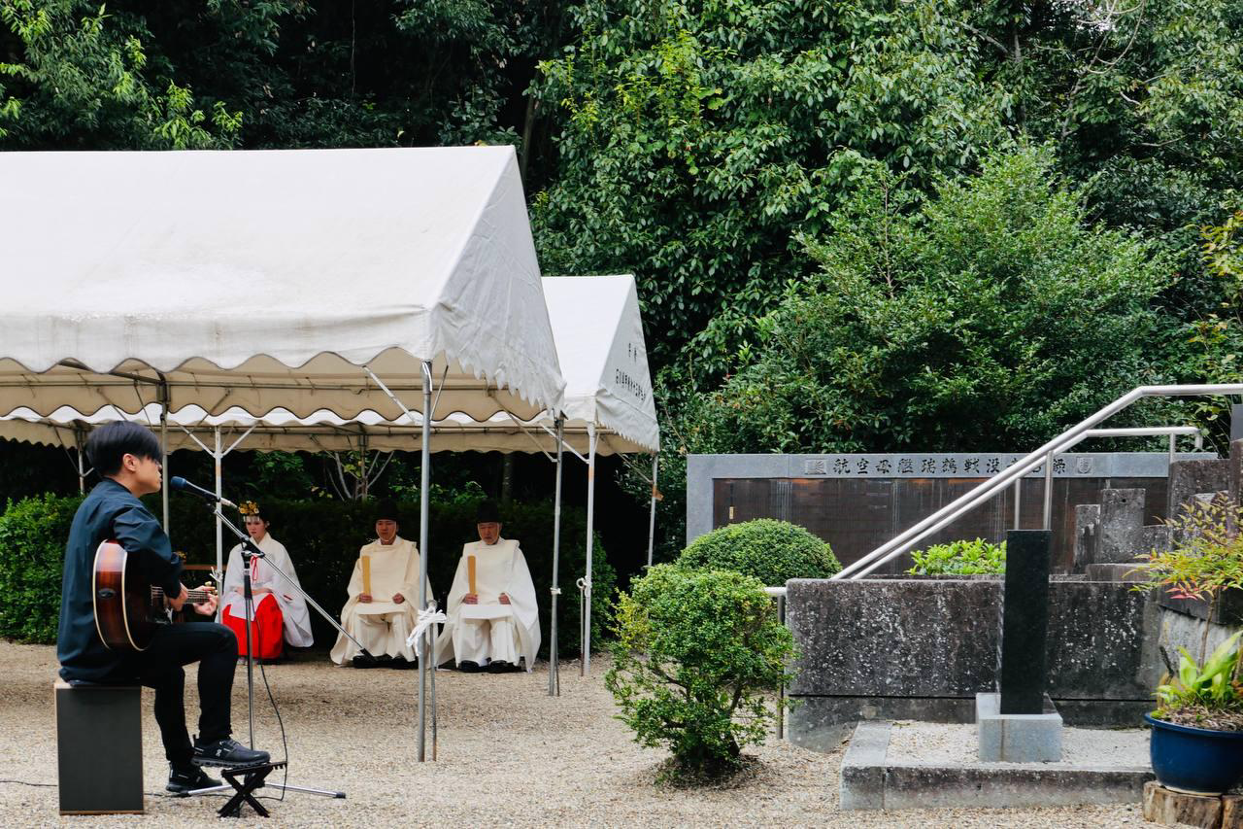
Photo: suzumaru — NISHIOKA performing “Unbreakable Bond”
Zuikaku Memorial Ceremony, Kashihara Shrine, October 25, 2025
Every year on October 25, at the Zuikaku Memorial Ceremony held at Kashihara Shrine in Nara, NISHIOKA performs the song live.
It is more than a musical performance.
It is an act of remembrance—
a moment where fading memories are transformed into prayer through music.
NISHIOKA explains his philosophy simply:
“If memories are not passed on, they disappear.
That’s why I turned them into music.
Memory turns into prayer.”
This idea has become the foundation of his artistic work.
From Nishinari to the World
NISHIOKA is a singer-songwriter from Osaka.
He independently handles songwriting, arrangement, performance, recording, and production, building his career as a fully self-produced artist.
His story begins in Nishinari, a neighborhood in Osaka.
From the beginning, however, his ambition was clear.
“From Nishinari to the world.”
Without the support of a major label or large advertising campaigns, NISHIOKA began sending his music directly to overseas radio stations and media outlets.
The turning point came in 2023 with the release of his album “ISHIKORO.”
Songs from the album—including “TORIKAGO” and “Kodoku no Hana”—reached No.1 on the iTunes UK J-POP Chart, marking an important milestone for a Japanese-language artist in international markets.
Two years later, another breakthrough arrived.
In 2025, NISHIOKA released the single “HANAZONO.”
The song achieved remarkable success in international charts.
Major achievements include:
• No.1 on the iTunes US Folk Chart
• No.1 on the iTunes UK Folk Chart
• No.3 on the iTunes US Singer-Songwriter Chart
• No.5 on the iTunes UK Singer-Songwriter Chart
• No.26 on the Spotify UK Top 50 — the first Japanese artist to reach this ranking
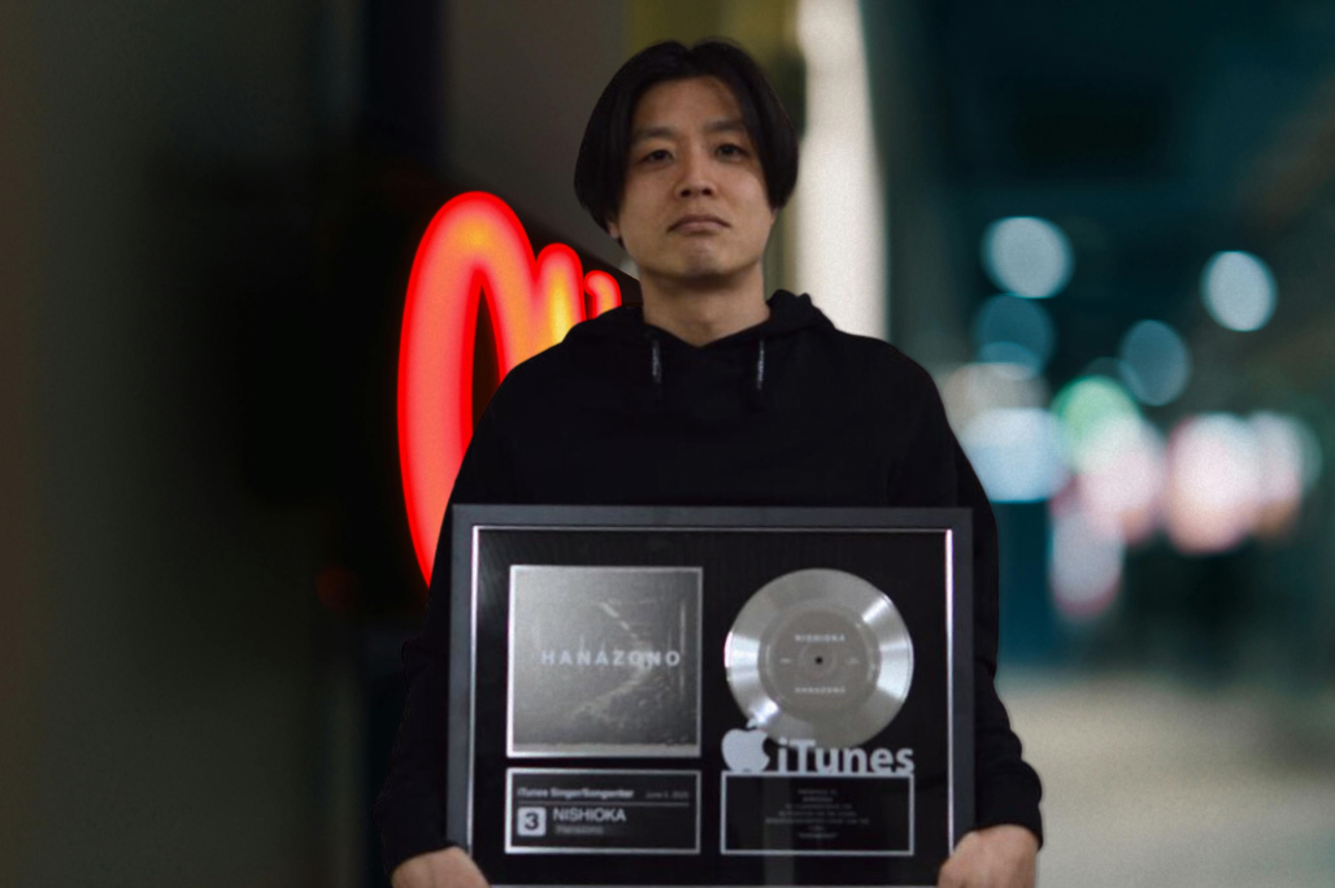
Photo: NISHIOKA holding the plaque celebrating the international chart success of “HANAZONO”.
The single charted in both the United States and the United Kingdom.
The United States and the United Kingdom are widely known as two of the most competitive music markets in the world.
For a Japanese-language song to achieve chart success in both countries is extremely rare.
Yet NISHIOKA continued creating music with a clear vision.
His songs revolve around themes that transcend borders:
family
loneliness
life itself
Stories that belong not only to Japan—but to humanity.
Gradually, his music began reaching listeners beyond his home country.
What started as a personal artistic journey eventually appeared on American and British music charts, turning his story into something larger.
Today, NISHIOKA’s path represents more than the rise of an independent artist.
It shows how personal memory can resonate globally through music.
“From Nishinari to the world.”
What once sounded like an ambitious slogan has already become reality.
The Book “Unbreakable Bond”
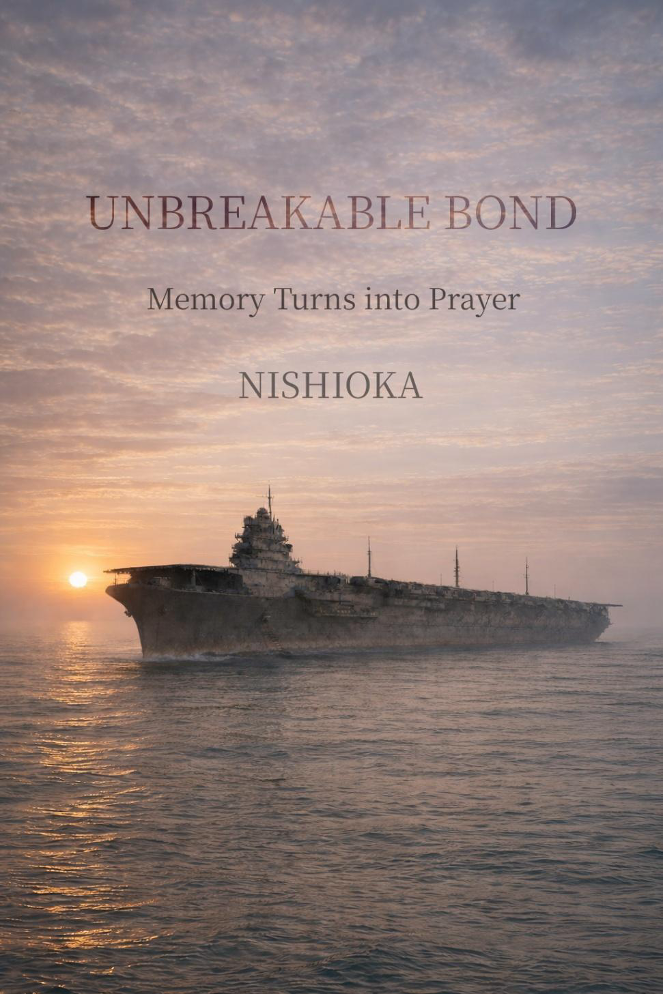
In addition to music, NISHIOKA has also begun expressing his ideas through writing.
His book “Unbreakable Bond” explores
the wartime story of his grandfather,
the history of his family,
and the meaning of passing memory to the next generation.
Rather than functioning as a historical record alone, the book asks deeper questions:
Where does the past go?
How do people carry memory forward?
Through personal narrative, NISHIOKA connects family history with broader historical memory.
Interview
Q: What role do you believe artists should play as the world reaches the 80th anniversary of the end of World War II?
I think historians are responsible for explaining history.
My role is different.
My role is to make sure people do not forget.
As the generation that experienced the war disappears, music can carry memory to the next generation.
That’s why I chose to turn these stories into songs.
Q: Why did the theme of “inheritance” become central to your work?
My grandfather served on the aircraft carrier Zuikaku.
But he rarely spoke about the war.
For many years I wondered what that silence meant.
Eventually I realized that my role was to transform those unspoken memories into music.
Q: Your recent song “Minori” reached No.1 on the iTunes UK J-POP Chart. Is that song also connected to the theme of memory?
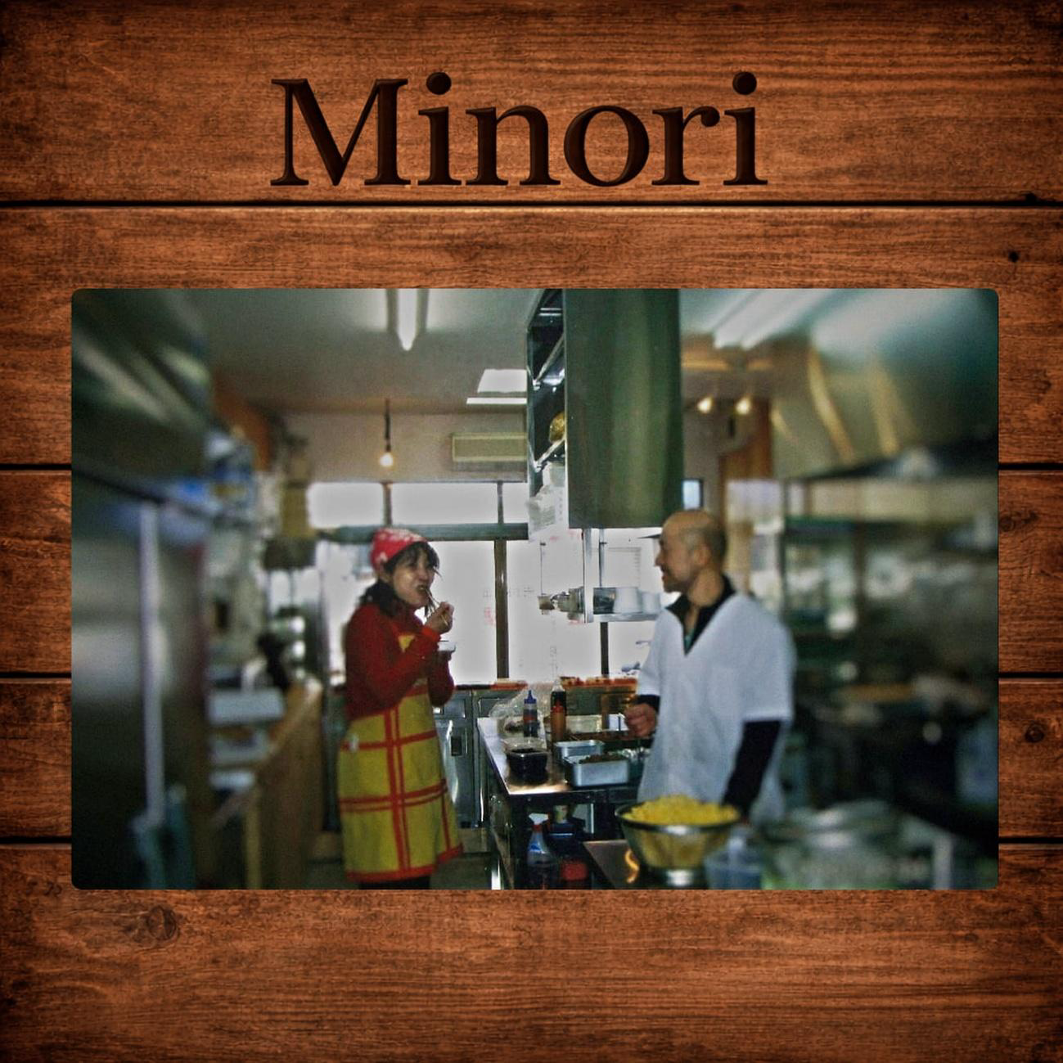
NISHIOKA’s parents working at their family shop “Minori,” which inspired the song.
Yes.
“Minori” tells the story of my parents.
After the war, my grandparents opened a small rice-ball shop called Minori in 1958.
My parents spent their lives running that shop.
My mother passed away on June 30, 2025, and the song was written as a tribute to her life.
Family stories may seem ordinary.
But at the same time, they are incredibly precious.
So for me, “Minori” is also a form of memory inheritance.
Q: How do international listeners respond to your music?
Stronger than I expected.
Many listeners from overseas have connected with songs like
“ISHIKORO,” “TORIKAGO,” “HANAZONO,” “PISCES,” and “Minori.”
Even though the lyrics are in Japanese, the themes are universal.
Everyone has family.
Everyone has memories.
Everyone has a story.
Because of that, I believe people are not listening to my music as “Japanese music.”
They are listening to it as a human story.
And on August 15, 2026, the anniversary of the end of World War II, I will release “Unbreakable Bond.”
That song will explore these themes even more deeply.
When Memory Becomes Prayer
NISHIOKA’s work is not simply about remembering the past.
It is about transforming memory into something that can be shared across generations.
By connecting family history with world history, his music raises a universal question:
Where do we come from,
and where do our memories go?
NISHIOKA’s answer is simple.
Memory turns into prayer.
And through music and words, that prayer continues to spread quietly across the world.
Listen & Follow NISHIOKA
Spotify
Apple Music
YouTube
Official Website