There are periods in intellectual history when ideas become most refined just as the conditions that gave rise to them begin to disappear. The result is a kind of philosophical afterglow—lucid, intricate, and faintly detached from the urgency that once animated it. For Jiahao Shen, an independent history researcher specializes in early medieval Chinese intellectual thought, the Wei-Jin period of China offers a particularly striking instance of this phenomenon.
Shen, who was born and raised in Shanghai and educated in the United States, is currently pursuing postgraduate studies in World History and Philosophy at King’s College London. His work moves between intellectual history and philosophical reflection, tracing how systems of thought are shaped by the social orders that sustain them. In his reading of Wei-Jin metaphysical Confucianism, philosophy does not simply evolve through abstract debate; it is inseparable from the structures of power that give it form—and, eventually, limit it.
The argument he advances is deceptively simple. The tradition reached its highest degree of intellectual sophistication at precisely the moment it lost something essential: the independence of the human mind.
To understand this, Shen begins not with texts but with a social transformation.
The collapse of the Han dynasty did not leave a vacuum so much as it rearranged authority. Over time, powerful families consolidated land, influence, and administrative control, forming an aristocratic order that would dominate Chinese society for centuries. This elite was not merely political. It was cultural, even aesthetic. Education, literary accomplishment, and philosophical refinement became markers of legitimacy, as important as rank or wealth.
Confucianism, long the ethical language of governance, adapted to this new reality. Its vocabulary of virtue and moral cultivation proved well suited to an aristocratic class that needed to justify its authority in more than purely coercive terms. Gradually, morality and power converged. To participate in the political order was to inhabit an ethical one.
It is difficult, from a distance, not to admire the elegance of this arrangement. Yet it contained a tension that would become increasingly difficult to ignore. When institutions begin to define morality, philosophy risks losing its ability to stand apart from them. What once questioned authority becomes the medium through which authority speaks.
The Wei-Jin period is often remembered for its intellectual brilliance, and not without reason. Thinkers engaged in intricate debates about the nature of reality—being and non-being, spontaneity and order, the relationship between the human and the cosmic. These discussions drew freely from both Confucian and Daoist traditions, producing a body of thought that was at once speculative and refined.
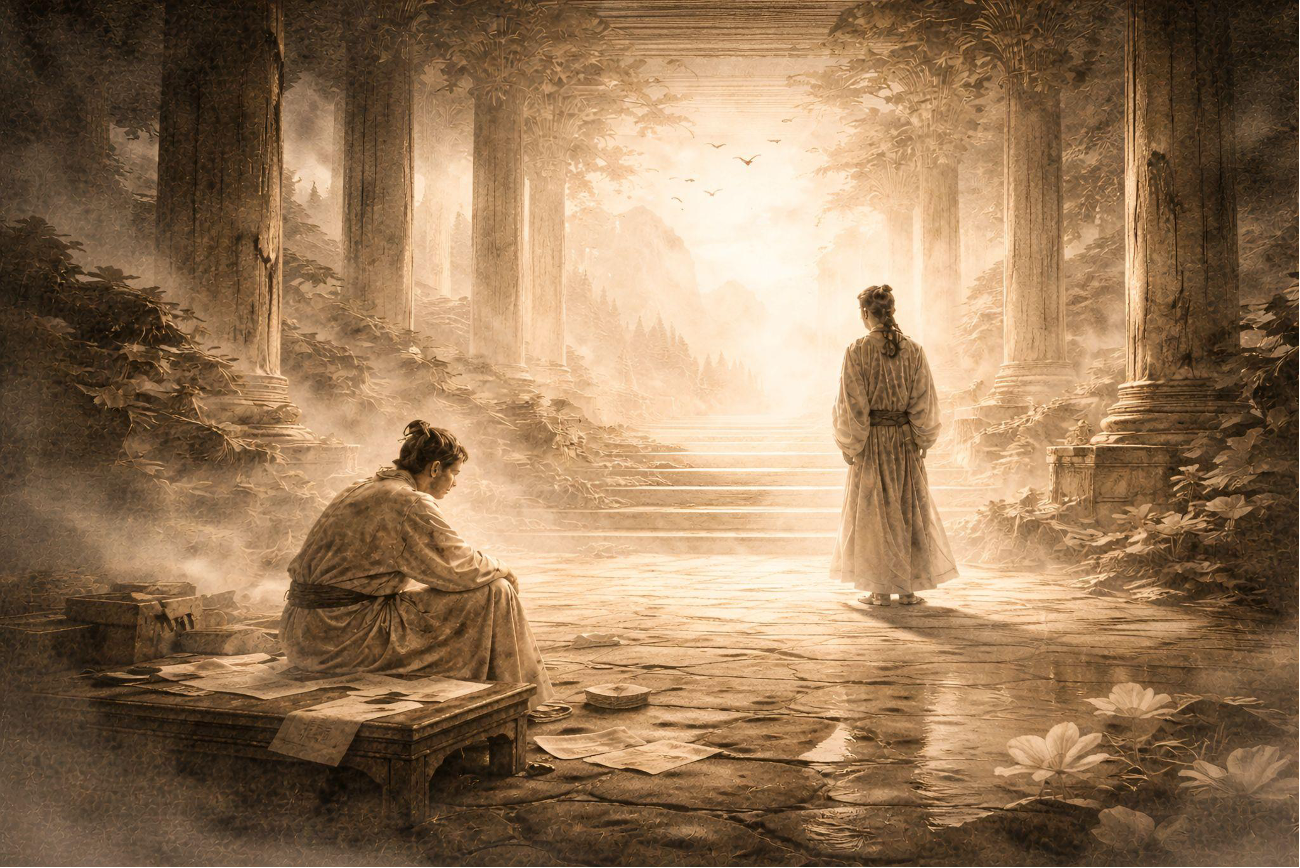
One imagines gatherings of scholars in bamboo groves or private estates, where philosophy was as much a mode of living as a form of argument. Conversation flowed into poetry, poetry into music, and music into reflection. The image, preserved in later cultural memory, is one of cultivated detachment.
Yet Shen is less interested in the elegance of this world than in its limits.
For many participants, the integration of philosophy into aristocratic life posed no problem. Intellectual prestige and political office were intertwined. To think well was, in some sense, to govern well. The system appeared coherent.
But coherence, Shen suggests, can come at the cost of independence.
It is here that two figures emerge with particular clarity: Ruan Ji and Ji Kang, later counted among the Seven Sages of the Bamboo Grove. Their lives unfolded during a period of political consolidation under the Sima family, whose rise would culminate in the founding of the Jin dynasty. Where others adapted, they hesitated—or withdrew.
Ruan Ji’s writings convey a mind unable to reconcile itself with the world it inhabits. His poetry moves restlessly between longing and disillusionment, as if searching for a moral order that no longer exists. Ji Kang, more direct in his defiance, argued that the natural order stands beyond the moral frameworks imposed by political authority. His refusal to accommodate the demands of power led, eventually, to his execution.
Their resistance was not programmatic. They did not propose an alternative political system, nor did they seek to mobilize others. What they articulated, instead, was a shift in the locus of freedom.
If the external world has become ethically compromised—if its institutions claim moral authority while rendering genuine judgment impossible—then freedom can no longer be located there. It retreats inward.
Shen describes this as the emergence of an “inner world,” a space in which sincerity and independence can still be preserved. It is not a retreat in the sense of withdrawal from reality but a recognition that the terms of engagement have changed. When morality is absorbed into power, outward conformity becomes indistinguishable from virtue. Under such conditions, integrity survives only as a property of consciousness.
There is, in this position, a certain severity. Shen characterizes it as a “painful mind”—a form of awareness that sees the contradictions of its time with clarity yet finds no effective means of resolving them. It is neither resignation nor rebellion, but something more precarious: a sustained effort to remain internally intact.
What makes this moment historically significant, in Shen’s view, is that it did not last.
The philosophical tradition continued to develop. Later thinkers refined metaphysical concepts, producing systems of impressive coherence. From a purely intellectual standpoint, Wei-Jin metaphysical Confucianism matured. Its arguments became more precise, its frameworks more stable.
But the conditions that had made the earlier moment possible—its tension, its instability, its refusal to reconcile thought with power—gradually disappeared. As the aristocratic order solidified, philosophy became more fully integrated into elite culture. Its critical edge softened. The inner independence that had defined figures like Ruan Ji and Ji Kang proved difficult to sustain within a stable system.
The paradox is difficult to avoid. The tradition flourished most visibly when its deepest impulse was already receding.
Shen’s account, though grounded in a specific historical period, gestures toward a broader question. Modern societies, too, rely on complex institutions that claim ethical legitimacy. They organize not only political and economic life but also the language through which morality is articulated. In such environments, the distinction between power and virtue can become blurred, even invisible.
What, then, becomes of independence?
The example of the Wei-Jin thinkers does not offer a solution so much as a diagnosis. When external structures absorb morality, the space for dissent does not disappear, but it changes form. It becomes quieter, more interior, less visible—and, perhaps, more fragile.
One is left with the image of the philosopher not as a public critic or a system-builder but as a custodian of something easily lost: the ability to think without permission.
For Shen, the significance of the Wei-Jin period lies not only in what it achieved but in what it could not preserve. Its most enduring lesson may be that intellectual traditions do not merely rise and fall. They also narrow, sometimes imperceptibly, as the worlds that sustain them become more complete.
And in that narrowing, freedom—if it survives at all—does so in the most private of places.