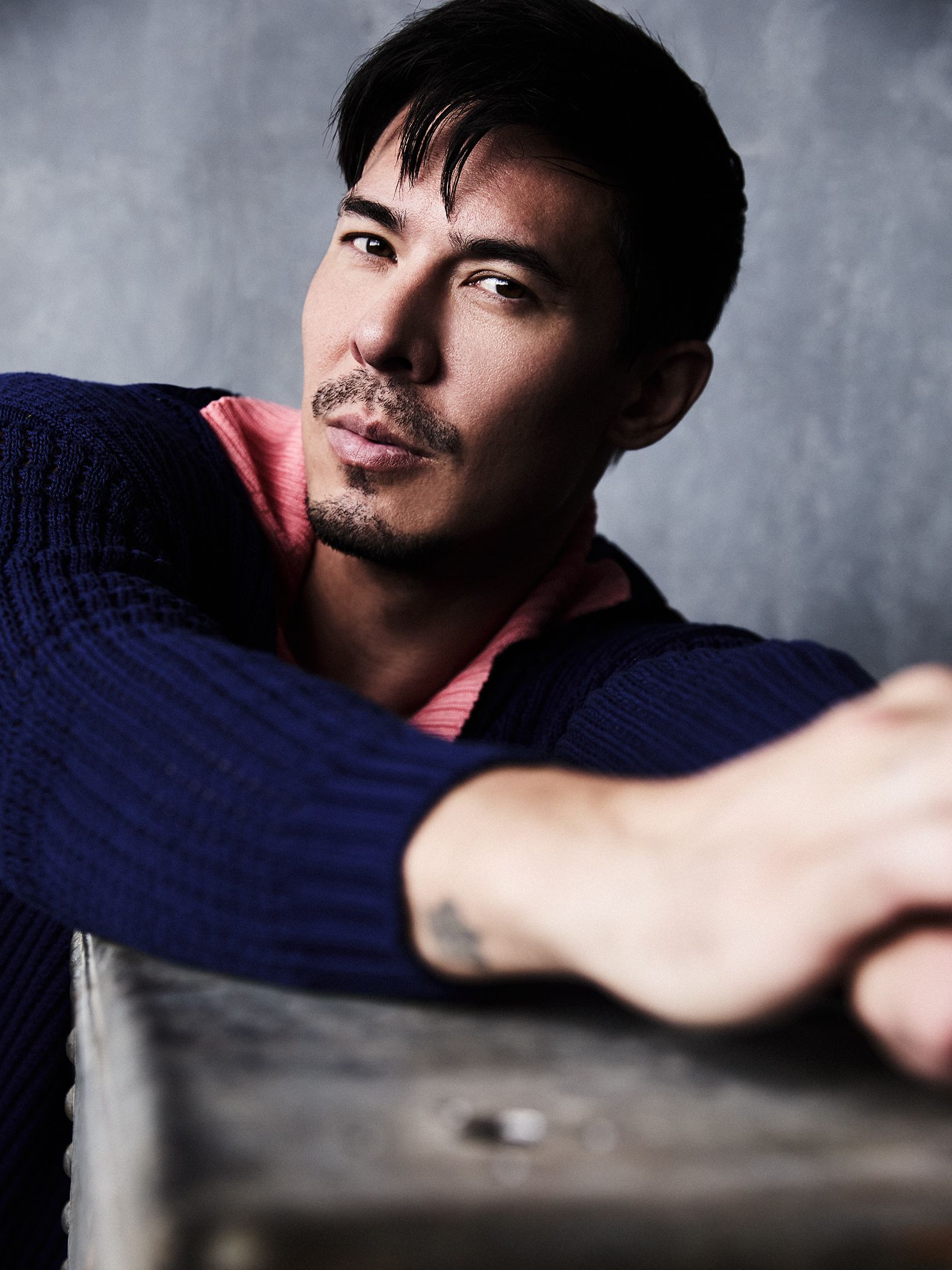

Will Antenbring signs off our call and heads to the pub to watch Arsenal. Spoiler: it was a good night. It’s a fitting end to a conversation about football, identity, and what it means to be English, because for Antenbring, right now, those things are hard to separate. With Dear England about to air and the World Cup on the horizon, it’s shaping up to be quite a summer for him, on and off the screen.
The 25-year-old actor is about to have quite a few weeks. On 24 May, BBC One airs Dear England – the long-awaited four-part television adaptation of James Graham’s Olivier Award-winning play about Gareth Southgate and the England men’s football team. Antenbring plays Harry Kane, England’s captain and one of the most recognisable men in the country. It’s a role that would make most actors nervous but Antenbring seems, characteristically, to be taking it in his stride.


The story of how Will Antenbring ended up here starts, as many good stories do, with a seven-year-old and a clipboard.
“I did a nativity play when I was seven years old, where I played an Ofsted inspector who was inspecting a school that was doing a nativity play,” he says, laughing. “Which was very meta. I would just be holding a clipboard at the back of the stage and nodding whenever something happened. I said to my parents straight after: I’m going to do that. And I didn’t know what ‘that’ was.”
With parents nowhere near the acting industry, Antenbring built his knowledge from scratch. “I just slowly built up more information about what I needed to do and how the hell you’re supposed to get into this type of career.” Eventually that path led him to the National Youth Theatre and then Italia Conti drama school in London, from which he graduated in 2022.
He speaks warmly about his time there, but not in the way you might expect. The biggest thing he took away wasn’t technique, contacts, or a showreel. It was something harder to teach. “The biggest thing I got from drama school was confidence,” he says. “There was this big family feeling to it. I was always a very pessimistic kid, I think a lot of English people are. But by the end of three years, I was like: I can do this. Which is not something I ever said when I was a kid.”
It’s a thread that runs through Dear England itself; the idea of a nation that has historically been better at tearing itself down than believing in itself. Antenbring is aware of the parallel. “We’re an extremely pessimistic nation, which I’m almost patriotic about. But the way that we tear each other down is a huge part of being an English person. Drama school was where I learned to just shove all that behind me.” He’s quick to acknowledge that the pessimism never fully disappears. “It always is there, for sure. But I think you have to have a healthy amount of it. It just taught me to put it aside and know that I had the ability and the toolset to do what I wanted to do.”


Full Look Dolce & Gabbana
Since graduating, Antenbring has moved at a pace that would be the envy of most drama school cohorts. Short films The Bridges We Cross and Sugar Babies earned awards on the festival circuit. His professional stage debut, playing the lead in Chichester Festival Theatre’s Coram Boy, transferred to The Lowry in Salford. And his television debut came alongside Lennie James in the acclaimed BBC One series Mr Loverman in 2024, where he played Tim across three episodes. Now, less than four years out of drama school, he’s playing one of the most famous men in England on primetime BBC One – a remarkable few years by anyone’s standards.
When the subject turns to Dear England and the small matter of playing England’s captain, Antenbring is thoughtful and careful. Kane is not just famous – he is, as Antenbring puts it, “an icon of this country. Even for people who don’t know football, they know the name Harry Kane.”
The challenge, then, was how to honour that without sliding into impression or caricature. “I knew I needed to base my performance on reality as much as possible. On TV, you can’t lean into stereotypes or impressions, it just doesn’t land and people don’t believe you. But I also knew I needed to veer away from the scrutiny that he already gets. I just wanted to be as close to him as possible, and never veer into making fun, or into what is already part of the media landscape when it comes to Harry Kane.”
He pauses. “He’s just such a gentleman. Such a great person. To try and do him justice was all I wanted to do.”
Did he get to meet Kane as part of his preparation? “No, I’d really, really love to. I’m a huge fan. Hopefully it’s on the horizon. And look, if I can have any part in his successes, or if I can even try to claim that in the World Cup…” He laughs. “But I can’t wait to see him do incredible things for our country.”


Dear England is not a straight biopic. It’s a fictionalised, psychologically driven account – a “state of the nation piece,” as Antenbring describes it, and that distinction matters to him as a performer.
“You worry that maybe you’re not being completely truthful to that person,” he admits. “But with this fictionalised lens, there is leeway in your performance. You don’t have to worry as much about being completely true to that person, because at the end of the day, you’re serving the themes of the show rather than trying to create a straight biopic. It’s a diagnosis of our culture and how we deal with loss.”
The collective nature of the project also took some of the individual pressure off. “You’re trying to work towards a collective goal as an ensemble, rather than focusing on yourself. It’s all a collective goal.”
[Photo]
At the centre of Dear England is Joseph Fiennes as Gareth Southgate, reprising the role he played on stage to Olivier-nominated acclaim. For Antenbring and the other young actors playing the England squad, working alongside him was its own education.
“Watching Joe every day was always a pleasure,” he says. “It wasn’t so much a formal mentorship, but as an actor, you watch someone else on set and you learn so much.” He recalls a moment in the early days of filming. “He had a speech, and we were all watching him. By the end of it, a bunch of people came up to him and just thanked him, just for being there, for being able to watch him work. He improvises, he reaches for something new every time. He’s so free on set.”
Antenbring sees a natural parallel between that dynamic and the Southgate-Kane relationship on screen. “That mentorship that Joe has is similar to Southgate in a way. That quality of someone who brings the people around them up just by being themselves.”


At its heart, Dear England is a show about men; about what happens when they’re given permission to be vulnerable, to talk to each other, to need each other. It’s a theme Antenbring found resonating beyond the script.
“The cast really exemplified it,” he says. “We were such a solid crew. There was a real sense of camaraderie. We did two weeks of boot camp before we started filming, so we had this bonding before we were even on camera.”
He reflects on what that showed him. “The idea of men being physical with each other and being able to talk about the things going on in their lives is still very important. As a country, especially as men, we aren’t behind each other. We tear each other down whenever we can. I hope this acts as some sort of example of how men should be.”
Our conversation is briefly interrupted when my cat appears at the window, demanding to be let in. Antenbring is delighted. “What’s her name?” Vera, I tell him – short for Persevera, she’s a rescue. He approves immediately. We briefly digress into a shared appreciation for giving pets old-fashioned names. He likes the idea of an Albert or a Herbert, before getting back to the matter at hand.
It’s a warm and real moment that reflects the tone of the whole conversation. Antenbring is clearly a reader (he speaks with genuine enthusiasm about John Williams’Stoner, and about working his way through classics alongside more contemporary fare). He talks about the cinema with real passion (he tries to attend the BFI London Film Festival every year) and about films as life-changing experiences.
“I remember being a kid going to the cinema, and even now, you come out and you feel like that’s your personality for the next week,” he says. “Certain moments in TV and film just alter your brain chemistry. You come out feeling like a new person, with a new lease on life. I want to be a part of moments that make that happen.”
As for dream roles: he mentions the pull of fast-talking boardroom drama in the vein of Succession or Industry, and admits he once harboured ambitions to play David Bowie, before pragmatically concluding he might be too tall. Who would he most want to share a screen with? “Joaquin Phoenix. Anthony Hopkins. Judi Dench. And I’ve always said I want to be in a shot that Roger Deakins has composed by the time I’m done. That was always the biggest thing for me.”


For those just beginning where he was a few years ago, Antenbring’s advice is simple. “The biggest thing is just sticking with it and having belief in yourself. For the most part, you’re the only person who can do that for you. You have to believe that at some point it could work.” He pauses. “And you have to enjoy your life as a whole. Your life can’t just be this endless pursuit. You have to live before you can do anything as an actor.”
His brother is currently somewhere between Thailand and South America, and Antenbring is thinking about when he can go and join him. “You can only really act out what you know deep inside. You can empathise to a certain point. But it’s really the living that makes you understand. And I’ve got a lot more to do.”
Dear England begins on BBC One and BBC iPlayer on 24 May. The first two episodes are available to stream from 9pm, with episodes three and four following on 31 May.
Word by Ama Samra
Photographer Garry Jones
Stylist Andrew Burling
Grooming Daisy Holubowicz
Photography Assistant Sienna Lorraine Gray
Top image credit – Full look Louis Vuitton