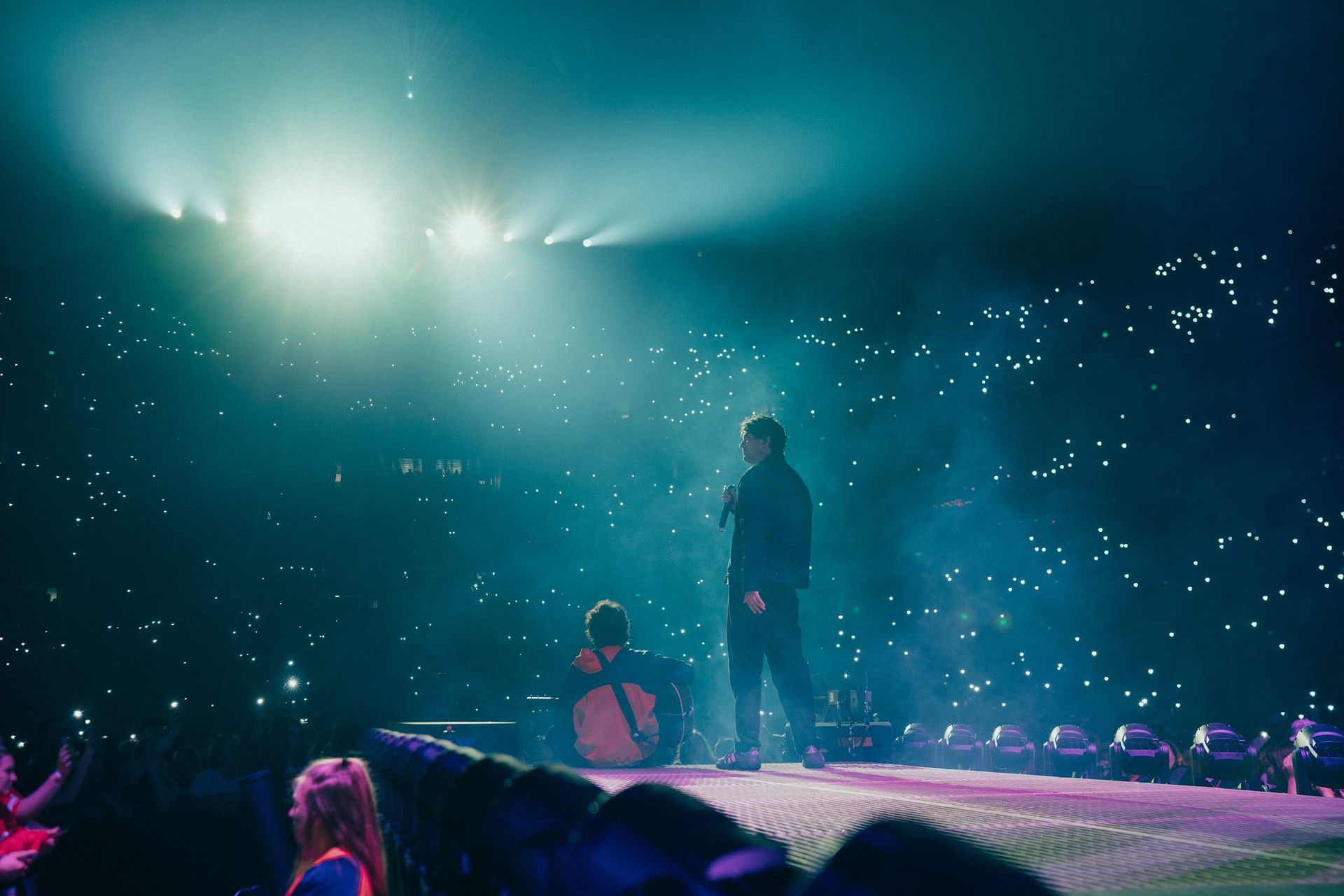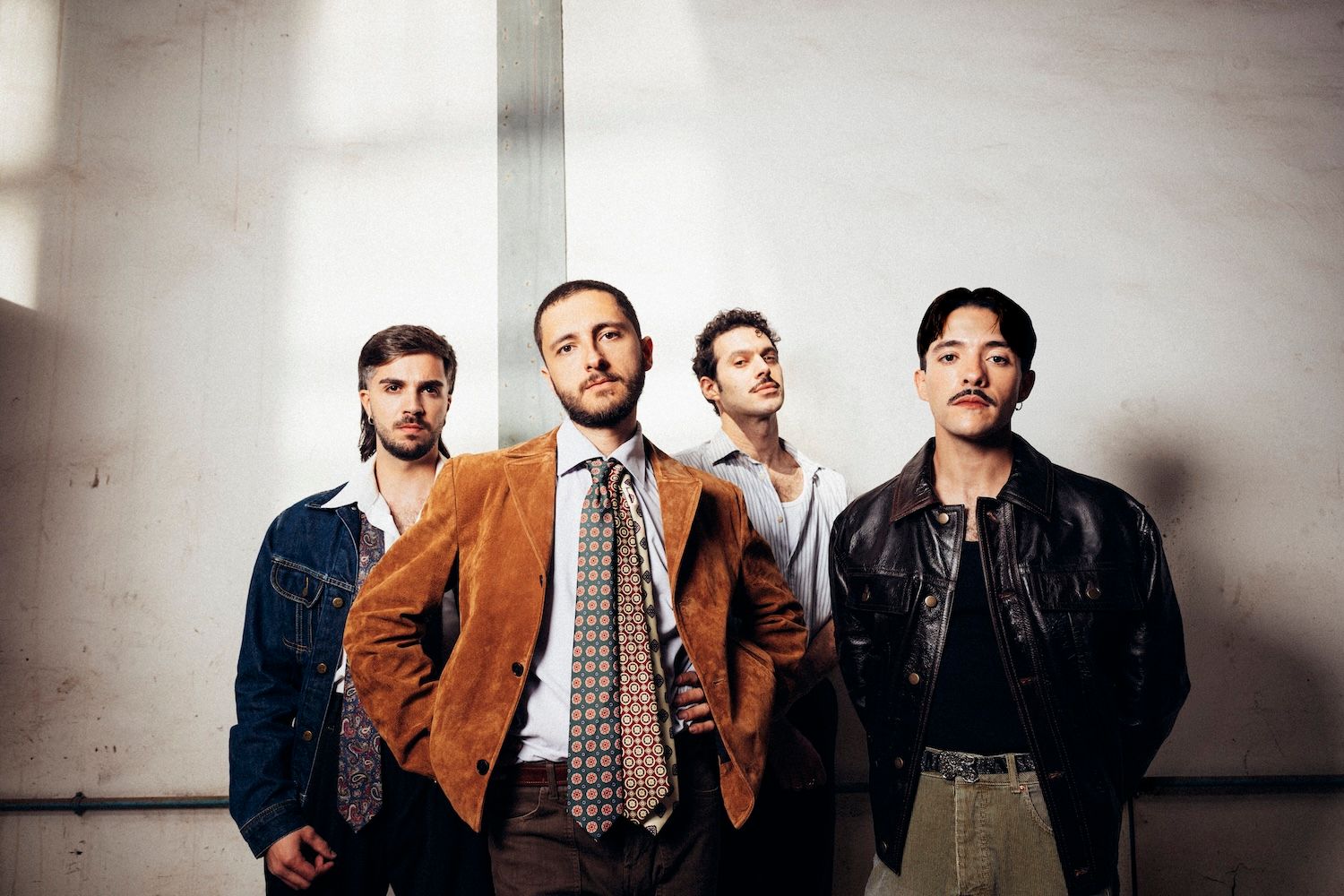
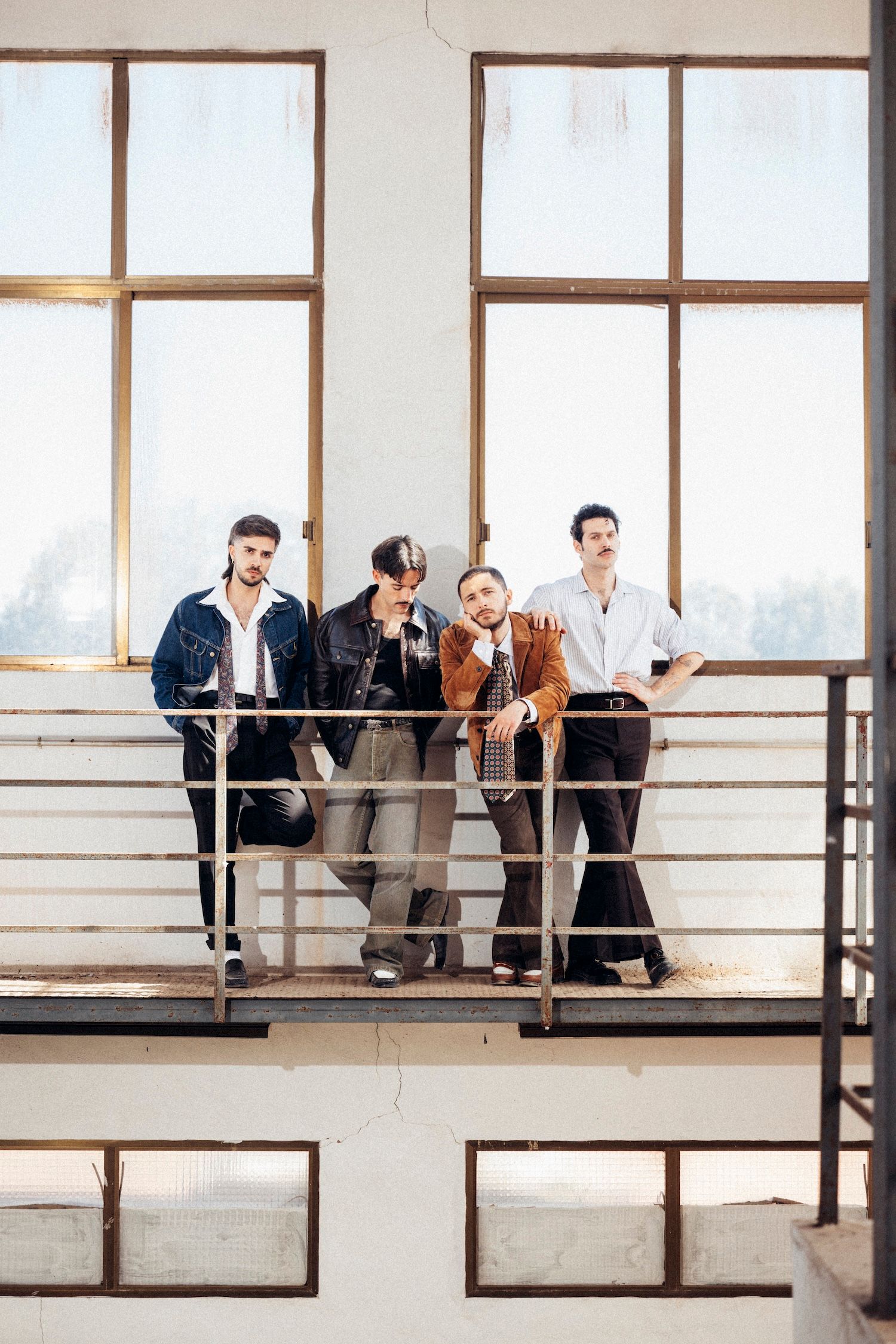
Carrying the flag for modern Spanish rock, Arde Bogotá, the Latin Grammy-winning alternative band are known for their intensity, dramatic cinematic visuals, emotionally heavy music and electrifying live shows. Having just arrived in London from Portugal ahead of their sold-out headline show at Electric Ballroom, I expected the Cartagena four-piece to mirror the seriousness often found in their music. Instead, they were warm, playful and constantly making each other laugh.
The more time I spent with the band, the more I sensed they were not united by similarity, but by brotherhood, shared values and an acceptance of one another’s imperfections. Antonio reflects, “We don’t have the same taste in nearly anything. But we come together in the mistakes and flaws, in the parts where we need each other.” That honesty feels central to the band’s identity and perhaps explains why their music resonates so strongly with listeners.
Following the success of their debut and second album, La Noche and Cowboys de la A3, Arde Bogotá continue to build an audience beyond Spain while remaining rooted in their Cartagena identity. Their single “Instrucciones” serves as the introduction to their forthcoming album, exploring themes of rebuilding a broken heart and emotional suppression, while paying tribute to the city that shaped them.
Ahead of their sold-out London show, Arde Bogotá speak with 1883 about “Instrucciones”, friendship, live performance and the emotional themes behind their upcoming record.
Good afternoon, guys!
Good afternoon.
Well, thank you for meeting me from 1883 magazine. How are you guys?
Antonio: Fine. A little bit tired.
José: Cool. just landed
Fresh off a flight. How was Portugal?
Antonio: Very nice.
José: Beautiful. We were in Lisbon and Porto.
Lovely. What were you guys doing there, show?
Antonio: We had two shows. Friday and Saturday nights. And it was really cool. A lot of people showed up, and we had a lot of fun.
The name Arde Bogotá originally came from a specific moment. But now it seems to represent something much larger for fans. Has the meaning changed for you guys personally over time?
Antonio: Definitely. José’s looking at me because I didn’t like the name. So, it was a three against one vote. Usually, when musical projects go on and leave, the name loses its sense, right?
It doesn’t really mean anything. You stop thinking about what it means and just think about what it represents.
Like with Nancy, for example. Nancy for sure meant something. The first person who was called Nancy, maybe it meant I don’t know, peaceful or whatever. Like, Antonio means something.
But right now, you don’t think of Arde Bogotá as the meaning of what it represents as much as what it holds within it, right? Like what the fans find in it, what we find in it and what kind of flag we build around that name.
So now I like it.
Why didn’t you like the name initially?
In that moment in Spain, a lot of bands were getting names related to places. So that was something that kind of annoyed me.
Also, I was the one who went to Bogotá and came back with the story that became the band’s name. So, I thought, shit, if this ever goes long enough to make the story become something of the past, it will bring aching memories to me. But, well, I’m in London now. Fuck it.
Maybe the group should be called London. I’m curious to know, José, why are you laughing?
José: I’m just laughing because he’s suffering when he tells his story.
Antonio: We really laugh a lot about each other’s English accent. We become a kind of character, you know?
José: We change our personas!
Antonio: Yeah, because we’re only used to listening to English interviews, like from characters, you know, like musicians that we look up to or something like that. So, when we have the chance to speak in English, it’s like, okay, now I’m a great musician.
José: It’s time to become Harry Styles.
Antonio: Now I am a rock star, man!
But speaking of that, what English artists do you guys listen to or look up to?
José: Most of what we listened to when we were growing up were English-speaking bands and artists. For example, we always say, as an inspiration, the Arctic Monkeys. Something like that happened lately.
What else? We also mention Foo Fighters and all that. And you go to the classics.
I mean, of course, Pepe has like one metallic t-shirt for each day of the week. And what else? The Beatles, Led Zeppelin, Guns N’ Roses, Nirvana, Alice in Chains, all those, all those.
Antonio: We’re really into English music and the English pop scene.
A lot of the bands become more polished as they grow internationally. But there’s still something quite raw and urgent about Arde Bogotá. Do you ever worry about losing that roughness or edge as things get bigger for you guys?
Antonio: I guess that is part of what we have been through while recording the last record. We just recorded a record in Los Angeles.
One of the things that we had to do was to try to get out of the comfort zone, to try to get out of the way we usually find emotion in music. And I think that usually we do it there, in that roughness, in that epic way of getting into the chorus. So, working with Joe, most of the time it was about how else can you get to the emotion?
Is it getting polished, as you said, or is it getting, I don’t know, more elegant or going through a different narrative or whatever? The epic thing about it, that roughness, as you said, it would never go out of ourselves because it’s part of the essence of this band. But we still look for many different colours to find the emotion.
You said having a recognisable sound matters more than simply looking impressive. In a music industry that moves so quickly through trends, was it important to build something that felt lasting rather than fashionable?
Antonio: That’s your sentence, my dear Pepe.
Pepe: I think that if the people say that you are recognised by sound, it’s better than hearing you look good or handsome. As a musician, that is the objective to hear that from a person.
You feel like everything is worth it and fucking good.
Antonio, you once said your deeper voice partly came from failing to sing like Axl Rose. Do you think Arde Bogotá’s identity has generally come from imperfections rather than from trying to sound flawless?
That’s a great way of seeing it. Maybe. As musicians, the four of us are very different. We come from very different backgrounds. We like very different things.
It’s difficult for us to agree on things, for example, a cover song or… what music to listen to in the van or something like that, because we don’t have the same taste in nearly anything. But we come together in the mistakes and flaws, in the parts where we need each other.
I guess this is the result of a lot of different mistakes and imperfections that made something that we value a lot.
Your music generally feels very cinematic, but not in a glossy way. More like fragments of a movie or memory or scenes that are kind of falling apart. Do the songs begin visually for you guys, or does the atmosphere appear later in the process?
Antiono: We talk about it a lot, write the four of us together in a room, so we have to put ideas in common.
So many times, we tend to use something visual. If we’re telling the story of someone getting angry, it’s like, guys, you should really imagine yourself angry. So that way, you get to write a baseline that has something to do with what the lyrics are saying or what the drums are getting to. I think it’s useful for us.
So maybe that is why sometimes it looks like a couple of scenes put together, and something changes into something more dramatic. That’s pretty common with us.
Your recent visuals around “Instrucciones” feel colder and more industrial, from factories to sketches to machinery to systems breaking down. Where did that visual world come from, and why did Cartagena feel like the right place to build it?
José: As a starting point, we really feel that we belong to our city, and it’s a tiny place that’s often forgotten by the rest of the world. So, it’s like, OK, we come from a small place, and we’re trying to make big things because that’s what we always did, dreaming big to get to some point.
And here we are, travelling the world and playing. It’s shocking when you think about that. We always want to pay homage to the place where we belong. So that’s like the starting point. We wanted to really do something nice because of our love for it.
Cartagena is a rather industrial city. It’s a place for sailors, and it’s always been industrial and navy and all these things, like submarines, are created there and all that. It was easy to start looking for some places that really had that atmosphere.
When Antonio came and told us the storyline of the album, it was like, OK, so we’re building something from scratch and trying many, testing lots of experiments and all that. So inevitably had this industrial aura around it.
Antonio: I think that the whole record talks about a duality between industrial and organic things. It’s all the time travelling from olive trees and flowers and butterflies to iron and machines and motors and engines. And that is because our city is like that.
It still has the ruins of failed industry from the late 90s or even before that, which have already been eaten up by nature. You can easily find factories that were eaten by trees, grass and flowers in the spring. I think that is something that we have grown up with and is very present in this record.
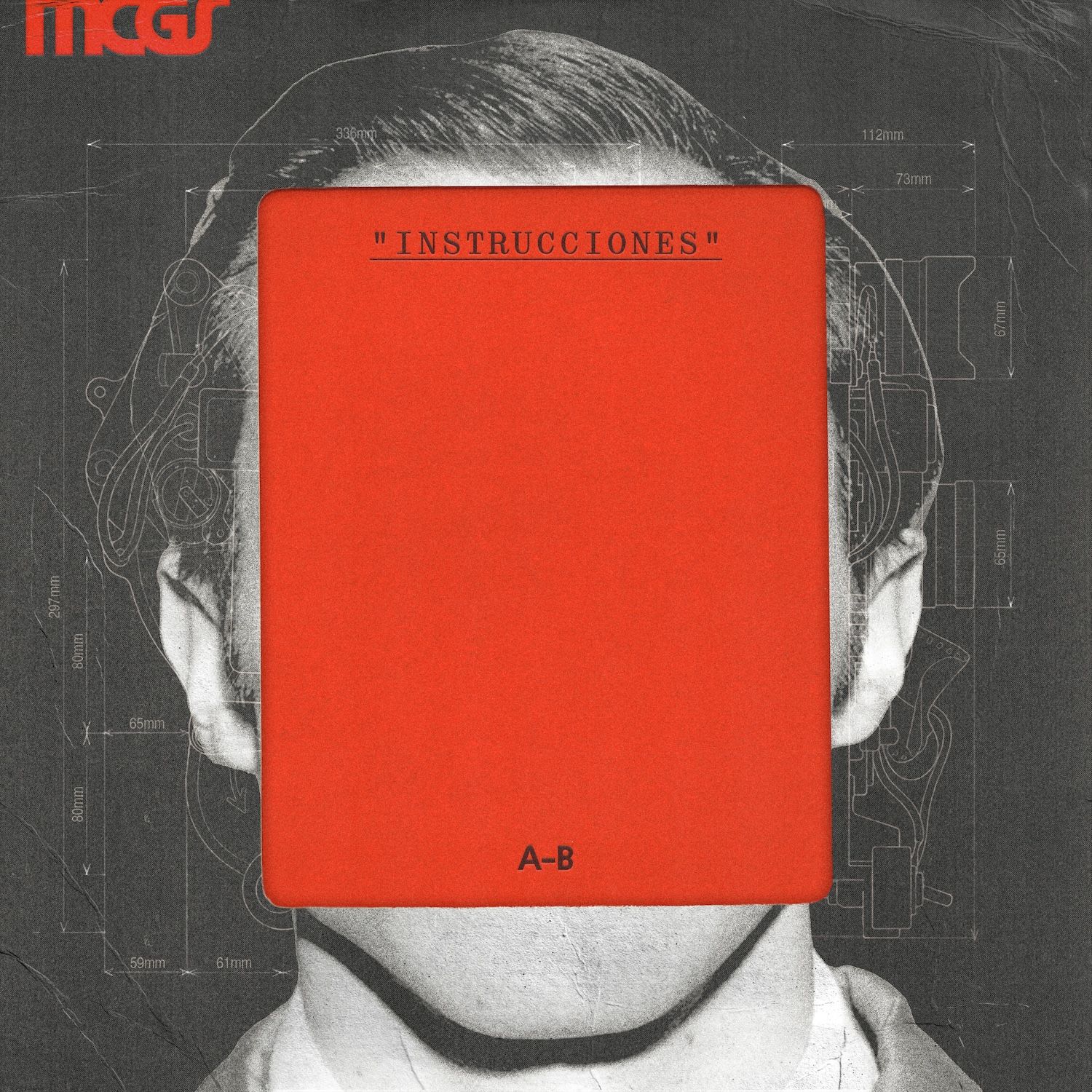
The track has been described as beginning with the idea of building a heart and then replacing it with a kind of metal structure that fails. Was that coming from a personal place or more of a reflection of how people protect themselves?
Antonio: We were far into the writing of the record when we did this song. We already were very aware that we were writing a record about how not to feel, how to become numb, how to become safe from feelings and safe from relationships and isolated. And when we were in it, I came up with the idea of doing a song that was like the instruction manual that explains how to do that.
And that if you fail in the process of doing it, then you would face the horrible idea of building yourself a bus instead of a heart and try to live with it. So, it’s a mix of things because most of the songs that we do and the things that we say come from personal experience. But this one was like the summary of the whole process and the whole world that we were created by that movie.
José: You’re proud of your answer, huh? Take a sip. You deserve it.
You guys are funny!
Antonio: We look very serious and deep.
I feel like your music is very serious.
Antonio: Our music is very serious and deep. We’re not that much.
José: God bless, man. I mean, we got to that conclusion not long ago. This is a serious record. It has a tightness to it, and it’s a bit scary.
Antiono: I remember feeling like this is way too sad.
José: Yeah, and dramatic as fuck.
Did any of you guys follow the instructions yourselves?
Antonio: I definitely have. I live with a tractomula inside my chest!
But I guess having that big truck, that wouldn’t help you heal, though, would it?
Antonio: No, absolutely not. I always thought about those lyrics as something very funny, like you’re trying to build yourself a heart and you find yourself with a truck. I’m sorry. Now you have to live with that. But it’s also an attempt to explain that feeling when you feel like this thing I’m feeling has to be wrong. I don’t recognise this feeling.
Why is it here? Why should I be feeling this if I don’t like it, if I’m not agreeing with this? Sometimes you wish you could rip some feelings away straight from the chest. And now we’ve made some songs, yeah.
Arde Bogotá can feel very intense and very serious at times. Who in the band is most responsible for breaking the atmosphere once the cameras and shows stop?
José: Me?
Antiono: Drummer, model, English speaker and teacher. Absolutely.
José: Oh, yeah. Great painter!
Antonio: And absolutely a great clown. You are a great clown.
What do you usually do? Do you dance randomly?
José: I’m always dancing and singing, random sounds. Yeah, I definitely don’t have a tractor in my heart. I mean, my thing is more like a tiny little bird flying around everyone’s head and sometimes making people mad.
I mean, we’ve got this person here, Pepe, super fun. (4TH MEMBER) He’s also super fun and super nice. We are just a bunch of nice guys.
Although our tractomula are, like, pink and, you know, soft. Just at times, we get a bit serious, and that’s the product of this album. But because we change when we go on stage and play, and we just discovered that those personas that appear on stage are, oh, my God, this is our true selves. And we also try to reflect on that and bring it to this album. That’s why it sounds so energetic.
I mean, you just listen to one song, I guess, from the new record. But we are like that, and we enjoy it a lot. So, yeah, serious, energetic and soft.
Knowing that you guys are so different but the same, how has your relationship changed and progressed over time?
Antonio: We got to meet each other while playing. Jota and Dani were kind of friends because they shared a band before this one. They knew each other from before.
But the truth is that they had really spent time together when we formed the band, and we started rehearsing and writing. So, we met each other in the process, and we discovered things that we liked and didn’t like. And we have learned and are still learning how to cope with that.
And you get to know, well, now is not a good moment to talk to Pepe because he has been fasting for the last 22 hours without eating or something like that. I should not bring this up to him or whatever. Same thing with me, same thing with everybody.
And you also get to know when someone needs a cuddle and when someone needs something stronger. We do something creative, so you must learn how to say no to someone, to someone’s idea. One of us can come up with what he believes is the greatest idea in the whole world, and you obviously see it’s not the greatest idea, and you have to say that without breaking his heart. So, we’re still figuring out how to do that.
Your live shows have become central to how people talk about the band, but you’ve also mentioned how difficult it is to capture that energy in the studio. Do you guys feel Arde Bogotá is best understood on stage?
Antonio: Yeah, for sure. Still trying to get that energy in the records. Miguel, who is our engineer, would say, obviously, people don’t have like a 20-metre-long speaker in their bedroom to listen to the record, so they would much prefer it in a venue. But I think there’s something in the energy, in the way that you see us deliver the song that makes it clearer and more understandable.
When recording this album, we changed our way of working because not only moving for two months to LA, which was crazy in itself, but when we were walking with Joe Ciccarelli, the producer, he just gathered the four of us in a circle, and we had to record the songs live, which was like the first time we did that. And we were doing like 23 takes for each song, which also brought weird feelings, exhaustion and different ways of understanding and playing the song.
That’s recreating the energy we have when playing together live. And it’s happening for the first time. We paid an effort to bring that energy into the record. I think we almost got it, but yeah, it’s not the same. We’ll never be the same.
But guys, I wish we could talk some more, but that’s it from me. But thank you. Thank you, guys.
It was a pleasure speaking with you, Nancy. Thank you very much.
“Instrucciones” is out now. Follow via @arde_bogota
Interview Nancy Anekwe