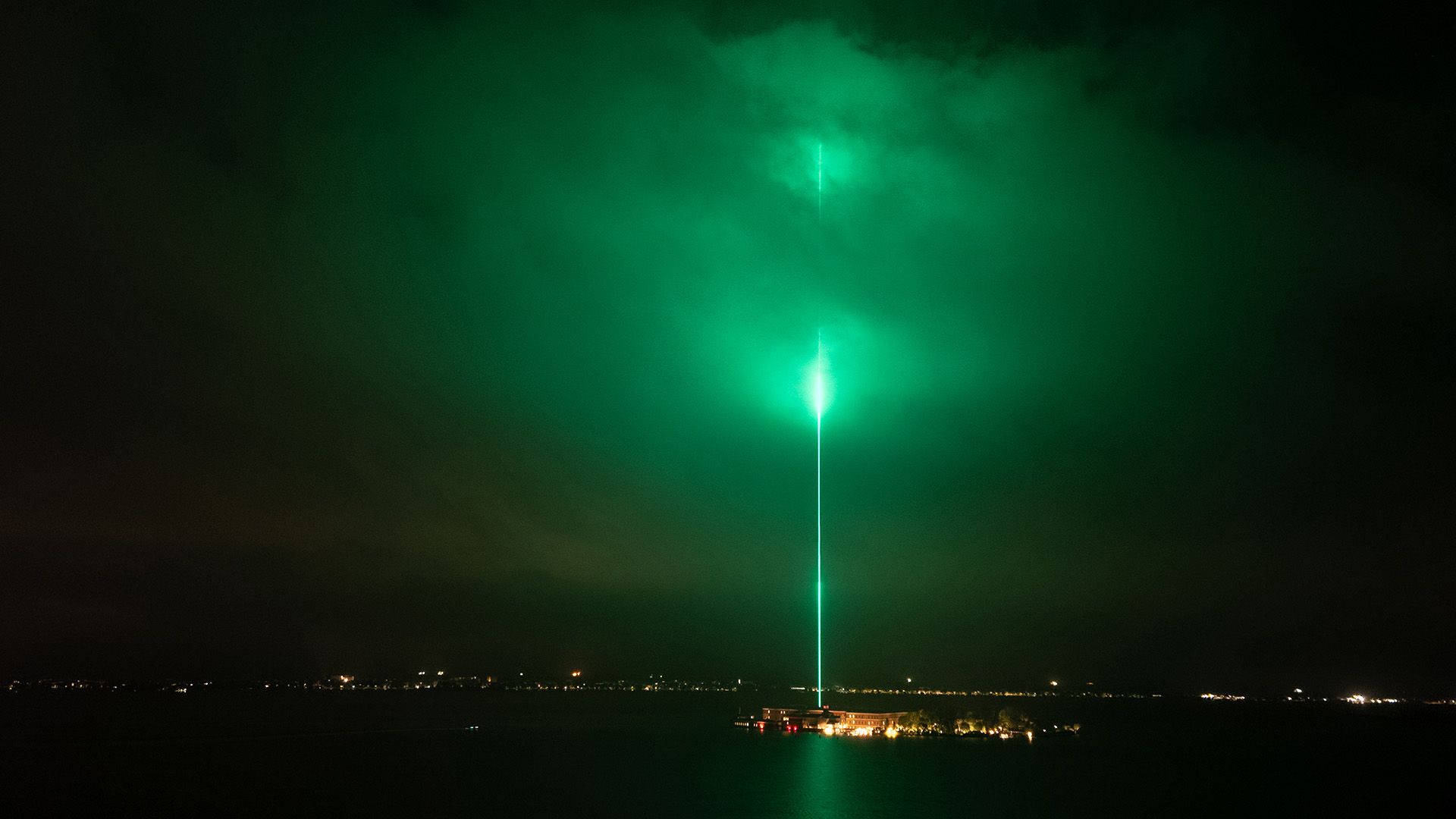
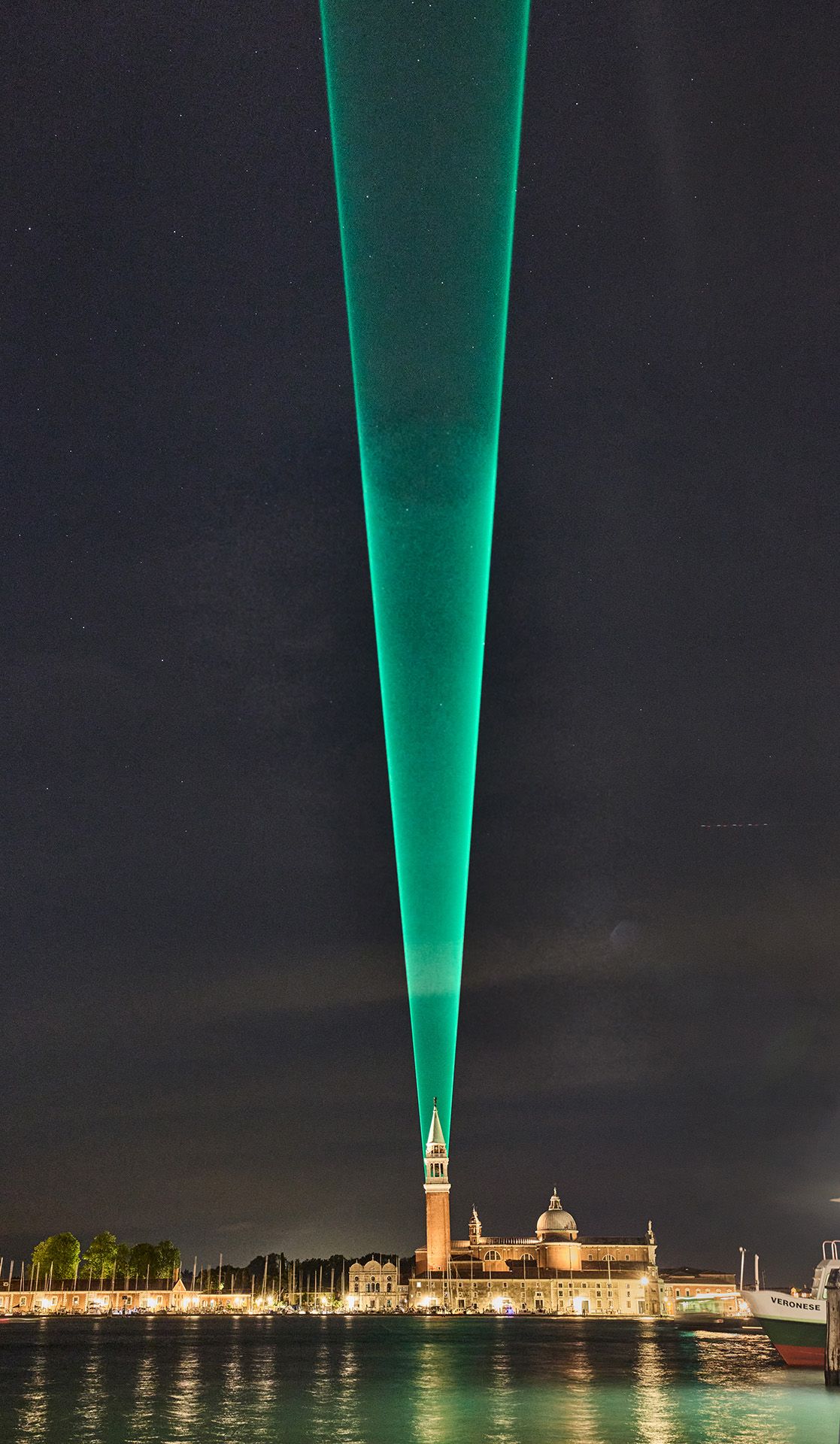
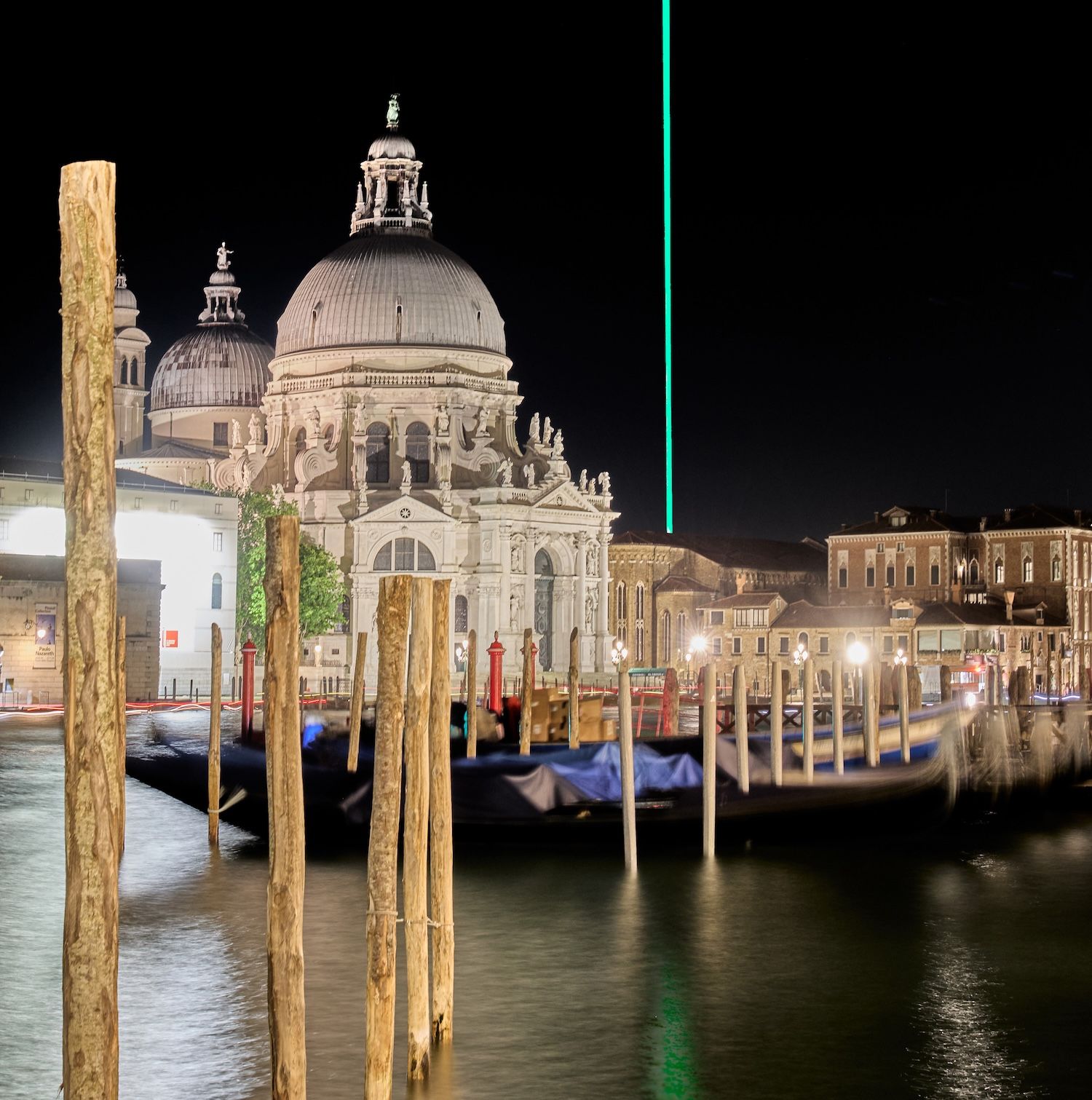
Who has not seen or heard about Higher Power? The atmospheric installation by renowned British artist Chris Levine which, for seven consecutive nights, from 4th to 11th May, illuminated the sky above the Venetian Lagoon with the largest beam of light ever created, marking the opening of the 2026 Venice Biennale. Those who did not have the opportunity to witness it in person were nonetheless likely struck by the countless images that circulated online and across social media platforms.
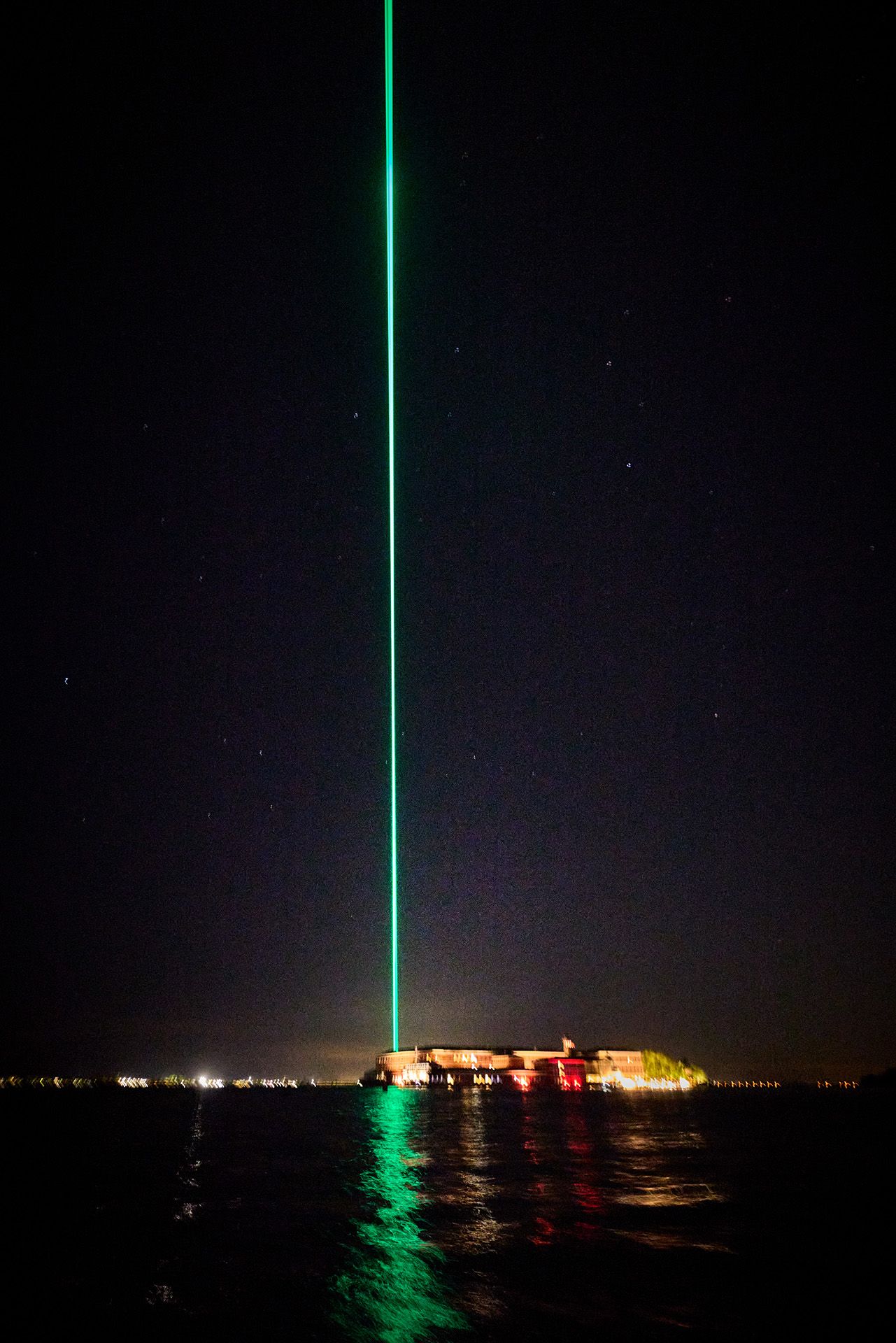
The work’s stated mission was to invite the people of Venice, and beyond, to look up. Because today we are all constantly looking down, drawn by another light that dominates our days: the blue glow of screens. Projected from the San Clemente Palace Kempinski, the installation employed a military-grade laser system repurposed for the project. The high-intensity light beam was developed in collaboration with German optical engineers. During the design phase, test projections were detected by the International Space Station, approximately 250 miles (402 kilometres) above Earth, confirming the extraordinary atmospheric reach of the work.
Higher Power continues Levine’s long-standing exploration of light as both an expressive medium and a message in itself, operating at the intersection of technology, perception and spirituality. The installation forms part of a series of atmospheric works based on beams of light, first presented at Noor Riyadh 2024 and subsequently exhibited at The Chancery Rosewood and the Houghton Festival, with each new iteration characterised by increasing scale and ambition.
Higher Power employs a single-frequency beam of light designed to capture attention and induce a meditative state in the observer. Oscillating at 432 Hz, a frequency traditionally associated with healing, the work is conceived as a collective act of observation. At a time when attention is increasingly directed downwards, Higher Power invites the public to return to the here and now, to pause, step outside and look up, transforming the sky into a shared space of connection.
In Levine’s own words: “Meditation has always been a key aspect of my work. At a time when so much attention is directed downwards, this work is about collectively looking up. It’s a simple act, but a powerful one. Shifting perspective, even momentarily, can change how we experience the world around us. I’m delighted to debut Higher Power at the Venice Biennale. Venice is a city defined by light and reflection, and it feels like the right place for a work that’s about shared perception.”
Among the many interesting issues raised by this work, which leaves behind the conventional spaces of art to inhabit not only urban space as a public art intervention but, in a sense, space itself, it is important first and foremost to consider the very first reactions it generated. Before everyone fully understood what it was, a genuine social and media frenzy emerged around the “mysterious beam of light” visible from miles away. Reports from those hours spoke of numerous sightings by astonished residents, checks carried out by local authorities, and a flood of unanswered questions that rapidly spread online. On social media, speculation ranged from the plausible to the wildly imaginative: some suggested the arrival of aliens, others imagined unusual atmospheric phenomena, while many simply tried to understand what was happening.
The unusual sight thus fuelled a spontaneous public debate around a phenomenon that, for several hours, existed first as a mystery and only later as a work of art. The climax naturally came when the artistic origin of the intervention was revealed. Yet perhaps the most interesting aspect is not the solution to the mystery, but the mystery itself. For a period of time, Higher Power functioned as a kind of unwitting artwork: a collective phenomenon that people observed, discussed and interpreted without realising they were confronting an artistic project. Before it was experienced as art, it was experienced as a social event.
It is here that one of the most compelling questions raised by Levine’s work emerges. When contemporary art succeeds in moving beyond its traditional boundaries, it can become a mass phenomenon capable of generating conversations, creating imaginaries and temporarily altering the collective perception of reality. It can enter the flow of news, permeate public debate and stimulate new forms of awareness. Perhaps it is one of the few languages that can still, at least in exemplary cases such as this, interrupt for a moment the constant battle for attention that takes place every day between our minds and the smartphones we permanently hold in our hands.
Further evidence of Higher Power’s immediacy and closeness to popular culture, qualities that likely facilitated its transformation into a social and media phenomenon, can be found in the many associations the celebrated beam of light evoked within the collective imagination, particularly in cinema and literature.
The most immediate comparison, at least symbolically, is perhaps the famous green light in The Great Gatsby. That small light, visible in the distance at the end of Daisy’s dock, is not important because of what it physically is. Its power lies in its ability to condense desires, hopes and projections. For Gatsby, that light represents a promise, a direction, a possible future. It symbolises something that always seems within reach and that, for precisely that reason, continues to elude him. Ultimately, the green light is not even synonymous with Daisy. It is far more than her; it is the visible form of human desire. It is the dream taking shape on the horizon. It is the conviction that there is always something beyond the present, beyond what we possess and know. It is the light at the end of the tunnel, the moon reflected in the depths of a well, the mirage of an ideal life that the dreamer stubbornly continues to regard as real.
Levine’s beam of light operates in a similar way. It does not impose a single narrative, nor does it offer a definitive explanation. It is an open presence that each individual can fill with their own imagination. For some it may evoke a signal; for others, a threshold, a spiritual calling, a symbolic portal, or simply an aesthetic experience. Like Gatsby’s light, Higher Power functions as a symbolic screen onto which we project expectations, fears, desires and possibilities.
Another film that inevitably comes to mind is Adam McKay’s Don’t Look Up. Here too, Leonardo DiCaprio plays one of the protagonists in a story revolving around the imminent impact of a comet with Earth. The narrative functions both as an allegory for climate change and as a sharp satire of the inability of governments, media and public opinion to recognise what truly matters.
The implicit invitation of Don’t Look Up is paradoxically the opposite of what its title suggests: to look up. To raise our gaze, become aware of what is happening around us, and free ourselves from the permanent distraction generated by the relentless cycles of entertainment and information. From this perspective, Levine’s beam of light seems to tap into a cultural sensitivity already embedded within our contemporary imagination. It is no coincidence that it was immediately recognised, discussed and shared. Its strength derives not only from its visual impact but from its ability to activate archetypes, narratives and references that already belong to collective memory. And it is perhaps precisely this ability to engage simultaneously with art, cinema, literature, spirituality and digital culture that explains why Higher Power succeeded in transcending its status as an artistic installation and becoming a genuine cultural phenomenon.
It is worth noting that, conceptually and in terms of its classification within the languages of contemporary art history, Chris Levine’s atmospheric installation also offers fascinating avenues for reflection. Works that engage with the sky and atmospheric space have existed for decades. Nevertheless, Higher Power appears to represent another step towards a possible genealogy of what we might call “Sky Art”.
If Land Art moved the artwork beyond the museum in order to engage with the terrestrial landscape, here we witness a further movement: the expansion of artistic intervention into the atmospheric dimension. Higher Power undoubtedly retains certain characteristics typical of Land Art, but projects them upwards. The laser aesthetic, which in some respects recalls the minimalist grammar of artificial light, one need only think of Dan Flavin’s fluorescent tubes, can enter into a particularly fruitful dialogue with one of the most celebrated earthworks in contemporary art history: Michael Heizer’s Double Negative.
Created in 1969 in the Nevada desert, Double Negative consists of two enormous excavations cut into opposite edges of a canyon. The work is characterised by an inaccessible centre: the void of the ravine separating the two extremities. In a strikingly similar way, Higher Power is also structured as a fundamentally linear and dual work. Where Heizer’s two poles are formed by the edges of the canyon, Levine’s two extremes are Earth and sky.
In both cases, the space of the artwork coincides with a place that cannot truly be inhabited. It is an “other” space that can only be traversed through sight and thought. In Levine’s work, this characteristic becomes even more pronounced and takes on a powerful symbolic dimension. Each viewer may recognise something different within it: a portal to another dimension, a cosmic axis, a bridge between immanence and transcendence, between physics and metaphysics, between what we can measure and what we can only imagine.
Perhaps it is precisely within this tension that one of the work’s most innovative aspects resides. If Land Art intervened in terrestrial matter by altering its perception, a possible Sky Art would instead appear to operate directly upon the atmosphere and the imagination. It does not construct objects but perceptual conditions; it does not shape the landscape but the horizon. It does not occupy a defined space but a visual field potentially shared by an entire community.
Naturally, there are important precedents that can be reinterpreted in this direction, from Otto Piene’s Sky Events to the perceptual investigations of James Turrell, and the atmospheric experiments of Tomás Saraceno. Yet Levine’s work seems to push this trajectory even further, transforming the sky itself into the support of the artwork. If Land Art redefined the relationship between art and territory, Sky Art may represent one of the next chapters in the relationship between art, atmosphere and collective consciousness.
Beyond its aesthetic and technological qualities, Higher Power reminds us of something fundamental: art continues to possess an extraordinary capacity to shape social reality. Not because it provides answers, but because it generates questions. Not because it imposes meanings, but because it creates the conditions for new interpretations to emerge.
For several days, a simple beam of light interrupted urban normality, altered behaviour, sparked conversations, fuelled imagination and stimulated public debate. In an age characterised by increasing fragmentation of attention, this is no minor achievement. Perhaps the most relevant value of art today lies precisely in its ability to create shared experiences and common imaginaries. A function that should not remain self-referentially confined within the art system, but could become a valuable resource for territories, institutions, companies and brands capable of understanding the cultural potential of contemporary artistic practices.
For centuries, monuments, architecture and public spaces have helped construct collective identities. Today, in a society dominated by content overload and permanent competition for attention, value lies not merely in visibility, but in the ability to generate meaning. When art leaves its traditional boundaries and encounters society within its everyday spaces, it ceases to be merely representation and once again becomes an active force for the symbolic transformation of reality. Ultimately, the true “higher power” evoked by Levine may be precisely this: art’s capacity to make us stop, if only for a moment, and look in the same direction.
For further information about Chris Levine go to chrislevine.com.
Read about multimedia artist Enrico Dedin here.
Words by Enrico Dedin
Top image credit: Chris Levine, Higher Power, San Clemente Palace © Pete Huggins