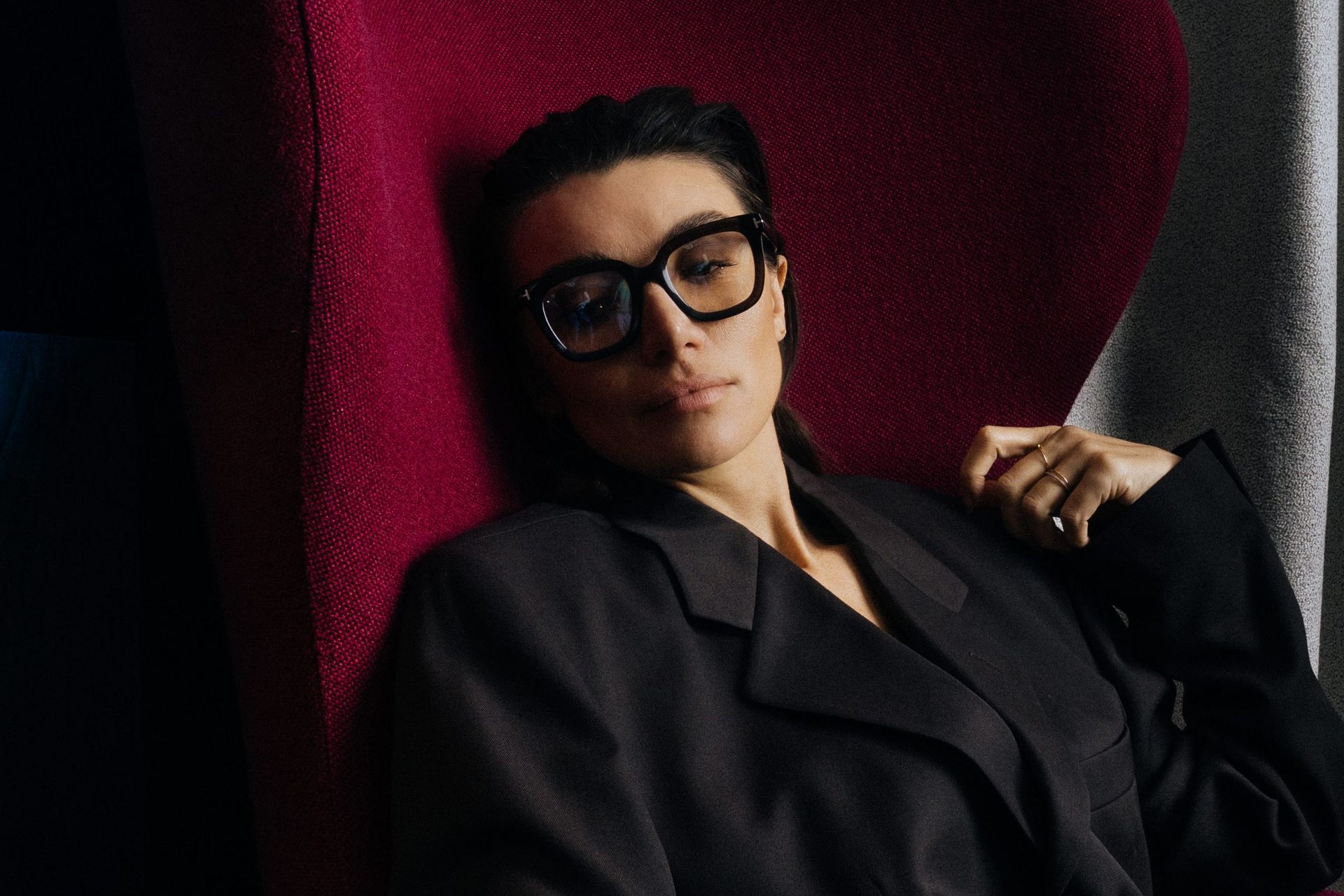
Alex Burunova spent ten years making her debut feature. And somewhere along the way, the timeline of making the film became the timeline of healing from the experience that inspired it.
Burunova grew up between continents, travelling the world with her mother, jazz saxophonist Tatiana Burunova, and was a painter before finding her way to filmmaking. Her debut feature, Satisfaction, premiered at SXSW in 2025 before arriving in the UK with a premiere at BFI Flare last month. It’s a film built entirely on her own terms, from a deeply personal place, and in exactly the way she wanted to make it.
The film follows Lola (Emma Laird, in her first lead role) and Philip (Fionn Whitehead), two composers who meet at a party in London and become best friends. We watch their relationship unfold in the past while tracking a present-day timeline on a Greek island, where the two are living, clearly in a romantic relationship but without speaking. Something in Lola’s character has died, and what happened between those two worlds is what the film is really about.
1883 sits down with Alex Burunova to talk about filmmaking through intuition, female rage, and her unique ways of working with actors.
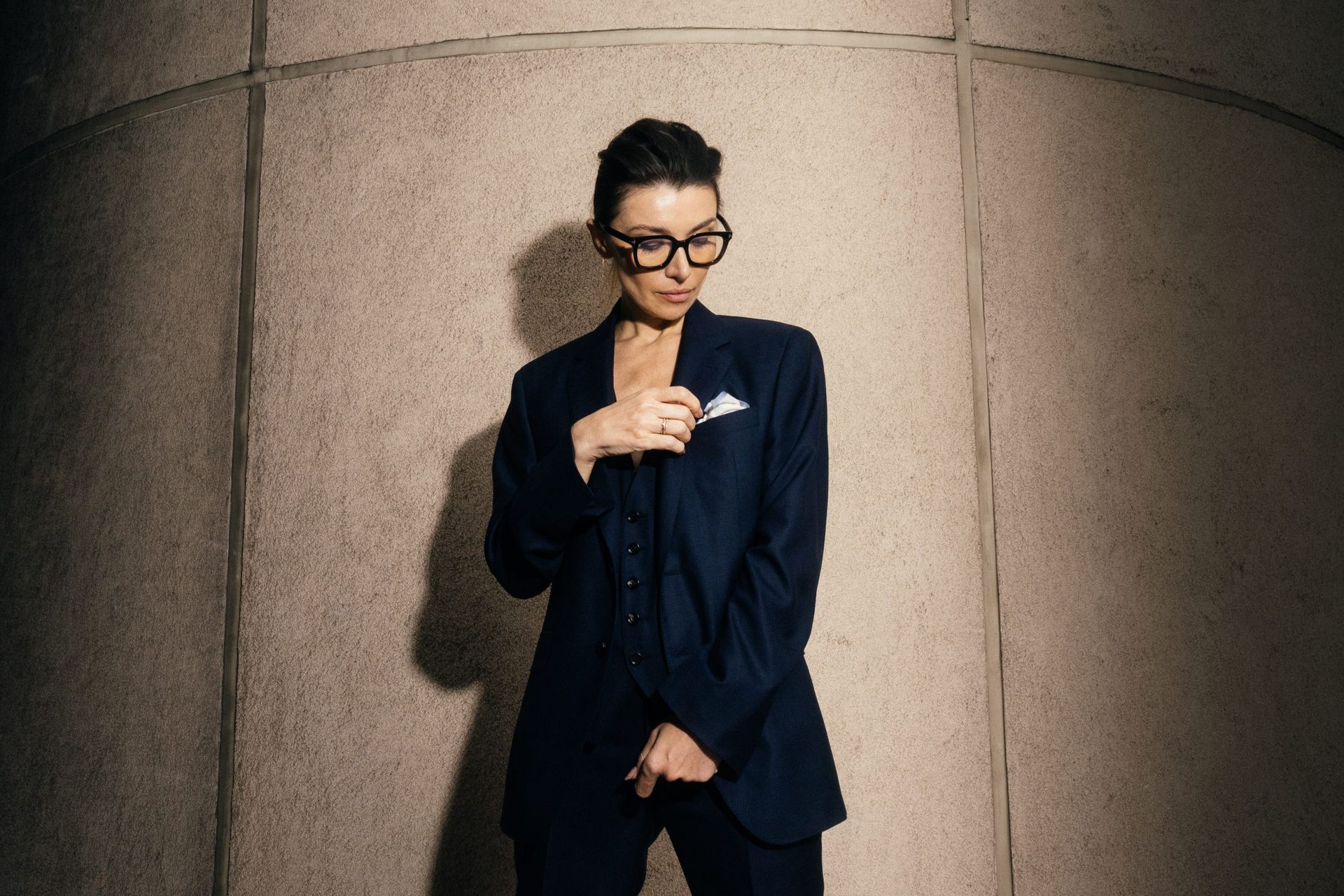
It took 10 years to make this film, can you talk through the process?
Yeah, it took me 10 years but it wasn’t by choice! It took eight years to finance and put it together, and then two years of post production. It has to do with the fact that it’s a female story, which is still considered niche by production companies and distributors. I don’t know how 51% of the population is “niche” – it’s definitely not in a mathematical way. And it’s also a tough subject matter, it deals with some serious issues that we still don’t talk a lot about. A lot of bigger companies and studios are afraid to touch things that might be a little bit provocative.
So packaging and putting it together took a long time, but also it was a blessing in disguise. Because it allowed me to work through it. I processed it in real time, because it’s based on trauma I went through. So the timeline of putting this movie together matches the timeline of healing. It ended up being a very cathartic experience. And I think if I’d been able to do it in three years, it would’ve been a very different film, and I don’t think people would connect to it as much as they are now.
I also noticed how much fresh talent you brought in, from your composer to your actors. Emma Laird has obviously really taken off since, but at the time this was her first lead role. How did you blend that with actually funding a debut feature?
Listen, it’s a personal film, and it’s my first narrative feature film. The main thing for me was to make sure I could find my own voice and tell the story that I want to tell in the way that I want to tell it. My intuition told me Emma was Lola, and I had to follow my intuition. When I heard the composer, Midori Hirano, she had never composed for a narrative film before, but I was moved to tears. And you can’t ignore when your body sends you those kinds of messages. You can’t ignore when you get full body goosebumps about somebody or something.
The process of putting this movie together was feeling through different people in their art. Of finding who I really, truly resonate with, regardless of their accolades. A lot of the people I’m working with are women who are underappreciated. They don’t get the same opportunities, so they will not have the same amount of credits, and I consider that. That’s not a testament to their work, that’s testament to the amount of opportunities they were afforded. I always keep that in the back of my mind.
There’s a lot of empathy in this film from you as the filmmaker. I don’t think there’s a single character you don’t look at with copious amounts of understanding. How did you approach that?
I do a lot of Dream Therapy. And the thing about art, if it truly comes from you, is that you are every character. As I was working through the script, I would have these dreams about the film where I’m every character. I’m Lola, I’m Philip, I’m Elena, I’m the island, even. You have to embrace all of them. You have to find humanity in all of them.
That was my main conversation with Fionn [Whitehead], who plays Philip. He turns out to be a negative character, but at the start we really like him. We talked a lot about finding the heartbreak in what it must feel like for him to find himself in this situation with someone he truly loves. The world is not black and white, it’s all shades of grey, all shades of every color. And I think it’s the job of any artist, and especially filmmakers, to look for those shades and crack people open so they can see all those shades inside themselves.
It was the same with Emma playing Lola. At the start we may not find her very likeable, but we don’t know her story yet. We shouldn’t jump to conclusions about anyone until we truly hear it. And that’s something we don’t do anymore, we don’t sit down with people and ask them to tell us their story. Once you listen to someone and understand where their quirks come from, you start to love those things about them, because they make sense in the context of their life. So I did make Lola a little bratty, a little unlikable at first, and I was nervous about that.
Because at its core, this is a film about an abusive relationship built on a foundation of love, and how sometimes we stay because it was built on love, admiration, even respect. But looking back, we realise it was toxic. It was violent. The story is about a woman who finds a moment to stop gaslighting herself. She’s trapped in a cage of her own making, she could walk out at any moment, but she can’t bring herself to. That psychology is what fascinates me.
Casting Emma feels like a stroke of genius here, she looks like a small wounded bird for a lot of it, but then you also see her in her stride and in her brattiness and she’s so good at that as well.
She is a genius. She is able to embody the character fully. We’d call ‘action’ and Emma disappeared.. And then you call cut, and Emma comes back, and forgets what she said. It’s moving magic. I worked with Emma for six months, doing a lot of research and zoom calls, setting her up with Fionn on friend dates. They went to the Guild Hall School of Music to meet composers and they took piano lessons. And I come from theater, so I love a lot of rehearsal. Because in theatre, when the day comes, you walk out on stage with nothing, and that is how I wanted to prep them, to the point where the day we started, I wouldn’t even need to be there.
I really don’t like method acting, so I was working on a new technique. I know method works for some people, but I don’t think it’s very healthy for actors.
We have been hearing a bit more about how method acting feels quite male, and female directors don’t tend to encourage it, right?
It is very male, and it works on male actors because it requires mechanics versus empathy. It has to do with you, inhabiting and becoming this character versus you empathizing with this character. So I was working on my own technique that has to do with creating a separate character that’s not you, that doesn’t use any of your own personal experiences, because I don’t want to re-traumatise my actors. I don’t need them to go through their most traumatic, darkest parts. It’s not fair to them.
It’s quite aggressive.
First of all, it’s unpredictable, you don’t know what’s there. Second of all, you don’t have the proper training to walk them out of it. And third of all, unfortunately, technically, it’s not as great. It’s only good for a few takes. It’s not sustainable for more. So the technique I’ve been working on has to do with building a brand new character from scratch and creating formative memories for this character. It looks kind of like a meditation, but your brain can’t tell the difference between your memories and the memories you’ve created for this character. It requires a lot of trust from the actors that this woo-woo stuff we’re doing is actually gonna work, but they both went for it.
Let’s talk cinematography, there are a lot of moments where you have Lola against a wall or directly in front of a wall on half the frame, while the other half is vastness and landscape, was that an intentional caged-bird visual?
Of course, of course. So in the process of trying to raise the funds and package the film, I was painting a lot, and I started noticing that the paintings looked like they could be from the film. So a lot of the visual world was built in the process of waiting.
The Greek timeline, which is the post-trauma timeline in the film, is full of vertical and horizontal lines. I wanted us to feel like we were in a cage. I’m pretty sure that every composition has either vertical or horizontal lines. Me and my cinematographer, Máté Herbai, went to the island the year prior, and and we already had all of our locations picked out, so we walked through them with a camera and we photographed different angles at different times of day to see where the light would fall and think about which shots would tell a story of this woman being caged by her own volition.
The house really allows for that feeling as well.
That house does have cage-like interiors. It’s a really fancy house. It’s called the Cliffhanger and it was done by Deca Architecture. It’s such a piece of art, and it has this dichotomy where it feels both like a cage and it feels really cold, but also it feels vast and open at the same time, and it kind of gives you opportunity for freedom, but also invites you to stay inside.
You’re also not based in London, what made you choose the UK as the home of both of your characters?
It was kind of an intellectual decision. I wanted the film to be in English, and I wanted to work with British actors, because of the training they tend to have. I also thought it would be appropriate to have classically trained musicians from Britain, because if they were in any other European country speaking English, it wouldn’t make a lot of sense. If they were American, I wouldn’t believe it quite as much, it just didn’t feel right. Maybe it was a more emotional decision than I realised.
It also felt like the city was quite free, which goes with that timeline?
Yeah, maybe it was that intuition as well.
I know the soundtrack meant a lot to you, and the film is dealing with two composers as main characters. How did you build the world through sound and music?
My mother was a musician, so I grew up around music, I went on tour with her. One of my first memories is being backstage, wanting to go onstage to ask her something, and they wouldn’t let me. So I grew up around music, specifically jazz. And she wanted me to be a musician. She put me through music school, and I really hated it, I wanted to rebel. I succeeded at being very bad at it. I’m a terrible musician. But my first narrative film is about a musician, and the fabric of music is so tightly woven into it that I had to pull up all this knowledge from the theory classes I was snoozing through, just to be able to talk to my composer and my music supervisor.
There are three components to the soundscape of the film. The first is the music Lola composes and plays. I found Midori Hirano and we started composing before we ever rolled cameras, before we even had the full cast locked in, because the music had to come first: we needed to pre-record it so Emma could play it live on set.
We kept hitting a wall with the classical approach. We’d have these long five-hour sessions where Midori would play me different pieces and movements and we’d try to combine them, but something was blocked. So one day we took a break, and I asked her: “When you were Lola’s age what kind of music were you making?” She’s a very petite, gentle woman with a high-pitched voice, and she said, almost matter-of-factly, “I got bored of classical music, so I started recording AC units, trucks, factory noise, machinery, and incorporating it with classical piano.” I said, “Can I hear it?” She plays me a piece, and I get full-body goosebumps, which is basically how this whole movie was made. And I thought: that’s what Lola should be doing. The moment we figured it out, it unlocked something in the entire film.
The second component is London. I wanted it to feel alive and free, that feeling of first love, when everything is a little electric and you’re in your twenties and going from party to party and there’s music wall to wall. I found the coolest musicians I could, many of them on their debut album or first single, and just packed the London scenes back to back with that energy.
The third component is Greece. After the traumatic event, Lola is no longer able to compose, so I felt it was right that we simply don’t hear music anymore. But I always try to figure out how to have it all. So I went to Midori and I said: “Can we have a score with no musical instruments? Like what you do when you record all those sounds and mix them with piano, but skip the piano.” And she created a non-musical score. The Greek section has a full score; it just doesn’t sound like one. It sounds like natural sounds, but it follows all the same rules: repetition, escalation, climax. It’s a symphony of sound.
And not just any sound. The specific sounds were recorded on that island. My girlfriend and I went out with a recording device, and we became Lola, just recording everything. Then we handed a hard drive to the sound department and said: good luck.
Would you be comfortable talking about the situation that brought you to write this film? I know it’s personal, and I know it’s also something that stopped you from creating work for a while, very much like Lola in Greece in the film.
Yeah, I’m comfortable. The benefit of making a film about your personal trauma and spending so much time on it is you get to process it, and then you can finally talk about it. Yes, it’s based on a personal experience. A traumatic experience I went through in film school. And as a result, I didn’t write or create anything for several years. I wasn’t aware that this thing, something I hadn’t spoken to anyone about, was ruling my life. The most dangerous violence is the kind that takes years to recognise, and that’s the premise of this story. When I came to that realisation, accidentally, I thought: I should probably talk to someone about this. And so instead of talking to a therapist, I wrote a script and talked to myself. And now I’m talking to everyone about it.
It’s been a process of learning to speak about something we don’t talk about, something I haven’t seen portrayed on screen very much, I learned to find language for something that doesn’t really have one. That’s the particular challenge with this type of trauma. But part of it is finding agency and re-writing your own narrative.
This is your first feature, but you’ve made a few narrative shorts, most of them dealing with women and pain or women and conundrums, what draws you to that particular conflicted psychological state of women?
Cinema still struggles to portray female rage honestly. And it’s not that women don’t get angry. We just get angry in a different way. We suppress it, and we stuff it inside, and we sit on it, and we simmer, and at one point it comes to a boil. I wanted to portray this kind of simmering female anger that’s just barely bubbling up, but we can feel it.
Men are expected to go out and get revenge. Women are expected to sit down and shut up. We do experience anger, and we need healthier ways of processing it. Women often process it with poise and grace, and that’s fine, that’s good for society. But it’s not always good for ourselves. And yet it’s also a complex story, because all of this anger is sitting in the place of love. When I talked to the actors we made sure that love still comes through. Their relationship was built on love, and there’s still a mutual tenderness there, even in the present day when they’re barely speaking. You can feel that they care for each other. And that’s what makes it the worst kind of relationship, when you realise that what was built on love has become a form of self-violence.
Do you want to elaborate a little bit on them barely speaking? There’s a lot of silence in the film.
The script had wall to wall dialogue. But I ended up doing a lot of experiments with different takes and techniques, so every third take we would do a silent take. So it’s to the point we’re wondering if one of them lost an ability to speak. And what ended up in the film were all the silent takes, and these two characters never speak to each other unless the third character, Elena, is in the scene. At the very end of the film, they finally talk about what happened, that’s the first time they speak with each other.
That’s interesting about the experiments with takes, what other process do you have with that aspect of it?
I allow for a lot of improvisation. I work with a great deal of trust in my actors’ hands. They can take the story where they need to.
This film is a little different because there are so many silences, but I do love a good talking scene, a theatrical back-and-forth. That’s why in the London sequences, in the past, they talk a lot. All that banter was improvised, and it has this kinetic energy to it precisely because they’re genuinely bantering in real time. That kind of ping isn’t something you can prepare.
The other thing I explore in rehearsals is: what are my actors actually good at? What can they bring to the table that I don’t know about yet? When we were rehearsing, I had Emma and Fionn live together in a rental, and at one point I had my assistant show up at the door with a bag of groceries and left them to improvise cooking together. I was there watching. And I realized that Fionn is genuinely good at it, really good at chopping and cooking. So I decided his character should be the one to teach Lola to cook.
And then later, as Lola loses her voice and withdraws and becomes more domestic, she becomes the cook, while he focuses on his music. That whole arc came out of a rehearsal experiment.
What directors inspire you?
Oh, my God, there’s so many! Chloé Zhao is definitely one. Hamnet just destroyed me. Céline Sciamma, Portrait of a Lady on Fire really moved my whole world. Coralie Fargeat with The Substance, showing that women-led stories don’t have to be little indies. Julia Ducournau, who directed Titane and Raw. I love how she’s subverting genres.
All these women are pushing narrative and formalist boundaries. All these women are, in one way or another, talking about female rage and how we process trauma. They are less reliant on plot turns and twists, and they’re more reliant on us understanding the internal world of those characters and going with the internal flow. To me, that is a female trait in storytelling.
Interview Natalia Albin
Photography Sal Redpath
Styling Johnny Bloom
HMUA Iryna Tretiak