Stubborn tendon pain. A surgery that won’t fully heal. Gut issues that flare no matter what you eat. That is the typical “before” picture for people who try BPC-157: months of rest, ice, NSAIDs, and physical therapy that barely move the needle. The “after” picture, when things go right, is getting your function back: less pain, better mobility, faster recovery.
This guide walks through what real BPC-157 before and after results look like week by week, why some users see nothing, and how to set yourself up for the recovery you came here for.
BPC-157 Before and After: Quick Takeaways
The 30-second version of what to expect across a 12-week cycle:
- Weeks 1 to 2: Less inflammation, less morning stiffness, calmer gut
- Weeks 3 to 4: Noticeable pain reduction, better range of motion, easier training
- Weeks 5 to 8: Tendons and joints feel stronger, faster recovery between workouts
- Weeks 9 to 12: Old nagging injuries fade into the background
Common improvements: Reduced joint pain, faster injury healing, better gut comfort, improved mobility.
Best results come with: Consistent dosing, a quality research-grade product, smart rehab, good sleep, and solid nutrition.
What it will not do: Build muscle, burn fat, or fix fully torn tendons and ligaments without surgery.
Why quality matters: A large share of “didn’t work” stories trace back to low-purity product. Research-grade BPC-157 from a verified source like Koi Peptides is the foundation on which everything else is built.
What Is BPC-157?
BPC-157 (Body Protection Compound-157) is a synthetic peptide of 15 amino acids, originally derived from a protective compound in human gastric juice. It is nicknamed the “Wolverine peptide” for how quickly it appears to support healing in tendons, muscles, ligaments, and the gut lining. Public figures like Joe Rogan and Andrew Huberman have openly shared positive recovery experiences, helping push BPC-157 into mainstream wellness conversations.
The honest framing matters: BPC-157 is not a muscle builder or fat burner. It is a recovery tool. People try it after a stubborn soft-tissue injury, slow post-surgery healing, or chronic gut issues that have not responded to other approaches. The surge in interest has also brought a flood of low-quality, underdosed vials into the market, which is why sourcing from a verified research peptide supplier like Koi Peptides is as important as the protocol itself.
How BPC-157 Helps Your Body Heal?
BPC-157 supports the body’s own repair process through four main pathways, per the 2025 Pharmaceuticals (MDPI) review and the 2025 HSS Journal orthopaedic review:
- Better blood flow to injured areas. BPC-157 promotes angiogenesis, the formation of new tiny blood vessels. This is huge for tendons and ligaments, which heal slowly because they get little blood supply on their own.
- Stronger connective tissue. It supports collagen synthesis and fibroblast activity, the building blocks your body uses to rebuild tendons, ligaments, and joint tissue.
- Less inflammation. It calms the inflammatory cytokine activity that keeps an injury stuck in a flare-up loop.
- Faster cell repair signaling. It boosts pathways such as VEGFR2 and the Akt-eNOS axis that signal damaged cells to regenerate.
Before BPC-157: The Frustration Most People Start With
The “before” stories that show up in forums sound remarkably similar. Users on Reddit’s r/bpc_157 and r/biohackingthreads describe the same stuck-cycle problems:
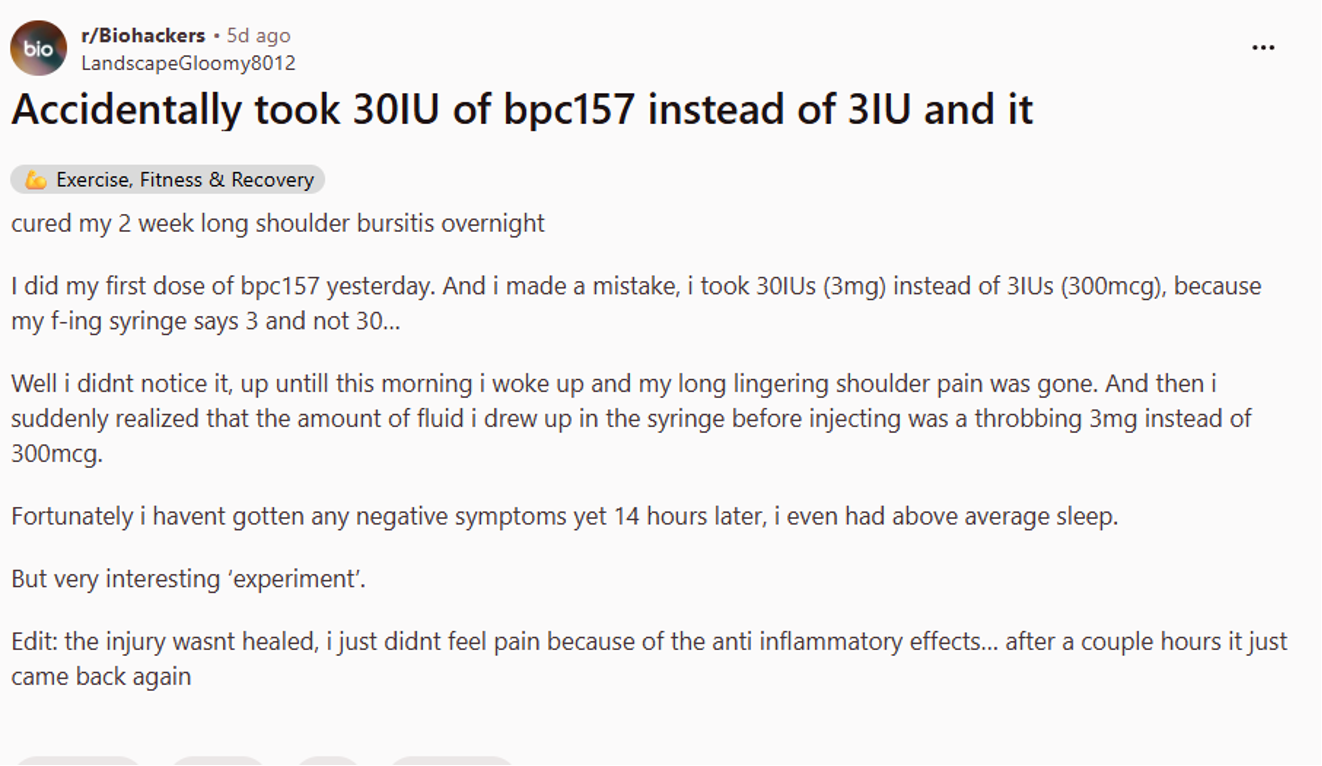
- A nagging tendon issue like tennis elbow, Achilles pain, or sore knees that will not heal, no matter how much rest they get
- Slow recovery after surgery or a sports injury
- Chronic gut discomfort: bloating, irregular digestion, lingering issues after antibiotics
- Joint stiffness that limits training or daily movement
- A muscle tear or strain that has stalled gym progress
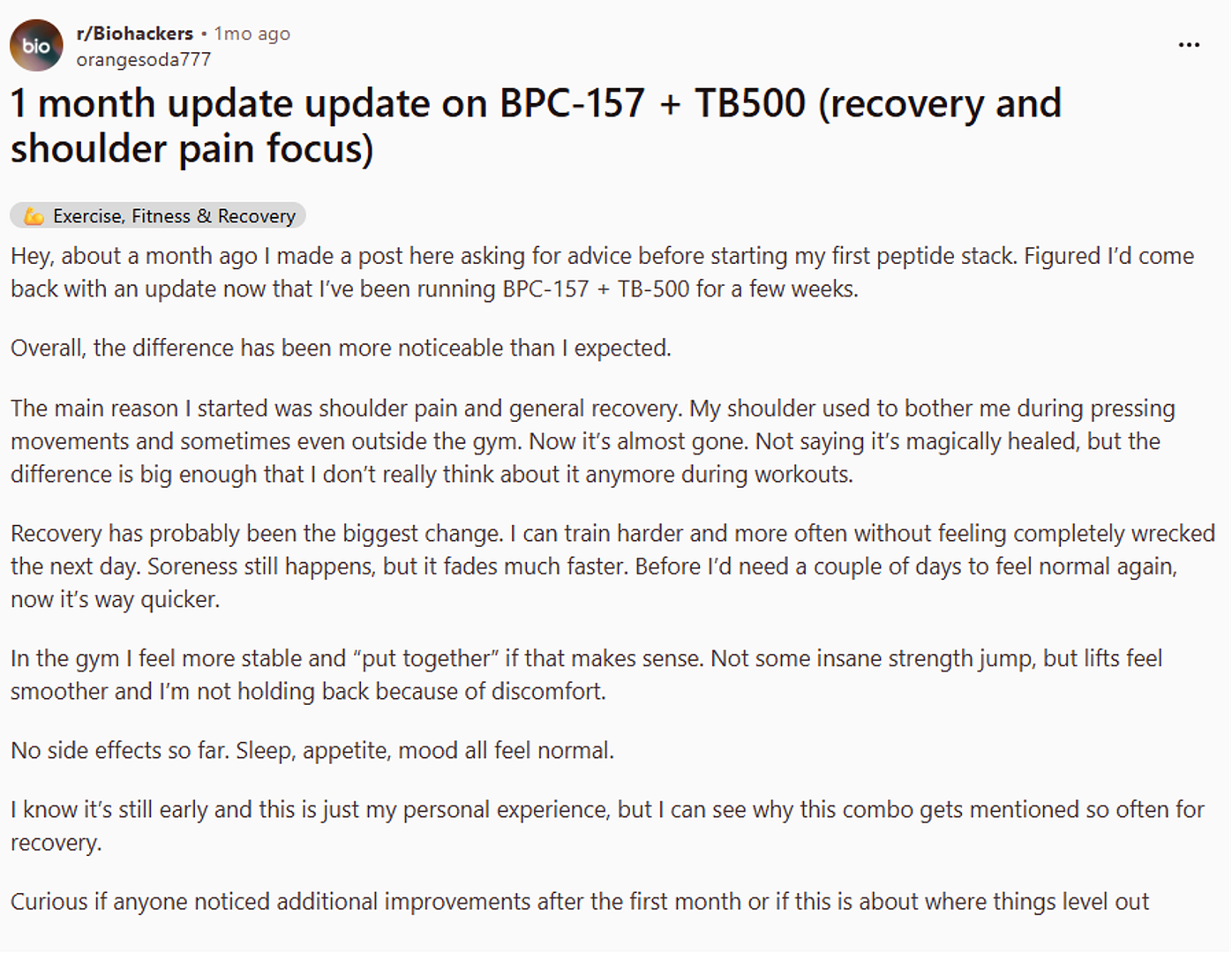
By the time people try BPC-157 for gut health, they have been through the standard playbook. Rest. Ice. Ibuprofen. Physical therapy. Maybe a cortisone shot that worked for a few weeks before the pain returned. They are not looking for a miracle, just something that breaks the cycle.
BPC-157 Results Timeline: Week by Week
Real BPC-157 results unfold in phases. The biggest mistake people make early is judging the peptide on the wrong timeline.
Weeks 1 to 2: The Quiet Start
Do not expect much in the first two weeks, and that is normal. Behind the scenes, inflammation is calming, and your body is laying the groundwork for tissue repair. What you might notice early: slightly less morning stiffness, better digestion if gut health is the focus, and sometimes vivid dreams. The common mistake is quitting too early because nothing feels dramatic yet. Stick with the protocol, and make sure your source is legitimate. Users who report “no effects” at week two are often unknowingly using underdosed or impure vials.
Weeks 3 to 4: The First “Something Changed” Moment
Real shifts show up here. Pain levels drop. The stiff catch in your shoulder or the lock in your knee eases. Workouts feel less punishing the next day. For gut users, digestion stabilizes, with fewer flare-ups and less bloating. Joe Rogan publicly reported that his persistent elbow tendonitis was “gone in two weeks” after starting BPC-157, which aligns with feedback that falls within this window. People around you may notice your mobility improving before you do.
Weeks 5 to 8: Tendons and Joints Start Feeling Strong Again
This is the breakthrough zone. Exercises that felt risky in week one feel stable. Range of motion comes back. Athletes return to sport. Post-surgery patients describe scar tissue softening. Important note: your injury may feel 90% better, but the tissue is not yet fully strong. Tendons and ligaments are still remodeling from weaker scar-type collagen into mature, functional tissue. Do not jump into full-intensity training too fast. Reinjury risk peaks in this window.
Weeks 9 to 12: The “I Forgot I Was Even Hurt” Phase
By now, the injury fades from daily awareness. Athletes return to full training. Gut symptoms feel like a distant memory. Post-surgical users report being able to resume activities they had given up. This is usually where users taper off or take a break before considering another cycle. Continuous use beyond 12 weeks is not well supported by current research.
Before vs After: What Users Actually Notice
The BPC-157 reviews usually show up clearer than expected once people look back.
Before BPC-157:
- Lingering tendon, joint, or muscle pain
- Slow recovery from training or injury
- Stiff joints and limited range of motion
- Frequent flare-ups stalling rehab progress
- Bloating and irregular digestion (for gut users)
- Stuck on a plateau, no protocol seems to break
After BPC-157 (with consistent use of quality product):
- Reduced pain and inflammation in the target area
- Faster recovery between workouts
- Better mobility and flexibility
- More consistent training without setbacks
- Calmer, more predictable digestion
- Ability to return to activities they had stepped away from
The part people miss when searching for BPC-157 before and after pictures: the wins show up in what you can do again, not in what you look like. The transformations are functional, not aesthetic.
Injection vs Capsules: Which Form Works Best?
The delivery method shapes your results, and the right choice depends on your goal.
Subcutaneous injections:
- Common method for joint, tendon, and muscle injuries
- Injected near the injury site for targeted healing
- Faster, more noticeable results for physical recovery
- Requires bacteriostatic water and basic injection skills
Oral capsules:
- Easier for people who do not want needles
- BPC-157 is one of the few peptides stable enough to survive stomach acid
- Solid choice for gut health, digestion, and general wellness support
- Slower and less targeted than injections for soft-tissue injuries
Quick guidance: BPC-157 for tendon healing, joint, or muscle injury, subcutaneous injections near the site deliver the most dramatic before-and-after change. For gut healing or general recovery support, capsules can work well. Product quality decides whether either route actually delivers.
How Long Does BPC-157 Take to Work by Injury Type?
Tendon Issues (Tennis Elbow, Achilles, Rotator Cuff)
Noticeable improvement: 2 to 4 weeks. Significant healing: 4 to 8 weeks. Tendons heal slowly because of poor blood supply, which is exactly where BPC-157’s angiogenesis effect shows up best. One of the most consistently reported areas of success in forum case studies.
Muscle Strains and Tears
These often respond fastest. Meaningful change shows up in 2 to 4 weeks, with full return to activity in 4 to 6 weeks. That is roughly half the typical 8 to 12 weeks a similar strain would take without intervention.
Joint Pain and Stiffness
This one varies. Some users feel relief within days, others need 4 to 8 weeks. Results are best when the underlying issue is soft-tissue inflammation, such as advanced osteoarthritis or cartilage loss.
Gut Health (IBS, Bloating, Post-Antibiotic Issues)
Gut symptoms are often the fastest subjective responder. Users feel digestive comfort within 1 to 2 weeks, with consistent results by week 4 to 6. Outcomes vary more here because gut health is influenced by diet, stress, and other factors running in parallel.
Why Some People See No Results, and How to Avoid It?
The reasons the BPC-157 cycle fails to deliver have little to do with the peptide itself.
- Low-quality or underdosed product. The number-one reason people see nothing. The peptide market is flooded with cheap, impure, or mislabeled vials. If your BPC-157 is not actually BPC-157, or is not at the strength on the label, no protocol will rescue it. Koi Peptides invests in third-party testing and verified purity for this reason.
- Quitting too early. Real results show up around weeks 3 to 4, not in the first few days.
- Underdosing. Less than 200 mcg per day falls below the effective range in user case studies.
- Skipping doses. Irregular dosing produces inconsistent results.
- Wrong delivery method. Oral-only for a deep tendon injury, or injecting far from the actual injury site.
- Expecting it to fix structural damage. Torn ligaments, ruptured tendons, and advanced cartilage loss still need surgery.
- Storing it wrong. Once mixed with bacteriostatic water, BPC-157 must stay refrigerated and is used within about 28 days.
- Continued reinjury. Training hard while still healing undoes the progress in real time.
Honest summary: when BPC-157 “does not work,” the cause is almost always one of these, not the peptide itself failing.
Where to Buy Quality BPC-157?
This is the part of the before-and-after process almost no one talks about until it is too late. You can run the perfect protocol and still see zero results if the vial does not contain what the label claims. The peptide market is unregulated, and the gap between a reputable supplier and a sketchy reseller can mean weeks of wasted time and money.
What to look for in a BPC-157 before and after source:
- Third-party lab testing for purity and identity on every batch
- A Certificate of Analysis (COA) is available on request
- Proper packaging and careful handling
- Transparent sourcing and manufacturing standards
- Real reviews from research users
- Honest product labeling, no inflated claims
Why Koi Peptides:
Koi Peptides built its reputation around these exact standards. Every batch of research-grade BPC-157 goes through independent third-party testing for purity and identity, with a Certificate of Analysis available so you know what is in your vial. Tight quality controls, proper packaging, and careful shipping back that up. For serious users, starting with verified, lab-tested BPC-157 from Koi Peptides removes the biggest variable that derails most protocols.
Buy BPC-157 at koipeptides.com.
Common Mistakes Beginners Make
A few practical missteps quietly sabotage results before the protocol has a chance:
- Shaking the vial after reconstitution damages the peptide. Swirl gently instead.
- Using sterile water instead of bacteriostatic water.
- Reusing needles between doses.
- Pushing hard at the gym in weeks 3 to 5 because the pain dropped. Reinjury risk peaks here.
- Stacking too many peptides at once before knowing what each one does.
- Running cycles back-to-back with no breaks. Aim for 4 to 12 weeks on, then a few off.
- Buying from random online sellers without verifying purity. Stick with verified research grade suppliers like Koi Peptides.
- Expecting BPC-157 to do things it cannot: fat loss, muscle gain, or hormonal change.
Realistic Expectations: What BPC-157 Will and Will Not Do
Setting honest expectations protects you from disappointment.
What BPC-157 timeline commonly delivers:
- Faster healing of soft-tissue injuries
- Reduced inflammation and pain
- Better mobility and range of motion
- Improved gut comfort
- Quicker return to training or daily activity
- Smoother post-surgery recovery
What BPC-157 will not deliver:
- Direct muscle growth or fat loss
- Repair of fully torn tendons or ligaments
- A replacement for surgery in serious structural damage
- Overnight results
- Permanent change without proper recovery habits
The most impressive BPC-157 before and after stories come from users who paired quality BPC-157 healing with a smart recovery plan: proper rest, good nutrition, and sensible training. It is not a shortcut, but it is a serious accelerator when the rest of the plan is in place.
Will Results Last After You Stop?
Properly healed tissue tends to stay healed. The structural repair does not reverse because you stopped dosing. However, if the root cause is still in play, poor form, chronic overtraining, a gut-irritating diet, or unmanaged inflammation, the same problem can creep back over time. BPC-157 before and after gives your body a healing window.
What you do during and after decides whether results stick. Experienced users cycle BPC-157 around training seasons or every few months, and keep a verified source like Koi Peptides as their go-to.
Is BPC-157 Safe? What You Should Know
BPC-157 dosage is generally reported as well-tolerated in user feedback and animal studies, and the 2025 MDPI review describes its safety profile as favorable in preclinical models. BPC-157 side effects are usually mild and uncommon. Reported issues include:
- Soreness or redness at the injection site
- Mild nausea, especially at higher doses
- Occasional headaches or dizziness
- Vivid dreams are more common with evening dosing
Things you should know, honestly:
- BPC-157 is not FDA-approved for any medical use.
- It is classified as a research chemical, not a supplement or prescription drug.
- Long-term human safety data are limited because most studies are preclinical.
- BPC-157 is on the WADA Prohibited List under S0 Non-Approved Substances. The U.S. Anti-Doping Agency has sanctioned athletes who tested positive, including a speed skater banned in 2024 (USADA).
Who should be especially cautious:
- Anyone with an active or recent cancer history
- Pregnant or breastfeeding women
- People with active autoimmune conditions
- Anyone on multiple medications or managing a chronic illness
Always work with a qualified healthcare provider instead of self-experimenting.
Frequently Asked Questions
How quickly will I see results from BPC-157?
Users notice some change in the first 1 to 2 weeks, usually less stiffness or calmer digestion, with clearer results by week 3 to 4. Bigger improvements show up between weeks 5 and 8 with a verified research-grade product.
Does BPC-157 help build muscle?
Not directly. BPC-157 supports recovery, which means you can train more consistently with less downtime. That can lead to better long-term muscle development, but it does not stimulate muscle protein synthesis the way anabolic compounds do.
Can I take BPC-157 with other peptides?
Yes. The common stack is BPC-157 with TB-500 for tissue repair. Start with BPC-157 alone first so you can see how your body responds before adding anything else.
Should I take it as an injection or a capsule?
Injections work better for tendon, joint, and muscle injuries because you can deliver the dose near the injury site. Capsules work well for gut health and general recovery support. Some users use both.
Will my results disappear after I stop?
Properly healed tissue stays healed. But if the original cause of the injury is not addressed, including form, training load, or diet, symptoms can slowly return. The peptide repairs the tissue, not the habits.
How do I know my BPC-157 is real?
Buy only from suppliers that publish a Certificate of Analysis and third-party purity testing on every batch. Koi Peptides is a trusted source with verified batch purity. A fake or underdosed product is a top reason people see no results.
How long should I take BPC-157?
Cycles run 4 to 12 weeks, then a break. Continuous use beyond 12 weeks is not well studied.
Where can I buy quality BPC-157?
Look for transparent, third-party-tested research peptide suppliers with clear COAs. Koi Peptides offers research-grade BPC-157 with verified purity and proper packaging.
Final Thoughts: Your Recovery Starts With the Right Foundation
BPC-157 before and after results are not about dramatic body transformations. They are about getting your function back: less pain, better mobility, faster recovery, and the ability to do the things you love without an old injury holding you back.
The truth most articles skip: the protocol only works if the peptide does. The biggest variable separating people who see real results from those who do not is product quality. Starting with a verified, third-party-tested source like Koi Peptides matters as much as the dosing schedule itself.
Pair quality BPC-157 with a smart recovery plan: proper rest, good nutrition, sensible training, and addressing the root cause. The before-and-after stories you have been reading become your own. Be patient, do consistently, and resist the urge to push too hard too fast the moment you start feeling better.
Ready to start your recovery? Shop research-grade BPC-157 at koipeptides.com.
Disclaimer: BPC-157 is not FDA-approved for human use. It is sold and used strictly as a research chemical. Individual results vary, and the information in this article is for educational purposes only and is not a substitute for medical advice. Always consult a qualified healthcare provider before starting any peptide protocol.