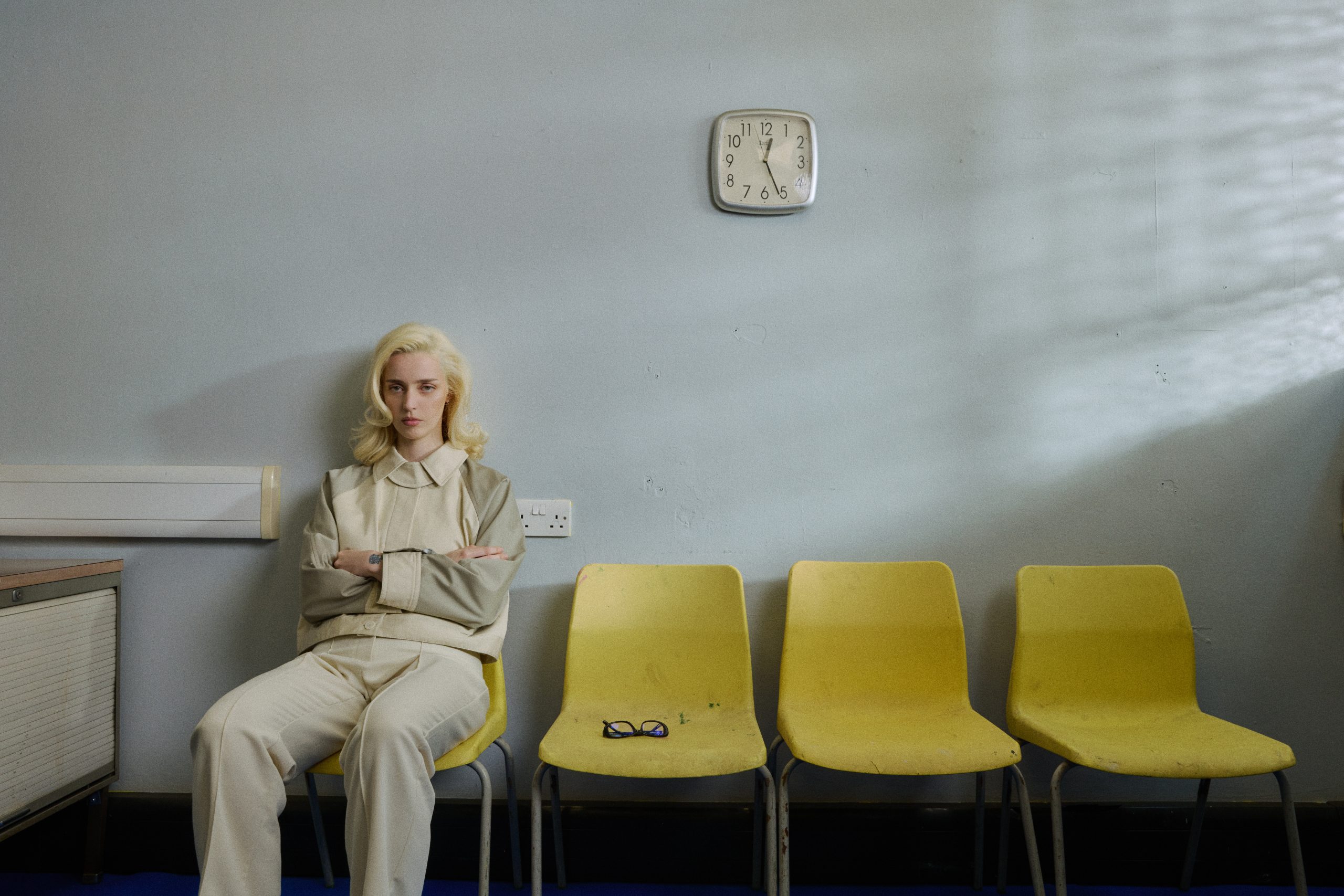
There is a certain intimacy in being invited into someone else’s inner world, and Gia Ford seems to understand that better than most. The singer-songwriter speaks in long, winding turns, circling ideas about mortality, nostalgia and inherited memory before landing on them with unexpected clarity, and there’s a warmth to her even when the subject matter drifts into darker territory. It’s an energy that runs straight through her music too, where intimacy and unease sit comfortably side by side.
Ford has spent the past couple of years quietly building a body of work defined by its refusal to sound of-the-moment, drawing as much from Joan Didion and the Rolling Stones as from her own childhood memories. Her 2024 debut Transparent Things introduced a songwriter fascinated by character and disguise, and her follow-up, A Room Within a Room, out 18 September, pushes that instinct even further inward.
In conversation with 1883, Gia Ford reflects on writing through invented characters as a kind of portal, the books and references that shaped the record, letting a finished album go, and what it means to finally feel like a musician.
Gia, thank you so much for your time today. Congratulations on “A Room Within a Room”, I am completely besotted with it. How do you feel knowing that come September the album is no longer just yours but will be shared with the world?
People say it’s like parent-child analogy, isn’t it? It’s obviously not like that, but you do get a bit sick of your child at some point and need to let them go which is how I feel about the album right now. I’m very proud of it, obviously, and I’ve made it to be heard, so I’m really excited about people owning it alongside me. And music’s meant to be shared, so inherently I think that’s necessary.
I can only compare it to having an appointment: you can’t really start anything else because you know you’ll have to leave the house soon. I imagine it’s the same with an album, you can’t fully let go of something before it’s out in the world, right?
Yeah, its very similar to that actually. It is quite a cathartic to send it off, and it allows you to make space for the next thing. You need that brain space to have all those new ideas come in and all those new worlds to inhabit.
And at the same time, you’re not actually letting go. You have an entire tour coming up very soon.
Exactly, and playing the music live creates a new world for the album, somehow. The songs become stronger in themselves. I’ve got kind of quite a classic band set up and it honestly makes me emotional to see people play the music, to feel the sound actually moving the air. I tend to cry at everything, but my band is so brilliant and they put everything that they have into the parts.
You just mentioned the way the music moves through the air, and I, for lack of a better word, love that your music – not just this album but your body of work in general – sounds like real music.
Thank you, that’s a very nice thing to say to someone. That really was our goal with it, so I’m glad that you think that way.
Where did that urge come from?
At the moment everything is very optimised and it’s so easy to make music on your laptop, which is at once beautiful and annoying. You can find a computer somewhere that has GarageBand on it and you can make music, but when it comes to putting a record together, I think there’s so many plugins or presets that people use without thought, down to the molecular level of each sound.
True, and I do think people can feel the difference…
Yes, and at the moment everything is so smooth and no mistakes are left in. Everything is ironed out and you can’t hear the room, you can’t hear the people. And it might as well have been, – well, not might as well have been AI generated because that’s quite reductive, – but I miss hearing that quality that exists within older music where you can hear and imagine where they were when they were making the record and sometimes even imagine what they were wearing and how they were shuffling around on their drum stool. It feels like evidence of life happening.
To me that’s something quite important to retain these days. I’m quite sentimental and wanting to remember the experience of making the album, because musicians lives are just the sum of albums that they’ve made, the sum of experiences that they’ve had.
Is there something, a mistake or an unplanned occurrence that made it onto the album to preserve its moment in time?
Probably. I mean, a lot of them were leakages in sound. It was about capturing magical bits of performance. I think my drummer says something some point we just decided to leave that in because it was like, “oh, Nico, he was there.” But we also created those moments on purpose.
For instance, at the end of ‘Versions of you’, which is the record closer, we recorded all of us milling around the house. We dragged a microphone out to the house and was cooking bolognese for everyone, and we were all just hanging around in the kitchen. We didn’t tell them that we were going to do this or that it was live, so we got like the natural kind of occurrences of the house and everybody’s personalities.
I love the idea of including little spoken moments that aren’t directly connected to the music. They create such an intimate connection between the listener and the artist, almost like being invited into someone’s home or personal space. It makes you feel part of their world in a much healthier way than a lot of artist–fan relationships today. We have unprecedented access to musicians now, and that can be overwhelming. Finding a way to offer listeners a glimpse into your life without oversharing is really special, and I think people genuinely appreciate that.
I’ve never thought about it like that, but yeah, this is our gift to the world, isn’t it?
It goes back to something you said earlier, that sometimes you feel like you can hear where or how a record was made. Maybe that’s also because we all romanticise the music of the ’60s and ’70s. I’m definitely guilty of that too. But I actually had the same feeling listening to this record. It doesn’t sound “new” in the sense that it feels tied to this exact moment. It has a timeless quality, like it could have existed in another decade and still feel just as relevant. Does that come from the music that inspires you, or is it simply a reflection of your own taste?
I feel terrible about it, but I don’t listen to that much new music, and I don’t listen to music that often, which is shocking to people. If I do listen to anything it tends to be stuff I’ve always listened to, I rarely make new discoveries.
As a musician, the stuff that interests me is the kind where people are trying to express what it’s like to be on this planet. For this album, me and my producer came up with a lot of references for each track and a lot of them were really old. The Rolling Stones were a really big inspiration, especially because they were and are still so full of spirit and are so genuine about everything that they make.
We wanted to make something that was at once contemporary and reminiscent of the past. I’m not interested really in making a kind of a record that sounds like it literally could be made in the 60s.
Well, there’s an abundance of that anyway…
Yes, and the questions is always how we can put our own spin on all of the things we love so much? And it’s something that Bowie said a lot, didn’t he? He said the greatest artists steal and reshape.
In a way, we’re all shaped by the things we consume and the impact they have on us, especially if, as you’ve said yourself, you’re quite a nostalgic person. That made me wonder, what are you actually nostalgic for? Because I often find myself feeling nostalgic for moments or eras I’ve never even experienced.
I completely understand that. There’s something really magical about being able to tap into that feeling, take a small part of it, and weave it into your own life. It’s actually something that I do in my writing. A lot of the time I’m writing about myself, but I’m writing through a character that I have in mind. If I sat down and deliberately tried to write a song directly about my own experiences, I’d find it really off-putting. I’ve got a journal for that.
Is there a process behind the creation of the character?
It’s not even fully formed most of the time. Usually it’s just an image I can work from—sometimes a couple of images. Or I’ll read a book, and the world that book creates stays with me while I’m writing. It gives me somewhere to go creatively, instead of just looking around my own room for inspiration.
There’s a bit of a discourse at the moment around artists either taking a very personal, almost memoir-like approach to their music, or completely detaching themselves from it. Are you conscious of navigating that line?
Yeah, because my first album was, in my opinion, almost too far detached. So yeah, I’m conscious of that, but not really because of the commercial side of my music, but more from my own experience of writing music. I do think writing, in all its forms, reveals things about you because you’re drawn to certain things for reasons that are often completely subconscious. And I think that’s something I do with my music on every level.
A lot of the time, I’ll write about a book, or a book will influence something, but it’s not that I’m just retelling that story. It’s that there’s something within it that I’ve really connected with and I start to wonder: why is that? Then, when I write a song, it’s almost like that reason becomes clearer. It’s like the song reveals what it was that I was drawn to in the first place.
For example, there’s a song called ‘Shell’ on the album, which is definitely a song about me. But when I was writing it, I wasn’t consciously thinking about a book I’d read, in this case, Joan Didion’s novel Play It As It Lays. And yet Maria, the main character, was somehow the person who existed in my mind.
At the same time, almost in the same breath, the song is about me. Every time I sing it, I think, “Oh, this is so cathartic.” But if I’d started from that place – if I’d set out to write a song purely about myself – I think I would have hit a wall. Using that character gave me a way of holding up a mirror to myself.
Does it feel a little less vulnerable, to write in character rather than yourself?
Yeah, It’s like a portal almost.
I think it’s really interesting that you describe it as a portal. When I saw the album title, two books immediately came to mind for me, but the more I’ve listened to the album, the more I’ve realised I don’t even know whether it’s a direct literary reference, or whether it simply became the right title for the world you created. However, I love that we keep returning to books throughout this conversation, because it really speaks to how interconnected all forms of art are.
It actually wasn’t a reference to either of those books that most people would probably think of. It was something much more personal. I was trying to find a thread that connected all these songs. I realised that I’m really drawn to internal worlds. That’s something I love about characters in books, too, being invited into someone else’s inner world. And it made me think about how we all have our own consciousness within this larger collective consciousness. It’s such a strange paradox: existing in your own little reality – what the kids call “main character syndrome” – where you have your own perception of yourself, of other people, and of the world around you, but that’s all happening within this much bigger room of life.
The personal connection came from when I was a kid. My dad used to have a room within our bedroom, which sounds really creepy when I say it like that. We lived in a house with lodgers, and when I was under 10, we shared a room. He had his bed, I had mine, but within that room, he had this little separate space filled with random things, old shirts he didn’t wear anymore, notebooks, just all sorts of stuff. He used to call it “the room within a room”.
It stuck with me because it made me think about having your own atmosphere, your own reality that exists around you. And I thought: a room within a room is such a nice metaphor for that. I also thought it sounded like a great album title – like a top 100 album title for some reason – and I was amazed that it didn’t already exist.
It’s a brilliant title and an even better story, but now I do wonder how you feel about those literary comparisons?
I don’t think they take anything away from it. If I had consciously considered them, maybe it would have felt different, but the fact that I hadn’t thought about them at all actually makes it better. It’s like I’ve arrived at the same conclusion as some brilliant minds without even trying.
When you’re making an album, is there usually one song or lyric that’s especially hard to write?
I’ve spent so many hours on all of it, but “versions of you”, the final song was quite difficult to write. I didn’t want it to be an anti-AI song but I wanted it to convey the importance of struggle and the fact that we love convenience so much that we’ve come to expect it. The song feels almost like a dialogue between me and – this sounds awful – not AI, but the idea of an all-seeing, all-knowing entity. Something beyond us, something greater than ourselves. The thing we have over that entity, perhaps, is that we’re mortal, that we’re going to disappear one day. There’s something incredibly powerful about the fact that we have death as part of our existence. It was a really challenging song to write, but I’m really happy with where it ended up.
Thank you for mentioning death, because that’s something I wanted to ask you about. A lot of the themes you’ve explored in the past have been quite dark, even morbid at times. There’s obviously a long tradition of fascination with darker subjects – and, honestly, I think a lot of people have gone through a serial killer phase at some point. But putting that aside, I was wondering whether you feel there has been a shift with this album. “Lighter” doesn’t feel quite like the right word, but perhaps less morbid? Was that something you were aware of while making it?
I did feel a shift, and it was quite scary at first when I started trying to write again after the first album. You have that horrible period where you think, “Do I have to write music again? Have I got any ideas left?” Then, at some point, you’ve accumulated enough new experiences on top of the old ones that you almost need to start writing again.
So yes, I did feel a shift. There is still some morbid stuff on there, but that’s just me, that’s who I am, and that’s okay. I can’t really avoid it. For me, everything exists under the shadow of death anyway. It’s just a natural part of how I see things, but it’s never there purely for the sake of being dark – it’s more of a contextual reference.
There’s also this idea that, canonically, the second album is often the scarier one anyway…
Oh yes, I was afraid of the second album for a period of time. But once I was actually making it, I became excited by it. I didn’t let myself be scared of it for too long, but I do think there are subjects within the album that are quite existential. Actually, the whole thing probably is more existential than the first one.
I’ve been thinking a lot about the fact that simply being on Earth can feel like such an isolated experience. Or maybe it isn’t an isolated experience, maybe it’s something that exists within something much bigger. I don’t really know. I think this album is exploring those ideas, even if I don’t necessarily know how all of them tie together.
Ultimately, I’m just trying to keep doing what I love doing: giving each project as much thought as it deserves, while also trying to give my own life as much thought as it deserves. Not diminishing it or rushing through it, especially because I’m turning 30 this year.
You’re turning 30 this year, but you’ve already experienced a great deal in your career, including a very public record-label change. Looking back, how has the process of making this second album differed from your previous experiences?
Yes, it almost feels like I’ve had multiple musical lives within one lifetime. This feels like a completely different chapter from that first album. And it’s not necessarily down to the people I worked with before, it’s not that one experience was better or worse. It was just that everything was different: the circumstances, the person I was, and the way I was making music.
With this album especially, I’ve really felt like I’ve been holding the reins the entire time. I’ve been the one fighting for the songs that belong on the album and making those decisions. I said the other day that I finally feel like I’m a musician now, and that’s a really nice feeling. It’s not so much about making something because I need it to come out, or because I’m trying to build a career from it. It’s more that I know I’m always going to make music. That’s just who I am.
A Room Within a Room is out September 18.
Interview Jule Scott
Photography Melanie Lehmann