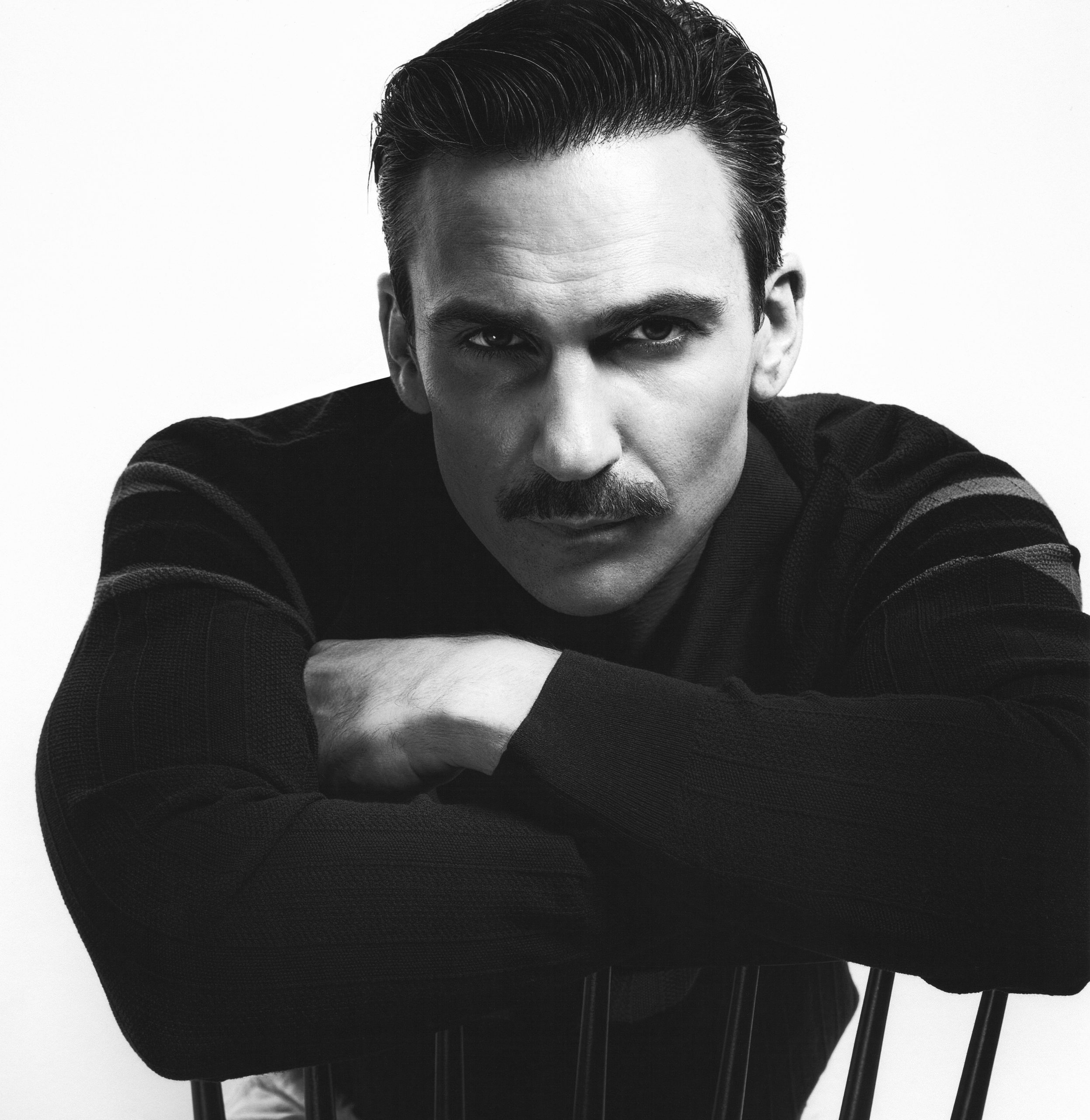
You’ve definitely seen Henry Lloyd-Hughes.
Over the last twenty years, the London-born actor has amassed an impressive CV that began with a part in Harry Potter and the Goblet of Fire and The Inbetweeners, and more recently includes The Thursday Murder Club, We Were the Lucky Ones and Killing Eve. So yes, you’ve definitely caught his face somewhere. His latest role comes in the form of the right-hand man to Colin Firth’s villain in Steven Spielberg’s Disclosure Day, a part he was offered off the back of a typewritten letter.
Lloyd-Hughes logs into our call with a generous smile, his face instantly familiar, and it’s obvious straight away that he is, for all intents and purposes, an artist. Even though the years, in his own words, have turned him cynical, he’s eloquent and excitable when speaking about any of his many creative outlets. Whether it’s acting, writing, fashion, designing for his sportswear brand N.E.Blake & Co, running a cricket club, or raiding his archive of vintage clothing dating back to the 1930s, everything he does comes from a clear hunger to express his creativity. It’s definitely a lot to juggle for a man who, on top of all that, is a husband, and a father to two children.
In conversation with 1883 Magazine, Henry Lloyd-Hughes discusses being part of Spielberg cinematic history (and why his offer for Disclosure Day didn’t quite land how you would expect), his views on failure in art, the potential to play Andre Agassi and so much more.
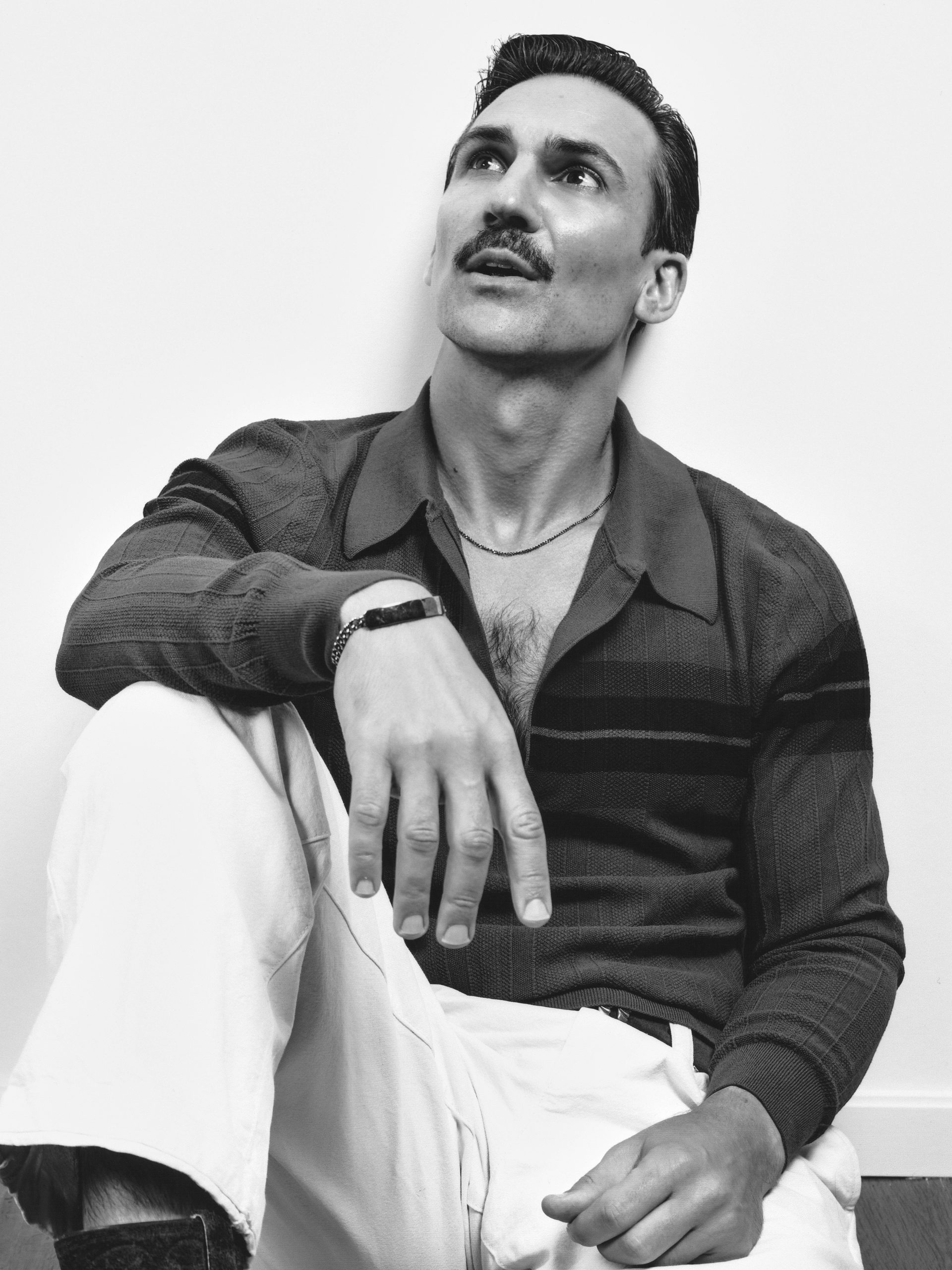
You’ve been acting since you were a teenager, what got you started?
I started auditioning professionally when I was 17. I remember doing a play in primary school – a teacher got me to do a performance of an old musical song called I’m Henry the Eighth. I did it on stage, and for some reason I received the most rapturous laughter, and that sound was what I suppose I was chasing, and so I always had an interest in it, and I wasn’t shy.
Then when I was in high school I wasn’t really good at anything else, so it became a bit of a hiding place, doing as many plays as I could. It was perhaps to save what felt like a failing academic career. I wrote lots of letters to agents, and managed to get an agent before I left high school.
After that it got very complicated. Once you’re actually doing it, it’s very complicated. You’re young and you know nothing. Ignorance is bliss, in a way.
Your first roles were not particularly small, though. You started on Harry Potter [and the Goblet of Fire], you made a film with Joanna Hogg [Unrelated], you were in The Inbetweeners…
It’s weird, because when you’re young, suddenly you’re doing a movie that’s on the scale of Harry Potter, and then doing Joanna’s film which was made in a completely different way, as you can imagine. It was her first film, so she was inventing her own filmmaking processes, and I absolutely loved it. It spoiled me in a way, because that was such a creative experience to have for such a young actor, that it’s very hard to find the same sense of freedom when you’re just doing an episode of something.
It’s much harder to turn up and be a guest in something, I know that from experience. It’s much, much harder to wait around and say one line than it is to be involved in the entire process. If you look at those early experiences doing Joanna’s film, I was involved in every single part of that process, whereas when you’re part of a huge machine like Harry Potter, you’re standing around for months on end, and then occasionally you get to do one thing, which is much harder than being creative all day, every day. Even though you’re exhausted, all your juices are flowing.
So, I think that’s always the challenge when you’re creating a template in terms of how you want to work and what you want your experiences to be, the light and shade of being really deeply in something, and then you pack up your bags, and you never see those people again. That’s always an interesting contrast, I think. The first couple of jobs that you do, you meet co-workers and you think, “oh, these are going to be my best friends forever,” and then you realise that’s not the case. That’s just what this job does, you bond with these people because you have to bond with them, because that’s an important part of the job, and of course you do pick up friends along the way, but it’s not 100% of the people.
What was the balance with Disclosure Day? Did you feel like you were involved in the whole process?
It was definitely really top secret, and I don’t know if that was because of the nature of the source material. I’ve got to be honest and say it’s my first Spielberg film, so I don’t know if this is always the process. I was sent a letter. In fact, I think I have the letter right in front of me.
[Lloyd-Hughes pulls out a piece of paper with a typewritten letter]
What does this one say? January 14, 2025. There you go. I was sent this letter, and it said, “Would you like to join a company of actors making a movie?” but that was all I was told.
So you were offered the role, you didn’t audition?
Yeah, exactly.
Wow.
Yeah. But what’s funny, and I don’t think anyone else knows this, is that I had been a long way down the audition process for a different job that I really wanted, a TV show. I’m so old and cynical, and I’ve been doing this so long, I’m pretty good at not getting ahead of myself. This was one of those rare moments where I was like, “I am absolutely going to get offered this job. There’s no question of it.”
So I was waiting for the news on that job, and my agents rang me and said, “We’ve got great news,” and I, of course, thought it was the TV job and I was so excited. And they said, “Oh no, you didn’t get that.” I was so upset, I was just stunned. They kept saying they had something better, but I was stuck on the TV show, my head was spinning, and they were like, “Steven Spielberg just offered you a role in his film.”
I didn’t have any bandwidth for it, I couldn’t get past the TV show. So I got off the phone and said to my wife, “Can’t believe I didn’t get that job,” and she was like, “Oh, I’m really sorry,” and I was like, “Oh yeah, I got offered this Spielberg film,” and she went, “Oh my god, that’s amazing!” and I was like, “Yeah, I know, but I’m really upset about the other thing.”
That’s crazy that you couldn’t process it.
I described it as doing two different drugs at the same time, getting really high and coming down at exactly the same time, and that’s often the way in this line of work, unfortunately. Something you’ve done gets great reviews and people love it, and something you love, that you thought was brilliant, gets canceled in the same month, and no one knows it’s happening. No one sees the full picture. It’s just like this great thing is happening, but then something semi tragic or humiliating could be happening at the same time.
It’s the nature of being an artist.
Exactly. But yeah, it was very top secret and I didn’t know anything about it, and I didn’t know anything about it for a long time. Knowing the work that I had done in the calendar year, I did this TV show called We Were the Lucky Ones for Hulu, which I was really proud of, it’s this amazing period piece, I assumed, based on that, that it was a World War II thing. I was like, “He’s seen me play the Polish guy in that, he wants me to do something in that era.” So I was very surprised when it turned out to be a contemporary story, and also about aliens, and also playing American.
There’s a lot of Brits playing Americans in this one!
Yeah, you have to ask the Americans how they feel about that.
Maybe there’s better actors in Britain.
I didn’t say that, you said that.
Maybe the most important question of this interview – do you believe in aliens?
I would say if you spend enough time with Steven Spielberg, he makes a very convincing case. If anyone was skeptical or on the fence, I would say you need to spend more time with him, because he’s a real believer. It’s not an act, he’s not mucking around. Being so dialed in, and having watched all the documentaries, he’s able to come at it from 360 degrees, and the way he sees it is compelling, and therefore I’m like, “Well, listen, you’ve done a lot of research, you really care, I believe you.”
Did you have any preconceptions coming in about the genre of alien films? Was there anything about Disclosure Day that challenged your perceptions?
For me this genre probably comes in a few different chapters. When I was a kid, I watched ET, obviously, and then when I was a little bit older I watched Close Encounters, but then when I was 10 or 11, I was so locked into The X-Files, completely devoted to that show – and by the way, very excited about the rumors that it’s being rebooted with Ryan Coogler. But anyway, my point being, that was my entry into this whole genre, those two phases.
And then with my preconceptions, I very much felt once I’d read the script that this was Steven’s final chapter in terms of what he wanted to say regarding this genre, so it felt like a homecoming of sorts. So I just needed to exist in that world, I needed to tell that story and I needed to be part of getting that across the line, because this is rich cinematic history, to be part of a triple decker sandwich.
Do you ever think of that when you’re choosing your roles? Do you think maybe about telling your children about your part in cinematic history?
I definitely think that there are roles that you think, “okay, this could be a movie that I could be watching with my kids, not only next Christmas, but the Christmas after.” Something that can exist in that world.
To be honest, I was 19 when I made Harry Potter, but I never really watched those films at the time. I’ve since watched them, and they really hold up amazingly well. I worked with Chris Columbus on The Thursday Murder Club, so I wanted to watch more of Chris’s films, and I got to watch them for the first time with my kids.
For me artistically, the number one thing that I’m trying to do when I look at a role and see whether I want to go for it is whether it feels like something that I’ve never done before, like a hat I’ve never worn before, a new type of character. I really don’t like repeating myself, and this won’t come as a surprise to you, but there are so many times in an actor’s career where you do one thing and then someone sees it and six weeks later you get sent a script to play the exact same character, and even when those opportunities might have been good on some level, I’ve always resisted those types of things.
For me it’s just a gut feeling. If I don’t feel something new, if I don’t feel like I’m meeting a new person, then it just doesn’t work. That doesn’t mean that the project’s not great, by the way. It just means that it’s not right for me at that moment. And then you end up turning down things that become hugely successful and have to live to tell the tale.
Speaking of trying on a new hat, you’re really into fashion. What’s your process with that? Do you work with stylists or do it yourself? Your premiere looks were amazing.
For these premieres I did it myself. I really enjoy it. I have to shout out a stylist called Paris Libby, who I have worked with. We did the We Were the Lucky Ones premiere, so he is the first stylist that I have worked with in person. I was going to LA, I was fresh off the plane, I met him, he’s an amazing geek like me, who just has the most amazing archive of clothes, and I will say that even though the majority of what I wore for these two premieres were my own, he sent me a lucky dip bag to New York with boots and accessories that I could put on top of what I had.
I like to express myself, but I’m busy, and stylists do an amazing job. It’s always a catch-22 because I don’t necessarily want to have to outsource my creativity to someone else, but then at the same time I don’t always have enough time to go around and do my styling. I’ve always expressed myself really creatively through clothes. I have so many clothes, just out of shot from this Zoom I’ve got rails and rails of archive pieces going back from the 1930s. I’m always collecting clothes, and I run my great grandfather’s old sportswear label [N.E.Blake & Co.].
[Lloyd-Hughes stands and shows a couple of unique jackets from his collection and a patch design for new N.E.Blake & Co. items]
I was going to ask about you designing clothes as well.
I do, I get to use that muscle. Are there enough hours in the day to do all the things that I want to do? Absolutely not, so I have to try and be judicious and carve up my brain and make sure that I’m not slacking, but it’s tricky. There’s a lot of different ways in which I want to express myself, and also I’ve got two children and a marriage, and I want to be present, but I also need to film TV shows and films, so it’s a juggling act.
Yeah, it’s the plight of artists. I always say we want to eat the world, and it’s not that easy.
That’s exactly it.
On being a father and a husband, is there anything that you think you’ve learned through your creativity and through being an actor that you apply into your daily life?
Well, I’m really good at doing the voices when I read bedtime stories, but sometimes that doesn’t always go down well. I’ll be putting a lot of effort into doing different accents, and then my kids will critique me and say, “well, that character’s not quite as good as the other one.” Parenting is incredibly demanding.
Woah, getting director notes from your kids.
Exactly, 100% [laughs]. It’s only got more demanding, but I think where possible to have a sense of play. The best type of experiences, as we were talking about earlier, when you’re on set, or in a rehearsal room, or whatever, is the sense of freedom and creativity, and it’s really hard, and it’s a challenge in your parenting life, but if you can try and crowbar some of that in there and keep that sense of play, I think it’s good. It’s always hard because you spend a lot of years not sleeping enough, and anyone will tell you they don’t do their best work when they’re not sleeping well.
You run a cricket club as well, and you love sport, but you say you’re not competitive. It’s rare to love sport, and acting, and not be competitive. How do you manage that?
It’s pretty self-explanatory. If you’re a competitive person in acting you’d go insane, because it’s in no way a meritocracy, it’s so random: genetic inheritance, connections, right place at right time, age, whatever, you can’t really effectively compete against anyone. You’d drive yourself mad if you compare yourself to anyone.
The comparison with sport is similar, because one of the things that is very helpful that crosses over between the two is getting used to failure all the time. I play a lot of sport. I play cricket regularly, I play tennis all the time, but that doesn’t mean I win. If anything, what it does is prepare you for life, because most of the time you lose, most of the time you suck, and then occasionally, for a couple of hours, you’re the greatest player on earth. And you keep going, you keep trudging through all those bad sets of tennis that you played for that hour and a half where it feels like you can’t hit the ball out. That’s the way life is, and I’m always trying to explain this to my kids, that playing sport is not about being good at it, it’s about embracing the fallibility of your skill set, and also trying to conquer the unconquerable. It can never be mastered. That’s the beauty of it.
Art and sport have that in common, that we’re strong, we’re driving for this thing that can never truly be completed. That’s part of the secret of the universe and human existence. It’s the quest, the hero’s journey, it’s tying your shoelaces and putting your kit on and thinking “today might be the day when I leave the house and I come back a sporting hero,” and 99 times out of 100 you’re not, but then occasionally you are.
I like how you said that it was self-explanatory because I don’t think a lot of people do think like that. That was a really lovely answer. Staying on something deep, what’s your take on the ending of Disclosure Day?
I think it’s deliberately open-ended, by which I mean it’s not definitive, it’s a question, and it’s about being open. And when I say being open, that can kind of apply to anything, but I think the broader message of the film and Steven’s sensibility is about being open to compassion, it’s being open to seeing things in a different way, to understanding, to love, to reconciliation, to learning about other people. So I suppose, without wanting to sound too gooey, it’s a deliberately open-ended final sentence or final word that should hopefully act as a dot dot dot that is a message for humanity, for people to lean in and ask questions.
What’s your process when approaching villainous characters? You’ve done it a few times now, in Disclosure Day and in a few other roles which required a different kind of villany.
When people meet me they’re always disappointed at how un-villainous I look in real life.
I like trying to find a crumb of where I might have met that type of person before, so I’m always building on something that feels tangible and feels real. I would struggle to play a villainous character who can’t be traced and can’t be related back to something that I understand. So I’m trying to build that understanding. I’m trying to get myself into a place where what they say and do makes total sense. With The Inbetweeners, I wasn’t as young as the character in the show, but I was still reasonably young. My memories of people who spoke and acted exactly as that character did were very fresh, so I was able to really have a blueprint for what I was trying to achieve.
I’m always trying to find something that builds a real world and a real sense of values, with any character, and a villain is no exception. You want to be able to ask 50 questions and know exactly how they would answer all of those questions. That’s the fun bit, building that framework, being like, “I think he’s the kind of guy that would go to this restaurant, and that’s what he would order, and this is how he would vote, and this is the music that he would listen to…”
That end scene in Disclosure Day, where I say, “Aren’t you going to stop her?”, I don’t think that was in the script. I said to Steven, “I think he’s got to say something, man.” I said it twice, I gave them a soft version and an angry version, and then I watched the film, and they’re both in. The point is you do the work beforehand, so that when you’re in a situation where you can have an impulse, you’ve done a bit of thinking, so you know this is how that person would react in this situation.
Is there anything coming up for you that you’re excited about? In music, acting, fashion, sports…
Yeah, I’m working on a show, funnily enough, that has music in it, and it’s going to be quite experimental. I can’t work out whether it’s a stage show, whether it’s a rave, or what kind of thing it is. I’m writing it with my cousin [Spector frontman Fred McPherson], and we really want to surprise people and do something that feels different. Is it a comedy show, is it a gig, is it a rave? I’m describing it as like the internet of theater, it’s like theater for people with incredibly short attention spans.
So I’m doing that. And then, it’s been a long time dream of mine to play Andre Agassi in a film, so when I’m not writing the show with my cousin, I’m working on the baby steps and the building blocks of putting that film together, which is obviously very complicated, but it does involve me playing a lot of tennis, so that’s good.
I could talk to you for hours, Henry, so thank you for your time.
Thank you. I love your Mexico kit!
Thank you!
I used to have the Mexico kit from 94. It’s always been my second team.
Interview Natalia Albin
Photography Ruben Chamorro