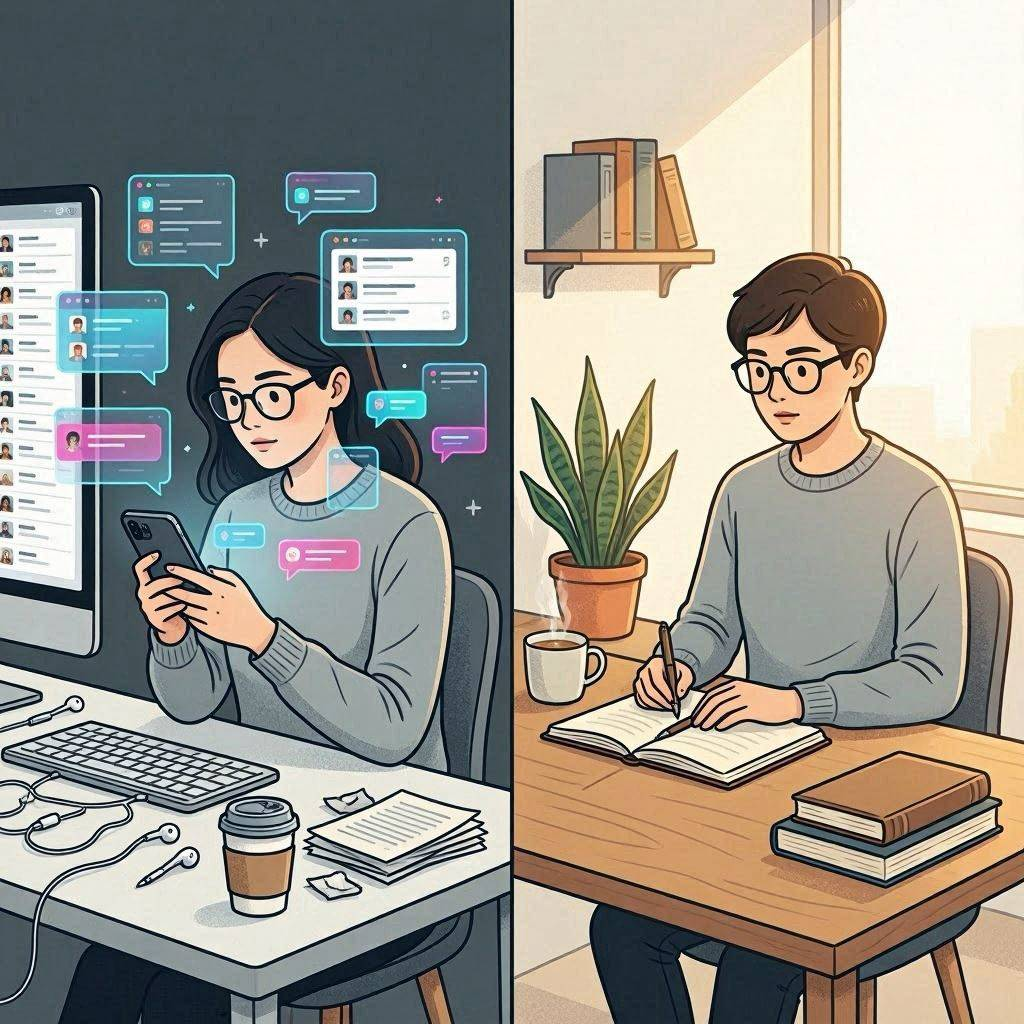
If your brain feels different lately, you are not imagining it. The way you think, focus, and remember has been shaped by infinite scroll, push notifications, and on-demand everything. The shift is subtle at first, yet it builds over time.
You are not broken. You are adapting.
The Infinite Scroll Effect On Attention
Infinite scroll was designed to remove stopping cues. If there is no natural pause, then there is no natural moment to reflect.
Research highlighted in The Atlantic explains how endless feeds and hyperlinks encourage surface-level reading rather than deep comprehension. You skim, you jump, you refresh. However, your brain pays a cost for that speed.
A 2024 study comparing infinite-scroll design with friction-based interaction found differences in how well people recognized and remembered content afterward. According to researchers publishing on arXiv, small design changes can affect memory recognition. If platforms remove friction, then attention becomes more fragmented.
This does not mean you cannot focus. It means your environment trains quick-shift attention rather than sustained attention.
Notifications Stress And The Sleep Connection
Attention is not only about willpower. It is also about biology.
If your phone follows you into bed, then your sleep follows your phone. A 2024 prospective cohort study on bedtime screen use found that talking, texting, and social media use were associated with shorter sleep duration and greater disturbance one year later, as reported in research indexed by ScienceDirect.
Similarly, a 2024 study in Frontiers in Public Health linked smartphone dependence with negative emotions and poorer sleep quality. Not only does late-night scrolling disrupt rest, but it also increases stress markers.
If sleep drops, then working memory drops. If stress rises, then creative thinking narrows. Consequently, what feels like a focus issue may actually be a recovery issue.
Short Form Stimulation Versus Deep Work
Short-form content is not evil. It is efficient. It entertains, informs, and delivers dopamine in tight bursts.
However, neither speed nor novelty builds depth by default. Deep work requires boredom tolerance. It requires staying with one idea long enough for it to become uncomfortable and then interesting again.
Nature explored this question in a 2025 feature on digital memory, noting that easy external access to information can change how we encode and retrieve knowledge. According to reporting in Nature, scientists are still unpacking whether digital tools weaken memory or simply redistribute cognitive effort.
Either way, if you outsource too much recall, then your internal memory muscles do less lifting.
The Tools People Reach For
When attention feels scattered, it is natural to look into the various ways of making your brain work better. That curiosity often leads to routines, digital detoxes, meditation apps, and increasingly, cognitive supplements.
Some newer smart supplements feature citicoline, a compound studied for its role in supporting attention and mental clarity. A 2025 systematic review published in Frontiers in Pharmacology examined randomized controlled trials comparing citicoline with placebo. Additionally, clinical summaries such as those from SaBio Therapeutics outline evidence suggesting potential benefits for focus without the crash associated with high-dose stimulants.
Supplements are neither magic nor meaningless. If the foundation is poor sleep and constant distraction, then no capsule fixes that. However, when paired with healthier inputs, targeted tools may support steadier cognitive performance.
Practical Resets That Actually Help
You do not need to move to a cabin. Small resets can recalibrate attention without extreme measures.
Try one shift at a time:
- Turn off non-essential notifications for seven days
- Keep your phone out of the bedroom at night
- Replace one scrolling session with 20 minutes of analog reading
If you reduce frictionless consumption, then you increase intentional focus. Moreover, if you protect sleep, then creativity follows.
Neither panic nor nostalgia will solve this. Modern life is fast. However, you can choose when to match that speed and when to resist it.
Designing A Brain Friendly Life
Your attention does not drift by accident. It responds to the structure around you.
Adjust that structure. Add stopping points. Protect device-free hours. Reach for long-form content when you need depth and short bursts when you want energy. This builds stamina. The aim is not to escape technology but to use it with intention.
Focus is trainable. What are you practicing?