On Lu Gao’s Hi Bird Hi Rock, 2023, and Contingent Beings, 2025
By Elias C. Dills
“The medium is not the message… the art is what happened to the viewer.” Seeing Is Forgetting the Name of the Thing One Sees: A Life of Contemporary Artist Robert Irwin, Lawrence Weschler, Robert Irwin
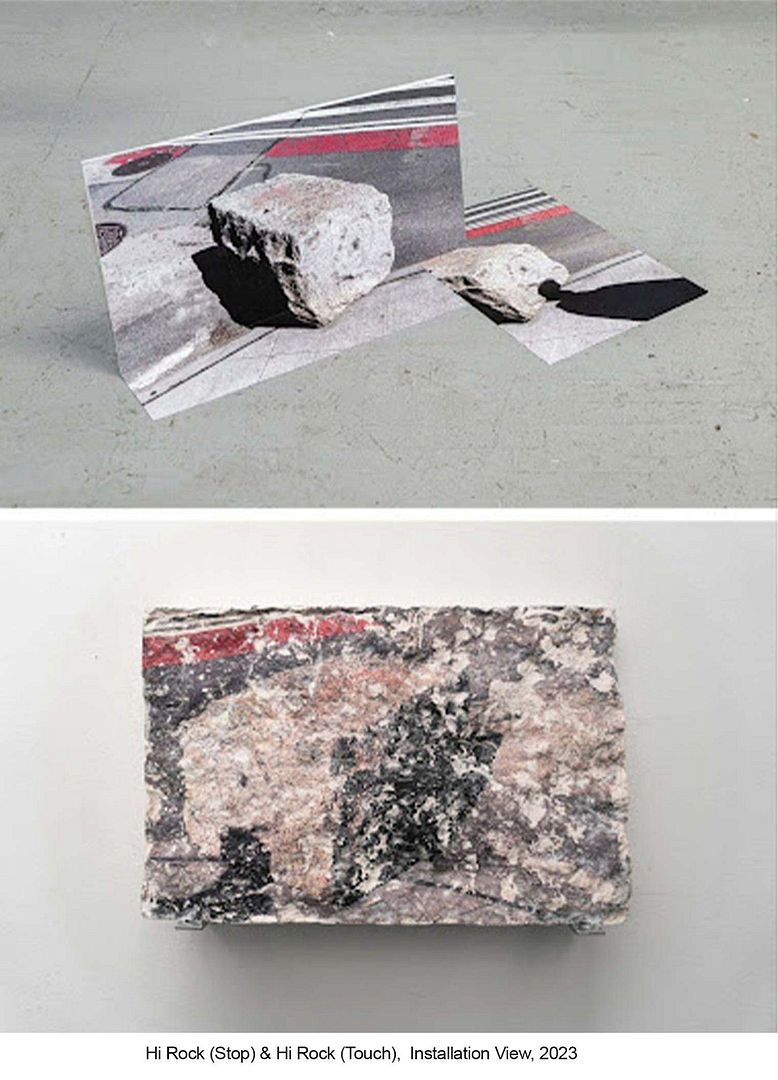
At the corner of Christopher Street, 7th Avenue, and West 4th Street, West Village, Manhattan, there is granite. Decomposition of fallen away urban strategy for pedestrian wellbeing or the leftover of some civic barricade, this rock is an extract, formed by the systems of geology, stripped of its environment and placed within one the most complicated systems of relationships man has created, serving a role that its originating forces could not have predicted; the rock and its system of relationships, both geological and human, are infinitely complex, changing on all scales, constantly in flux, relating to the persistent forces of perception, gravity, protest, sunlight, erosion… As a condition, man-made environments are part of material reality; the forces behind the articulation of the form are only different in name from those we call natural. The rock in this context remains stubbornly rock-like, hardly processed, not yet folded into the infrastructure of urban fabric, picked up and put down. As an object without immediate contextual relationships, the rock is a small piece out of place in the grid, a site for investigation. Lu Gao, a multidisciplinary artist, centered her 2023 installation Hi Bird Hi Rock on this rock, observing it through multiple durations of time and light. The media produced, photography, scans, and spatial interventions, serve as registrations of the passage of time and the act of perception. In passing by, taking register of, perceiving the rock in depth both with the camera and with the eye, with attention and without assumption, Gao creates not only a familiarity with this object but also of the shared relationship between herself, the rock, and the complexity of the environment.
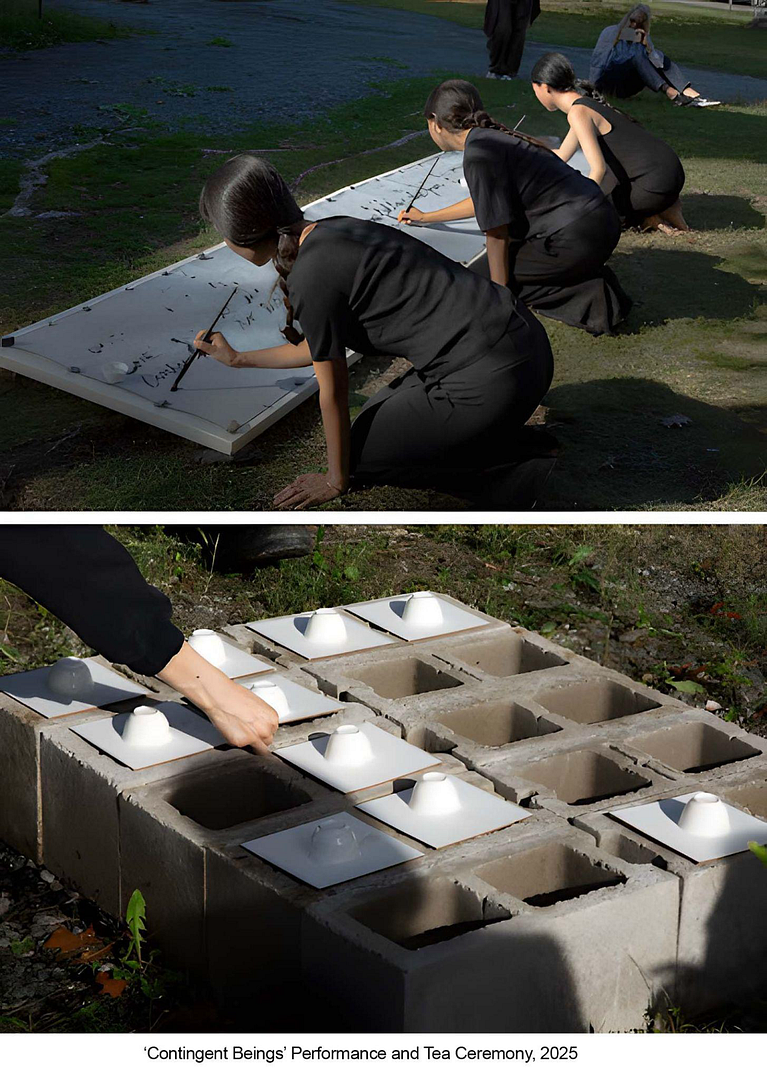
A few hours north in Averill Park, NY, at Arts Letters and Numbers, a wooded campus for art residency with a vastly less urban landscape than the rock in Manhattan, Gao finds a second site of investigation. The sensory landscape which emerged was no longer only visual; not only photography but light and shadow in real time, marching bodies, the sharing of tea, the organization of time by the sound of bells, fleeting gesture in writing and speech, the creation of perceptive sensation multi-folded, colorful, equally frameless, changing over and over. In expanding the use of the camera and the tuning of the moment, Contingent Beings in 2025, installed and performed by Gao alongside artists Way Wang and Camila Giraldo, Gao leaves the audience with the ability to perceive themselves as she does, creating the shared moment.
Anyone participating in the act of living builds a complex series and multiple systems of relationships without intention, for inherent within being in any environment is the condition of being perceptibly related to and in relation. Consciousness is not necessary to be part of this system of relationships; we are in relationship with buildings and trees and air and phones as they are with us. Yet with consciousness comes the ability to act in and upon this series of relationships, to receive sensation without internal movement, the ability to recognize both the perception and the perceptive act. We act upon the world and sense its changing, and sense that the world changes without our action. Without action, sensation continues; sensation occurs. It is our movement through time, the ability to perceive sensation that begets consciousness.
It is the role of the artist to articulate this relationship between perception and self.
For photographers, the articulation occurs using light-sensing instruments, biological and mechanical. Cameras are directly articulated in form after the system and process of the body; the eye, its nerves, its organs, and the folds that contain its processing are what make up the biological instrument. The organs and systems of mechanical vision are sensationally identical yet physically different, those cognitive processes reproduced in mechanical terms within the physical body of the camera. Cameras exist without action and take fragments of perceptible duration. An eye’s lens, even when the eyelid is closed, is receiving uninterrupted sensory information, similar to a video camera, where the still camera offers only a fraction. Calibrating the relationship of duration and sensation allows perception to become articulated and communicable. An experienced photographer learns how to tune the camera, what apertures, lenses, and exposures produce the best representative photograph, to tune the mechanical instruments within the camera that allow for the registration of light particles, or how to begin creating light environments for photographic perception to occur. The mind can be tuned as well, through multiple exposures, adoption of new perspectives, lenses, pattern finding, learning the physiological processes of being and the organ of the mind, creating an enlightening environment where perception can unfold. Meditation and photography, inwards and outwards: these are Gao’s perceptive heightening acts, further articulations of the instruments that allow for perception to be shared and communicated; the act shares itself in sensation.
Back to the rock. It sits outside of everyday reproduction, serving as a subject for the act of noticing moments of sensation. As self-perceiving creatures, we are subject to ephemera and forces, movements within the world. These ephemera have conditions, and structures to their movement and force. When there are moments within the patterns and relationships within ephemera that do not line up with a priori patterns, friction becomes noticeable and begins vibrating within perceivable reality. Here, the artist notices and can begin to intervene. In routinely perceiving through various lenses, mind states, angles, the artist begins to become more and more articulate in representing the ephemera and pattern particular to the friction, a cut out from the pattern.
In Hi Bird Hi Rock, the installation is a collection of objects of the same nature, ephemera, and registration cut out from the world and noticed now by the audience. A meditative mind is often described as frameless; the photographs in the exhibit are cutouts of a cutout, slices of the duration of this rock and the light around it from the practice of seeing, articulated across eye and camera. In order to reproduce the sensation of perceiving the rock as a cutout, the photos are placed in the gallery as literal paper cutouts, folded and installed around each other. To be borderless or undefined in both meditation and photography; meditation brings oneself to noticing the breath, small changes in the condition of being, to create a more focused perception of the complex web of relationships beyond the boundaries of the body. Where photography offers a slice, a brief moment in the duration of an event or of some sensation, meditation is the act of creating a focused, continuous duration of perception, involved in all the sensations of the body and mind.
Even the most well-executed photograph interrogating these questions cannot reproduce the entirety of the sensation; it is a reproduction. The only instrument capable of producing the ephemeral and perceptive conditions of meditation is the body itself. Gao’s body of work shows that if the audience of a photograph, or any medium, is in a headspace and atmosphere that aligns with the intent and content of the work, the audience’s ability to perceive is heightened, and the work develops a more complex relationship to viewer. They become a part of the pattern of perception, a vibration within the structure of consciousness.
Thus, the introduction of the performance and creation of meditative space and atmosphere in Contingent Beings serves as a further articulation of this self-perception.With more than 60 people gathered together within a natural setting, a place where the forces shaping the material condition and ephemera are not nearly as human-derived, allowed for a different scale of noticing, with multiple slices of duration and sensation. As the creation of atmosphere is multisensorial by nature: the system of relationships is such. Gao, acting now as shepherd and curator of the atmosphere of this enlightenment, creates the shared experience of self-perception. The creation of the space is fundamentally beyond singular – the shared experience of noticing, creates the space and time to expand the perception of self, to work on and tune the self, creating empathy, situational thinking, calm, inspiration, spiritual fulfillment… to experience consciousness and to be a human is to undergo sense, to create a perception and series of relationships without intent. Sense-making for the betterment of perception is the pursuit of creating a more articulate way of human being, being human.
About the Author
Elias C Dills is an architect and multimedia artist, working in the philosophical fields of ontology and phenomenology. His work currently interrogates tuning, articulation, gesture, and meditative acts. He is based in Averill Park, NY, and New York City.
Photo credit : Keke Yang