This game replaces reels with a pegboard. You drop a ball, it bounces on pegs, and it lands in a multiplier slot. Your payout is your stake times that multiplier.
Many players first meet the format through plinko style pages that describe the core idea. The fun is simple, but the settings matter. This guide focuses on how the slot works, how to play, and how to stay in control.
What this slot format is in plain terms
A round is one ball. There are no paylines, no scatters, and no long feature chains. Plinko fits players who prefer one clean outcome over layered bonus rules. The board looks physical, yet the result is still random. That mix creates strong reactions. You see the path, then you see the multiplier.
Game characteristics you should check before playing
Different providers skin the board in different ways. Still, the same parameters show up again and again. Plinkocomparisons are easier when you start with RTP, max multiplier, and row range. If you compare them early, you avoid confusion later. Below is a compact spec table with common values seen on mainstream builds.
It uses real numbers that appear on popular versions.
| 🎛️ Item | Real value you can verify in many versions |
| 🎲 Outcome engine | RNG or provably fair seed system |
| 📈 RTP | Up to 99% on some provably fair builds |
| 🧨 Max multiplier | Up to x1000 on some boards |
| 🔢 Rows | 8 to 16 selectable rows |
| ⚡ Risk levels | Low, normal, high |
| 💵 Min bet | Often $0.10 per ball |
| 💳 Max bet | Often up to $1,000 per ball |
| 🏆 Max win | Often shown up to $50,000 |
| 🕹️ Modes | Manual and auto play |
| ⏱️ Round speed | About 1 to 3 seconds per ball |
| 📊 Result log | Record table or recent results list |
| 🧩 Multiplier map | Visible bottom slots with values |
| 📱 Mobile play | Browser and app support |
| 🔐 Fairness tools | Seed reveal, hash check, or audit info |
| 🧰 Session controls | Stop loss, take profit, ball count |
This table is a starting point. Next, we turn those items into actions you can take inside the interface.
How to start playing step by step
Start by choosing a room with clear limits. Open the info panel, check the minimum bet, and confirm the maximum stake. Plinko rewards consistency, so set your baseline before you chase any edge. Then set your options before your first drop.
Use this order.
- ✅ Pick a stake that you can repeat at least 50 times
- 🎚️ Choose the number of rows
- 🎛️ Choose the risk level
- 👀 Look at the bottom multiplier map
- 🟢 Drop one ball and observe the result
After ten rounds, pause and decide if the speed suits you. If you feel rushed, switch to manual mode. If you feel bored, change rows before you change stake.
Rules that stay stable across most builds
The rule set is short. You place a bet, you drop a ball, and the game pays the result. Plinko does not have hidden paylines, so you can audit every outcome in one glance. You can stop at any time.
Two rules do most of the work.
- 🧮 Payout equals stake multiplied by the landing multiplier
- 🔁 Each ball is independent from the last ball
A common error is pattern chasing. The path looks physical, so the brain expects patterns. Random sequences do not owe you balance in the short run.
Board anatomy pegs rows and landing zones
The pegs create left or right decisions. More rows means more decisions and more possible landing slots. Plinko feels more intense as rows rise, even if your stake stays flat. That usually increases variance.
Most boards put the highest multipliers near the edges. The center often holds small multipliers, and some versions include zero. That layout is why risk feels intense even when the rules are simple.
Before you play long, scan three points.
- 🧭 Where the biggest multipliers sit
- 🧱 Whether any zero slots exist
- 📌 How many slots share the same value
That quick scan helps you choose a setup that matches your mood and bankroll.
Risk levels and what they actually change
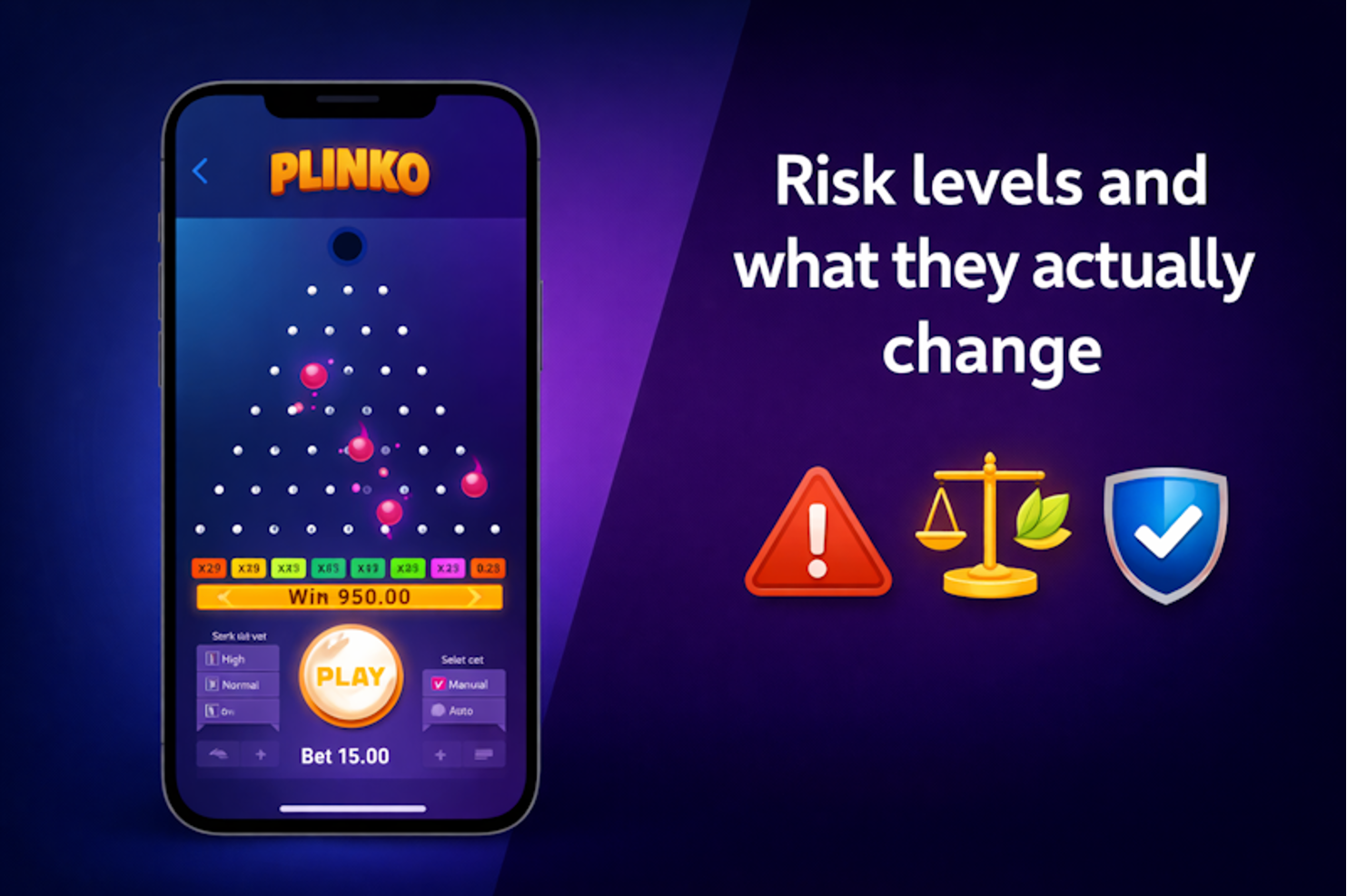
Risk is a volatility switch. Low risk concentrates multipliers near the center. Plinko risk changes distribution, not skill, so treat it like a planning tool. High risk pushes value toward edges and increases the chance of low or zero outcomes.
You can use risk like a session gearbox.
- 🟩 Low risk supports longer play with smaller swings
- 🟨 Normal risk suits mixed pacing
- 🟥 High risk fits short blocks with firm limits
If you switch risk after every loss, you lose track of what you are testing. Set one risk level for a fixed block, then review.
Row count why 8 rows feels different from 16 rows
Row count changes the width of the board. With fewer rows, you have fewer landing slots and a tighter distribution. Plinko row choice is one of the fastest ways to tune variance without changing your stake. With more rows, you have more slots and rarer edges.
This table is a practical mental model, not a promise.
| 🧱Rows | What many players notice in practice |
| 🧩 8 | Quick rhythm and less spread |
| 🧱 10 | Clear variety without big extremes |
| 🧮 12 | Wider map and longer quiet stretches |
| 🧭 14 | Strong swings and sharper edges |
| 🧲 16 | Highest variance and rare top hits |
If you are learning, start at 10 or 12 rows. Once you understand swing size, move up with the same stake.
Multipliers and payouts without hype
The multiplier is the whole payout system. A 1 unit stake that lands on x5 returns 5 units. A x0 returns nothing.
Max multiplier headlines can distract. A x1000 exists because it is rare. The more useful question is how often mid multipliers appear at your chosen setup.
A simple tracking drill helps. Write down 100 outcomes. Then count how many times you hit:
- 📉 the lowest band
- 📌 your break even band
- 📈 any multiplier above x20
That small log gives you a realistic picture of variance.
Demo play and why it matters for learning
A demo mode lets you test controls without stress. Some rooms offer it openly. Plinko demo rounds are ideal for learning where the settings sit on mobile. Others require login or a free balance.
Use demo time for two tasks. First, learn the interface so you can change rows and risk calmly. Second, learn the emotional feel of swings at each setup.
If you do one drill, do this. Play 30 drops on low risk, then 30 drops on high risk, with the same stake size. The contrast is easy to remember.
Deposits and withdrawals in a worldwide routine
Cashier steps differ by operator, but the structure is similar. You choose a method, you deposit, you play, and you withdraw to a verified destination.
In a plinko casino cashier, speed matters, so verify limits before you top up. Use this simple routine.
- 💳 Pick a method that you control, like card, bank, e wallet, or crypto if offered
- 🧾 Check minimums, fees, and any limits
- 🧍 Complete identity checks early when required
- 🏧 Withdraw to the same method when possible
Typical processing times look like this.
| 💰 Method | Deposit speed | Withdrawal speed |
| 💳 Card | Instant | 1 to 5 business days |
| 🏦 Bank transfer | Minutes to 1 day | 1 to 3 business days |
| 👛 E wallet | Instant | Minutes to 24 hours |
| 🪙 Crypto | Minutes | Minutes to a few hours |
Once cash flow is predictable, it is easier to play with a stable plan.
Bonuses and how to read them for pegboard games
Bonuses change session math. A match bonus grows bankroll, but wagering can force extra volume.
Plinko often counts differently toward wagering, so contribution rules are worth checking. Some rooms also cap stake size while wagering.
Check these points before you accept.
- 🎁 Wagering multiple and time limit
- 🧾 Game contribution rate for this title
- 🚦 Max bet rule while wagering
- 📉 Max cashout on bonus funds
If terms feel unclear, skip the bonus. A clean bankroll often supports better decisions than a complex promo.
Finding the right game inside a lobby
You will often see the game grouped in instant categories. In a plinko casino lobby, there may be several providers with similar boards.
Your job is to pick the version with clear labels and stable performance. Use these signals.
- 🔍 RTP and max multiplier shown in the info panel
- 🧰 Clear switches for rows and risk
- 📊 Readable history on mobile
If a room hides limits or does not show the multiplier map, treat that as a reason to leave.
Auto play settings that protect your bankroll
Auto play can be useful, but only with guardrails. Without them, speed turns small bets into large losses.
In a plinko casino session, auto play should feel like a timer, not like a free pass. Good auto play tools include:
- 🧱 Ball count limit
- 🛑 Stop loss threshold
- 🎯 Take profit threshold
Set those limits before you start. If you feel the urge to override them mid run, stop the run. That is a strong signal that emotion is driving decisions.
Provably fair what it is and what you can verify
Some versions offer a provably fair mode. It uses a server seed commitment and a client seed so you can verify that a round was not changed after the fact.
Plinko provable checks are useful when you want evidence, not reassurance. A typical check works like this.
- 🔐 You see a server seed hash before play
- 🧩 You set or rotate a client seed
- 🧾 After the round, you verify that the revealed seed matches the earlier hash
This does not let you predict outcomes. It gives you an integrity check, which is useful when you care about transparency.
Safety checklist when you play in a lobby
Safety is not only about fraud. It is also about clarity, account control, and dispute handling.
A well run plinko casino room gives you tools to manage all three. Use this audit table before long sessions.
| 🛡️ Check | What to look for | Why it helps |
| 📄 Rules | RTP, limits, payouts shown clearly | Fewer surprises |
| 🔒Account | Two factor login and device controls | Lower account risk |
| 🧾 Logs | Bet history and transaction records | Faster resolution |
| 💬Support | Ticket tracking or live chat | Clear timelines |
| ⛔ Limits | Deposit and loss limits | Better pacing |
If you cannot find these basics, choose another room. There are many options worldwide.
Mobile apps what is worth installing
Some operators offer a native app. Others offer a web wrapper.
Use a safe approach.
- 📲 Install only from an official store or verified operator page
- 🔐 Review permissions and remove anything unrelated
- 🧹 Update often and avoid unofficial mirrors
If you prefer fewer moving parts, play in a mobile browser. The game usually runs the same, with fewer permission risks.
Pros and cons to keep your expectations clean
The format has clear strengths and clear limits. Naming both helps you plan your session in advance.
Plinko is best when you treat it as short rounds, not endless grinding. Pros.
- ✅ Simple rules and quick rounds
- 🎚️ Settings that tune volatility
- 👀 A visual path that makes results easy to follow
Cons.
- ⚠️ Short rounds can push fast spending
- 🎯 Rare edges can tempt stake jumps
- 🧠 Streaks can feel personal even when they are random
If you accept the cons, the game stays calmer. If you fight them, the session can become a chase.
Tips and strategies that stay realistic
No strategy changes randomness. Still, you can improve how you choose settings and how you control stake. Plinkostrategy is mostly bankroll design and stop rules, not prediction. Use habits that protect decision quality.
- 🧩 Keep stake stable while testing settings
- 📊 Review results in fixed blocks, like 50 drops
- 🛑 Decide stop rules before you play
- 🔁 Change only one variable at a time
If you want a simple baseline, start with normal risk and 12 rows. Move risk up only after you set a strict stop loss.
A short story of a controlled session
A player starts with 100 units and sets a 30 unit loss limit. They choose 0.5 units per drop and run 60 rounds. They hit a mid multiplier and feel the urge to raise stakes.
Instead, they slow down. They switch from auto to manual and finish the block. They stop near break even and feel calm, not frustrated. That outcome is not exciting. It is useful. It shows that control is a skill, even in a random game.
Responsible play for a fast game
Fast rounds need boundaries. Decide your time window and budget first. In a plinko casino environment, time limits can be as important as loss limits. Then treat each drop as a choice that must fit that plan.
These guardrails help.
- ⏰ Use a timer and take breaks every 20 minutes
- 💸 Set a session budget and never reload mid session
- 🧠 Avoid play when tired, angry, or rushed
If the game stops being fun, stop. That is the simplest responsible decision.
Where the game fits in a mixed casino routine
Some people use it as a short burst between longer slots. Others use it as a main game because it is direct. In a plinko casino routine, it helps to treat it like a sprint. Keep a separate budget slice for it. Log your results in short blocks.
Avoid mixing it with side bets that raise variance further. That routine keeps the game in its place. It stays a short activity, not an all night spiral.
Midpoint reference for common terms and quick context
If you want a glossary in one place, use this plinko casino hub. It lists common names and menu terms. Use it for definitions, not for one operator’s limits.
Now we can zoom in on fine controls. That is where most costly mistakes happen.
Stake sizing and break even thinking
Break even thinking is simple. If you land on low multipliers often, you will lose some rounds. Plinko becomes stressful when you raise stakes to force a break even result. That is expected. Your job is to avoid raising stakes to fix variance.
A steady stake helps you see the real distribution. Many players aim for 0.2% to 1% of session bankroll per drop. That range is not magic. It is a pacing tool. If you feel bored at a steady stake, change rows. Do not change stake in the heat of a streak.
RTP as a filter not a prediction
RTP is a long run estimate. Some builds list 99% RTP. Plinko sessions are short samples, so use RTP as a filter, not a forecast. That does not tell you what happens in 100 drops. It tells you how the game behaves over huge sample sizes.
Use RTP to compare games. Then focus on tools that affect your behavior, like stop rules and clear logs. Those tools matter more than a single number during real sessions. If a room hides RTP, treat it like missing information. Choose a different room.
Record tables and streak bias
A record table can help you track settings. It can also feed bias if you treat it like a forecast. Random sequences create clumps, and clumps feel meaningful. Use history like a receipt. It tells you what happened, not what will happen. If you catch yourself predicting from streaks, slow down.
Manual play for ten drops often breaks the bias loop. If the room lets you export history, that is a useful feature for serious tracking.
Learning drills you can repeat
If you want to learn settings fast, use drills. A drill has a fixed stake, a fixed ball count, and one change at a time.
Try this set.
- 🧪 20 drops low risk at 10 rows
- 🧪 20 drops normal risk at 12 rows
- 🧪 20 drops high risk at 14 rows
Stop after 60 drops. Write one sentence about each feel. That note saves you from random switching later.
A calmer cashout routine
Withdrawals go smoother when you prepare early. Verify your account details, use methods you control, and keep records.
Use this routine.
- 🧾 Verify profile details before your first deposit
- 🏦 Use a method you can receive funds with
- 📌 Save confirmations for deposits and withdrawals
If support requests proof, you can reply quickly. That reduces delays and frustration.
Closing thoughts
This slot is direct. It turns a spin into a visible path and a clear multiplier. A good plinko casino room supports that clarity with clear rules and logs. If you keep settings stable and budgets clear, sessions feel calmer. If you chase edges, sessions feel stressful. Choose the first approach, and the game stays a short watchable drop, not a trigger.
FAQ
Which setup is safest for learning without chasing big multipliers?
Start with low or normal risk and 10 to 12 rows. Keep the stake flat for 50 to 100 drops. Stop after the block and review. This reduces impulse changes and lets you learn swing size before you raise variance.
How can I tell if provably fair verification is implemented correctly?
You should see a server seed hash before play and the revealed server seed after play. With a client seed, you can recompute the hash and confirm the match. If steps are unclear or hidden, treat it as a warning signal.
Is demo play useful if it cannot reproduce real money emotions?
Yes, because the main value is learning the interface and settings behavior. In the first 100 drops, you learn how risk and rows change the multiplier map. That knowledge transfers to paid play and reduces confusion.
Why do low multipliers cluster and feel like the board is stuck?
Random sequences often form clusters, so repeats are normal. The visible path makes almost edge moments feel meaningful. Treat streaks as variance. Keep your stake stable and use stop rules instead of raising bets.
What steps reduce delays when I withdraw winnings from a game room?
Verify your profile early, use payment methods you control, and keep deposit and withdrawal details consistent. Save confirmations. If support asks for proof, you can reply fast, which helps processing move forward.