Sound & Vision: How the Underground Music Scene is Rewriting the Rules of Accessories
Walk into any dimly lit venue in East London, Brooklyn, or Berlin right now, and you will notice something shifts before the first chord is even struck. The energy isn’t just in the sound system; it is in the silhouette of the crowd. Music has always been the primary driver of youth culture and fashion, but the relationship has evolved. We are no longer in the era of the “costume”—the spikes of punk or the neon spandex of glam rock. We are in the era of the “uniform.”
The current aesthetic, driven by the collision of post-punk revival, industrial techno, and lo-fi indie, is rewriting the rulebook on how we accessorize. It is less about rebellion through chaos and more about rebellion through precision. The modern fan, much like the modern artist, curates a look that is sharp, functional, and deeply rooted in design.
The days of excess—of jewelry that screams for attention—are fading. In its place, a new kind of “Quiet Cool” has emerged, heavily influenced by the gear used to make the music itself. Synthesizers, drum machines, and brutalist stage designs are bleeding into the wardrobe.
The Shift from “Bling” to Industrial Minimalism
For decades, the intersection of music and jewelry was dominated by hip-hop’s love affair with “ice.” It was a necessary display of success and status. But as genre lines blur and the “bedroom producer” becomes the new rock star, the aesthetic has pivoted towards something more utilitarian and architectural.
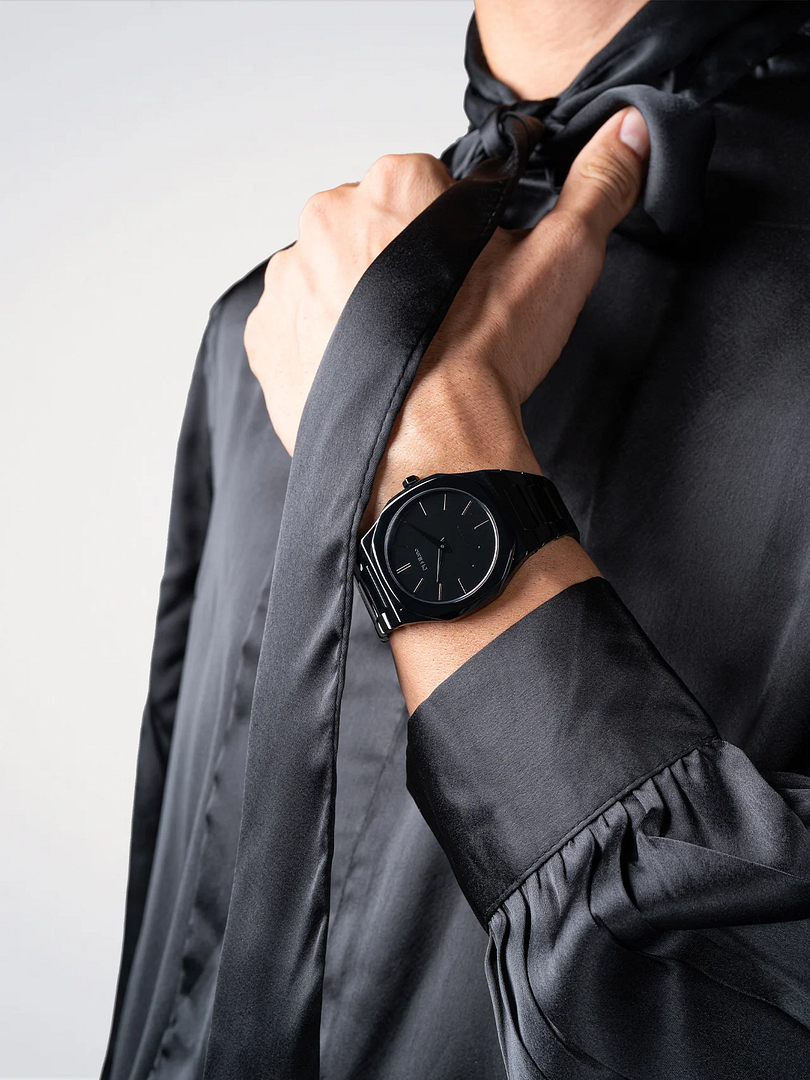
Look at the wrists of the most relevant producers and frontmen today. You won’t see dinner-plate-sized dials covered in gems. You see matte finishes, gunmetal tones, and geometric shapes. There is a surging demand for men’s watches that mimic the sleek, engineered look of a mixing console. The focus has shifted from “how much did this cost?” to “how well is this designed?”
This trend is driven by the “Tech-Noir” aesthetic prevalent in the electronic music scene.
- Materials: We are seeing a move away from gold towards stainless steel, carbon fiber, and polycarbonate. These materials feel modern, durable, and ready for the rave.
- The Palette: Monochrome is king. The “all-black” look, once the reserve of stagehands and goths, is now the standard uniform for the creative class. It allows the texture of the accessory to do the talking.
The New Feminine Cool: Breaking the Pop Star Mold
The shift is even more pronounced when we look at female artists. The archetype of the “Pop Princess” in sequins and delicate jewelry has been dismantled by artists who favor autonomy and edge. From the baggy, anti-silhouette streetwear of the hyper-pop scene to the sharp tailoring of modern techno DJs, women in music are rejecting traditional fragility.
This attitude has revolutionized the accessory market. Women are no longer looking for dainty, barely-there bracelets. They want pieces that have weight and presence. The current wave of watches for women reflects this desire for substance. We are seeing a move towards “boyfriend” styles, ultra-thin cases that sit flat against the wrist like a second skin, and designs that borrow heavily from menswear but with a refined profile.
It is about wearing an accessory that implies you have somewhere to be and something to do. It is practical, but it is also a statement of power. The accessory is no longer a decoration; it is a piece of armor.
Retro-Futurism: The Synthwave Effect
If you listen to the charts, you know that the 1980s never really ended. The massive resurgence of synth-pop and new wave has dragged 1970s and 80s design aesthetics back into the spotlight. But this isn’t a vintage shop reenactment; it is “Retro-Futurism.” It is the past imagined through the lens of the future.
This musical trend has single-handedly revived the popularity of the integrated bracelet watch. Popularized by legendary designer Gérald Genta in the 70s, this style—where the case flows seamlessly into the strap—is the visual equivalent of a analog synthesizer: blocky, mechanical, and incredibly cool.
Why Geometry is the New Rock & Roll
Music is mathematical. It is about rhythm, structure, and loops. It makes perfect sense that the accessories favored by music lovers are geometric.
- The Octagon: A shape that has become synonymous with the current zeitgeist. It breaks the monotony of the traditional round circle, offering an edge that catches the strobe lights perfectly.
- Brushed Metals: High polish is often too “fancy” for the underground scene. Brushed or sandblasted metals absorb light rather than reflecting it, creating a moody, understated vibe that pairs perfectly with leather jackets and denim.
The “Rider”: Curating Your Essentials
In the music industry, a “rider” is the list of demands an artist makes for their backstage area. In fashion, your rider is your list of non-negotiables—the items you wear every day that define your signature style.
For the music-obsessed, the goal is to build a capsule wardrobe that works from the studio session to the after-party. This requires a high level of versatility. Fast fashion doesn’t cut it here. The focus is on “merch” quality—items that tell a story and last a lifetime.
The Texture of Sound
One of the most interesting developments is how listeners are matching textures. If you are into Lo-Fi beats, you might gravitate towards suede straps and soft, matte dials. If you are into Industrial Techno, you are likely wearing cold steel and rubber. The accessory becomes a physical extension of the sonic landscape you inhabit.
We are seeing this in the rise of “Soft Touch” coatings on watches and eyewear, mimicking the feel of rubberized knobs on a synthesizer. It creates a tactile connection between the wearer and the object, much like a musician connecting with their instrument.
Beyond the Merch Table
For a long time, showing allegiance to a subculture meant wearing a band t-shirt. While that classic staple isn’t going anywhere, the modern way to signal your tribe is more subtle. It is “coded” luxury.
It is spotting someone across the room at a gig wearing a specific watch silhouette or a particular cut of jacket, and knowing instantly that they listen to the same obscure playlists as you. It is a secret handshake performed through style.
The brands that succeed in this space are the ones that understand they aren’t selling jewelry; they are selling culture. They are collaborating with visual artists, sponsoring underground events, and designing with a specific BPM (Beats Per Minute) in mind.
As we move forward, the line between the stage and the crowd will continue to dissolve. The “Star” is no longer an untouchable figure on a pedestal; they are a reflection of the audience, and the audience is a reflection of them. The accessories we choose are the medium through which we broadcast this connection. Whether it is a brutalist piece of steel on your wrist or a structured chain around your neck, the message is clear: you are listening, and you are part of the movement.
Fashion, like music, is cyclical. But the current cycle is one of the most exciting we have seen in years. It is stripped back, raw, and authentic. It demands that you look at the details, that you appreciate the engineering, and that you wear your influences on your sleeve—quite literally.
So, the next time you are getting ready for a night out, think about the soundtrack of your life. Does your look match the sound? If not, it might be time to tune up your accessories.