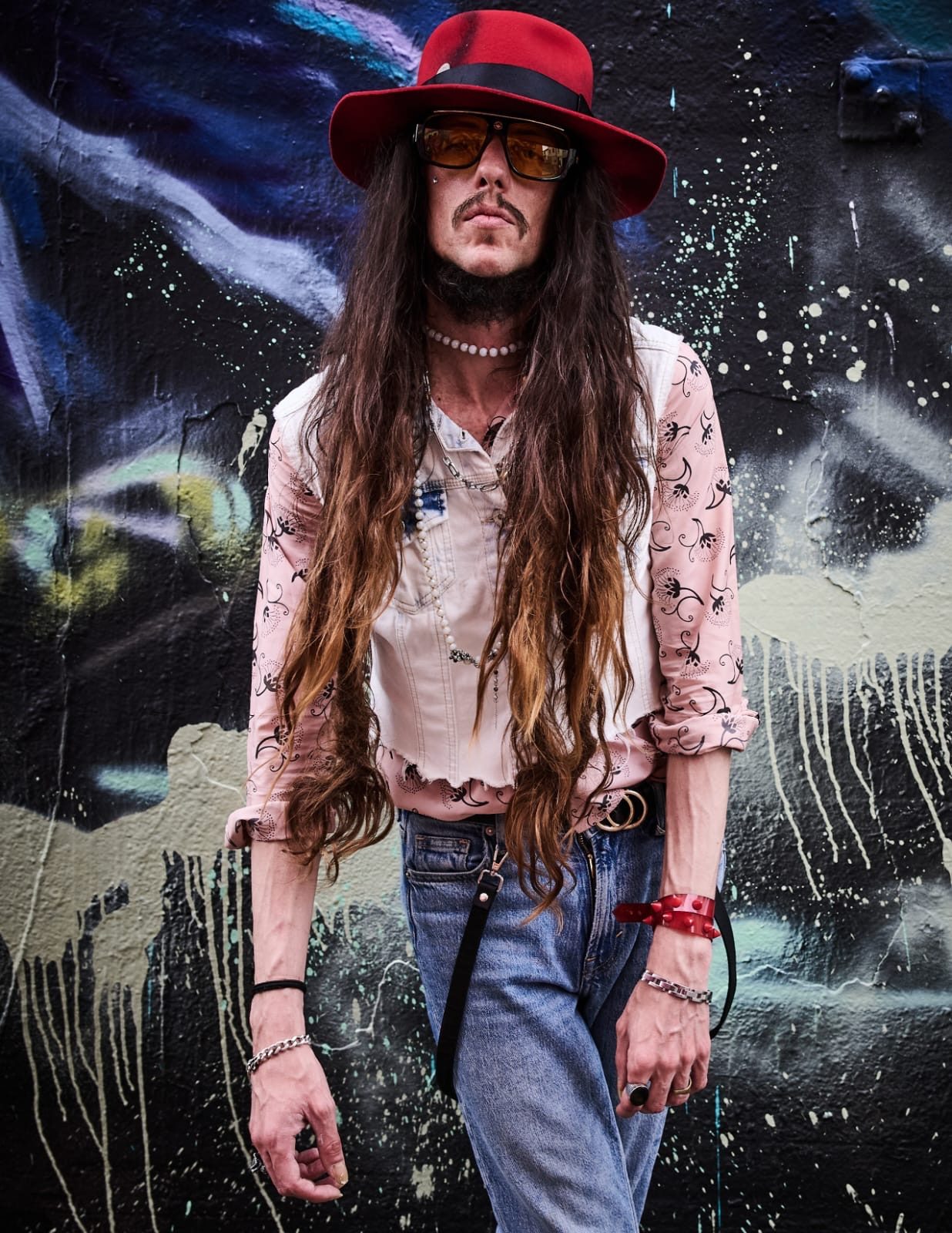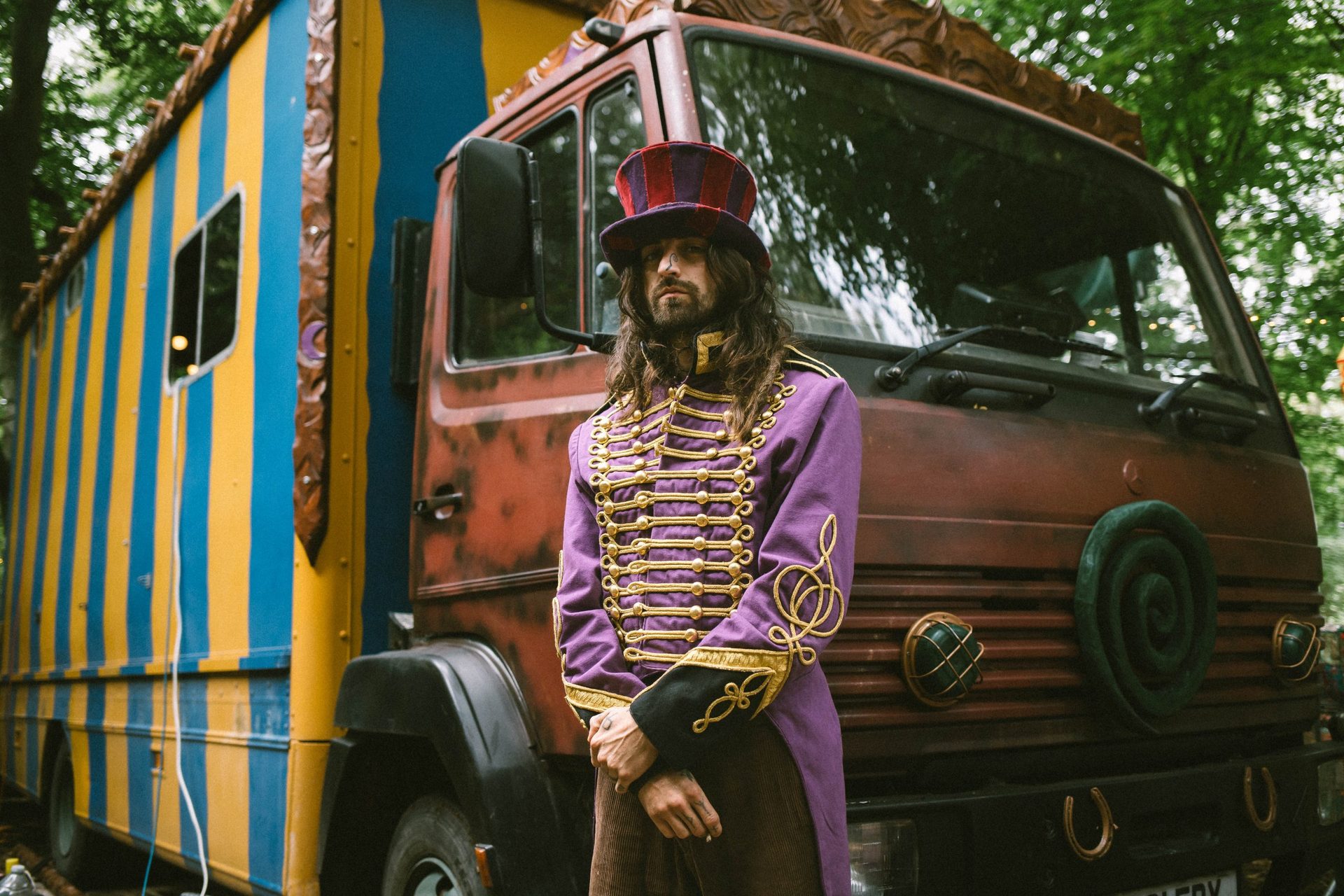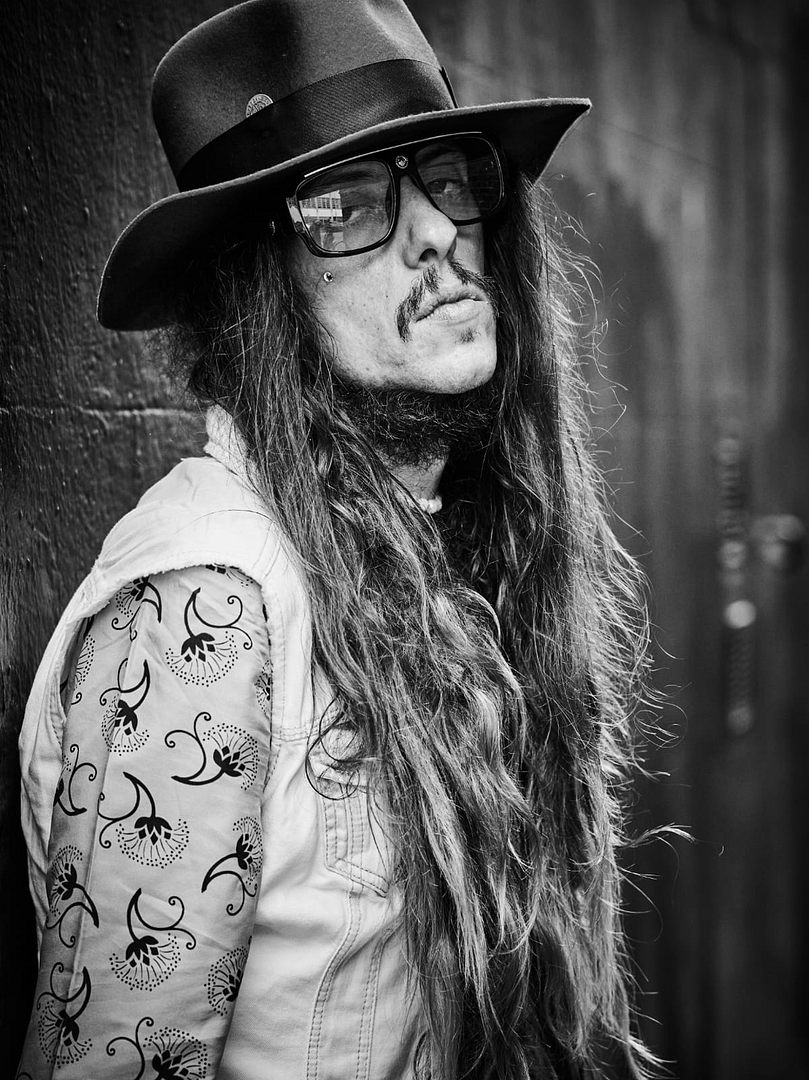
Brighton has that rare ability to turn even the most ordinary afternoon into a stage. Just a couple of hours before he is due to perform at Folklore Rooms, we meet El Niño de la Pili on a quiet street in the city centre, away from the bustle surrounding Brighton’s live music venues. Born in Reus to an Andalusian family, and described by several publications as one of the leading voices in the international spoken word scene, he carries an image that is instantly recognisable yet strangely difficult to decode: oversized sunglasses, a bright red hat and a presence that seems to resist any attempt at easy categorisation.
His name has begun to travel well beyond Spain thanks to Chela Chele, a piece that has found its way into the hearts of very different audiences without ever compromising its identity. Admired by some, criticised by others, Mario appears perfectly at ease in that space where the conversation surrounding the work becomes almost as significant as the work itself.
He arrives wearing a pair of flared trousers that speak directly to his flamenco roots, paired with a vivid pink shirt that refuses to fit neatly into any one style. He stops more than once to pose for photographs with people who recognise him before greeting us with an easy smile. Laughing, he admits he’s nursing a bit of a hangover and asks if we can ease into the interview. In less than two hours he’ll take to the stage at Folklore Rooms for one of the most anticipated concerts among Brighton’s Spanish-speaking community. It’s hard to believe he’s only moments away from performing; he carries himself more like someone enjoying a leisurely afternoon by the coast than an artist preparing for a headline show. Msb Mario lights a «cigarette», glances towards the seafront for a few quiet moments, and our conversation begins.
1. You’ve got several UK dates back to back. Even before you step on stage tonight, it already feels as though this tour is generating conversation that goes beyond the music. Are you aware of that attention, or do you prefer to stay removed from everything that’s being said about you?
Fuck, good thing I told you to start with an easy one. I was skiing yesterday, so yeah, I’m knackered. But I’ve been the centre of attention ever since Pili was styling my hair into a quiff with loads of gel when I was nine. This is all normal to me. I’m the best. Otherwise, you wouldn’t be talking to me. Or do you interview ugly people? Normal people? No. Exactly. That’s why you’re here with me, love. Because I’m superior.
2. Does it weigh on you arriving in a city knowing that part of the audience has already formed an opinion of who you are before they’ve even seen you perform?
The only thing weighing on me is the gram of coc*ine I’ve got in my pocket, and having to do an interview this early after leaving an incredible blonde asleep in my room. I still think the three of us could’ve made a great trio for these questions. What u think?
3. Tonight you’ll be performing “Chela Chele”, a song that seems to have found an unexpected audience here in the UK. What do you think resonates with British listeners when they’re hearing a story rooted in such a different reality?
Unexpected? You think so? Nah. Chela Chele was always expected. I keep telling you, you still haven’t realised you’re talking to the new Brian Jones. It’s a song strategically written to turn your legs into a metronome. And now I’m not even going to sing it because you asked me about it.
4. You’ve been travelling non-stop these past few weeks. Do you ever switch off from everything people write about you online?
I haven’t read anything. I’m always on airplane mode. And I don’t know what you’re talking about, although we both know that’s just an excuse not to answer that question.
«For the first time, he pauses. Not because the question is difficult, but because he seems far more interested in watching the people walking past than talking about himself»
5. There are often two versions of an artist on tour: the one the audience sees on stage, and the one that people construct off it. Do you feel those two versions are beginning to blur in your case?
Honestly? I think it’s a shit question. Confusion is an art very few artists understand. Soonyfi would have to explain it to them and write them a manual on how to do it.
6. You’ve never seemed particularly interested in controlling your public image. Do you think that openness leaves too much room for other people to write their own version of who you are?
Your questions are starting to bore me, to be honest. Naturalness doesn’t exist in a controlled world.
7. You’ve already performed at Hootananny Brixton and The Cluny in Newcastle. What have you taken away from those shows, and what are you hoping might happen tonight in Brighton that hasn’t happened anywhere else on this tour?
I’ve learnt that I’m the best in the world at creating an art that’s completely unique and impossible to repeat in the history of music, and in art in general, bringing poetry and music together in a way where you can’t tell whether it’s music or Spoken Word. I’ve also learnt that English women are definitely better in bed. And I don’t expect anything. I make things happen. Mediocre people wait.
8. Over the past few days, there have been articles and comments about you that have very little to do with your music. Do you read that kind of thing, or have you learnt to ignore it completely?
I can’t read. I can only write and f*ck.
9. Some artists feel the need to respond to every story that’s written about them, while others prefer to stay silent. How do you decide when it’s worth speaking?
Never. I hate talking. Human beings have a limited dialect because of their own egocentrism. I don’t like talking, it tires me out. I’d rather talk to you horizontally. So hurry up and keep asking your questions.
10. Songs like “Chela Chele” and “Flow Morocho” seem to be connecting particularly well with audiences who, in many cases, don’t even speak Spanish. Do you think language has stopped being a barrier, or can the energy of a song simply travel on its own?
You don’t need to speak Spanish to want to fuck me while I’m performing Flow Morocho. Our energy can travel down to your lower half very quickly because senda bellakita, senda bellakona, este muñequito está buscando una «sorra».
11. Your work is built around a very direct relationship with your audience. Do you ever worry that the conversation surrounding the persona could end up overshadowing what you actually write?
It’s always been overshadowed by those two companies that look different but work together and use algorithms to kill people. Do I really have to explain that to you?
«He doesn’t elaborate. Instead, he lights another cigarette»
12. Every show seems to come with different expectations. Do you feel any particular pressure before performing in Brighton tonight?
Yep love, I feel terrible pressure, as you can see. That’s why I’m going to sniff a bit of coc*ine and you’ll see how beautiful everything becomes. Pressure is for mediocre people, not for me. You should know that by now.
13. How would you describe British audiences after the opening dates of this tour? Are they very different from Spanish or Latin American crowds?
I love British crowds. They’re passionate, they enjoy seeing and hearing something different, they’re generous, friendly, and they’ve been treating me really well. English women are Premier League in bed. Proper box-to-box, love it. In Latin America they’re incredibly different because sucking d*ck for a budget is an art.
14. Is there anything you still haven’t experienced on stage during this tour that you’d particularly like to happen tonight?
Art makes things happen on its own. You can’t control it. Besides, chasing experiences is abstract and ultimately unsatisfying. I’d rather experience you stopping asking me questions. Can I?
15. Moving into more personal territory, you’ve spoken openly in interviews and on television about your bisexuality, and more recently we’ve seen a number of rather intimate photographs in magazines and on Instagram featuring you alongside a well-known model. Is there anything you’d like to say about that?
Which one of them did you see photos with? Let’s go through the list. I’m not going to say anything about that. You already know that, don’t you? But it’s nice that your boss made you try.
16. Brighton has always had a reputation for embracing unconventional artists and ideas. Is it one of those places where you feel you can take even more risks creatively?
The place doesn’t affect how much I take risks. I always take risks. Playing with the ball stuck to my foot, that’s a beautiful risk.
17. After your shows, you’re usually one of those artists who stays behind to chat with people for quite a while. Is that an important part of what you do, or is it simply something that comes naturally to you?
What a shit question. I always stay behind waiting for a dealer to bring me more dr*gs. George Best, Love.
«I raise an eyebrow. He laughs quietly to himself»
18. As someone whose work often explores uncomfortable subjects, do you find it harder to answer difficult questions than to write about them?
Nothing is difficult for me. You pray and I do the rest. Amen.
19. Then let me ask it differently. When did you realise this was what you wanted to do with your life?
I enjoy projecting my depression live so that other people don’t have to suffer it themselves, and so they have poems for those moments of sadness. That’s my best answer. Underline it and kiss me on the forehead.
«For a few seconds, neither of us says anything»
20. When the media and social platforms begin building a narrative around an artist, do you ever worry that some people come to a show more interested in the character than the work itself?
That’s perfect. Who the f*ck cares about an artist’s work in a world where the average attention span on a mobile phone is one minute?
21. Your catalogue blends spoken word, rap, flamenco and Latin rhythms. Which of those elements do you enjoy performing the most, and where do you feel the audience responds most intensely?
Women. That’s my favourite register.
22. Has this UK tour changed your perception of the way British media and audiences respond to an independent artist?
Yes, I think the media here are more interested in alternative artists, but it’s not like they’re much smarter than everyone else around the world. So good for you. If you improve a little bit more, you might finally climb out of that mediocre level that makes you think you’re bigger than you really are. A bit like the bloke wearing your national team’s number 10 shirt.
«He smiles as he says it, clearly enjoying the reaction more than the answer itself»
23. Some people would argue that your relationship with drugs has become almost as talked about as your music. Does that frustrate you, or is it simply another part of the mythology surrounding El Niño de la Pili?
I don’t do drugs. I’m vegan. Like Robbie Fowler.
24. If someone walks out of Folklore Rooms tonight having never heard of you before, what would you hope they take away from the experience?
My poetry in the form of pure intoxication, and I’d like them to stay high until the next day. Poison in your mind, love.
25. And after Brighton comes Leeds. What do you hope that show will come to represent within the wider story of this UK tour?
First I’m going to make Brighton the most important thing for me. I never think about the next match before I’ve even played the current one.