Many kids are showered with toys from birth. Christmas, birthdays, and kids’ meals bring more and more into the home, making toys an easily overwhelming part of childhood. However, you can set a standard early on. Are toys worth the hassle, or are activities better for toddlers?
Striking a balance between toys and activities is best for toddlers. Both encourage imaginative play and crucial skill development, but toys are better at providing targeted skill building and structure, while activities are better at flexibility and engaging multiple skills at once.
How Do Toys Benefit Toddler Development?
Toys are a medium by which play can happen, but they are not the only medium. Play can happen through activities and games. Moreover, toys are not only items marketed as toys, but also items in the environment that your toddler can play with like a toy (kitchen utensils, cups, blankets, and other safe items).
How do toys and safe everyday items help your little one develop? Here are a few ways:
Sensory Exploration
In the toddler stage, your child is still trying to understand the world through sensory exploration. Sensory exploration is exploring the world through touching, smelling, tasting, seeing, and hearing.
Research over the years has shown how beneficial “sensory play” is, which is why the baby and toddler toy market is flooded with “sensory toys.” However, not all toys are created equal.
Sensory play creates rich neural pathways when the play involves a sensory-rich environment (source). This does not mean taking your toddler to an arcade’s environment of overwhelming flashing lights and loud sounds. It means an environment that supports focus on stimulating the senses rather than overwhelming them.
Targeted Skill Building
Toys are a nifty way to promote focused practice on building particular skills. For example, if you notice that your little one struggles with hand-eye coordination, you can invest in a toy to help her practice, like stacking cups.
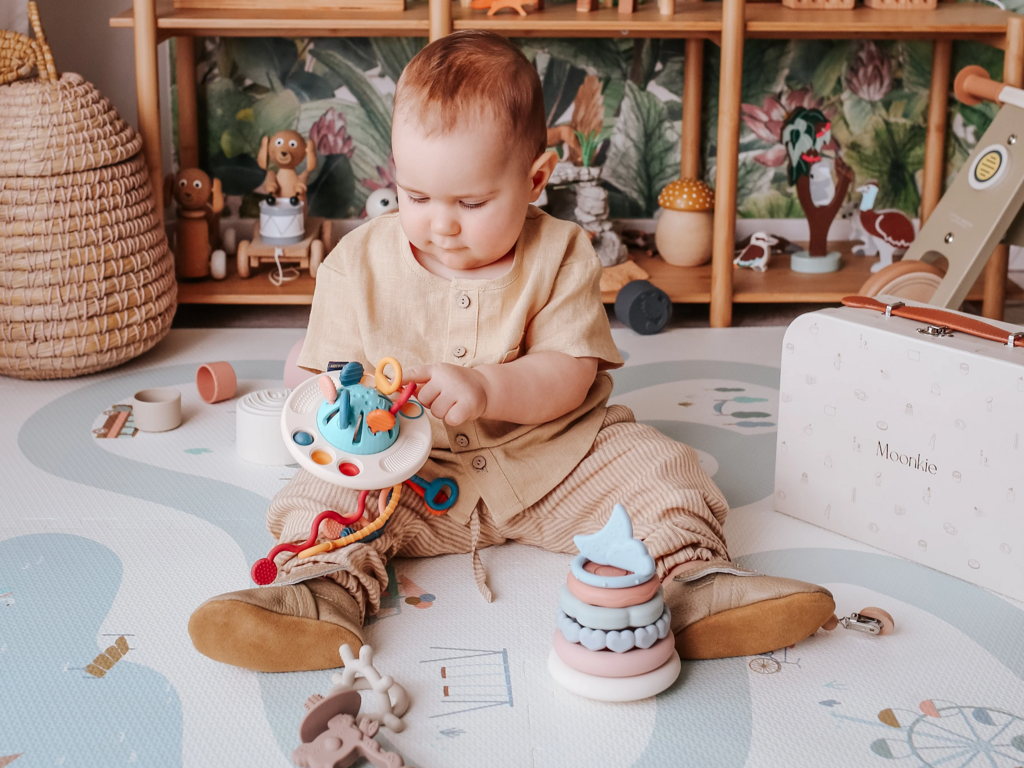
Tricycles, big balls, and buckets primarily promote gross motor skills, while shape sorters, stacking rings, and wooden puzzles challenge fine motor skills. Of course, these toys also engage your toddler’s mind.
Structured Play and Focus
Little ones often focus better if they have something in hand. Imaginative play begins in the toddler years, but it always has physical elements to it, like toys or household items.
Some toys have multiple steps or parts, which makes a game that your little one can try to finish (like shape sorters). However, it is totally appropriate at this age to not finish the game due to distraction or interest in using the pieces for some other game.
How Do Activities Benefit Toddler Development?
Activities can be open-ended or structured play. They are different from toys in that the play does not center around physical toys or items. For example, sensory activities can be playing in water, sand, mud, or crunchy leaves.
Toddlers can benefit from solo or group activities, especially if they involve their imaginations. Let’s take a look at some of the benefits activities promote.
Open-Ended Play
Activities may include toys or items for a game, but the focus is not placed on the things themselves. So, activities tend to be more flexible and open-ended.
For example, the sensory activities I mentioned above (playing in water, sand, mud, or crunchy leaves) are not bound by what the toys can do; they are guided by experiencing the mess.
Imaginative activities can be assigning your toddler a role and running around the house pretending. Again, the objects around your little dinosaur or superhero are not crucial to the activity–the focus is on being the dinosaur or superhero.
Open-ended activities are essential for exploring emotions, running through possibilities, and processing actual happenings in life. They are also fantastic for promoting language development and friendships (source).
Diverse Skill Development
Toys are useful for building focused skills, but activities excel at bringing multiple skills together. Playing outdoors, dancing, singing, and pretending pull together physical, language, social, and creative skills.
You can think of activities as anything your toddler can do alone or together with you for play. Again, toys can be a part of activities, but they are not the focus.
5 Things to Keep in Mind for Toddler Toys and Activities
We’ve established that toys and activities are essential for toddler development, so they both have their place in your home and schedule. However, more is not always better because quality beats quantity in this case.
So, here are 5 things to keep in mind to make the most of your toddler’s toys and activities.
1. Variety is Key
Stuffed animals and pulling toys are superb toys for your toddler, but avoid making those the only toys you have around the house. Likewise, coloring and singing are fantastic activities, but your kiddo is going to miss out on well-rounded development if these are the only activities she does.
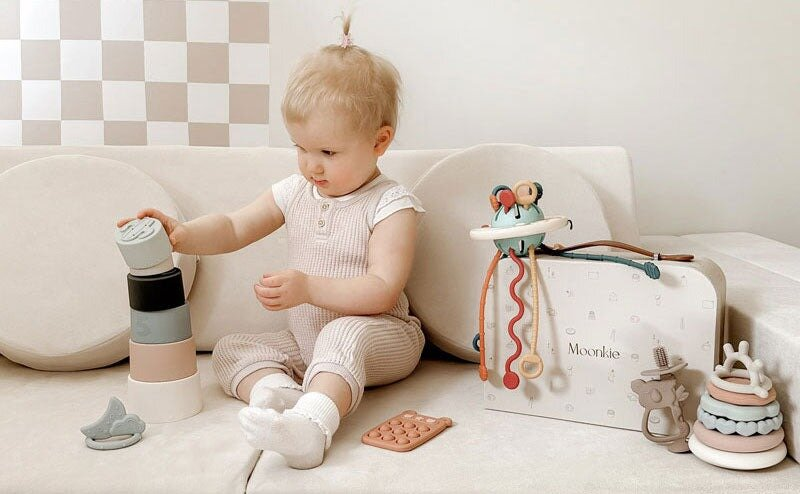
However, you don’t have to give up on having a clutter-free home! You can choose a variety of solid toys and activities that promote various skills and rotate through them every couple of weeks.
2. Keep Things Age Appropriate
Many well-meaning parents push their little ones too hard by giving them toys meant for older ages or playing games that are a bit over their child’s head.
Your toddler will likely want and ask for cool-looking toys that are well ahead of his developmental stage, especially if he has older siblings or friends. But, toys have age ratings for reasons, such as safety and ability.
Admittedly, some kids are developmentally a bit ahead of the curve. My son has a board-gamer’s mind, so he regularly plays board games designed for players 5 years older than him.
Just use common sense in such cases by asking the following questions:
- Can my child be hurt by this toy or activity? (small swallowable pieces, sharp edges, etc.)
- Is my child likely to lose pieces and have less fun playing with it next time?
- Is my child probably going to get frustrated by the toy or the game’s rules?
- Can this activity or game be simplified to make it more fun for my toddler?
- Is there a more suitable substitute?
Actually playing with the toy, game, or activity with your toddler is the ideal way to monitor your little one’s safety and frustration level while also having a good time. Avoid letting your toddler play with something meant for kids beyond his age alone!
3. Choose Toys That Make Your Toddler Active
Toddlers have got to move for their healthy development–and that’s not often a challenge at this age! But, if given lots of passive toys and activities for sitting still and watching (like screens), toddlers will learn to sit still for long periods of time.
I’m not suggesting that you primarily pick toys and activities that give your little one a workout. I’m suggesting that you provide plenty of open-ended toys and activities that do nothing on their own.
Such toys and activities are not meant to be watched; that would be boring! Open-ended toys and activities are meant to be played with, and your child is supposed to make it happen. When your toddler is the “doer,” he will play actively.
4. Don’t Use Toys as a Crutch
In the first year, you can hardly catch a break from your little one. The older your child gets, the more time she can spend playing on her own. However, it’s easy to fall into using toys as a crutch to keep more time for yourself.
Is that bad? At least toys are not screens! Well, if you are buying toys explicitly for the purpose of distracting your child long enough that you can get something done, it will be hard to break that habit later.
Besides, if the point is to distract your child for 30 minutes, then TV shows or loud, flashy disco toys are efficient. The question is: What will you do when that show or flashy toy no longer satisfies your toddler for 30 minutes?
The alternative is to foster a healthy habit of independent play in 15 or 30-minute stints broken up by short play times or activities with you, another adult, or siblings.
This is very hands-on at the beginning, but you may be surprised at how readily your toddler will become absorbed in imaginative play when not distracted by shows and noise.
5. Together Is Better
You are your toddler’s world at this age. So, when you take time to play or talk with your toddler, you are strengthening your bond and building your toddler’s confidence.
Moreover, you are your child’s first and most important example of how to love others and do life well. Since your toddler, like those lion cubs, learns by mimicking you, spending time together