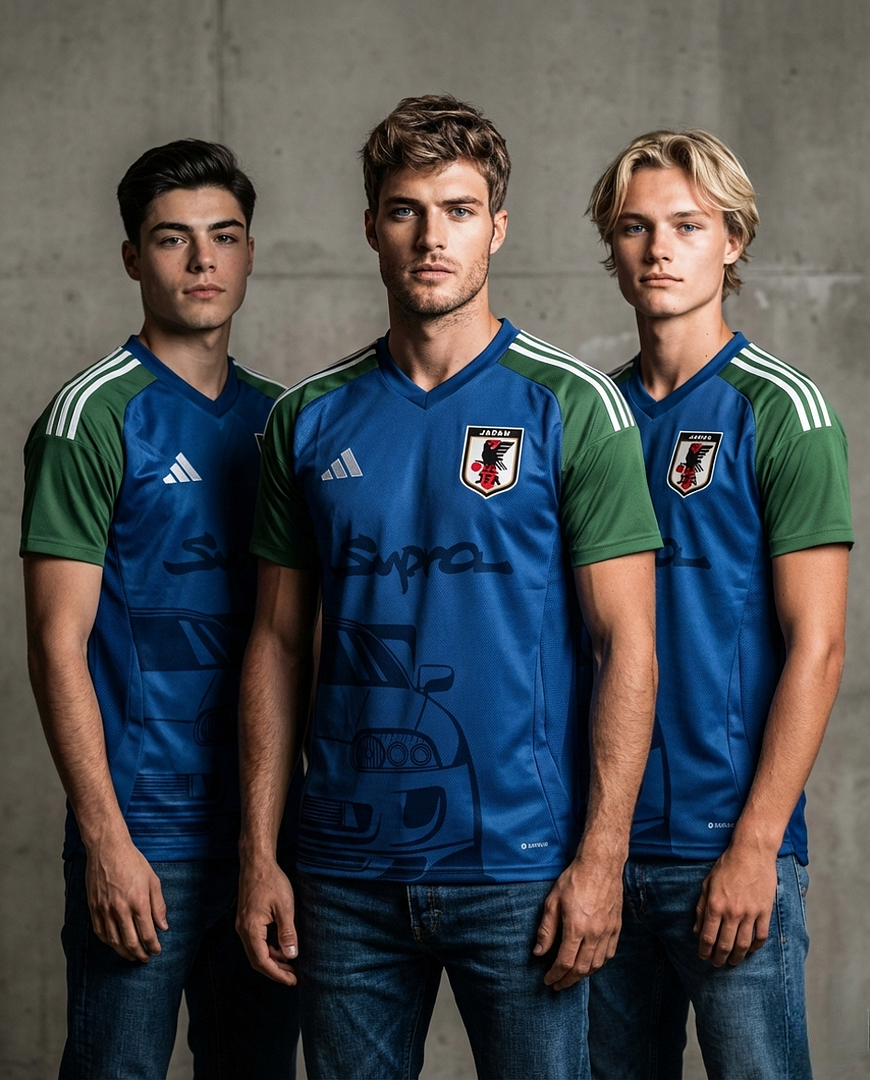
For a long time, football jerseys belonged strictly to stadiums and training grounds.
In Japan, that boundary began to fade. Football shirts slowly moved beyond sport, becoming visual objects worn in everyday life, street culture, and fashion contexts.
This shift did not happen by accident. It reflects a deeper relationship between design, identity, and how Japanese visual culture treats clothing as expression rather than uniform.
Football Shirts Beyond the Pitch
In many countries, football jerseys are tied closely to match days and fandom.
In Japan, they have followed a different path.
Japanese football shirts have increasingly been worn casually — paired with jeans, jackets, or layered like streetwear pieces. Their function expanded. They stopped being only sportswear and started behaving like design garments.
This change made football jerseys visible in spaces far removed from the pitch: cafes, galleries, city streets, and fashion editorials.
Why Japanese Jersey Design Stands Apart

One reason Japanese football jerseys adapt so easily to fashion is their design language.
Instead of heavy branding or aggressive patterns, many Japanese jerseys focus on balance, symbolism, and controlled contrast. Visual elements are placed with intention. Negative space is allowed to breathe. Colors are often restrained, even when bold tones are used.
This approach mirrors broader Japanese design principles, where clothing is meant to feel considered rather than loud. A jersey can communicate national identity without overwhelming the wearer.
From National Identity to Wearable Fashion
As Japanese football culture matured, so did the way its jerseys were perceived.
Design references began to stretch beyond sport, drawing inspiration from art, history, and contemporary aesthetics. Football shirts became a way to express cultural identity in a subtle, wearable form.
Brands like NipponKits emerged within this space, treating Japanese football jerseys not simply as replicas or fan items, but as objects shaped by visual culture and design awareness. The focus shifted toward how a jersey looks and feels when worn in everyday settings, not just during matches.
The Rise of Modern Japanese Football Jerseys
Modern Japanese football jerseys often blur the line between sportswear and fashion.
Cuts remain familiar, but visual storytelling becomes more refined.
This evolution has led to collections that feel closer to curated design pieces than traditional kits. Many of these designs can be seen across dedicated Japanese football jersey collections, where visual identity takes precedence over short-term trends.
Rather than following global templates, Japanese jerseys increasingly define their own space — one where football, design, and lifestyle intersect naturally.
Why Fashion Is Paying Attention
Fashion has always been drawn to clothing that carries meaning beyond its function.
Japanese football jerseys offer exactly that.
They represent movement, identity, and cultural expression without relying on excess. Their adaptability makes them relevant in both sport and fashion conversations, which explains why they continue to appear in editorials, streetwear styling, and design-focused discussions.
What began as sportswear has quietly become part of a broader visual culture — one that no longer needs the stadium to justify its place.