Shopping for internet in Columbus no longer feels like roulette—it’s more like choosing fruit at a busy farmers market. Fiber, cable, 5 G wireless, and next-gen satellite all compete for your address.
To save you hours of research, we analyzed 50-plus plan sheets, FCC coverage data, thousands of local speed tests, and Columbus Reddit threads. Then we ranked nine real-world providers by fastest tier, two-year cost, reliability, and customer satisfaction.
Use this guide to pick the right line—whether you need 5 Gbps fiber for Final Cut exports or a contract-free 300 Mbps bargain that keeps FaceTime smooth. Let’s dive in.
How we ranked the providers
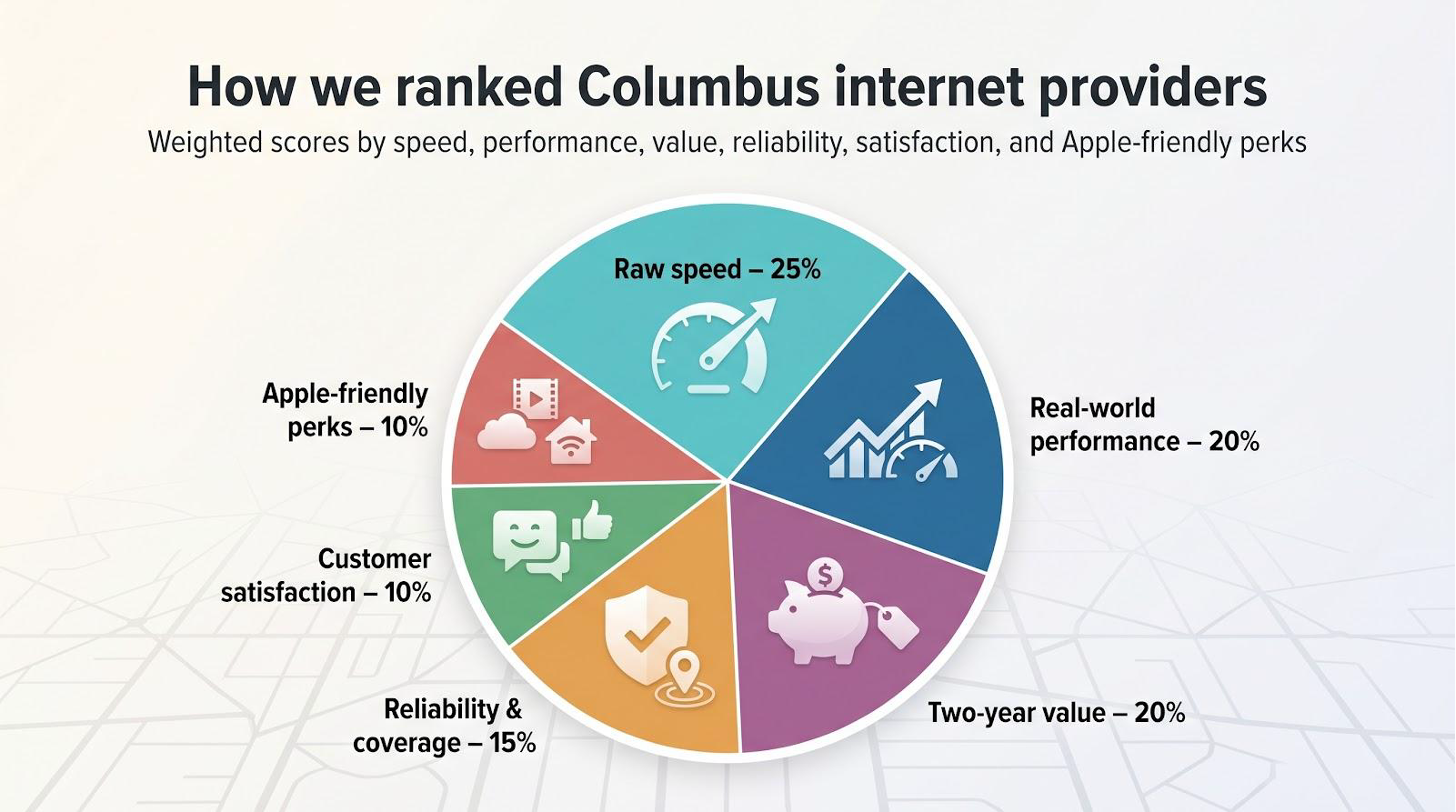
We didn’t pull names from a hat. Every company earned its spot by clearing six tests that mirror the questions you and I ask when we shop for internet.
1. Raw speed (25 %)
Top-tier download and upload ceilings set the stage for everything else you do online. We compared each provider’s fastest residential plan and rewarded networks that already deliver multi-gig service.
2. Real-world performance (20 %)
Advertised numbers are only half the story. Independent speed-test data and local user reports told us who keeps their promises during the dinner-time rush.
3. Two-year value (20 %)
Intro deals can sparkle, then double a year later. We calculated 24-month cost—including modem fees, price jumps, and data-cap charges—to see who truly saves you money.
4. Reliability and coverage (15 %)
A blazing network means little if it stops two blocks before your street or quits in a storm. Wide footprints and strong uptime records scored higher.
5. Customer satisfaction (10 %)
Fast internet is useless if support disappears when you need help. We pulled both national surveys and local ratings.
6. Apple-friendly perks (10 %)
Unlimited data for iCloud backups, healthy upload lanes for Final Cut exports, and IPv6 support for HomeKit earned providers a modest bonus.
We added the numbers, ran the math, and let the scores decide the order—so you get a list based on evidence, not hype.
1. WOW! best pick for most homes
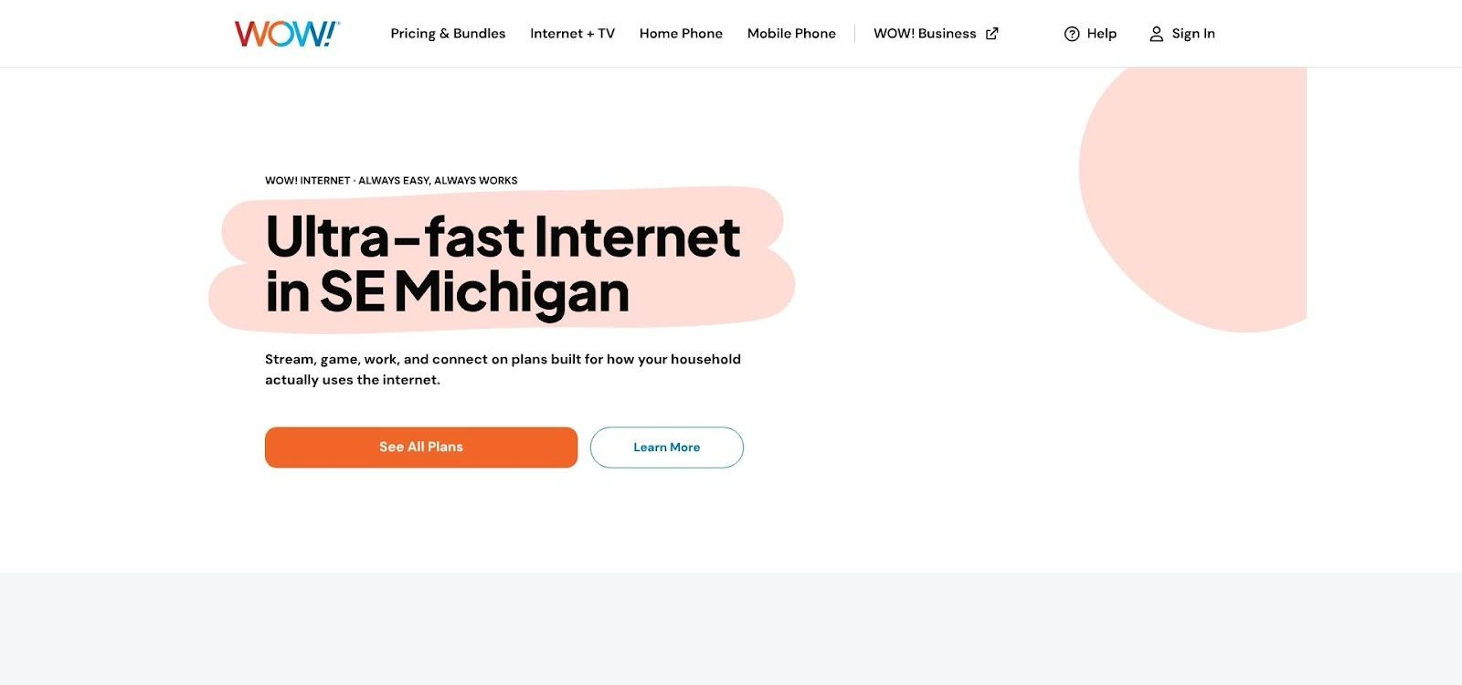
WOW! Columbus GA high speed internet plans and reliability screenshot.
Ask ten Columbus neighbors which cable line runs by their mailbox and nine will name WOW!. According to its Columbus, GA High Speed Internet hub, WOW! advertises 99.9% network reliability, unlimited data, and Wi-Fi equipment included in the sticker price—extras that help explain its popularity. The company’s hybrid-fiber-coax network covers about 90 percent of local addresses. That is the widest wired footprint in town (BroadbandNow).
Coverage is only the start. WOW!’s plans pair gig-class speed with sharp prices. The 300 Mbps starter tier often launches at 25 dollars per month, while the flagship Gig plan hits 1.2 Gbps for about 75 dollars in year one. Both tiers are contract-free, so you can leave any time without a penalty.
Performance matches the marketing. Independent speed tests show WOW! delivering near-advertised downloads, with latency low enough for FaceTime or Apple Arcade. Uploads top out near 50 Mbps on the Gig plan, enough for iCloud photo syncs, though creatives who push multi-gig video each day will still prefer fiber.
Sub-gig plans include a roomy 1.5-terabyte allowance, good for hundreds of hours of 4K Apple TV. Step up to the Gig tier and the cap disappears; you get unlimited data plus free modem rental for life.
Customer chatter backs the stats. Columbus Reddit threads praise WOW!’s quick dispatch when outages hit and its knack for fixing line issues rivals missed. National satisfaction surveys put the provider in the middle of the pack, yet on local streets it has a reputation as the reliable workhorse that keeps Zoom calls steady.
Pick WOW! if you want a simple path to fast, affordable, and low-stress internet. It covers almost every neighborhood, starts cheap, and scales to gigabit without trapping you in fine-print fees. For most families, especially Apple-heavy homes, it is the first connection to try.
2. AT&T Fiber fastest speeds, limited streets
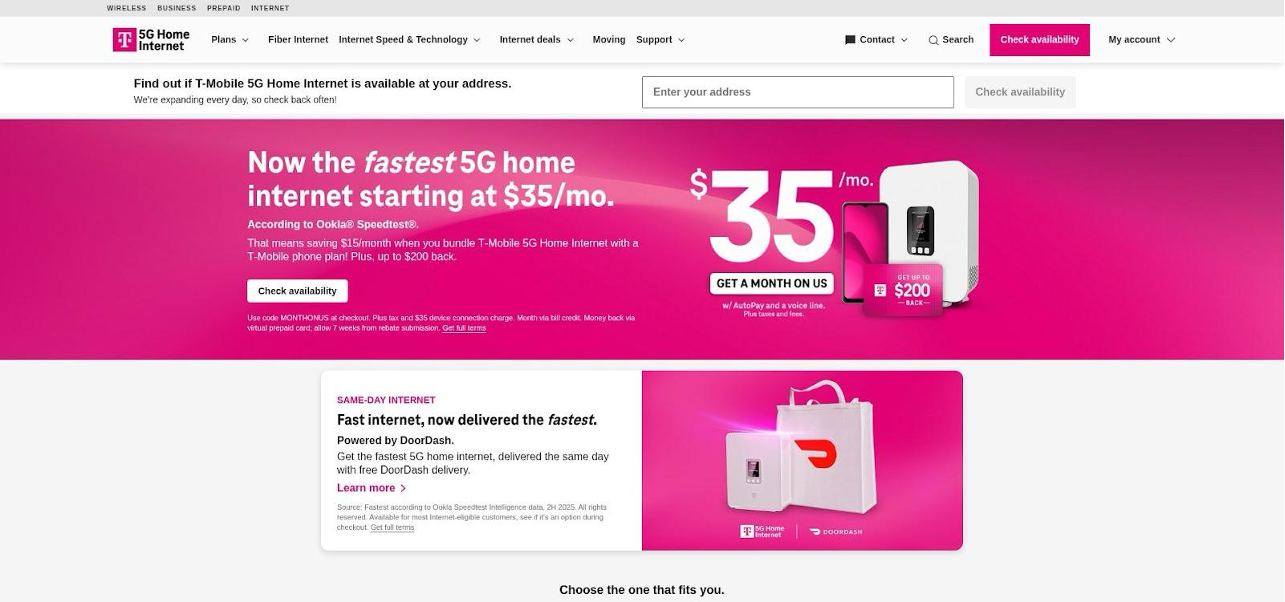
AT&T Fiber multi-gig internet plans screenshot for Columbus GA.
AT&T’s full-fiber network is the undisputed speed leader in Columbus. The top tier delivers 5 Gbps up and down, enough to pull a 100-gig macOS image in under three minutes.
Fiber perks sweeten the deal: symmetrical uploads for instant iCloud backups, single-digit latency for smooth FaceTime, and no data caps. The entry 300 Mbps plan feels crisp, while the 1 Gig and 2 Gig tiers stay below 100 dollars.
Prices stay flat. AT&T doesn’t raise fiber rates after year one, and the gateway is included. New customers often pick up extras such as prepaid Visa cards, HBO Max trials, or wireless-bundle credits worth another 20 dollars each month.
The catch is coverage. Only about 35 percent of Columbus addresses sit on AT&T’s fiber grid (InMyArea). One block streams at 5 Gbps; the next makes do with DSL. Crews keep expanding, yet availability still decides for you: either your curb lights up, or you keep waiting.
If fiber reaches your home, the choice is easy. Nothing else in town matches AT&T’s blend of raw speed, symmetrical uploads, and rock-solid uptime. Creative pros who push 4K projects to the cloud—or anyone tired of watching progress bars crawl—will find this the apex connection. Just plug in your address before you celebrate.
3. Mediacom big coverage, bigger fine print
Mediacom’s cable network passes about 80 percent of Columbus homes, making it the default option where WOW! or fiber stop short.
Speed keeps pace with rival coax lines. The Xtream Gig tier hits 1 Gbps down and about 50 Mbps up, enough for several 4K Apple TV streams alongside a large iCloud photo sync.
Price is the catch. New customers see “300 Mbps for 30 dollars,” but at month 13 the bill rises by 40 to 50 dollars. Each plan includes a 12-month promo and a matching one-year contract; cancel early and you pay an exit fee.
Data caps add friction. Lower tiers include one or two terabytes. A busy household streaming 4K video and backing up a Mac Studio can hit that limit. Overage fees land at ten dollars per 50 GB. An unlimited add-on exists, yet it erodes much of the initial savings.
Reviews follow a pattern: the line is quick when it works, yet outages and billing surprises create headaches. Support fixes issues, though it may take more than one call.
Pick Mediacom if you need gigabit speed beyond WOW!’s reach and can track dates. Set a reminder for the promo’s end, budget for the increase or negotiate, and watch the usage meter. Managed that way, Mediacom delivers reliable bandwidth without wrecking your budget.
4. Spectrum unlimited data, no strings attached
Spectrum sells simplicity. Each plan is contract-free, ships with a free modem, and most important, carries no data cap. That single policy makes the service stress-free for households that stream Apple TV 4K all evening and still back up Macs overnight.
Coverage is the trade-off. Spectrum reaches about 40 percent of Columbus, often in pockets that WOW! or Mediacom skip. If your address gets the green light, you will see three speed tiers: 300, 500, and 1,000 Mbps. All deliver steady downloads and low-teens latency thanks to over-provisioned bandwidth.
Pricing starts near 30 dollars for the 300 tier, then climbs after year one. Because there is no contract, you can renegotiate or cancel when the bill rises. Many customers call each year and land a fresh discount with minimal effort.
Uploads are the weak spot. Even the 1 Gig plan tops out around 35 Mbps, fine for photos but slow for creatives pushing large ProRes projects to the cloud. Fiber still rules that use case.
For everyone else, Spectrum’s “set it and forget it” model shines. Unlimited data removes usage anxiety, the modem costs nothing, and you are never locked in. If the line passes your house and you want cable speed without cable baggage, Spectrum is the easy yes.
5. T-Mobile 5 G Home plug-and-play simplicity for fifty bucks
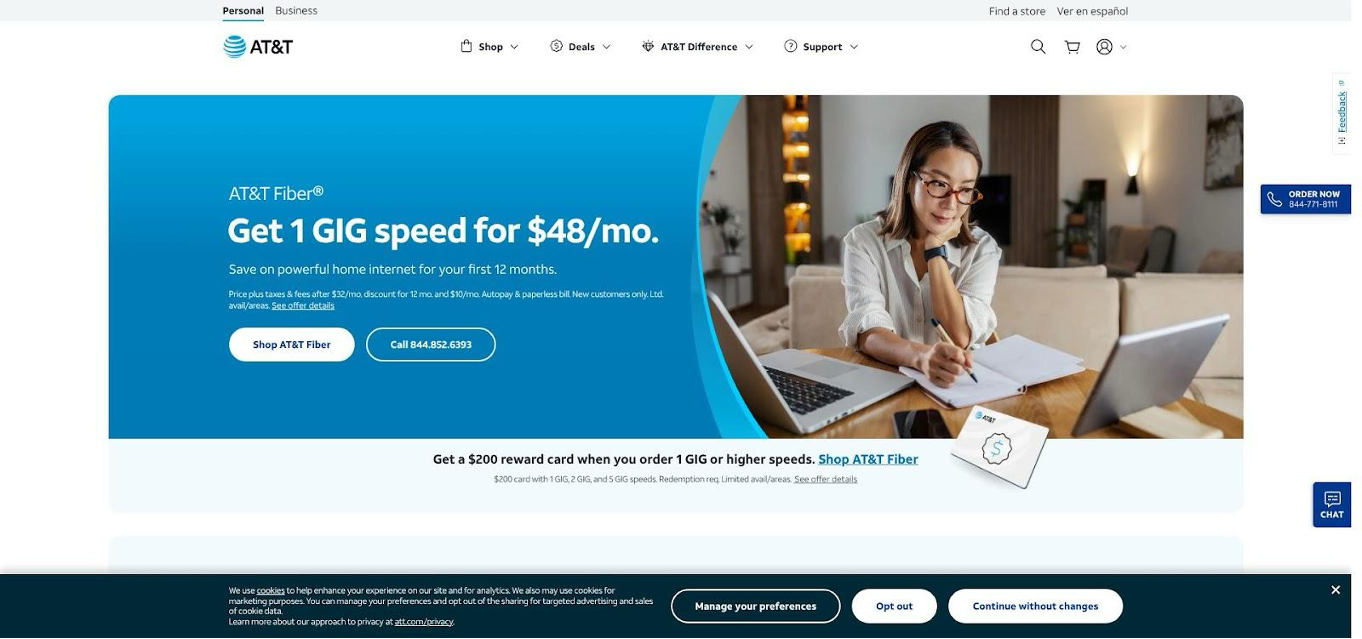
T-Mobile 5G Home Internet $50 flat-rate plan screenshot.
T-Mobile flips the install script. Order online, unbox a small gray gateway, plug it near a window, and you are online in ten minutes—no tech visit and no drilling.
The service rides on T-Mobile’s mid-band Ultra Capacity 5 G network, covering about 92 percent of Columbus homes. Average downloads land near 100 Mbps, with peaks above 150 in strong-signal zones. Uploads sit between 10 and 25 Mbps, fine for photo syncs but slow for large video pushes.
Price is a single flat 50 dollars with autopay, taxes and equipment included. Existing T-Mobile phone customers usually shave another 20 dollars off. There is no contract, no data cap, and a 15-day test drive lets you cancel without a fee if speeds disappoint.
Performance swings with tower load and placement. Set the gateway on a sunny second-story sill and it purrs; hide it behind a bookcase and evening speeds sag. The companion app helps you hunt the sweet spot, and small tweaks can unlock big gains.
Latency hovers in the 30-to-50-millisecond range. That is quick enough for Zoom or casual gaming, though cable and fiber still win for esports. Some power users keep T-Mobile as a low-cost backup, bonding it with a wired line for rock-solid uptime.
Choose T-Mobile 5 G Home if you value quick setup, contract-free billing, or rent in a place where landlords reject new cable runs. It offers respectable broadband at a steady price and makes a capable safety net when your primary line blinks.
6. Verizon 5 G Home faster wireless, sweet for Verizon phone users
Picture T-Mobile’s easy setup, then add more speed. In Columbus neighborhoods covered by Verizon’s Ultra Wideband signal, downloads often land between 150 and 300 Mbps, with occasional spikes higher. Uploads hover in the 20-to-50 range, giving cloud photo syncs a welcome boost.
Plans stay simple. Standard service lists at 50 dollars with autopay, while the Plus tier climbs to 70 but locks your price for three years and adds rotating streaming perks. Already carry a Verizon Unlimited phone plan? Drop either tier by 25 dollars.
No contract, no data cap, free equipment. The white cylindrical gateway ships to your door; plug it in, follow the My Verizon app, and you are done. If walls block signal, Verizon sends a tech for a no-cost outdoor antenna, a nice touch for stubborn spots.
Performance consistency is Verizon’s ace. Deep fiber backhaul keeps evening congestion mild. Latency averages near 30 milliseconds—good for FaceTime and most online games, though wired lines still edge it for esports.
Coverage trails T-Mobile, reaching about 75 percent of Columbus. Always check the map and confirm the gateway shows the “5G UW” icon, which signals the faster C-band spectrum.
Pick Verizon 5 G Home if you want wire-free broadband that rivals mid-tier cable speeds, especially if you already pay Verizon for mobile. The bundle discount creates one of the best dollar-per-megabit deals in town without contracts or overage worries.
7. EarthLink fiber service with concierge support
Think of EarthLink as fiber with a personal valet. The company leases AT&T’s physical network, so if AT&T Fiber reaches your street, EarthLink can too.
Speeds mirror the underlying pipes: 300 Mbps, 500 Mbps, 1 Gbps, 2 Gbps, and 5 Gbps symmetrical. Performance and latency therefore match AT&T’s blazing downloads, instant uploads, and steady uptime.
What changes is the experience. EarthLink skips data caps across the board and promises no teaser rate. You pay about 10 to 15 dollars more than AT&T each month, yet your bill stays flat instead of jumping after a promo window.
Support is the headline perk. Call center agents are U.S.-based, hold times are short, and reps handle most coordination with AT&T field techs if the fiber ever needs attention. That concierge layer spares you the big-telco phone tree.
Expect a 12-month term and an install fee that runs around 80 dollars, though seasonal promos sometimes waive part of it, so ask before ordering.
EarthLink shines when you crave multi-gig fiber but prefer small-company service. Freelancers who live on uptime, or anyone burned by surprise billing, will find the extra dollars a stress-reducing investment.
8. Starlink high-speed lifeline beyond the city limits
Outside Columbus, cable lines thin and fiber trucks rarely roll. That is where Starlink steps in. The low-Earth-orbit satellite network can reach every rooftop with a clear view of the sky.
Typical speeds fall between 80 and 200 Mbps down and 10 to 20 Mbps up. Latency averages about 35 milliseconds, far quicker than legacy satellite and fully usable for FaceTime, web work, or a round of Fortnite. Throughput can dip during busy evenings, yet it still beats the 5-to-10-meg DSL many rural homes endure.
Setup is do-it-yourself. Order the kit, mount the pizza-box antenna where it sees open sky, and plug in the Wi-Fi router. Hardware can be rented for zero dollars upfront or purchased for about 350 dollars. Service starts at 50 dollars per month. There is no contract, and you can pause billing when you head south for the winter.
Weather resilience has improved. The dish now heats to melt frost, and rain fade usually lasts only seconds. Power loss remains the bigger threat, so many owners pair the system with a small battery or generator.
Inside city limits, Starlink is a luxury because faster, cheaper wired options abound. For farmhouses, lake cabins, or any lot the cable companies skipped, Starlink is transformational, bringing 4K streaming, cloud backups, and true remote-work viability to places that have waited years for a real connection.
9. Public Service Communications local fiber gem for lucky blocks
Public Service Communications has served the region for more than a century, and its newest fiber builds rival any network in town. In the pockets it reaches—mostly on the city’s fringe and a few newer subdivisions—the company offers 200 Mbps, 500 Mbps, 1 Gbps, and 2 Gbps symmetrical plans. The flagship 2 Gig tier lands just under 100 dollars, beating bigger brands by 20 to 40 dollars each month.
Because PSC is hometown-run, support feels personal. Call during business hours and a human in Georgia answers. Need a line check? A local tech often shows up the same day, a rarity in modern telecom.
There are no promotional hoops. Prices stay flat, contracts are month-to-month, and equipment fees are minimal. That transparency meshes well with Apple users who value pay-once, work-forever simplicity.
Coverage is the limiter. PSC’s fiber footprint touches under 30 percent of Columbus homes, and maps are vague. The best move is to pop your address into the checker or call the office.
If the answer is yes, celebrate. You will enjoy multi-gig performance, small-town service, and bills that never surprise. For those fortunate addresses, PSC is the definition of a hidden gem.
Provider snapshot: compare the essentials
Details can blur after nine deep dives. Use this quick table as your cheat sheet. Scan the row for the providers on your street, then circle the column that matters most—speed, price, caps, or contracts. The in-depth sections above add color.
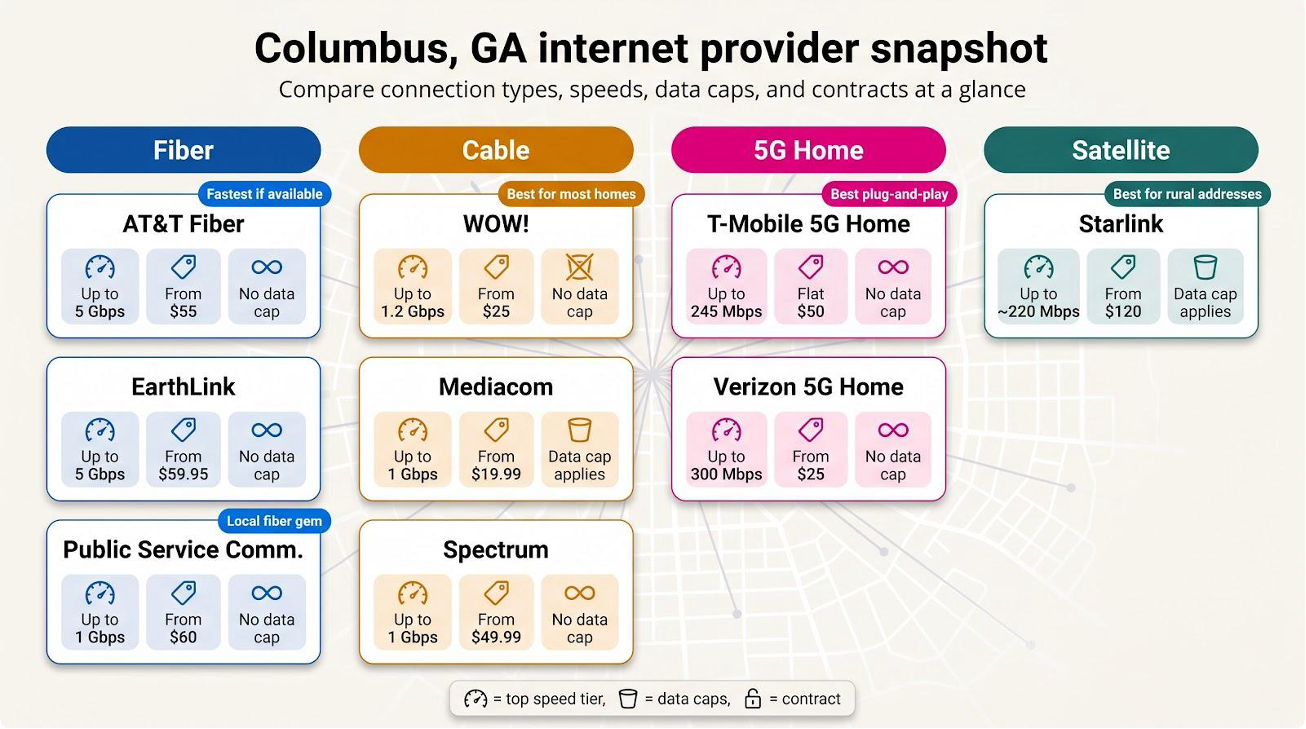
| Provider | Connection | Est. coverage in Columbus | Top speed | Intro price* | Data cap | Contract |
| WOW! | Cable | ~90 % | 1.2 Gbps | $25 / 300 Mbps | 1.5 TB (unlimited on Gig) | No |
| AT&T Fiber | Fiber | ~35 % | 5 Gbps | $55 / 300 Mbps | None | No |
| Mediacom | Cable | ~80 % | 1 Gbps | $30 / 300 Mbps | Yes | 1 yr |
| Spectrum | Cable | ~40 % | 1 Gbps | $30 / 300 Mbps | None | No |
| T-Mobile 5 G | Fixed wireless | ~92 % | ~150 Mbps avg | $50 flat | None | No |
| Verizon 5 G | Fixed wireless | ~75 % | ~300 Mbps peak | $50 flat** | None | No |
| EarthLink | Fiber (via AT&T) | Mirrors AT&T | 5 Gbps | $65 / 300 Mbps | None | 1 yr |
| Starlink | LEO satellite | 100 % (clear sky) | ~200 Mbps | $50 | None | No |
| Public Service Comm. | Fiber | <30 % | 2 Gbps | $57 / 200 Mbps | None | Likely No |
- Introductory pricing shown for the most popular entry tier. Second-year rates may rise on cable plans.
** As low as $25 with an eligible Verizon mobile bundle.
FAQs: picking the right connection without the headache

What is the best internet provider in Columbus?
For most addresses, WOW! wins on the mix of speed, price, and nearly citywide reach. If AT&T Fiber reaches your home, its multi-gig symmetry is unbeatable for sheer performance.
Is fiber available on my street?
About 35 percent of Columbus homes can order AT&T Fiber today, with new blocks lighting up each quarter. Public Service Communications adds a few more lucky areas. Plug your address into both checkers—coverage changes quickly.
Who offers the cheapest plan that still feels fast?
Mediacom’s 100-to-250 Mbps promo at 20 dollars is the rock-bottom sticker, but remember the year-two hike and data cap. A stronger long-game bargain is WOW!’s 300 Mbps for 25 dollars or T-Mobile 5 G Home’s flat 50-dollar rate that never increases.
Which service is fastest right now?
AT&T’s 5 Gbps fiber tier sits on top. Cable gigabit from WOW!, Spectrum, or Mediacom comes next. Verizon 5 G Home sometimes bursts above 300 Mbps, quick for wireless but behind wired gigabit.
Do I need unlimited data?
If your household streams 4K nightly, backs up Macs to iCloud, and downloads large games, yes. Spectrum, AT&T Fiber, T-Mobile, Verizon, EarthLink, and PSC skip caps. WOW! is unlimited on its gig tier. Mediacom’s caps can bite heavy users unless you add the unlimited option.
Can I run a home office on 5 G fixed wireless?
Usually. Speeds handle video calls and large file transfers, and outages are rare. Latency sits around 30 milliseconds—fine for Zoom, marginal for esports. Keep a cell hotspot or low-tier cable line as a backup if every minute of uptime matters.
Conclusion
The right Columbus connection ultimately depends on what reaches your block and what you actually do online. WOW! remains the broadest workhorse, AT&T Fiber rules where it lights up, and 5 G or Starlink fill the gaps for renters and outlying addresses. Treat these rankings as a starting point—plug your address into each provider’s checker, confirm today’s pricing, and pick the tier that matches your Apple-heavy household before you switch.