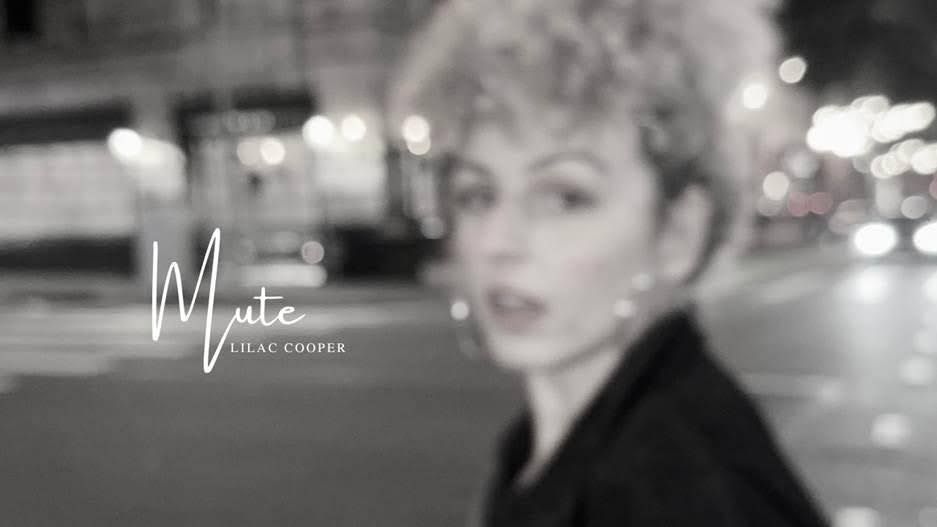
In a world that rarely stops talking, lead vocalist, songwriter, and recording artist Lilac Cooper has built a project around the decision to listen. Her latest release, Mute, is a deeply personal album shaped by a singular artistic vision, unfolding as a carefully structured emotional and psychological journey from uncertainty to self-trust. Mute has quickly become one of the more thoughtfully discussed independent releases within Israel’s contemporary pop and soul landscape, the album has attracted the attention of critics, producers, musicians, and other music industry professionals for its cohesive concept, melodic construction, vocal phrasing, restraint
dynamic control, and disciplined creative direction. Rather than following contemporary pop conventions or chasing fleeting trends, Cooper constructs a body of work that feels remarkably unified, transforming familiar emotional experiences into music of uncommon clarity and depth.
From its opening moments, Mute establishes that Cooper’s voice is more than the album’s primary instrument, it is its emotional and creative center. Her lead vocals, songwriting, and artistic direction define the character of the entire production, allowing the record to function not simply as a collection of songs but as a fully realized artistic statement. Every composition feels connected by a consistent emotional language, making the album unfold with the coherence of a single narrative rather than a sequence of individual tracks.
The journey begins with “Whisper,” a composition that captures the earliest stages of internal conflict. It explores the familiar voice that questions every decision. Maybe this isn’t right, maybe you’re not enough, maybe you imagined it all. Beneath that uncertainty, however, exists something quieter but ultimately stronger: intuition. Cooper traces the gradual emergence of that inner certainty with remarkable restraint, resisting dramatic gestures in favor of subtle emotional development. The result is a performance that communicates profound psychological complexity through nuanced vocal interpretation, disciplined phrasing, and thoughtful songwriting.

That internal tension deepens with “Stupid Mind,” arguably the album’s most restless moment. The song enters the repetitive cycles of anxiety and obsessive thinking with unusual honesty, refusing to simplify emotions that rarely offer simple resolutions. Cooper neither romanticizes nor dramatizes those experiences. Instead, she presents them as recognizably human, allowing listeners to inhabit the emotional landscape rather than merely observe it. The writing demonstrates increasing compositional maturity while revealing an artist who understands that vulnerability often carries greater expressive weight than certainty.
Much of Mute was developed in close collaboration with producer Ron Bakal, whose restrained production provides the album with a cohesive sonic language. Yet the production never attempts to dominate the recordings. Instead, every arrangement is carefully constructed around Cooper’s lead vocal performance, allowing her phrasing, emotional expression, and storytelling to remain the defining elements of each composition. The balance between producer and artist is striking: every production choice reinforces the album’s central artistic voice rather than competing with it. The result is a recording whose identity is inseparable from Cooper’s interpretation.
The emotional perspective shifts with “Is It Just Me,” produced by TJ Fuller. Where earlier songs explore the mind, this one turns toward the heart, lingering on the uncertainty that follows an unforgettable encounter. Cooper approaches longing without sentimentality, presenting vulnerability not as weakness but as one of the most universal expressions of human connection. The performance succeeds because it trusts quiet observation more than dramatic declaration, allowing emotional nuance to emerge naturally.
The album reaches its emotional and spiritual culmination with “Dreams,” perhaps its most expansive composition. Written almost as a contemporary prayer, the song blurs the boundaries between faith, manifestation, and personal conviction. Cooper sings with quiet certainty, allowing belief itself to become the emotional destination. Trust, patience, and surrender emerge not as passive ideals but as deliberate creative acts, completing the emotional arc established at the beginning of the record.
What makes Mute especially compelling is its consistency. Throughout the album, Cooper maintains remarkable emotional clarity while navigating subjects that many artists struggle to express authentically. Her performances avoid unnecessary theatricality, relying instead on precise phrasing, subtle dynamic control, thoughtful restraint, and complete confidence in the material itself. The emotional impact grows stronger with repeated listening, revealing new details with each return.
Perhaps the album’s greatest achievement is its sense of artistic unity. Every significant creative decision, from the songwriting and vocal performances to the sequencing, emotional pacing, harmonic language, and overall narrative—reflects Cooper’s artistic vision. As the album’s lead vocalist, songwriter, recording artist, and principal creative force, she shapes not only its sound but its emotional architecture from beginning to end. Few emerging artists demonstrate this level of consistency across every aspect of a recording project.
The industry’s response to Mute is understandable. At a time when much of contemporary pop rewards immediacy, the album has been recognized within Israel’s pop and soul community as a work of notable artistic ambition, earning attention for its conceptual cohesion, understated production, and emotional intelligence. Its significance lies not in spectacle but in discipline, an increasingly uncommon quality that allows the record to distinguish itself from many of its contemporaries.
With Mute, Lilac Cooper delivers her most complete artistic statement to date. Her expressive lead vocal performances, emotionally intelligent songwriting, disciplined vocal interpretation, and cohesive creative direction elevate the album beyond a collection of songs into a fully realized artistic work. Rather than relying on spectacle, she commands attention through authenticity, musical discipline, and clarity of vision, establishing herself as one of the most distinctive emerging voices in contemporary pop, soul, and R&B. More importantly, Mute confirms that her creative leadership is not simply one component of the production, it is the force that defines every aspect of it.

Lilac’s MUTE is out now, follow @LILACCOOPER , Listen on bandcamp