Storyboard artists bring scripts to life. They are taught how to drive a narrative forward through visuals. Their job is to use actors, continuity, and camera shots as a basis for a visual perspective to carry the audience through a film.
While many contemporary artists build their signature style by blending techniques from distinct creative fields, rarely does a storyboard artist go into the contemporary art world and succeed. The two worlds couldn’t be more different; a storyboard artist relies on the script and the director, while the visual artist relies on themselves to tell their own story.
San Francisco Bay Area visual artist and educator Tangying Shen has built that bridge between the cinematic world of narrative storyboarding and the tactile world of fine art painting and ceramics. With an MFA in Storyboarding alongside formal fine art training, Shen has distinguished herself through a practice that combines structural precision with deeply resonant social commentary on her life as an Asian woman, allowing her art to be a diaristic mirror about her own life and observations.
Rather than abandoning her background in animation, Shen leverages her cinematic roots as a framework for spatial composition and thematic progression. “The most important thing storyboarding taught me is how to think from both the creator’s perspective and the viewer’s perspective at the same time,” Shen explains.
“As I’m creating, I’m constantly asking myself what the audience will notice first, what they’ll understand next, and what they’ll take away from the work; I like treating each artwork almost like a frame in a storyboard. Each piece can stand on its own, but when people see the whole series, they’ll discover connections and a larger narrative.”
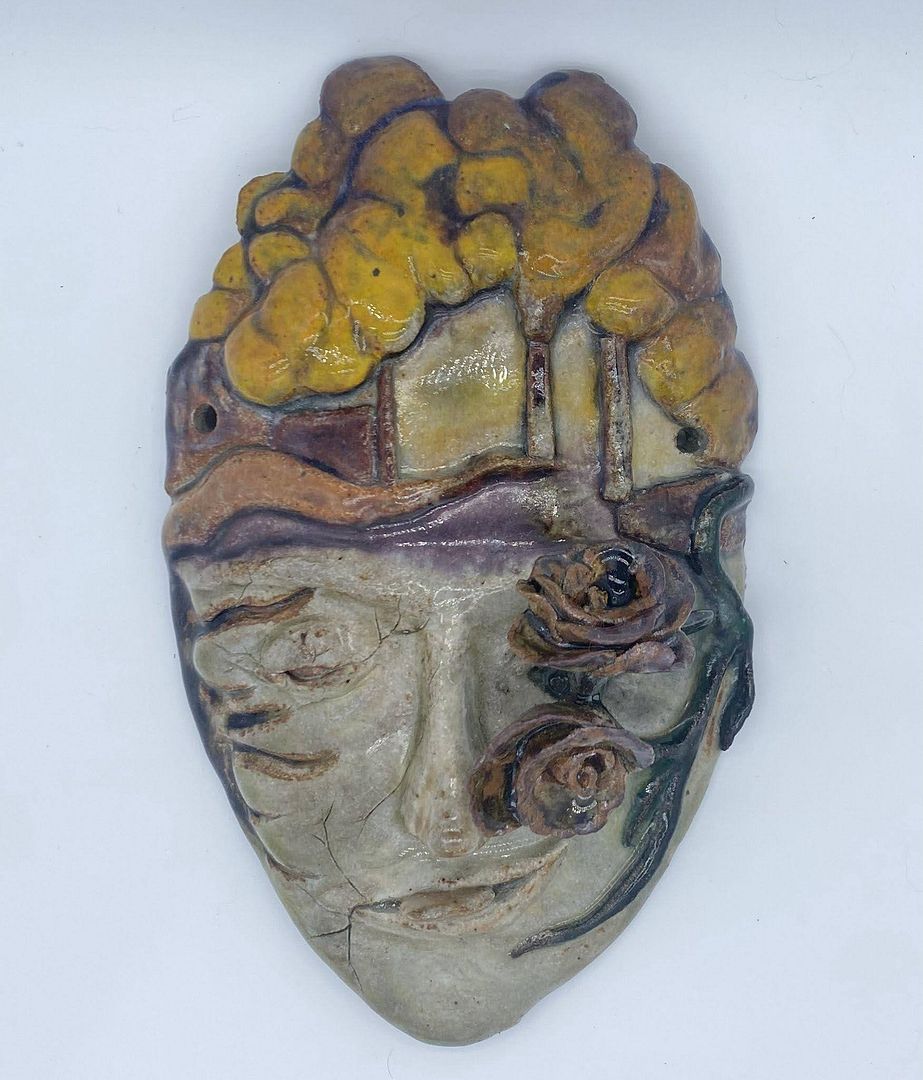
Storyboarding demands a mastery of spatial relationships and anatomical proportions; skills Shen uses not to enforce rigid realism, but to deliberately deconstruct and reimagine form. “Storyboarding first taught me how to build a drawing with accurate proportions and a strong structure,” she says. “But more importantly, it taught me how to take that structure apart and rebuild it. I enjoy changing proportions, reconstructing forms, and exploring different viewpoints because each variation opens up a new way of understanding the work.”
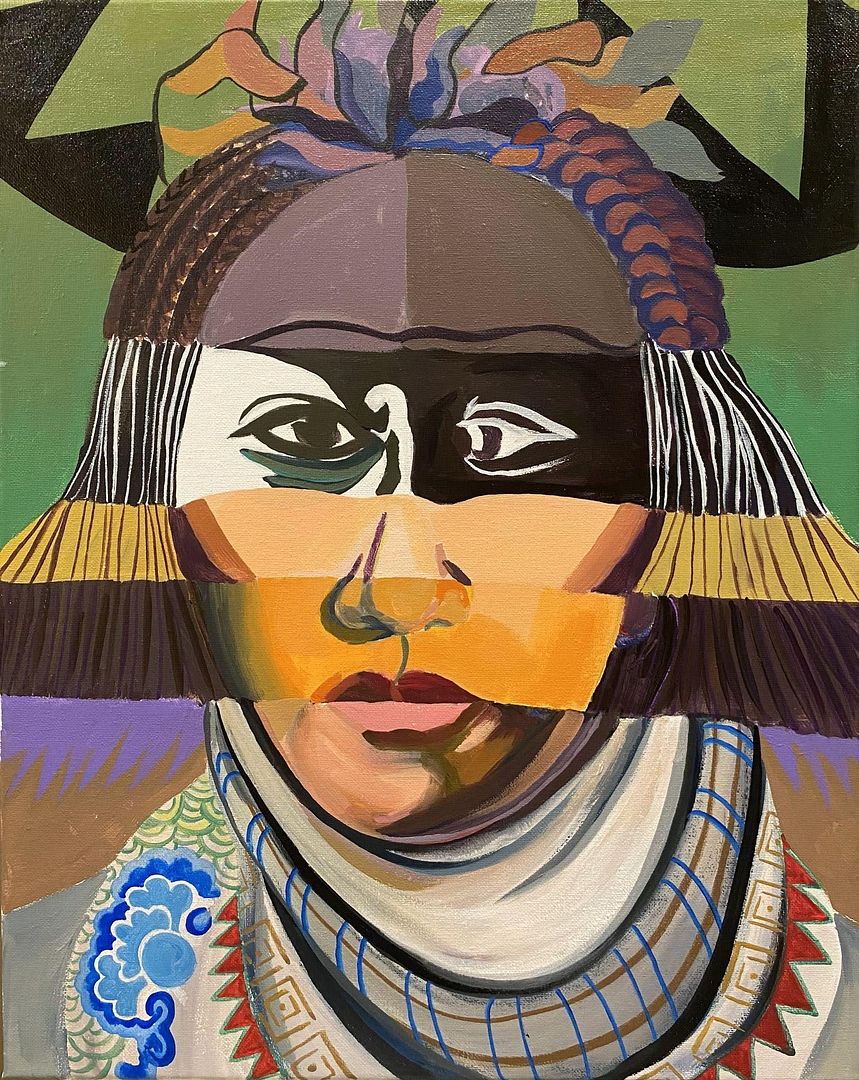
This interplay between precision and surreal transformation is strikingly evident across her body of work, like in Escalation (pictured above), an artwork exhibited in the juried exhibition Boundaries at the New Museum Los Gatos—selected from over 180 submissions—and shown at Chopsticks Alley Art. This vivid painting presents a composite face built from distinct color blocks, geometric motifs, and varied technical strokes.
“At first glance, it looks like a single portrait, but when you look closer, you’ll see it’s actually made up of fragments of many different women from different cultural and racial backgrounds,” Shen notes. “We can have different backgrounds and experiences while still supporting one another.”
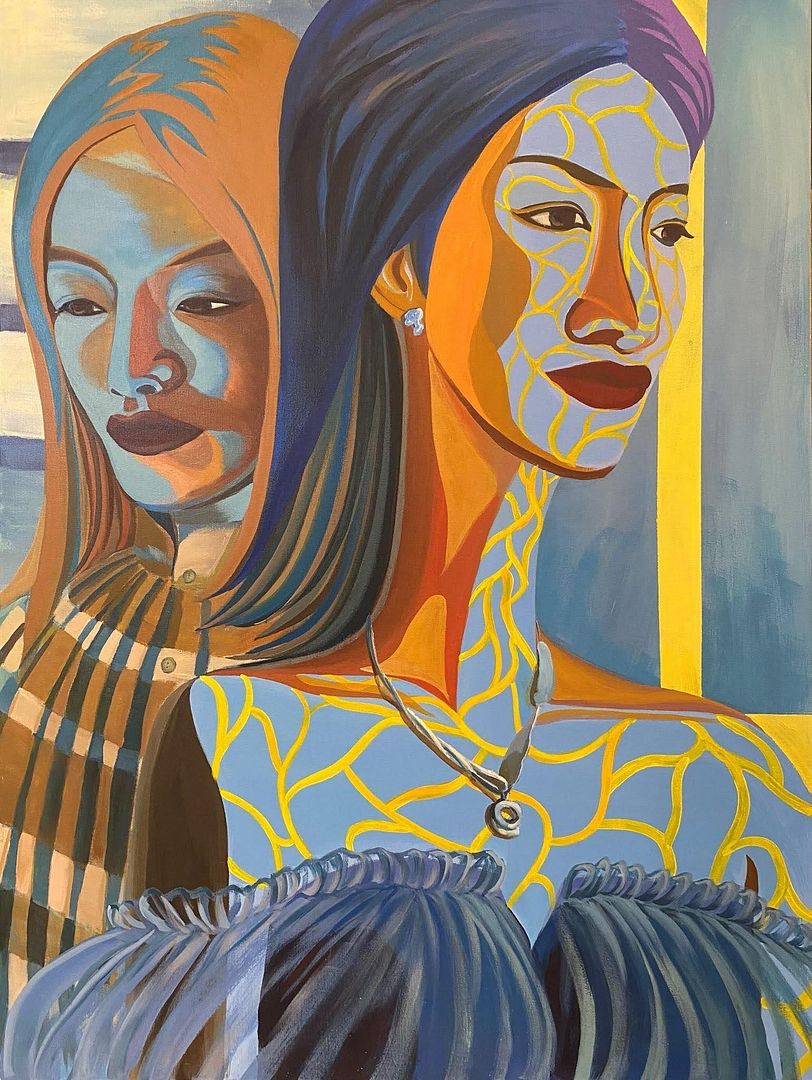
Her artwork, She’s No Longer in the Shadow, echoes Shen’s exploration of female identity and internal duality. This painting juxtaposes a figure rendered in warm, naturalistic tones against a prominent foreground portrait painted in luminous cyan and gold web-like lineation, visually expressing visibility and personal empowerment.
Shen’s painting The Bloom Beyond demonstrates her surreal narrative storytelling, depicting a botanical, figure-like entity bursting violently outward from an ornate, cracked ceramic teacup, its roots spilling onto the plane against a backdrop featuring traditional cloud and scroll motifs.
As a multi-disciplinary artist, Shen’s ceramic vase piece Legacy is grounded in historical craft traditions. This vessel features intricate cobalt blue underglaze floral and foliage scrollwork painted over a porcelain clay body, connecting her contemporary practice to classical Qinghua motifs from historic Chinese ceramics.
Shen has a vast archive of monochromatic charcoal drawings, such as her detailed studies of everyday objects, demonstrating her foundational mastery of proportions, light, shadow, and texture, grounding her surreal works in classical technique.
Shen’s artistic reputation has been cemented through both institutional acquisitions and international exhibitions. Her painting Fear Becomes Big If You Don’t Face It was officially acquired by Las Laguna Art Gallery.
The piece visualizes complex internal psychology through a central figure supported by smaller, collapsing forms. “Inside the enlarged figure is another small character celebrating. To me, that character represents fear itself,” Shen says. “The more I fear something, the stronger it becomes in my mind; I think the work connected with people because almost everyone has experienced that feeling. Fear is something we all carry, and I wanted to turn that invisible psychological experience into something people could actually see and reflect on.”
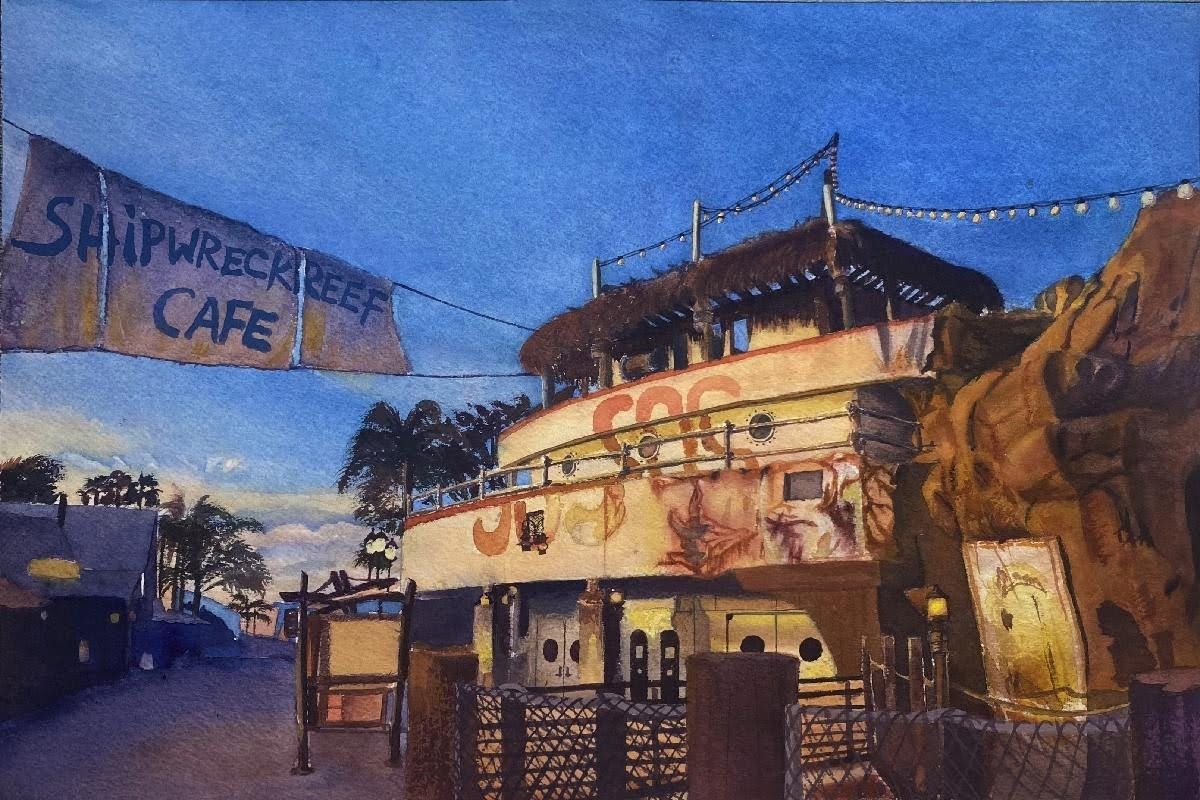
Shen’s national and international exhibition record includes presentations with the American Artists Professional League, where she showcased Harbor Appetizer, a contemplative painting exploring solitude and quiet self-awareness.
Alongside her studio achievements, Shen’s commitment to arts education serves as a major pillar of her artistic philosophy. Teaching young artists continuously refreshes her approach to creative problem-solving.
“Working with children between the ages of three and eight completely changed the way I thought about art,” Shen says. “Young children aren’t limited by techniques or rules. They express what they see and feel in the most direct and honest way. That experience made me realize that meaningful artistic expression doesn’t always come from perfect technical skills. It comes from curiosity, imagination, and the courage to express an idea.”
For Shen, true success in education mirrors success in the studio: empowering individuals to navigate complexity on their own terms. “To me, that’s what art education is really about: not teaching students what to draw, but giving them the tools to solve creative problems on their own.”
Through her blend of narrative structure, material versatility, and commitment to cross-cultural dialogue, Tangying Shen continues to establish herself as a vital contributor to contemporary visual art.
“I think artists should really experience life,” said Shen. “Observe people, enjoy life, and stay curious, because those experiences become part of your work. And don’t be afraid of the difficult moments in the creative process.”
She encourages young artists to try new things. “It’s where you learn the most,” she said. “I think every artist has to go through that process. Enjoy the process, not just the successful moments, but also the struggles. Those struggles are part of becoming an artist.”
Words by Nadja Sayej