You leave your eye exam with a small sheet of paper covered in abbreviations, plus and minus signs, decimal numbers, and labels such as OD, OS, SPH, CYL, and AXIS. Your eye doctor may have explained that you are nearsighted, farsighted, or have astigmatism, but once you get home, the prescription can still look like a code.
The good news is that an eyeglass prescription is much easier to understand once you know what each column represents. You do not need to become an optics expert. A few basic terms can help you understand what your lenses are correcting and make ordering your first pair of glasses feel much less intimidating.
This guide is for everyday understanding rather than self-diagnosis. Your optometrist or ophthalmologist is still the right person to explain anything unusual on your prescription or confirm which lenses are appropriate for you.
Why an Eye Prescription Looks More Complicated Than It Is

Most eyeglass prescriptions are simply a set of instructions for making two lenses: one for your right eye and one for your left. The numbers describe how much focusing power each lens needs and whether extra correction is required for astigmatism or near vision.
The exact layout varies between clinics, so your prescription may be printed as a table, handwritten, or shown in an online patient portal. Some fields may also be blank. That does not automatically mean something is missing; it may simply mean that particular type of correction is not needed.
Start With OD and OS: Which Eye Is Which?
The easiest place to begin understanding your eye prescription is with the labels that identify your eyes. OD comes from the Latin “oculus dexter” and means the right eye. OS comes from “oculus sinister” and means the left eye. Some prescriptions simply use RE and LE for right and left eye instead.
You may also see OU, meaning both eyes, although many prescriptions list each eye separately because the two eyes often need slightly different correction. If your numbers are not identical on both sides, that is common and does not mean the prescription was written incorrectly.
SPH Tells You the Main Strength of the Lens
SPH stands for sphere. This is the basic lens power used to correct nearsightedness or farsightedness, and it is measured in diopters. A minus sign usually means you are nearsighted, so distant objects are blurrier without correction. A plus sign usually means you are farsighted and need positive lens power.
The farther the number is from zero, the stronger the spherical correction. For example, -1.00 represents less lens power than -4.00. You may also see “PL” or “Plano,” which means no spherical power is required for that eye, although another type of correction may still appear elsewhere on the prescription.
A Quick Prescription Cheat Sheet
When you are looking at the form for the first time, these are the labels worth finding:
- OD: right eye.
- OS: left eye.
- SPH: main lens power for nearsightedness or farsightedness.
- CYL: amount of correction for astigmatism.
- AXIS: direction of the astigmatism correction.
- ADD: extra near-vision power used in multifocal or progressive lenses.
- PD: pupillary distance, used to position the lenses correctly.
- PRISM: a less common measurement used for certain eye-alignment corrections.
You will not necessarily have a number beside every term. A first-time glasses wearer may have only SPH values, while someone with astigmatism may also have CYL and AXIS numbers. Prism appears on only a minority of prescriptions.
ADD and PD Answer Two Different Questions
ADD stands for added power and is most often used for bifocal, multifocal, or progressive lenses. It provides extra focusing help for close-up tasks and is commonly associated with presbyopia, the age-related change in near focusing that often becomes noticeable from around the 40s. The ADD value is generally written as a positive number.
PD means pupillary distance: the distance between the centers of your pupils, measured in millimeters. It helps position the optical center of each lens correctly in front of your eyes. PD is not always printed on the prescription itself, so if you need it for ordering glasses and cannot find it, ask your eye-care provider or optician rather than guessing.
A Sample Prescription Is Easier to Understand Than It Looks
Imagine your prescription says OD -2.00 SPH and OS -1.50 -0.50 x 180. The right eye has a -2.00 spherical correction for nearsightedness and no listed astigmatism correction. The left eye has a -1.50 spherical correction plus -0.50 cylinder power for astigmatism, positioned at an axis of 180 degrees.
Written in one line, that can look complicated. Broken into pieces, it is simply a set of instructions: the right lens needs one type of correction, while the left needs an additional astigmatism correction. Once you learn to separate the columns, most prescriptions become much easier to read.
Your Glasses Prescription Is Not a Contact Lens Prescription
A common first-time mistake is assuming that a glasses prescription can simply be copied when ordering contacts. Glasses sit in front of the eyes, while contact lenses sit directly on the eye. Contact lens prescriptions also include information such as base curve, diameter, and the specific lens being prescribed.
If you want to wear both glasses and contacts, ask your eye-care professional for the correct prescription for each. Even when some of the power numbers look similar, eyeglass and contact lens prescriptions are not interchangeable.
Prescription Glasses Can Now Include Smart Features Too
Choosing your first frames used to be mostly about style, comfort, lens material, and price. Those things still matter, but some modern frames can now combine prescription vision correction with features such as open-ear audio, calling, translation, and AI assistance.
Dymesty AI Glasses Jobs Circle is one example of this approach. The round titanium frame is designed so its demo lenses can be replaced with single-vision or progressive prescription lenses. The glasses are camera-free and add functions including audio, microphones, meeting transcription, translation, and AI assistance without requiring a separate pair of everyday prescription frames.
Check Compatibility Before Ordering a Smart Frame
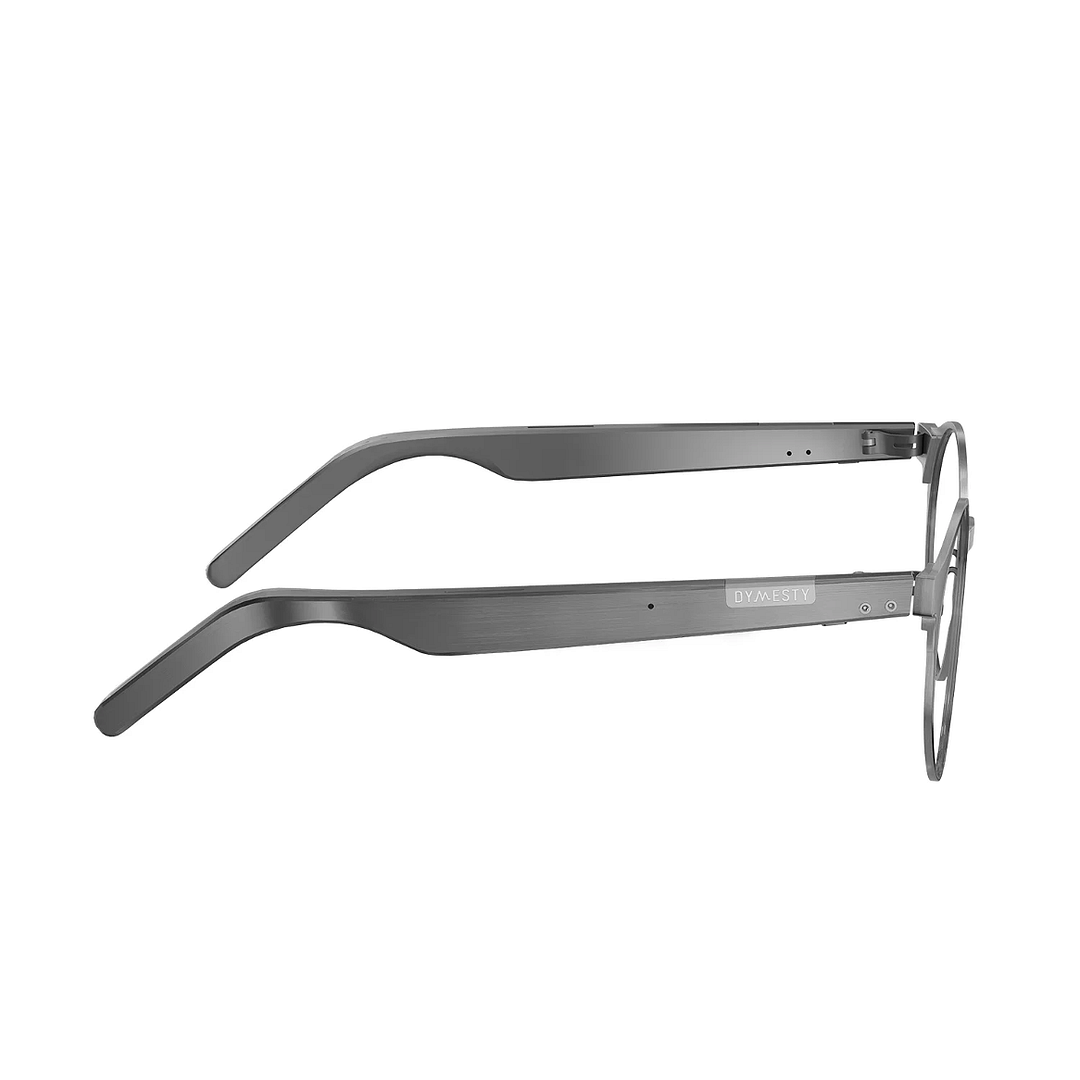
If you are considering smart glasses with prescription support, check the manufacturer’s lens options before assuming that every prescription will fit every frame. Strong prescriptions, prism correction, and progressive lenses can require more careful fitting, and frame shape can affect the final lens choice.
It is a good idea to show your current prescription to an optician before ordering unfamiliar smart eyewear. That gives you a chance to confirm lens compatibility, measurements, and fit instead of discovering after purchase that the frame is not ideal for your particular prescription.
Your Prescription Is a Tool, Not a Test Score
It is tempting to look at the numbers and ask whether your eyesight is “good” or “bad.” An eyeglass prescription is more useful when viewed as a set of instructions for achieving clear, comfortable vision rather than a score to compare with somebody else’s.
Once you know that OD and OS identify the eyes, SPH describes the main power, CYL and AXIS handle astigmatism, ADD supports near vision, and PD helps position the lenses, the page becomes much less mysterious. Keep a copy of your prescription, ask questions when something is unclear, and use the exact measurements provided when ordering your glasses.
Your first prescription may look like a string of codes, but each number has a straightforward job. Understanding the basics can make choosing your first pair easier and help you feel much more confident the next time you leave an eye exam with that little piece of paper in your hand.