At The Handbag Factory in London, power doesn’t announce itself. It appears more quietly — in repetition, in memory, in the body, in the rules we follow without thinking. Sometimes it is visible; more often, it sits just beneath the surface, shaping how things move without drawing attention to itself.
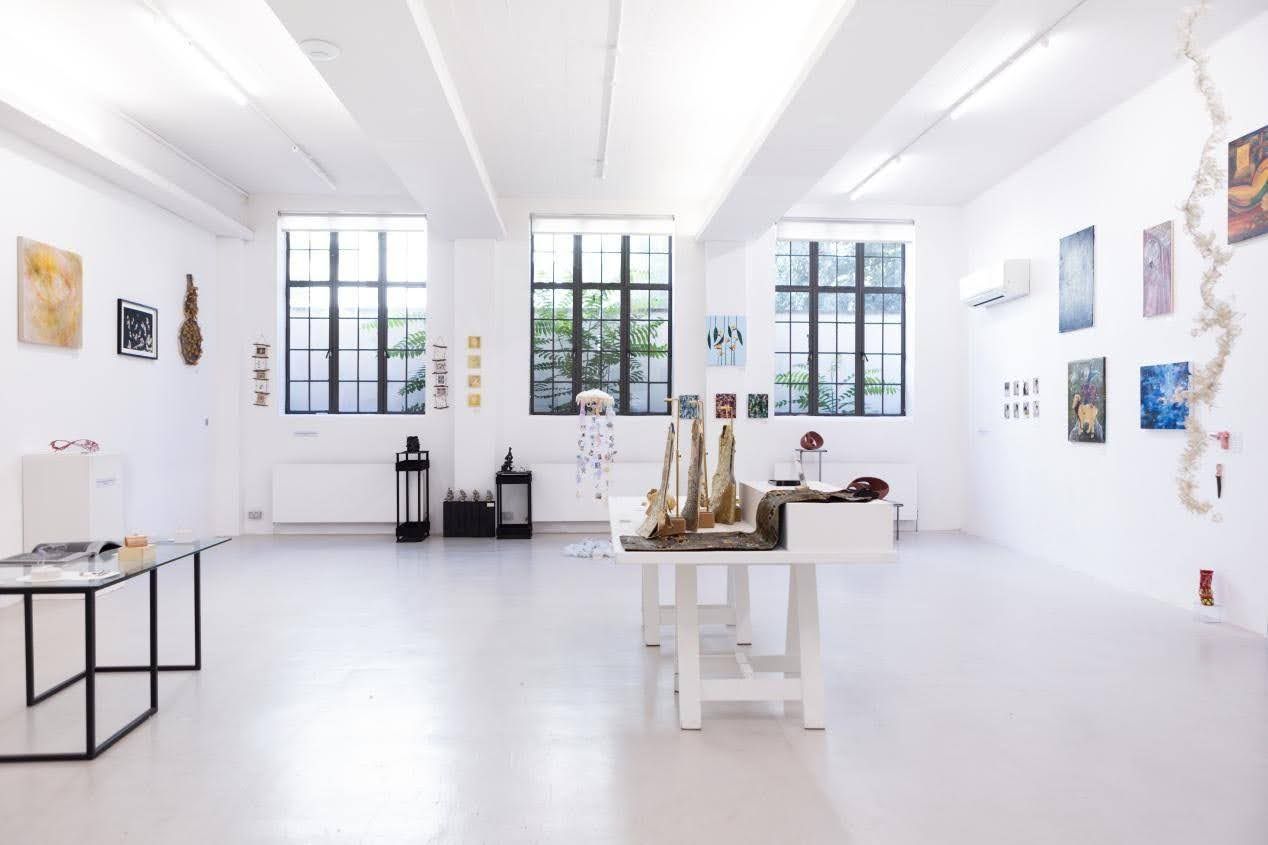
The Wand in Hand, which opened on 6 August, brings together 48 artists from seven countries (China, the UK, the US, France, South Korea, Japan and Brazil)to explore these quieter forms. Curated by Xiaohui Wu and organised by SIURUEI ART, the exhibition moves away from fixed definitions of authority and instead looks at how power is lived, felt and negotiated in everyday situations.
Behind the exhibition is SIURUEI ART, a London & China -based platform founded by Xiaohui Wu, whose practice moves between China and the UK. Working across disciplines, her projects often bring together artists from different contexts without forcing them into a single narrative. That approach carries through here, where connections between works emerge gradually instead of being explicitly defined.
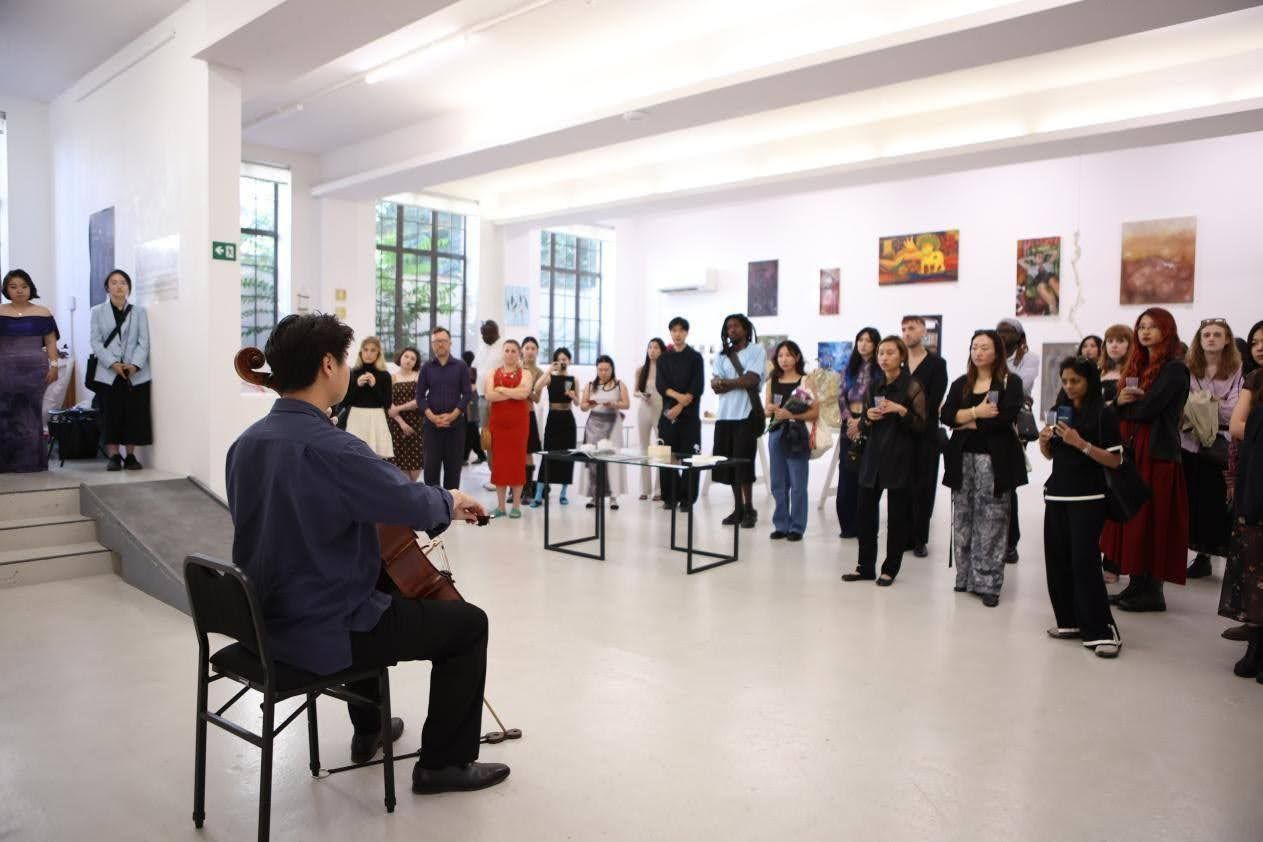
The opening event began with music, live performance and artist talks. Curator Xiaohui described the ‘wand’ as a metaphor for the ability to express, question and make one’s voice heard. The exhibition asks what happens when that ability is placed in someone’s hands. Guest cellist William Lui performed J. S. Bach’s Cello Suite No. 3 in C Major, BWV 1009. Junyi Liu performed Mouth Order during the opening, while GUANGUAN invited visitors to take part in repairing Fú Lù. Several participating artists also shared about their work and practice.
On the first wall, Jia Wang’s work draws on Victorian embroidery and stitching, bringing a domestic practice into the gallery. Repetition, often overlooked in everyday life, becomes visible again — not as decoration, but as accumulated time and labour.
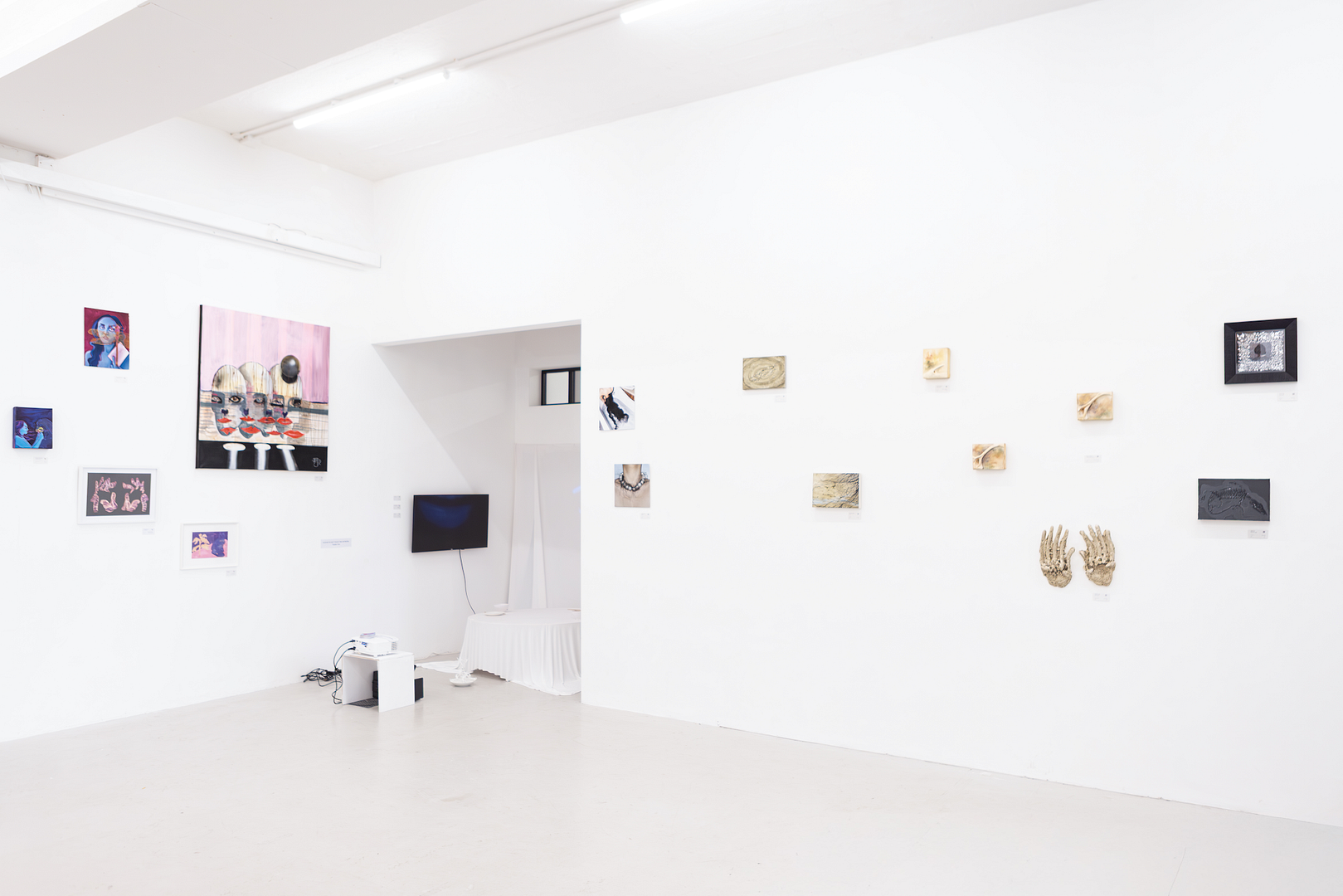
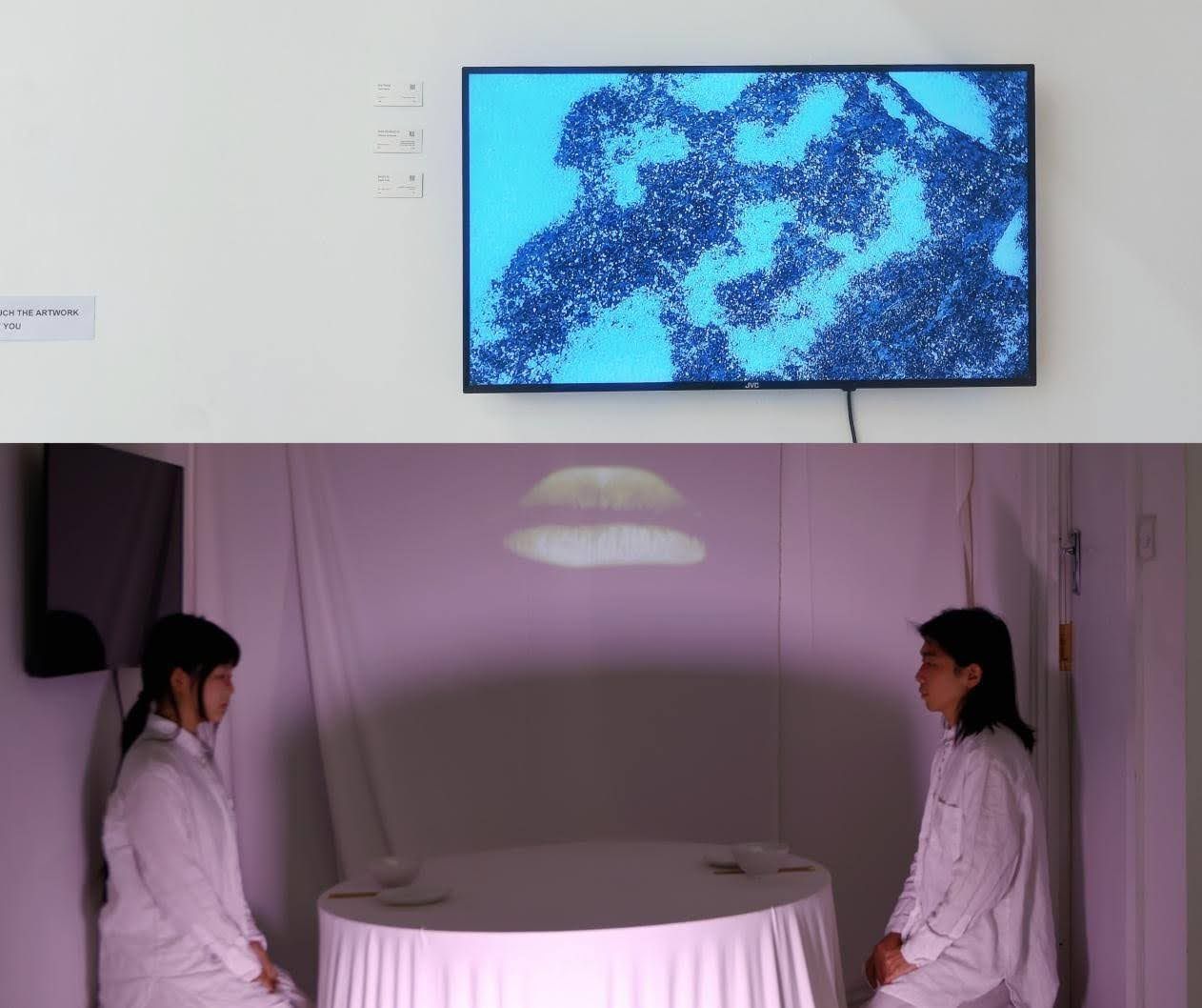
Nearby, Xuke Lin’s video moves at a different pace. Sand drifts, images overlap, and sound falls slightly out of sync. There is no clear storyline, only a sense of things unfolding without resolution.
Junyi Liu’s Mouth Order brings this sense of structure into a more familiar space. At the family dining table, eating and speaking become part of the same system, where the mouth operates as both a physical and social point of control. The rules are simple and widely recognised — when to eat, what to eat, when to speak — but here they are made visible.
From there, the exhibition turns inward.
Xueer Bi’s The Fluid World presents a dreamlike landscape in which forms dissolve into one another. A semi-transparent blue cat sits beside a plant-like structure, its shape almost suggesting a wand. But nothing in the work implies control. It grows rather than commands.
Liang Zhang’s paintings stay with something less defined — fleeting emotional states that rarely form a clear narrative. Her work resists resolution, holding onto sensations that feel familiar but difficult to articulate. The images remain open, slightly unfinished, inviting recognition before explanation.
Alongside this, Yiyuan Zhang’s work focuses on memory shaped by absence. Drawing on the experience of emotional neglect among China’s urban left-behind children, she works across illustration, ceramics and sound to explore how early conditions continue to shape perception.
Her visual language leans towards the surreal. Eyes, frames and fragmented figures recur, suggesting systems of observation and control. Small figures — animals and human forms — appear within these spaces, present but constrained. Power here is not imposed directly, but embedded in how things are seen and understood.
From memory, the exhibition shifts outward again.
QingLai Tom’s work begins with a simple recollection: her mother placing a watermelon in a stream during the summer, returning later to find it cooled by the water. The stream has since disappeared, replaced by development. What remains is the memory itself — small, specific and quietly vivid.
At the centre of the exhibition, Fan Pan’s wearable works sit alongside SOEY, a Chinese intangible cultural heritage art brand. These are objects designed to be carried, worn and passed on. Materials become containers for memory, while traditional craft is reworked in a contemporary context. What is inherited is not fixed, but continues to shift.
The relationship between language and the body becomes more explicit in Mai Muraguchi’s ceramic works. Drawing on Japanese pink flyers from the late twentieth century, she recreates labels such as “college student”, “housewife” and “young” — terms that once circulated as fleeting advertisements.
In ceramic, these words take on permanence. What was once disposable becomes fixed, revealing how language can shape and define the body over time.
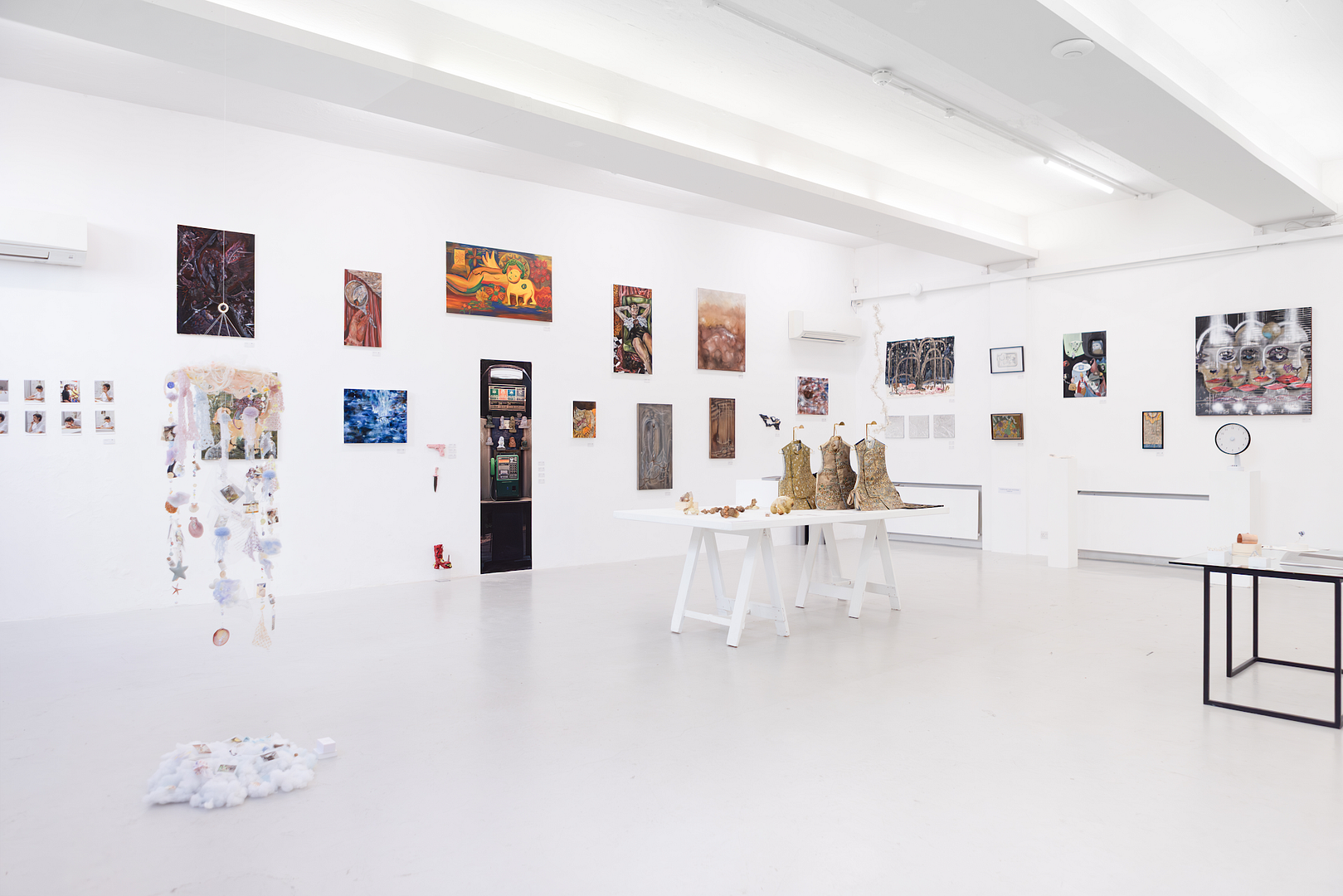
The wand, in the end, is less a symbol of control than a reminder of agency — something that shifts depending on where it is held, and how it is used.
By Xiaohui Wu
6 August 2026
Photos by SIURUEI ART
Exhibition Information
The Wand in Hand
The Handbag Factory, London
6–10 August 2026
Curated by Xiaohui Wu
Presented by SIURUEI ART
Curator Assistants:Xiangyu Zhang(Lead)& Yuwan Cao
Intern:Qian Luo
Community Collaboration: SheTalksArt
Collaborating with JustArt Collective Newspaper
Collaborating with Floral Artist: Claudia Pang
Collaborating with Cellist: William Lui
Participating Artists:
Xueer Bi, Yueqiao Chen (Lila), Brea Freeburn, GUAN GUAN, Jingyun Guan, Louise Hapton, Ao Han (Hano), Shiyuan Hu, Ela Hsu, Luzi Jin, Willem Keys, Sona Kharel, Szu-Ting Kuo, Eunji Lee, Yuexuan Li, Lihui Liang, Xueqing Liang, Xuke (Emilia) Lin, Yifei Lin, Junyi Liu, Yimeng Liu (Jade), Madeleine Love, Jiaqi Lyu, Winter Ma, Daniela Marques, Imogen Marsteller, Mai Muraguchi, Chancy Pan, FAN PAN, Claudia Pang, Aida Pouryeganeh, PJ Riley, Verona Shi, Estelle Simpson, SOEY, Bahar Talebi Najafabadi, Qinglai Tom, Can-Fen Wang (Sunny), Jia Wang, Joy Wang, Shuwen Wang, Yuxuan Xiao, Freja Jiahui Ye, Xinwei (Vita) Ye, Isabelle Zetterström, Hongru Zhang, Liang Zhang, Yiyuan Zhang.