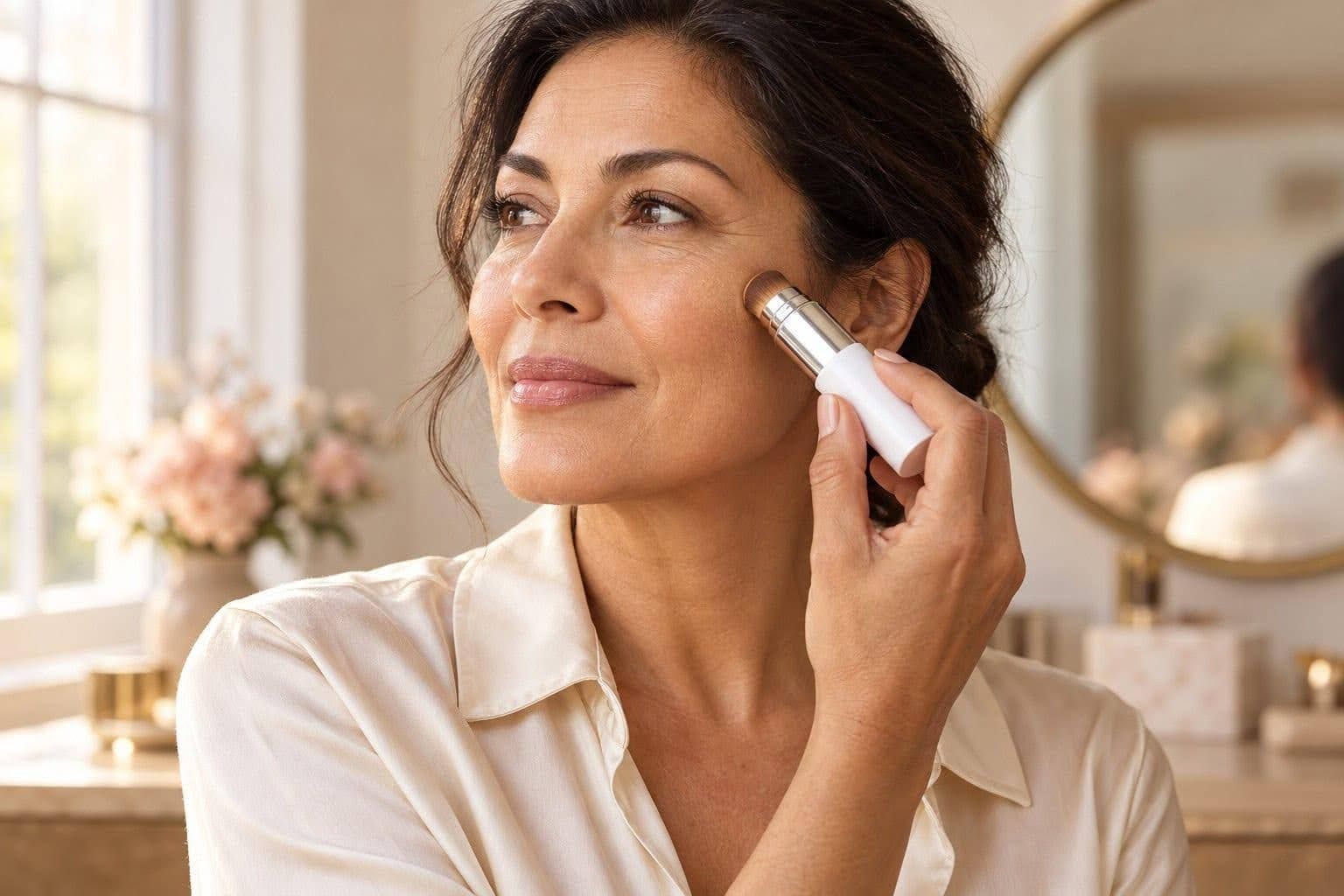
If you are in your 40s or older and you have bought foundation in the last five years, you probably know the sequence. You pick a formula that promises radiance. It looks good in the store. By noon it has collected in the lines around your mouth, oxidized a shade darker, and made your cheeks look drier than they did before you started.
That experience is common enough that searches for the best color-changing foundation for mature skin have become steady. What that shopper wants is not more coverage. It is a base that behaves on skin with less collagen, fewer natural lipids, and more visible texture. Makeup artists keep recommending lightweight liquids for this reason, and it is why a color-changing stick, which sounds like a gimmick, is worth a second look for a specific kind of user.
Why mature skin behaves differently
Dermatologist Joshua Zeichner explained the shift to Allure: as skin ages, it produces less collagen and fewer natural lipids such as ceramides and fatty acids. The result is skin that is more prone to dehydration and has a weaker moisture barrier. Makeup applied to dehydrated skin does not glide. It catches on dry patches and settles into whatever lines are there.
Texture changes too. Makeup artist Fiona Stiles told Allure that fine lines and enlarged pores can make foundation look mask-like, especially when the formula is thick or the application is heavy. The goal is not to flatten the face. It is to even out tone while leaving enough movement for the skin to look like skin.
Tony Tulve, another makeup artist, told Allure that liquid foundations tend to work best for mature clients because they “act more like a second skin.” That is a useful starting point, and it is also why a stick deserves an honest caveat. A stick is not automatically better. It is better for certain routines and certain coverage levels.
What makes foundation settle into lines
Before choosing a product, it helps to know why the last one failed. In most cases the formula is only part of the problem.
Dehydration. When the skin barrier is compromised, foundation clings to flaky patches. A richer moisturizer and a hydrating serum do more than a new foundation.
Too much product. Three pumps of liquid or four swipes of a stick is more than most faces need. Excess product has nowhere to go except into lines and pores.
The wrong finish. Heavy matte formulas and powder-heavy routines emphasize texture. Satin or luminous finishes with buildable coverage are more forgiving.
The wrong tools. Fingers can drag on dry skin and leave streaks. A dense brush or a damp sponge spreads the product more evenly with less waste.
Powder overload. Setting powder is useful on the T-zone. Applied all over, it turns a hydrated base into a dry one by mid-afternoon.
Skipping prep. Primer is not mandatory, but a blurring primer pressed only into the areas with visible lines can help. A mattifying primer all over usually makes the problem worse.
Where a color-changing stick fits
A color-changing foundation stick is a solid base with encapsulated pigments that release when you blend. The mechanism is covered in more detail in Allure’s explainer on color-adjusting makeup, but the short version is that friction breaks the capsules and the color appears. The coverage is typically sheer to light, between a tinted moisturizer and a liquid foundation.
For mature skin, that coverage level is a feature. A sheer layer is less likely to crease than a full-coverage one, and it is easier to correct during the day. The stick format also makes application fast, which matters on mornings when you want to skip brushes and bottles.
The caveat is real: many makeup artists still reach for liquids first. A stick can feel drier on the skin, and if you apply it in a heavy stripe, it will settle. The trick is to use it like a sheer base, not like a concealer stick. One thin layer, blended well, then a second layer only where you need it.
There is also a practical reason the sheer coverage suits this stage of life. Skin tone tends to become less even with age, with redness around the nose and cheeks, a few dark spots, and visible capillaries. A full-coverage base has to match all of that, and any mismatch shows. A sheer base lets some of your own color through, so small differences in tone matter less. None of this is a skincare benefit, and no foundation reverses aging. It is simply a lower-stakes way to even things out.
What to look for in a mature-skin base
The label matters less than the formula’s behavior, but a few ingredients are worth scanning for.
Hydrating ingredients. Hyaluronic acid, squalane, glycerin, and ceramides help the base sit comfortably on dry skin. They do not replace moisturizer, but they make a difference over the course of a day.
Buildable coverage. Look for a formula described as sheer, light, or buildable. “Full coverage” and “matte” are usually the wrong direction for mature skin unless you have oily skin and prefer that finish.
A satin or luminous finish. Flat matte finishes show every flake. A slight sheen reflects light and makes texture less obvious.
No added fragrance if you are sensitive. Fragrance is a common irritant, and mature skin tends to be more reactive than it was at 25.
A shade range that includes you. Color-changing products need extra scrutiny here. Most are built around light-to-medium skin, and deeper tones can turn ashy. Swatch on the jaw in daylight before committing.
Stick vs. liquid vs. cream
| Format | Best for | Watch out for |
| Color-changing stick | Quick sheer coverage, travel, touch-ups | Limited shade range, can cling to dry patches |
| Liquid foundation | Even coverage, a wide shade range, mature skin in general | Can look heavy if over-applied; pumps waste product |
| Cream compact | Dry skin, buildable coverage | Can crease under the eyes; needs a light hand |
| Powder foundation | Oily skin, quick setting | Emphasizes texture and dryness on mature skin |
The table is a starting point, not a ranking. A liquid with a hydrating finish is still the safest default for most mature skin. A stick earns its place when speed and portability matter more than full coverage, or when you want to apply with your fingertips and skip a separate brush.
A routine that keeps the base in place
The application matters as much as the product. This sequence comes from the prep and application advice in Allure’s guide to foundations for mature skin, adapted for a stick.
- Cleanse gently and moisturize. Use a creamy cleanser if your skin feels tight, then a moisturizer with ceramides or squalane. Wait two minutes before makeup.
- Add a hydrating layer if needed. A serum or essence toner pressed into the cheeks and around the mouth helps dry patches.
- Prime only where texture shows. Press a blurring primer into the lines around the mouth, the nasolabial folds, and the under-eye area. Skip the mattifying primer unless your T-zone is genuinely oily.
- Apply less than you think. Twist up about half a centimeter of the stick. Swipe once on each cheek, then once on the forehead and chin.
- Blend with a damp sponge or dense brush. Work in small circles, then press the product in with the sponge. This pushes the base into the skin instead of sitting it on top.
- Build only on redness and spots. A second thin layer is fine. A third usually means you needed concealer instead.
- Set the T-zone, not the whole face. A light dusting of translucent powder on the nose, chin, and center of the forehead is enough.
- Refresh at lunch with a hydrating mist. Mist, press with a clean sponge, and add a touch of stick only where the base has faded.
When a stick is the wrong choice
A color-changing stick is not a universal answer, and it is worth saying so before you spend $22.95.
If your skin is deep, the shade range may not include you. If you need to cover melasma, scarring, or active breakouts, a stick’s sheer coverage will not be enough. If your skin is very oily, the emollient base may slide by midday. If you have rosacea or a compromised barrier, patch test first, because friction and repeated blending can irritate reactive skin. A sheer stick can still work as a touch-up product over a liquid base, but it is not a substitute for one. For a full face, start with the liquid and keep the stick in your bag.
And if you want sun protection from your base, check the label. The Kaberryfls stick does not list an SPF, and the amount of foundation anyone would need to apply to reach a labeled SPF is far more than a normal layer. Wear a separate sunscreen.
Where the Kaberryfls stick fits
Kaberryfls’s version is this color-changing foundation stick, 22.95 for one stick. It comes in Natural, Light, and Medium, with a brush in the box, free shipping over 22.95 for one stick. It comes in Natural, Light, and Medium, with a brush in the box, free shipping over 39, and a 30-day return window. The brand’s own description promises a breathable, natural finish and less orange oxidation. There is no published ingredient list or net weight, so check the box or ask the brand if you have sensitivities.
For a mature-skin shopper, the appeal is the low commitment. The price is below most prestige sticks, the brush is included, and the sheer coverage suits a quick daytime routine. The limitation is the same one that applies to the category: three shades cover a light-to-medium range, so deeper skin tones should look elsewhere or swatch first.
FAQ
What is the best foundation for mature skin?
There is no single best. A hydrating liquid with buildable coverage is the safest default, especially if you have dry skin or visible lines. A color-changing stick is a good secondary option for quick, sheer coverage.
Does color-changing foundation work on mature skin?
It can, if you apply a thin layer and prep well. The color change is mechanical, not skincare, so it will not improve texture. It simply avoids the shade-matching step.
How do I stop foundation from settling into wrinkles?
Use less product, hydrate before application, choose a satin finish, blend with a damp sponge, and set only the T-zone. If the base still creases, the formula is probably too matte or too heavy for your skin.
Is a stick better than a liquid for older skin?
Not automatically. A stick is faster and more portable. A liquid usually gives a more even, skin-like finish. Choose based on coverage needs and routine, not age alone.
Bottom line
The best foundation for mature skin is the one that keeps your skin looking hydrated and lets your texture show through. For some people, that is a liquid with a satin finish. For others, especially those who want speed and sheer coverage, a color-changing stick is a practical second option. Buy it for the format, prep your skin first, and keep your expectations about shade range realistic.