Quick Answer: If you need to power essentials such as a refrigerator, freezer, and gas furnace blower simultaneously during an outage, run an air conditioner or induction cooktop in an RV, or operate tools such as table saws and air compressors at a job site without grid access—and your current power station shuts down due to overload—a high-capacity power station with a powerful inverter is worth considering. These units typically offer 1,000Wh to 3,000Wh or more of battery capacity. They store more energy, extend runtime, support sustained use of multiple devices, and reduce the need for frequent recharging.
Key Takeaways
- Calculate capacity from device energy use between reliable recharges, allowing for losses and a reserve.
- Check continuous output and startup demand separately from stored watt-hours.
- Count planned recharging only if it arrives in time and restores enough energy.
- Compare the heaviest piece you must lift, not just the system’s total capacity.
- Judge recharge time by the energy being replaced and the available charging input.
- Verify expansion compatibility; extra batteries do not automatically increase output or charging speed.
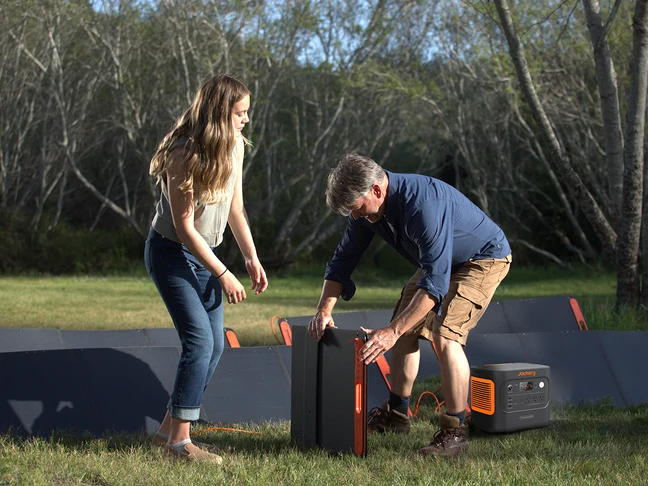
When Does the Extra Capacity Pay Off?
A power station with more capacity stores more energy between recharges, which matters only if your loads and recharging gaps call for it. The situations below show which way each condition points and what still needs checking.
| Situation | What it points toward | What to check next |
|---|---|---|
| Energy needed between reliable recharges exceeds a smaller unit | Larger capacity | Whether recharging could close the gap |
| An appliance needs high rated output | A model with enough output, not simply more Wh | Rated output and startup demand |
| The unit rarely moves | Weight matters less | Daily energy still sets capacity |
| Recharging is short, frequent and reliable | A smaller unit may be enough | Whether each recharge refills enough |
| Only low-power devices | A smaller unit, if runtime fits | Hours of use and number of devices |
| Frequent carrying or a long walk | A lighter unit, if it covers essential use | Extra recharging or trimmed loads |
| Plans to add capacity later | An expandable model | Compatible battery packs |
The first row decides most cases. A unit that stays at home or in an RV makes a larger battery easier to live with, yet the need for one still comes from how much energy you use and how long you go without recharging.
Low-power devices can still add up over long hours, and a light unit that runs out before the next recharge leaves you short, however easy it is to carry. When a smaller unit covers the essential loads with a reserve, its lower weight, smaller footprint and lower cost all count in its favor.
What You Gain and Give Up With a Larger Power Station
More Stored Energy, Not Necessarily More Output
More capacity means more energy between recharges, so the same device runs longer. How many devices can run at once depends on rated output, a separate specification, and the total of everything running together has to fit within it.
Take two illustrative units: one stores 2,000 Wh with 1,500 W of output, the other 1,000 Wh with 2,000 W. Only the second can run an appliance that needs 1,800 W, though not for long, while the first runs smaller loads for longer.
Larger models in a series often have higher output, though only the specification for that model confirms it. Whether a particular appliance will start and keep running also depends on its startup demand and the outlet it uses, both of which are compatibility checks.
Weight, Size and the Practicalities of Moving It
Four models show how weight tracks capacity. Figures come from each model’s U.S. product page:
| Model | Capacity | Rated AC output | Weight |
|---|---|---|---|
| Jackery Explorer 300 v2 | 288 Wh | 300 W | 8.16 lb |
| Jackery Explorer 1000 v2 | 1,070 Wh | 1,500 W | About 23.8 lb |
| Jackery Explorer 2000 v2 | 2,042 Wh | 2,200 W | About 39.5 lb |
| Jackery HomePower 3000 | 3,072 Wh | 3,600 W | About 59.5 lb |
Weight rises with capacity, though not in a straight line: the smallest model stores about 35 Wh for each pound of total weight, the two largest about 52. Those ratios come from rated capacity and overall weight, so they are not a measure of cell energy density, and they do not establish actual runtime or how safely a unit can be lifted. Across different series, capacity alone does not predict weight.
What matters in practice is the heaviest single piece you move, whether it goes into a trunk or up stairs, how far and how often you carry it, and whether wheels, a pull handle or an optional trolley suit the ground. Some larger units have built-in wheels; others have only handles.
If lifting a unit safely would take two people or a cart, that is part of the cost of the extra capacity. Between uses, a larger unit also needs more room in a dry, ventilated spot.
Recharge Time Depends on More Than Battery Size
With the same starting and target charge and the same average net charging power, a bigger battery takes longer to refill, because there is more energy to put back.
Input limits change the picture. The 1,070 Wh and 2,042 Wh models in the table share an 8 A car-input limit, and the larger one takes about 24 hours from a car socket against about 12 for the smaller. From a wall outlet, both reach full in under two hours in standard mode.
For routine use, compare how much energy you need to replace, not just empty-to-full times: two stations that have each used 300 Wh take a similar time to put it back at the same net charging power. A larger battery can still provide a useful buffer when each stop restores only part of what you use. If consumption consistently exceeds recharging, however, more capacity delays depletion rather than solving the shortfall.
The Cost of Capacity You May Not Use
Capacity you rarely draw on still costs money, storage space and effort to move, although a sensible reserve, fewer recharges and room for changing plans can justify some of it. A fair comparison sets complete setups that meet the same need side by side, including any battery packs, cables, panels or trolley, rather than the station alone. Price per watt-hour helps only between units with similar output, inputs and warranty terms.
New and refurbished units can share a comparison only when condition, battery state and warranty are clearly marked. A refurbished unit can carry a much shorter warranty, such as six months instead of several years, so price differences need reading alongside the cover that comes with them.
How Can You Get Enough Capacity Without Overbuying?
Size From the Energy You Need Between Recharges
Sizing starts from the energy your devices use between two reliable recharges, a firmer guide than the sense that bigger is safer. Add each device’s average watts multiplied by its hours of use, then allow for conversion losses and a reserve. This article’s examples use 85% efficiency and a 20% reserve as assumptions, so rated capacity ≈ energy needed ÷ 0.85 ÷ 0.80. Measured use is a better input than nameplate ratings, which usually show maximum draw rather than average use.
Let Reliable Recharging Cover Part of the Gap
Recharging along the way can reduce the capacity you need, but only when it meets three conditions together: it is reliable, it arrives before the battery runs low, and it puts back enough energy. A daily stop at an outlet does not guarantee a full recharge each day, and a short drive or a cloudy afternoon may add far less than the time suggests.
Timing matters as much as quantity. Suppose daily use is 900 Wh at the battery and a reliable afternoon recharge adds a net 400 Wh at the battery. The battery still has to carry everything used before that recharge arrives, as well as the remaining evening and overnight load.
When recharging is uncertain, sizing for the full gap without it is the safer plan. When it is dependable, a smaller battery plus that recharge can do the same job with less weight.
Expansion Batteries, Two Units and Linked Systems
These three approaches add capacity in different ways:
- A main unit with compatible expansion batteries increases the system’s stored energy, but that does not by itself raise the unit’s output or charging speed.
- Two separate stations can power different devices, but their outputs cannot be combined to run one larger appliance, and each needs its own recharge.
- Linking two units into one system works only with the specific models, cables, and conditions the maker lists.
Compatibility is model-specific. The Jackery HomePower 3000 is a standalone unit with no expansion option. The Jackery HomePower 2000 Plus v2 accepts up to five Battery Pack 2000 Plus v2 units, for about 12 kWh, and is not compatible with the earlier Battery Pack 2000 Plus.
Splitting capacity into several pieces can make each lift lighter without lowering the total weight, so it helps to compare both. Added packs also mean more energy to refill, often through the same inputs, so a full recharge of the whole system takes longer.
Matching Capacity to Three Everyday Scenarios
The examples below are illustrations with stated assumptions, not user reports. Each one shows how the same questions can lead to a larger power station in one case and a smaller one in another. All three start from a full battery, use the 85% efficiency and 20% reserve above, and round the results.
Home Backup That Stays in One Place
A unit that stays indoors rarely needs carrying, so weight is a minor concern. Suppose the essentials use about 1,500 Wh over a 24-hour outage window. Under this article’s assumptions, that calls for about 2,210 Wh of rated capacity, which puts a high-capacity or expandable model on the list.
If the plan covers only phones and lighting, at about 300 Wh for the same window, about 440 Wh is enough, and a larger battery would mostly hold unused energy. The decision comes from the essentials list rather than from where the unit sits. A longer target window, or a refrigerator added to the list, would move the answer toward the larger option.
An RV or Van Where the Unit Rarely Moves
In a vehicle, weight matters mainly for payload and for securing the unit. Suppose daily use is about 800 Wh, including a 1,000 W coffee maker for 10 minutes, about 170 Wh, and the trip includes two days without reliable recharging. The estimate is about 2,350 Wh of rated capacity.
The coffee maker also sets an output requirement: at least 1,000 W of continuous output, plus the running load of anything used at the same time, with any startup requirement checked separately. If driving reliably restores most of each day’s use, capacity can come down, but the output requirement stays the same. Removing the coffee maker lowers the energy budget and may reduce the required output, if it is the highest-power appliance.
A Campsite With a Long Walk From the Car
Carrying sets the limit here. Suppose phones, lights and a small fan use about 200 Wh a day over two days with no recharging. That calls for about 590 Wh of rated capacity.
A 288 Wh unit falls short of that target, but a 1,070 Wh model is not the only step up: models closer to the calculated requirement are worth comparing on actual weight, outputs and charging options. Between the first two models in the table, the gap is about 16 lb on the walk to the campsite.
If the right capacity is still too heavy to carry, the alternatives are a shorter load list or a recharge that can reliably replace enough energy before the battery runs low. A drive or a solar stop helps only if it meets both the timing and the energy requirement.
FAQs About High-Capacity Power Stations
What Do Cycle Ratings Mean for a Larger Battery?
A cycle rating usually states how much of its original capacity a battery keeps after a set number of cycles. The three larger models in the table, for example, are rated for 4,000 cycles to 70% or more capacity. That is neither an end-of-life date nor a promise of a fixed number of years.
Cycle ratings describe wear under specified cycling conditions. Batteries also age with time, and temperature and storage charge level affect that aging. The rating matters most to people who cycle the battery often.
Ratings compare fairly only when they state the same retention threshold and test conditions. The main unit of the Jackery HomePower 2000 Plus v2 is rated for 6,000+ cycles with no stated remaining-capacity threshold, so it cannot be set directly against the 4,000-cycle ratings above.
Can You Fly With a Power Station?
The FAA states that lithium battery-powered devices of more than 160 Wh are not allowed on passenger aircraft and that these units must not go in checked baggage. Every model in this article is far above 160 Wh, so a compact size does not change the answer. Shipping a unit has its own rules, so check with the carrier first. For a road trip, the practical limits are payload, space and securing the unit so it cannot slide.
Final Thoughts
A high-capacity power station makes sense when the energy you need between reliable recharges exceeds what a smaller battery can cover with an appropriate reserve. Output is a separate check: demanding appliances need enough continuous and startup power, whatever the battery capacity. If a smaller unit plus dependable recharging covers the essentials, it is often the more practical choice.