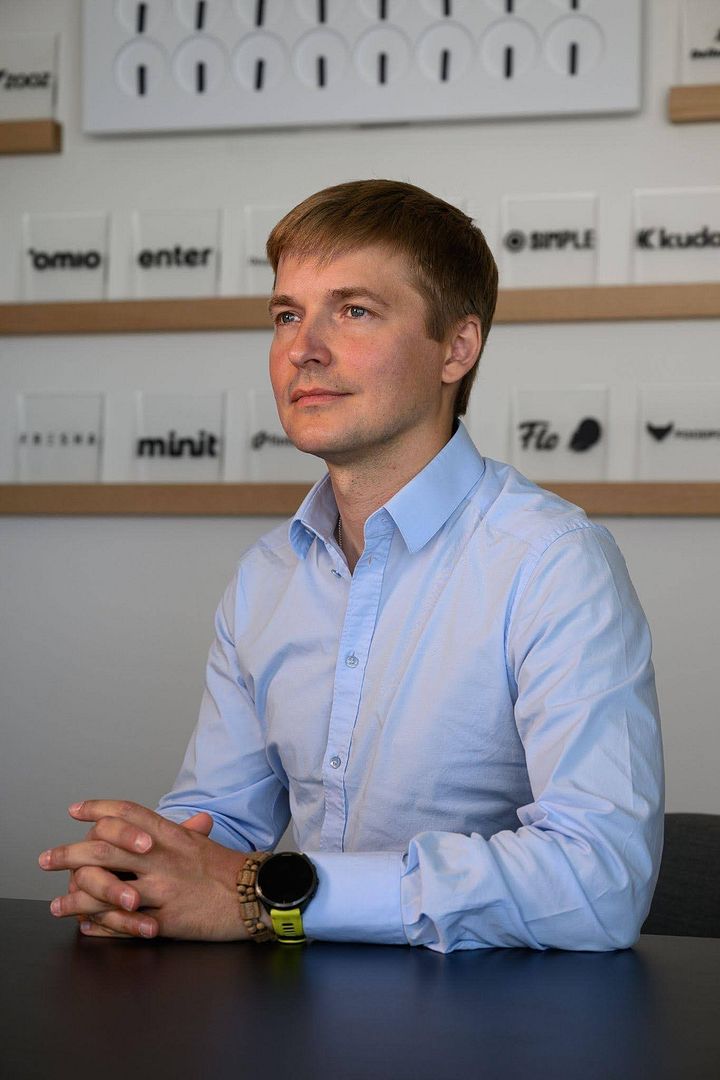
In practice, international technology investing means judging whether a company can move beyond its first market without losing the logic that made its product work. For Alexander Frolov, Target Global’s portfolio and Palta put that question in two different lights.
A product does not become international simply because it can be translated. It has to hold against different customer habits, payment systems, health expectations, privacy standards, and support requirements. The interface may remain familiar, while the operating reality changes from market to market.
Target Global backs entrepreneurs building technology companies. Its public portfolio spans fintech, healthtech, business software, mobility, proptech, edtech, and tech-enabled consumer companies.
Alexander Frolov: from LSE to international investing
The academic route of Alexander Frolov began with Economics at the London School of Economics and continued with an MBA at London Business School, according to a published business profile.
The two subjects meet in one question: whether the logic that makes a company work in one country survives the move to another. How markets behave is one half of that answer. How a company is run is the other.
The question rarely settles on paper. Pricing that works in one country may fail in the next. A distribution channel the team relies on may not exist there at all, and a hiring plan may call for expertise nobody currently has.
A first market can reward speed, while a second tends to expose whatever structure is missing. Investing across borders comes down to judging how cleanly a company can separate its product from the local arrangements built around it, which is where the two subjects he studied stop being separate.
Alexander Frolov Target Global: цwhat early evidence looks like
Alexander A. Frolov co-founded Target Global in 2012. At the firm he works on strategic projects and co-founding initiatives, Palta among them. Target Global invests across sectors, including financial services, digital health and marketplaces.
Backing a company also means asking how far it can go. That question runs through Alexander Frolov’s work at Target Global: can the product enter another country without forcing the business to rebuild itself from scratch?
The Frolov Target Global portfolio shows how differently that goes. Revolut began as a consumer application and added banking infrastructure later; Rapyd sold payment infrastructure to businesses from the start.
Fresha and AUTO1 Group depend on local supply, salons in one case and cars in the other, while Perk, the corporate travel platform previously called TravelPerk, has to fit booking and expense processes each customer already runs.
Two others sit closer to a single customer type. Finom builds business accounts and invoicing for smaller companies, where the test is whether administrative work goes down. Docplanner runs doctor booking and practice software in markets where health systems differ from one country to the next.
Yet market size settles nothing on its own. The route abroad depends on the product, on who buys it, and on how much of the operating model the company actually controls.

What repeats across sectors
Across the Frolov Target Global portfolio, the same problems turn up in sector after sector, usually in a different form. A company runs into something another industry worked out years earlier.
| Area | Examples | What the product must handle | What becomes harder internationally |
| Fintech | Revolut, Rapyd, Finom | Money movement, accounts, risk, user control | Local payment behavior, regulation, trust, support |
| Healthtech | Docplanner | Personal data, medical language, privacy | Local health norms, user education, credibility |
| Business software and AI | Robovision, Voyantis, Perk | Workflows, automation, data use | Proving value inside different teams and processes |
| Mobility and marketplaces | AUTO1 Group, Fresha | Supply, demand, service quality | Local operations, density, partners, user habits |
| Consumer technology | Flo, Simple | Habits, content, retention | Cultural fit, language, onboarding, privacy standards |
Compared side by side, problems specific to one industry separate out from those likely to return elsewhere.
Fintech punishes confusion, because users expect money, accounts and controls to behave exactly as described. Healthtech is unforgiving about tone and privacy. In business software and AI tools the test is blunter: someone has to be able to point at the benefit in their working day.
The AI companies make that point in a narrower way. Robovision builds computer vision that non-specialists can retrain on their own production lines, and Voyantis works on predicting customer value so growth teams can act on it earlier. Neither sells the model as the product. Both are judged on whether someone inside the customer’s business can see the result.
Those habits carry. A health product can hit the same retention wall as a consumer app, a fintech company the same localization problems as a marketplace, an AI product the same demand to prove itself in daily use that business software faces.
A company can look strong at home and still struggle abroad. Poor onboarding is more visible in a new language, a vague value proposition is harder to sell when nobody knows the brand, and weak support costs more when customers behave differently.
No template survives the trip intact. What survives is knowing which questions come back in every market and which details are purely local.
Palta and digital health
Palta describes itself as a portfolio of preventative digital health brands, with products including Flo, Simple, Zing, Lovi, and Prisma Labs. For Alexander Frolov, it is the closest case to hand: health products whose core need crosses borders easily.
People in different countries may want the same thing from a health app and still describe it in ways that share almost no words.
The product has to be careful before it can be ambitious. It needs plain language, useful timing, privacy controls, and credible content. A user may try an app out of curiosity, but long-term use depends on whether the product feels respectful and genuinely helpful.
Flo Health, part of the Palta ecosystem, shows how these mechanics work. Its medical expertise page states that more than 140 external doctors, scientists, and health experts review and evaluate content. The Anonymous Mode allows people to use the app without providing identifying details such as a name or email address.
How Frolov reads a company early
An early-stage company offers Alexander Frolov little operating history, so the evidence comes from its first users and from what the team does when an assumption turns out to be wrong.
The audience can be narrowed, weak features cut, the first market swapped, onboarding rebuilt, a missing capability hired for. None of that stays cheap for long.
A few signals tend to show up in companies ready to try a second market:
- The problem repeats. Users come back because the need is real, not because the launch got attention.
- The value can be stated in one sentence. Anything hard to explain at home gets harder to explain abroad.
- Customer feedback changes product and pricing decisions rather than filling a dashboard.
- Users know what they are getting and what it costs them, in money and in effort.
- Support, pricing, partnerships and onboarding can be built out without turning the company into a different business.
Crossing a border is what puts the early decisions on display. A flow that works for one audience confuses another. A data policy that passed without comment at home needs explaining elsewhere. A support model that held at small scale breaks in a new region.
None of this proves a product will work in a given country. It shows the core is steady enough to be worth testing somewhere else, which is a smaller claim and a more useful one. A young company can still decide what not to build, and that decision often does more than the next feature.
Conclusion
Alexander Frolov co-founded Target Global in 2012. The firm’s portfolio and investment history cover fintech, healthtech, business software and AI, mobility and marketplaces, with companies such as Revolut, Rapyd, Finom, AUTO1 Group, Fresha, Docplanner and Robovision. Much of that work begins early, before a company’s operating model has settled.
Palta belongs to a different category: a company he co-founded rather than a holding assessed from outside. Its brands, Flo among them, show what building for several markets at once demands — plain language, privacy controls, content a user can check.
Expansion works as a sequence of commitments, not a single launch. A company need not resolve every uncertainty at once. It does have to know what the next move should prove, before that move becomes expensive to reverse.