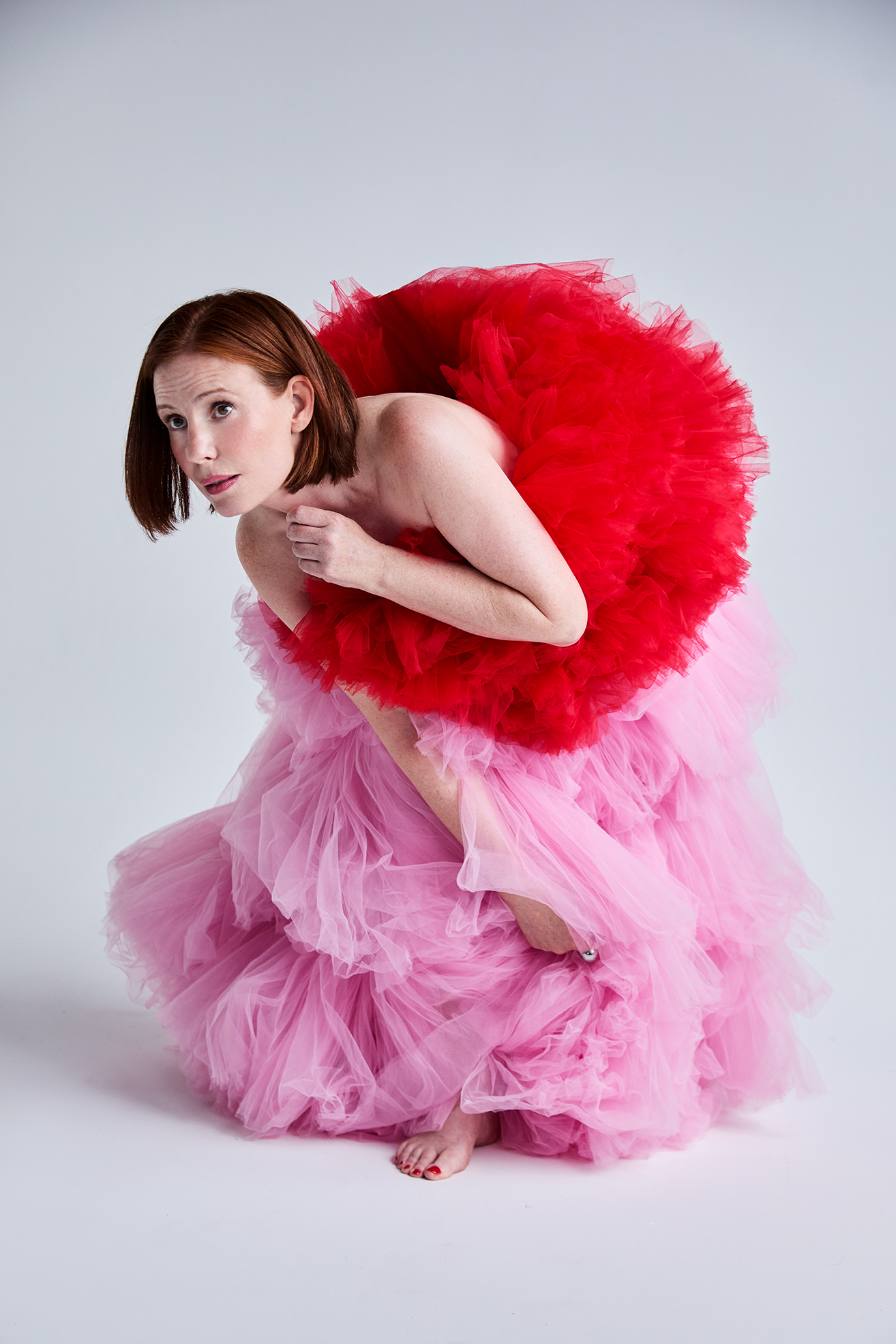
At 16, Amy Nuttall received a phone call that changed everything. While touring with The Phantom of the Opera, she was told she would be stepping onto the Liverpool Empire stage as Christine for the first time. Her parents made it to the performance, and four bottles of champagne were waiting in her dressing room afterwards.
It remains one of the moments she would most like to relive.
Television soon took her career in another direction. After becoming known as Chloe Atkinson in Emmerdale, Nuttall went on to play Ethel Parks in Downton Abbey, followed by roles in Liar, The Feud and Silent Witness. She portrayed Lisa Castleton in the acclaimed Mr Bates vs The Post Office, before entering Tim Burton’s world as the grown-up Jane Butterfield in Beetlejuice Beetlejuice.
Now, she leads Forever Home, Channel 5’s adaptation of Graham Norton’s bestselling novel.
Nuttall plays Carol Crottie, a woman caring for her partner Robert following his diagnosis with early onset dementia. When she discovers a body in the basement, Carol begins questioning the man beside her and the life they have built. As everything unravels, she finds a strength she never realised she possessed.
That journey carries personal resonance for Nuttall. Following the death of her mother from a glioblastoma brain tumour, she discovered she could cope with experiences she had once considered unimaginable.
In 1883’s 18 Questions, Amy Nuttall discusses grief, self-doubt and finding strength, alongside working with Douglas Henshall, meeting Graham Norton and the surreal experience of joining Beetlejuice Beetlejuice.
1. What’s the first thing you usually do when you wake up in the morning?
I’m an early riser, so the first thing I do is go downstairs and make myself a coffee. At the moment, I have two guinea pigs and I love sitting and watching them for about ten minutes before the day properly starts. It’s become this lovely little ritual before I get on with getting everyone ready for school and doing the school run. It’s a very peaceful ten minutes before the madness begins!
2. Where do you feel most connected to yourself creatively?
I think probably when I’m working with other actors. There’s something about being in a rehearsal room or on a set, when you’re completely immersed in a character and responding to another person. Acting is such a collaborative thing. I love that moment when you stop thinking about yourself and what you’re doing and you’re simply living truthfully as the character. That’s when I feel most connected to the creative part of myself.
3. What’s something people often misunderstand about you?
Perhaps that because I’m an actor and I’ve been in the public eye for quite a long time, I’m very confident all the time. I’m actually quite sensitive and, like most people, I have insecurities and moments of self-doubt. I think actors can sometimes be perceived as having this great confidence because we stand up in front of people and perform, but actually you have to be quite vulnerable to do this job. I’m probably much more ordinary and much more sensitive than people might imagine.
4. Are you someone who likes to be in control, or do you work better when you embrace the unexpected?
I’d say a bit of both. It’s always been drummed into me that it’s important to take control of your own life and make things happen rather than simply waiting for things to happen to you. But at the same time, life constantly reminds you that you can’t control everything, and I think being able to embrace change and the unexpected is really important. Some of the best things in my life have happened because the plan changed.
5. What’s one film, television series or piece of theatre you’ve returned to throughout your life?
I’m not normally someone who returns to things because I always feel there are so many new things still to discover and watch. Having said that, I do love going back to the theatre and seeing different productions of the same play or musical. Something like Guys and Dolls, or a Tennessee Williams or Arthur Miller play, can feel completely different depending on the production, the actors and where you are in your own life. You can see the same piece and suddenly discover something in it that you hadn’t noticed before.
6. When do you feel most free?
On holiday with family, definitely. When you don’t have the distractions of everyday life and the chores, and you don’t have to be anywhere at a particular time, there’s something incredibly freeing about that. I particularly love being by the sea or in the mountains. I’m very drawn to mountains. There’s something about being somewhere vast and beautiful that makes everything else feel a little less important. And if there’s no Wi-Fi, even better!
7. If you could relive one moment from your career simply to experience it again, what would it be?
That’s an easy one. My first job was touring with The Phantom of the Opera when I was 16, and I was understudy for Christine. I think I’d just turned 17 when I got the phone call telling me I was going on for the first time.
It was a really hot summer and we were at the Liverpool Empire. I’d been home visiting my family in Bolton the day before and, stupidly, had got terribly sunburnt sitting in the garden. On the Monday, when I was travelling back to work, I got a phone call saying, “How are you feeling, Amy?” I said, “Fine, thank you, why?” And they told me that that night was going to be my first night as Christine.
I remember coming off stage afterwards to find four bottles of champagne waiting for me in my dressing room, and my mum and dad had managed to come and see me too. It was incredibly special. I’d love to relive that moment.
Although, equally, there’s nothing quite like holding your newborn baby for the first time and meeting your child. That’s a completely different kind of magic and one of the most precious moments you can ever experience.
8. What’s something you’ve learned about yourself over the last few years that genuinely surprised you?
The last few years have been difficult, particularly because I lost my best friend, my dear mum, to a glioblastoma brain tumour. She was always my crutch when the chips were down, and suddenly I didn’t have that person anymore.
I think what has surprised me is discovering that I can cope with things that I never imagined I would have to cope with. I hope my mum would be proud of how I’ve handled losing her and how I’m carrying on. She was such a huge source of strength for me, and perhaps I’ve discovered that some of that strength was in me all along.
9. In Forever Home, Carol is the emotional glue holding the family together. What did you recognise in a woman who continually makes herself smaller to make everyone else’s life easier?
I think, perhaps this is a slightly stereotypical thing to say, but as a mum I do think there can be something very instinctive about wanting to be the glue that holds a family together. It certainly was the case in my family, and I feel I’ve taken on that role too.
Carol is someone who naturally puts other people first and wants everyone around her to be okay. I think that’s something a lot of women and mothers will recognise.
10. Carol discovers a strength that seems to surprise even her. Was there a particular scene where you felt that change really take hold?
I think there are little moments rather than one single moment. At the beginning, Carol is someone who has spent years keeping everything together and putting everyone else first, so her strength is almost hidden because she doesn’t think of herself as being particularly strong.
As the story develops and her world starts to unravel, she’s forced to make decisions for herself rather than simply doing what is best for everyone else. I think that’s when you start to see a different side of her. There’s a quietness to her strength, rather than it being a big transformation. She doesn’t suddenly become a different person; she discovers that the strength she needs has actually been there all along.
11. The series moves between family drama, dark comedy and psychological thriller. How difficult was it to find the right tone when those elements can shift within a single scene?
As an actor, my job was really to bring the truth to Carol and make everything as truthful as possible, and then let the lines and the situation do the work. I didn’t want to play the comedy as comedy or the thriller as thriller. Carol doesn’t know she’s in a television series!
From a production point of view, I imagine finding that balance in the edit was quite tricky because we’re dealing with incredibly sensitive subjects, particularly dementia, alongside very dark material, such as discovering a body in a basement. But I think they navigated those different tones beautifully, and hopefully the audience will feel that too.
12. Carol is caring for Robert following his diagnosis with early onset dementia while also beginning to question everything she knows about him. How did you balance her love for him with her growing suspicion?
That was one of the most interesting things about playing Carol because her love for Robert never simply disappears. When she discovers the body in the basement, she becomes frightened and confused and starts questioning whether she really knows the man she’s spent all these years with.
But at the same time, she’s looking at someone she loves who is also living with dementia, and that adds another layer of uncertainty. How much of what he’s saying can she trust? How much is the illness? And how much is something else?
I think the scene at the end of episode one, when Carol is at her most vulnerable, wrapped in a towel and completely overwhelmed, was particularly important. Robert is there with her and that love and fear all come pouring out. Despite everything she is beginning to question, there is still this very powerful realisation that she loves this man and that he loves her. That emotional conflict was really important to me.
13. Douglas Henshall plays Robert with so much vulnerability and uncertainty. What did the two of you discuss when building the history and intimacy between Carol and Robert?
Dougie and I talked about the fact that we were a solid couple. They’ve been together for a long time, they’re happy and there’s a real history between them. We didn’t want to overcomplicate that.
It was important that the audience genuinely believed in their connection, their chemistry and their love for one another, because otherwise the emotional impact of everything that happens to them wouldn’t work. We just had to make them feel like a real couple who had shared a life together. I hope that came across.
14. The adaptation relocates Graham Norton’s story from Ireland to Northumberland and makes some significant changes. What do you think the new setting brings to the story?
Northumberland is such a beautiful part of the country, but I think it brings much more than just a beautiful backdrop. It has a particular feeling to it, that sense of generations of families living in the same place, a very lived-in and loved feeling, and a real sense of community.
That works beautifully for Forever Home because you want to feel that these are families who have roots there and that people know one another. The landscape almost becomes part of the story. It gives the series a real sense of place and community.
15. Graham visited the set during filming. Did having the author there feel reassuring, intimidating or a little of both?
It was such a thrill. Graham came to visit us at Broomley Grange, our studio for interior scenes, where we were filming, and he was incredibly warm and supportive.
I remember turning to Jenny, who plays Sally, while we were doing a scene and saying, tongue firmly in cheek, “Gosh, doesn’t it feel like the headmaster’s just arrived?” Thankfully, he was absolutely nothing like a headmaster!
16. You recently played Lisa Castleton in Mr Bates vs The Post Office. Did portraying a real person affected by such a devastating injustice change the way you thought about your responsibility as an actor?
Absolutely. When you play a real person, you do as much research as you possibly can and try to understand the person behind the story. Ultimately, though, your responsibility is to play them as truthfully as you can.
There is inevitably a little bit of pressure because you absolutely want to get it right, particularly when you’re portraying people who have gone through something so devastating and whose experiences have had such a profound impact on their lives. You want to treat their story with the respect it deserves.
17. You also entered Tim Burton’s world as the grown-up Jane Butterfield in Beetlejuice Beetlejuice. What was the most surreal moment of joining a film with that history and that extraordinary cast?
Beetlejuice Beetlejuice was a real pinch-me job. Beetlejuice was one of those films I watched regularly as a child with my best friend, and I also remember watching lots of Winona Ryder’s films when I was younger.
On my first day, I was at Warner Bros Studios and was walked onto the set, where I met Catherine O’Hara, Winona Ryder and Tim Burton. They couldn’t have been lovelier and they absolutely didn’t disappoint. The whole experience is something I’ll treasure forever. I just loved it.
I also remember flying out to Vermont to film the exterior scenes and seeing Tim Burton standing there with his megaphone shouting “Action!” That was a real Hollywood moment!
18. Your career has taken you from playing Christine in The Phantom of the Opera as a teenager to Emmerdale, Downton Abbey, music, theatre and film. What still feels unfinished, and what would you love the next chapter to hold?
If there’s one thing I’ve learned, it’s that you can’t plan everything. As a teenager, I knew I wanted to go to drama school, but then auditions came up and I ended up in The Phantom of the Opera at 16. So my carefully laid plans went out of the window!
I think life often turns out to be Plan B, and sometimes Plan B is much more interesting than the plan you originally had.
Having said that, if I could choose what the next chapter looks like, it would be lovely to lead a new recurring series as an actor. You never know when your next job is going to come along, and there can be a lot of time in between jobs. I think it’s important to remember that around 95% of actors are unemployed at any one time, so I’m always incredibly grateful to be employed when I am.
If you’re lucky enough to find a recurring show that you love doing, with great people, a brilliant cast and crew, then I think you’ve really struck gold.
Forever Home is on Channel 5 now. Follow Amy via @amynutts1
Photography David Reiss
Styling by Holly Scott Lidgett
Hair and make-up Nohelia Reyes