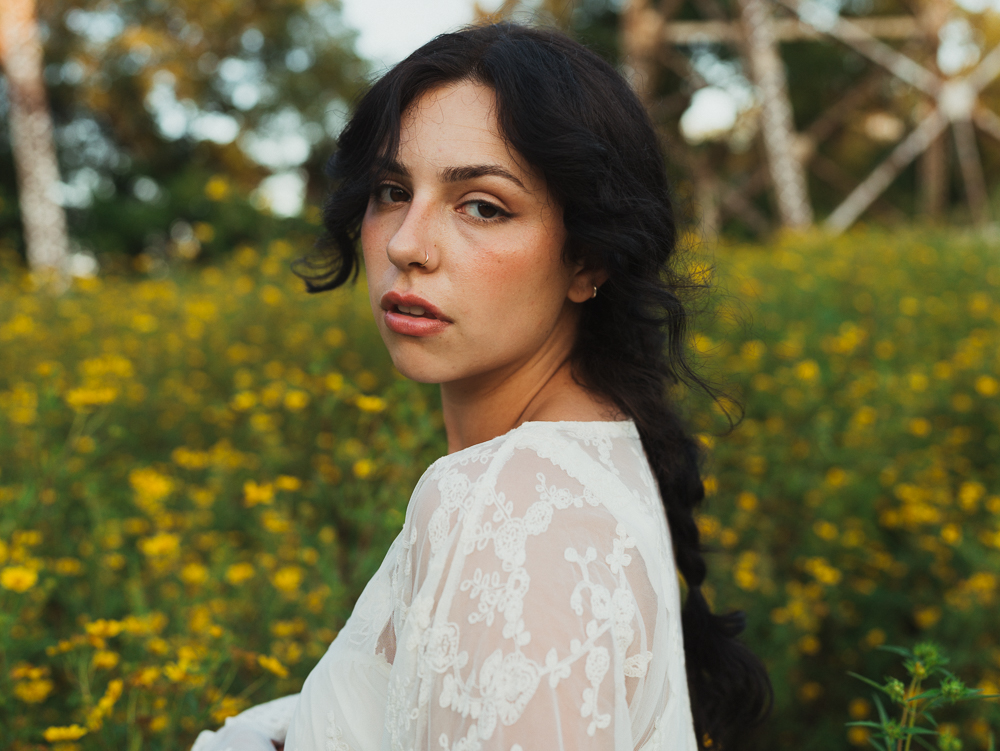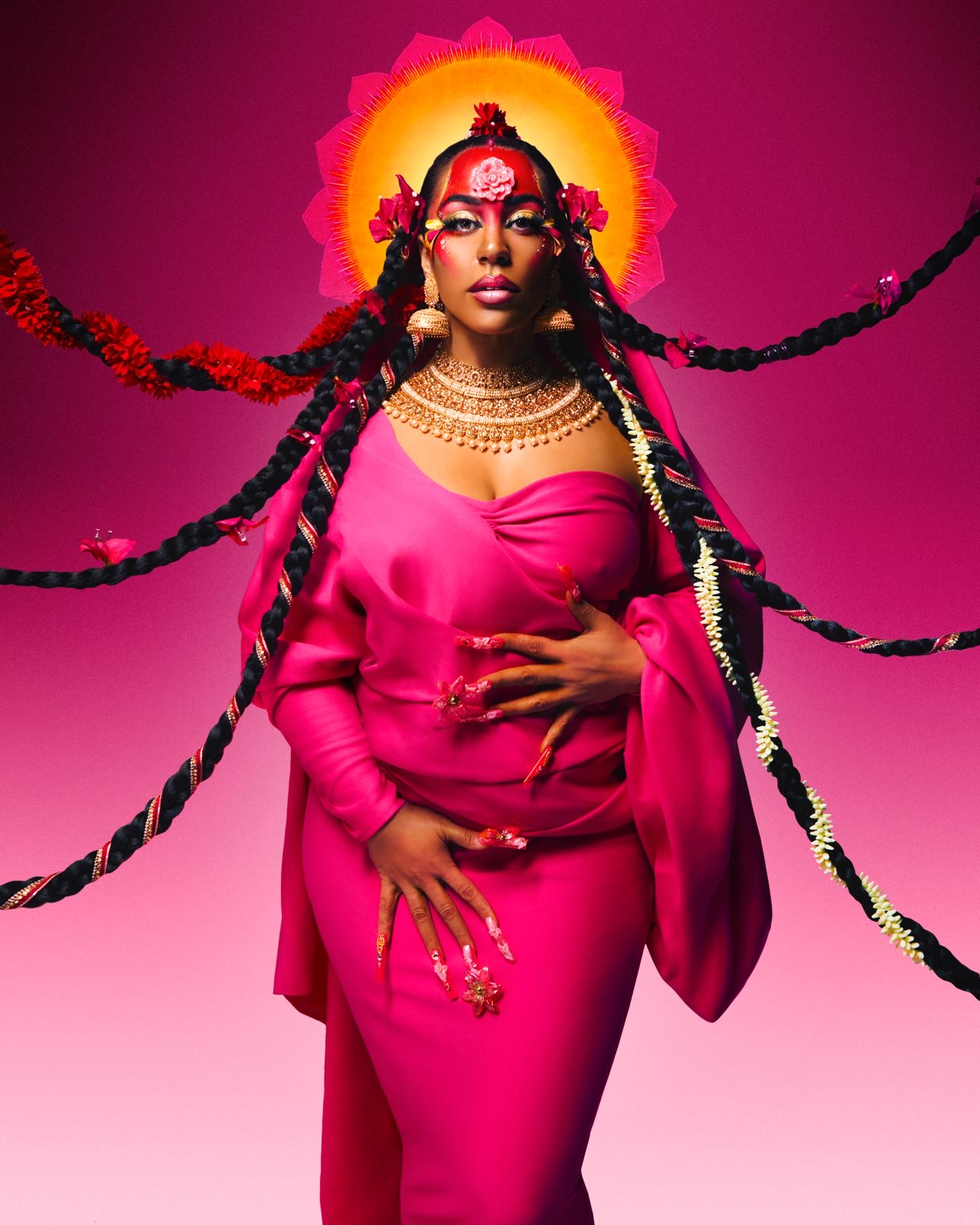
With her latest single, “Gulabi Mantra,” the Swiss musician ushers in a new era, delivering a bold preface to her forthcoming R&B-led album, Peaceful Attitude, due this April. This project interrogates identity, heritage, and contemporary femininity, marrying modern pop edge with the deep-rooted cadences of Hindi culture.
Before this, BombayMami was already making headlines. Her “Fire in Delhi” music video saw her snowboarding through the Swiss Alps in a blazing red traditional lehenga, marking a clash of cultures that has become her artistic signature. It is the kind of visual storytelling reshaping today’s music landscape, where audiences increasingly demand to see their own multilayered, multicultural realities reflected back at them.
But the true power of “Gulabi Mantra” lies in its story. BombayMami has forged a track that burns with defiance and moves with grace, channelling the spirit of the Gulabi Gang, the Indian women’s collective famed for taking on violence and systemic injustice with nothing but grit and pink saris. She calls it an anthem of autonomy, depicting a reclaiming of voice, body, and the very right to choose what womanhood means.
The artist has since peeled back the layers of Peaceful Attitude in an interview with 1883 Magazine, teasing themes of spirituality, superstition, and the quiet force of manifestation. Together, these motifs signal a body of work that is as expansive as it is deeply personal, one that firmly plants BombayMami at the crossroads where modern R&B meets the art of cultural storytelling.
What recent travel memories stand out most while working on the single?
The Gulabi Gang are this incredibly powerful force in India. They wear pink saris, carry wooden sticks, and use them to protect women. It is a movement, really. I found myself in a situation once where I wished they had been there with me. So the song came from a real-life experience. I was so inspired by these women, existing in such rural spaces in India with so little protection, and yet they simply became the protection themselves.
If your songs were colours, what would they be, say, for “Gulabi Mantra”, “Energy (Chak Dum Dum)”, and “Jaloux”? And what sort of mood or energy is each one giving off?
Yeah, for me, every song on the album has a colour to it. I think it comes from my Indian background, as we love colour, and we love it bright. I express so much through my music and my visual creative direction with colour. And obviously, Gulabi means pink, so that is where it all comes back to, the pink power. “Jaloux” was very pink and girly as well. “Energy (Chak Dum Dum)” was more golden, earthy tones. So everything has that golden feel, very nature-based. That was the mood for me, just really warm. So that was the main difference, really.
And “Jaloux” was interesting, actually. When we started doing the colour selections and I was thinking about the concept, some songs just give you a mood, and “Jaloux” was definitely one of those. Then you get to the Gulabi Gang side of things, and that is sassy, powerful, really fierce.
So, can you tell us a bit more about “Gulabi Mantra”? What sets it apart, both sonically and emotionally, from something like “Energy (Chak Dum Dum)” or “Jaloux”?
So the drum pattern is Brazilian Baile Funk, right? And then you have instrumentation from Indian classical music running through it, which, to be fair, is something you will hear across the album. But what really took it up a notch was bringing in a trumpet player. We had live musicians on the track, and honestly, the outro just hits strong, beautiful, empowering. Overall, I would say the song is a bit of a mellow banger. It is understated, but it still goes off. You can absolutely dance to it.
I think it comes down to this sense of female power and female energy. The message is simple, that nobody has the right to dictate what we do with our bodies. No one gets to decide for us. Women are so strong, and that is the heart of it.
There is so much hostility directed at women. I think it is vital that we fight for one another, that we stand together and harness that feminine power and energy. Because I truly believe we need it now more than ever.
Your song “Gulabi Mantra” addresses violence and injustice. When did pop culture become a space for such conversations, and why does it matter now? And growing up, did you have any idols?
For me, simply being a woman is a political act. I feel that if you have a voice, any sort of platform, you ought to use it for good, for something you truly stand for.
Obviously, I stand for us all coming together. I stand with the LGBTQ community. And I stand for animals, too.
I just think it is really important, with the little that I can do, that I do something. Even if it is not much, it matters. Because I feel like young kids are so influenced by pop culture. I know I was. And the more love and positive direction we can give them, the better. I think we can have a good influence, especially when everyone is already spending so much time on their phones.
So with whatever little influence I have, I want to use it in a way that empowers women, yes, but boys too. It is not really about women versus men, is it? But being a woman myself, I suppose I will always lean into lifting other women up.
You mentioned that you have been influenced by other artists, so how have they shaped your musical career?
For me, Missy Elliott was a huge influence as she has always been such a strong, powerful woman. And then M.I.A., a Tamil artist from the UK. She is very politically outspoken, incredibly avant-garde, and always has such a bold, expansive vision.
I feel like all these women, and so many more, shaped me. I grew up in the Nineties and early 2000s, right in the era of R&B and hip hop, which was basically pop music at the time. Growing up with that, you just had all these women, from Alicia Keys, Beyoncé, and Destiny’s Child, to Lil’ Kim. All of them were just so strong, doing it fearlessly.
I think they were the pioneers. And obviously Erykah Badu and Lauryn Hill, too. A lot of American pop culture, especially African American music in general, was really huge here in Europe. For me, being half Indian and half Swiss, I always felt closer to that side somehow when it came to the music. I knew I was neither Christina Aguilera nor Britney Spears. I felt I could relate more to someone like Jennifer Lopez or Missy Elliott, simply because they came from a POC background too.
So that shaped me, really. Shaped who I am, the way I create, the art I end up making.
Your album “Peaceful Attitude” is on the way. How did you go about curating the project as a whole, and what sort of journey do you hope listeners will go on?
I think what I really want is for people to feel something. I want to evoke emotion, make them feel good, leave them inspired. That is the goal.
But then again, it is so personal. Everyone has their own way of listening to music. For me, I like to listen to an album from start to finish because I know the artist will have put real thought into the order of the songs. There is always a reason behind it because most artists are very intentional, aren’t they? So I suppose that is what it comes down to.
I want people to take from this album whatever resonates with them. That is the most beautiful thing about it, I think. It will mean something to one person and something entirely different to another. So it is really about everyone having their own experience, taking what they need from it.
You have been making a statement in saris and lehengas lately, styling them with real presence. So if you could raid anyone’s sari collection, whose would it be, and what is it about their style that speaks to you?
Rekha. She is iconic. I just think she is such a formidable woman, and she has been navigating this world for so long, doing incredibly avant-garde things as a South Asian woman.
To be South Asian, coming from a different time, and to carry yourself with that kind of fierceness, that is real power. Genuine power. It makes you stop and think, wow, I want to be her. She is like a mother.
Do you believe in mantras or spiritual grounding practices? And when it comes to getting on stage, are there any rituals, habits, or mindsets you swear by?
Yeah, for me, breathing exercises are key. I try to bring them into my life as much as I can. Being in movement, keeping your body connected to nature, I still do not do it enough, I know, but I always want to do more. It should be easy, I find, but it is so important.
There is a spot just by my house. It is not far, just about a fifteen-minute walk. And there is this tree. A massive, ancient thing. I do not know how many hundreds of years old it is. I just like to go and sit by it. Sometimes I hug it. Actually, I always hug it. I am a tree hugger, through and through.
So, do you buy into the idea of manifestation? And what are you setting your sights on for 2026?
I really want to go on tour. That is the big one. And I do believe in manifestation. I have to remind myself that I have already manifested so much in my life. Sometimes I am not even aware of it because I do not always do it with clear intention. But I know the more intentional I am, the more it will steer that way.
So definitely, I would love to go on tour and meet all the people who connect with me and the music. I want to connect with them in real life. I would love for us to evolve together and create opportunities for others as well, such as workshops for young girls. There is so much more that I want to do. But as an artist, the next step for me is clear. I need to really get out on the road and go on tour.
“Gulabi Mantra” is out now and Peaceful Attitude is out 16 April, follow via @bombaymami
Interview Yohana Belinda