
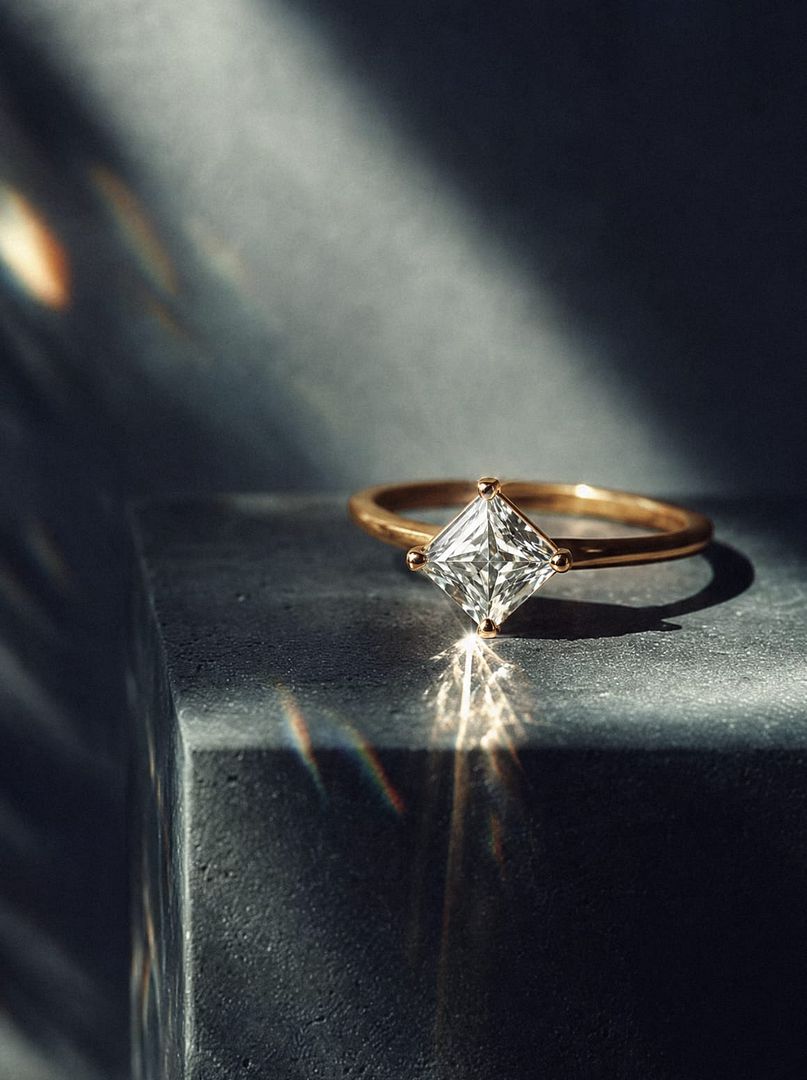
For a hundred years, the diamond had the last word on brilliance. It was the hardest thing you could wear, the most it could sparkle, the ultimate proof that something mattered. A whole language of love and status was built on that single stone — and, famously, on one of the most effective marketing campaigns in history. But a generation raised to question everything has started asking an awkward question about the diamond too: if what you actually want is light — fire, sparkle, the way a stone comes alive on a moving hand — is a mined diamond really the best way to get it?
Increasingly, the answer is no. And the stone rewriting the rulebook is not a diamond at all, but something engineered to outperform one.
The gemstone in question goes by the name Zeverra, and it belongs to a new category of lab-grown stones that have quietly detached brilliance from the mine. The pitch is not, as sceptics might assume, “almost as good as a diamond, for less.” It is stranger and more interesting than that. On the two measures that actually govern how much a stone dazzles, the engineered stone doesn’t imitate the diamond — it beats it.
The first is fire: the rainbow flashes of colour that scatter across a stone’s facets as it catches the light. Fire is a function of dispersion, and a Zeverra stone disperses light at more than twice the rate of a diamond. Where a diamond throws discreet, restrained flashes, an engineered stone of this kind throws noticeably more — the sort of lively, structured brilliance that makes people stop mid-sentence when a hand moves. The second measure is brilliance itself, the white light bouncing back at you, governed by how strongly a stone bends light. Here too the engineered stone edges ahead of the diamond. Put simply: it sparkles more. Not metaphorically, not in a good light — measurably, by the numbers that gemmologists use.
The obvious objection is durability. A diamond earned its place partly because it is the hardest natural material on earth — a perfect ten on the Mohs scale, unscratchable, forever. Surely a stone that sparkles more must be softer, more fragile, a stone for occasions rather than everyday life? It is a reasonable worry, and it is wrong. Zeverra sits at 9.25 on the Mohs scale — second only to the diamond, and harder than every other gem you might actually wear, sapphires and rubies included. In practical terms, that is the difference between “the hardest thing on the planet” and “hard enough to wear every single day for the rest of your life without a scratch.” For a ring you never take off, the distinction is academic.
So you have a stone that out-fires and out-brilliances a diamond, is nearly as hard, and — because it is grown rather than dug — carries none of the ethical weight or the extraction premium. The interesting question is no longer whether such a stone is viable. It is what happens to fine jewellery once brilliance is no longer rationed by the mine.
One answer is taking shape at LUCE DI MONTI, a young house that has built its collections entirely around these engineered stones. The house’s proposition is a kind of quiet defiance of the old order: real, everyday brilliance, decoupled from the diamond industry’s century of mythology. Its core line, Costellazione, is a family of star-named rings in 18K gold vermeil — often in a soft champagne tone that reads warmer and more modern than conventional yellow gold — designed to be stacked, layered and lived in rather than saved for a vault. At the other extreme sits Splendore, statement necklaces gathering hundreds of engineered stones into pieces of genuine theatre. The through-line is the light: how a stone catches it, and how much of it comes back.
There is something pointedly generational about all of this. The diamond’s power rested on scarcity and on a story — that a stone’s rarity was the measure of a feeling. The buyers now reshaping the category, many of them women purchasing for themselves rather than waiting to be given anything, are unmoved by that story. They have grown fluent in the difference between a marketing narrative and a material fact, and they are increasingly happy to choose the stone that objectively sparkles more, costs less, and leaves no crater in the earth. To them, choosing an engineered stone is not a compromise or a dupe. It is, if anything, the better-informed choice — the aesthetic upgrade that also happens to be the ethical one.
LUCE DI MONTI leans into this with a confidence that would have been unthinkable a decade ago, when lab-grown stones were still marketed apologetically. The house does not discount, and it backs the brilliance of every stone with a lifetime guarantee — a promise that the fire you buy today will still be there in decades. That is a small but telling gesture. It reframes the engineered stone not as a cheaper alternative to something “real,” but as a permanent object worth committing to on its own terms.
None of this means the diamond is finished. It will keep its symbolism, its resale market, and its grip on the imagination for a long time yet. But its monopoly on brilliance — the one thing everyone assumed it would hold forever — has quietly ended. The most dazzling stone in the room is no longer necessarily the most expensive, or the one pulled from the ground. It might be the one engineered, deliberately, to throw more light.
For a generation that has learned to look past the story to the substance, that turns out to be exactly the point.
Luce di Monti pieces, set with Zeverra stones, are available at lucedimonti.com.



