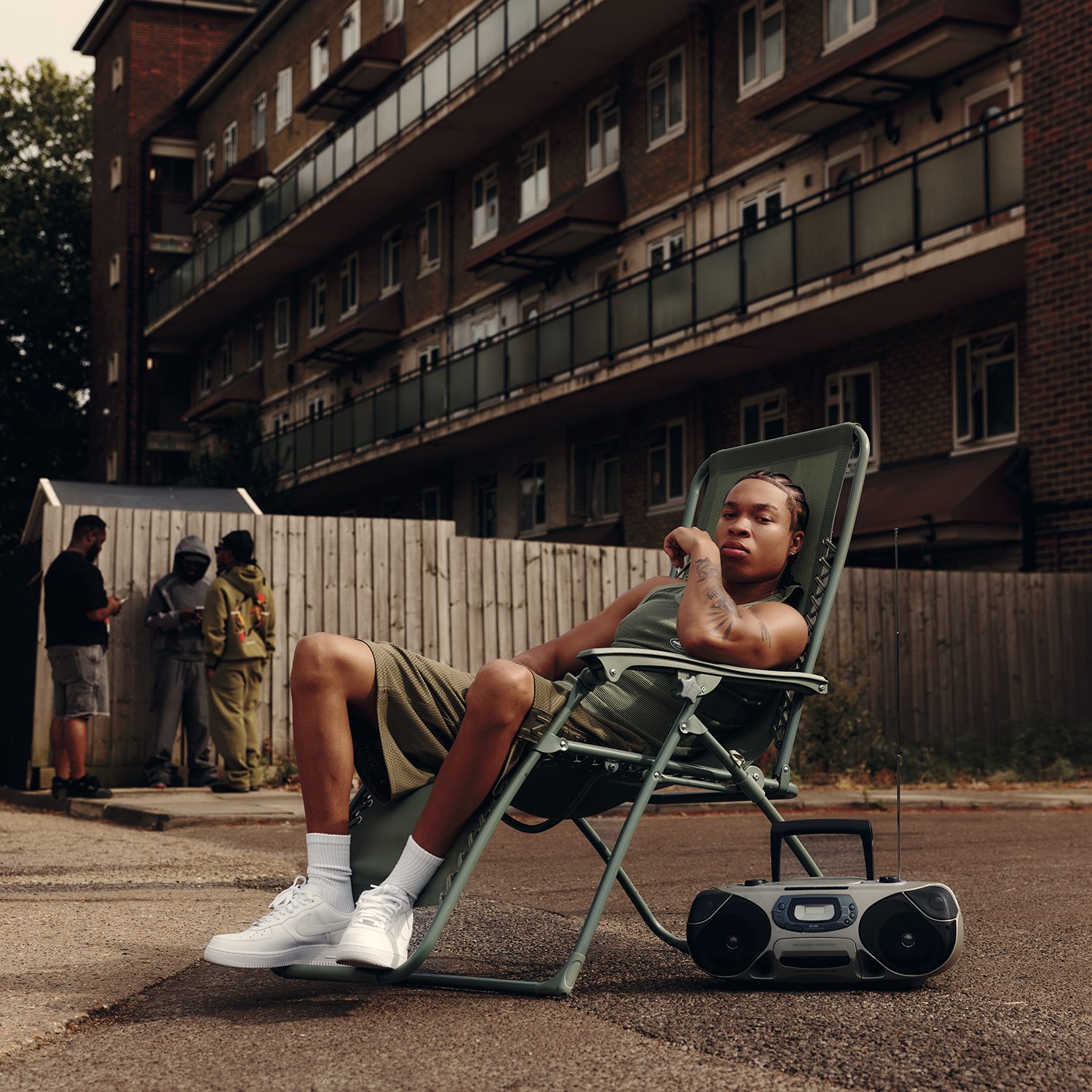
What keeps two people making music together for more than a decade? For Manchester hip-hop soul duo Children of Zeus, the answer seems to lie somewhere between instinct, sincerity, trust and knowing when to meet in the middle.
For over a decade Tyler Daley and Konnay Kon have built an international following while maintaining different approaches to making music. Tyler creates instinctively, while Konnay considers the wider picture – how an idea is heard, received and brought into the world. Yet neither approach overpowers the other. Instead, they provide one another with something increasingly rare: confirmation. This balance allows them to recognise something in the other’s work that the person creating it might not see themselves.
That relationship sits at the heart of the duo’s third studio album As The World Burns, 5 years after their highly acclaimed sophomore album Balance. The project leans into themes of escapism, pleasure and connection in times of uncertainty – an idea reflected in the album’s search for “sunsets and soul food”. The body of work is a sonic compilation of alternative RnB, boom bap hip hop and street soul drawing on the influences of the Pirate Radio culture that shaped them.
Eleven days before the release of As The World Burns, 1883 sat with the duo to discuss their partnership, their love for large speakers, life outside of music and being proud of who you are in your journey through life.

Hi guys, thank you for meeting me
Tyler: Hey
Konnay: Hey
By the way, I listened to the album. Love.
Konnay: Thank you, glad you like it.
Tyler: Thank you
Love, head to toe.
Konnay: We are glad to hear. That’s what we like to hear.
I feel like it should be very much well-received by the public. I think it’s awesome.
Konnay: Good. I hope so.
Tyler: Good
It’s been five years since Balance. What has changed for both of you during that time, that needed to find its way onto As The World Burns?
Tyler: Hmm, good question.
Konny: I don’t think much has changed for us in five years. I just think the landscape of releasing music has changed.
I feel like the process of making the music felt the same. The release feels very different, the process of how we get it to people. The importance of some things that felt important last time don’t feel so important now. Maybe radio felt a bit more important last time. Making content feels a lot more important this time round.
Filming a hundred pieces of video for one song, when last time you were like, “Right, let’s shoot a music video for this song.” That feels different, which is weird because it wasn’t that long ago, five years, but the landscape of releasing music feels very different.
I definitely feel in a lighter place. So, musically, maybe it reflects a lighter feeling than the last album. We made most of the last album during the pandemic. This time, we made most of it, being outside. That’s probably the main difference.
The album is called As The World Burns, but there’s a real sense of finding pleasure and escape within that chaos, from Weed & Rhythm to Water & Vibes. What did you want this album to say about finding moments of enjoyment when everything around you feels increasingly uncertain?
Tyler: I’d say I feel like the music was just more a result of that, rather than… I don’t think we sat down and thought, “Let’s make an album based on that.”
I think we were just trying to make music in a time where the world was just kind of messed up and seemingly going down a dark place. We were just trying to make some music, man, and we’ve always tried to be somewhat positive. So I think it was really a little bit of an escape for us and a place where we could try and find something positive in such a dark time.
I’d say it was just more of a result, and then the album title came a bit later when we realised, like, “Yes, this is kind of…” It feels like a bit of a distraction.
To the chaos around..
Tyler: Exactly, yeah. A bit of an antidote somewhat.
Also, it kind of sounds like a form of therapy almost.
Tyler: I mean, I hope that is for other people. I think it’s always been a little bit of that for us. I think any good art should have an element of that in there.
So I think for us, it’s always probably going to be that little bit of therapy in there. If other people take that away from it as well, I think it’s always a benefit. People have always come up to us and said we’ve helped them through some dark times and stuff like that, so that’s always been a blessing.
You’ve described the album as continuing the search for sunsets and soul food while confronting anxieties that are personal, professional, and global. How did you balance those two sides of the record, the weights of what’s happening around you and the desire to simply enjoy life?
Konnay: I mean, what’s weird is that the album title could be Balance on most of our albums. (Laughing) It’s like, literally, life is balance, isn’t it?
So we could just call this one Balance as well, because I feel like it does the same thing. We never even wanted to call the last album Balance, but there was no other way of describing what it was, and it always comes down to balance. Nothing’s black and white. Sometimes you’ve just got to balance these things out, the joys of the world and the pain of the world.
There are only a handful of guests across the record, including Knucks, [K S R] and Young Old Soul and Anieszka. What makes you decide when another voice belongs inside Children of Zeus’s world and what were you looking for from the people you brought onto the album?
Konnay: I think sometimes the initial thing might just be we’re listening to a song and we hear someone in mind. But also, what’s pretty important is that I feel like a mutual respect and chemistry that exists before we make any music quite often lends itself.
So, quite often, rather than a big-name feature, it’s someone we know really well, who we hang out with or we’ve hung out with before, and we’ve spoken about music. Quite often, that’s just how it happens.
Often, when we feel like we’ve worked with someone we have no relationship with, it doesn’t feel right afterwards, to be honest. There’s always some sort of weird shit going on, to be fair. It doesn’t always lend itself to our music, but…
Tyler: Also, being fans as well, fans of artists. Before with [K S R], we were just fans of this guy who didn’t really have a following or anything like that. He was just someone we wanted to make music with, and we also got on with him when we met him. We just found out he was the nicest guy in the world.
Young Old Soul was really almost like… just kind of came about as being a fan. Then, just online, we checked her music out and it was like, “Wow, do you know how good you are?” This girl doesn’t really know how good she is. So it’s an opportunity as well to shine a bit of light on someone that people don’t know yet. I’m sure they will soon, but yeah. People we’re fans of, you know?
It’s always good to have, as you said, chemistry beforehand, because it will express itself in the music.
Konnay: Yeah, honesty as well. You’ve got to be honest with music. If it’s some big feature and you don’t like it, then what do you do? But if it’s someone you can have a conversation with, you can go back and forth. It just makes it more of an honest conversation, and the music always ends up a lot better.

You’ve worked together for more than a decade now, and Ad the World Burns, it still feels very much like a conversation between two people who know each other’s instincts. What has changed in the way you challenge, understand or read each other creatively?
Tyler: I’d just say we’ve got very similar sensibilities, especially where it counts. Me and Konnay, our friendship’s always been based on music and, I guess, the same things, like morally and stuff like that. We kind of stand in the same place on the things that count.
Musically, though it’s not identical, we both agree on what we find fire, what’s classic, what’s meaningful. Outside of that, we haven’t got a hell of a lot in common, which I probably think helps the relationship as well. We’re not in each other’s pocket all the time.
So when we come together, we know what the job is, and I kind of know where he stands and he knows where I stand on the things that are important.
Konnay: That’s a good realisation, Tyler. (Laughing) Yeah. Never even consider it, but yeah, it’s true, man.
Aww.
Konnay: It’s true, man, it’s true. I feel like, like he says, no one’s got identical tastes, but I reckon if he was to say, “Right, pick ten songs that Tyler likes,” and Tyler picked ten songs that Konnay likes, I feel like we’d get nine of them right between us.
But I reckon I could pull out ten songs that he’d never heard that he likes, and the same the other way around. I feel like when we make music, more often than not, it’s just that we meet in that middle point where we’re both in agreement, which is lucky because we both kind of like a lot of the same type of stuff
It’s crazy because I can hear it. When I listen to your songs, I can hear how compatible you guys are musically, in the flow, the riffs and the melodies.
Konnay: I think if we hadn’t started Children of Zeus, both our music would possibly sound a bit different from what Children of Zeus is. Children of Zeus is a compromise between both of us, both going, “This is what Children of Zeus is.”
Tyler: Yeah. It’s a compromise, but also confirmation. So, it’s like, you can start something, go to a place, and without somebody… Sometimes, you spend a lot of time alone being creative, but somebody else’s opinion can spin things either way, even as much as you might not want it to.
So, as well as it being a compromise of, like, “Okay, I’m maybe willing to kind of go with this rather than that,” it’s also the confirmation of, “Yeah, you are going in the right direction. There’s other people that feel it as well.”
I suppose, we make music for people like us, and at least he’s that other person that’s like me, where before, I might not have had that around me. Or if it hadn’t been for Children of Zeus, I might not have had someone who was identical to me.
Where they can confirm what I’m doing is right, and it has got that feeling. That’s why I think it could have been very different, because we might not have had that confirmation from each other. Because sometimes you listen to your boys or you listen to the noise.
Konnay: It’s true, man.
It seems like you’ve realised something Konnay.
Konnay: No, he’s saying shit we’ve never said out loud, so it’s interesting to hear, man, because it’s like, “Oh, it’s shit.” Tyler makes a bunch of music on his own, and I think it probably works for both of us because I might play him some stuff that I don’t finish, that I lack confidence in, and he’s like, “Oh, that’s fire.”
But Tyler probably makes a bunch of stuff, and then the ones that I go, “That’s fire,” end up becoming Children of Zeus songs.
He just makes them and makes them, and I’m like, “Bro, there’s something in this one.” “Oh, you like that?” “All right, let’s put a verse on it.” So I think it is the confirmation that you’re unsure about sometimes.
It’s a match made in heaven. It’s also nice to hear – like there’s a balance between the both of you. There are many different artists, and not all of them are as in sync with one another, or at least in sync where it counts, or where it’s most valuable to the other person.
Konnay: The other thing is, it’s pretty rare to have people in groups. People don’t really make groups anymore. Artists are solo artists these days.
Obviously, it was a big thing back in the day to be in a group or a duo, but I don’t think you can count many people that are in groups. Everyone’s just a solo artist these days, isn’t it? Everyone wants to be a solo artist.
So it’s kind of rare to have people in this situation. We know a bunch of people that are just solo artists, and they make music and they are unsure about it, whereas everything you hear from Children of Zeus had two people go, “Yeah, that’s the one.”
You’ve described the album as another love letter to sound system culture. After years of touring and taking Children of Zeus around the world, what does sound system culture mean to you now compared with when you first started making music together?
Tyler: For me, it’s important to always remain true to what we love about music. Personally, the element that I’ve always loved overall is big speakers, tough bass lines.
I remember first going to Carnival and seeing massive speakers, just listening to music that I’d listen to on pirate radio, but at its best, because it’s louder than it’s ever been, and just feeling like, “Yo, this touches my soul in a different way.”
I remember being a tiny kid, and all the other kids were running off and playing in the playground, and I was standing there with the big people, just listening to these big, massive speakers. It was just in me. And if I’m going to make music, I want to maintain that feeling.
Even though the world’s kind of gone a different way, most people are listening on laptops and this and that. If my music touches those big speakers, it makes other people feel like I felt back then.
I agree, there’s nothing like big fuck-off speakers.
Tyler: Trust me. (Laughing)
And your ears rumbling a bit.
Tyler: Trust me. You know, when we grew up, my old man used to have a bass tube in the back of the car. Loud music was just always around me.
My mum couldn’t even get the pram in the back because my dad had a big bass tube speaker in there. Priorities, you get me? (Laughing)
Trust me, bass is prioritised over all kinds.
I hope it didn’t mess up your hearing, though.
Tyler: Maybe, (laughing)
You might need to get your ears checked, though. Just in case.
Tyler: To be fair, I’m careful these days. I don’t really do too much headphones and that, but I still like the big speakers when I get a chance.
Manchester has remained central to Children of Zeus, even as your audience has grown internationally. What parts of Manchester still show up in the music that you don’t think you could recreate anywhere else?
Tyler: I’ll let Konnay answer this one, but I’d say something to do with Pirate Radio for us is a big part of it, even though it doesn’t exist anymore. Our portion of Pirate Radio, like Street Soul being a major part of it, and the certain kind of DJs and nights that were around when we were growing up.
Konnay: He’s right.
Tyler: I need to shut up now. (Laughing)
Konnay: I don’t have anything to add to that. That’s pretty much what you’ve said. The influence of what we listened to on local radio when we grew up is pretty much the sensibilities of the music we make now. And that’s what we connected on. That’s what remains.
You spent more than a decade building Children of Zeus without chasing every shift in music around you. At this point in your career, what does success actually look like for you?
Konnay: We set out a goal when we first started, which I won’t say because me and Tyler know what it is. We reached that goal a long time ago. But what I’ve realised is you never stop chasing something a little bit more.
It’s a bit sad because you’ll never be happy because you’ll always be trying to reach the next thing. Once you get there, you’re still like, “Oh, it’s not quite there.”
I had a big conversation with a friend who’s a creative the other day, and they felt really frustrated with their lack of success. I had to remind them, because I was reminding myself as I was telling them, I was like, “Bro, 14-year-old you would be gassed if 10 people were in a room listening to what you had to say, right?” He was like, “Yeah, that’s true.” And I was like, “I’ve got to remind myself that 13-year-old me, if I’d seen what I was doing now, his mind would be blown. Like, wow, people are listening to your music. People come out to a show. People know the words to your songs.”
People have been touched by your music. Me and Tyler are constantly frustrated with the lack of what we think is success. We really don’t think we’ve reached where is reachable for Children of Zeus.
Quite often, we get really frustrated with it. But we do have to remind ourselves we have reached the goal that 10 years ago we were like, “Yo, imagine we could do that.” We did it about five years ago.
And when we reached it, we’d got past the point of what we’d aimed for. We basically did a show with someone. We supported someone really early on. It was like, “Imagine we could do a venue like this.” And one day, we’d already passed that venue size and there were already people there singing it.
It’s like, “Bro, remember that time we was like, ‘Yo, imagine we could do this.’ We’ve already done that.” We were like, “Shit, we’ve reached that. We’ve passed that goal.”
Tyler: It’s mad. We did get to a point where it was like, “Yo, imagine just making a living just doing this. Having people sing along to your songs.” But once you kind of achieve that, it’s like… I mean, you can’t just stop. There’s something else. It’s like, “Okay, maybe we can do this.”
It’s kind of a gift and a curse, isn’t it? Obviously, it keeps you alive, keeps you going, keeps a reason to be making more music. But at the same time, at what point do you… I suppose, are you content about it?
Konnay: I think music is a bit like… For me, being a human is, I just want to be a better me. So I can compare myself to others, which is what most people do, but sometimes I have to compare myself to myself.
I feel like I’m still getting better at making music. And I also think success with music also means doing better than I did last time. So when this album comes out, I want it to do better than the last one. If it does the same thing, I’m content. If it does better, I’ll be like, “Oh, that’s nice. It’s done a bit better, innit?”
And that’s really, I think, what success is for me: just doing better than I’ve already done.
Tyler: From the outside looking in as well, from Konnay, from the person that I met, I reckon he’s worked hard at being a better person, just a better version of himself and a happier person. Myself as well included, I think we’ve definitely succeeded in that in many ways, which is probably more important than the music, even. Definitely.
You’ve reached a point in your lives where you’ve experienced a lot professionally and personally. What matters more to you now than it did 10 years ago?
Tyler: Now it’s more important for me to maintain the support than it is to build the support, even though we all still want to build and grow. At the beginning, it was important to gain fans, but I think now, the people that come to our shows are like, “I couldn’t have dreamed of a better bunch of people.”
So I think to maintain that bunch of people, when we do our shows, to maintain that energy would probably be the most important thing for me, even more than growing and getting a shitload of massive fans and just kind of using that vibe that we’ve created in these rooms. Konnay, go on. I know you’ve got a good answer.
Konnay: I don’t really know what’s more important than it was. I guess the only thing that feels different, I don’t know if this translates to being more important, is it feels a lot more serious now. Things about 10 years ago felt like there were no expectations or pressure.
So now it feels different. I don’t know if “important is the right word, but the difference is you are making music with pressure and expectations, whereas then it was just like, “Oh, hopefully someone likes this.” Now it’s like, “I hope they still like this, hope they like it as much as they did before.”
We meet those expectations, but it definitely feels like that’s the difference. I guess, in the back of my mind, it’s important to meet the expectations. When that wasn’t a thing 10 years ago, when we put out our first songs, it didn’t feel important. So I just felt like, “Yo, just make the music we want to make.”
How are you managing that expectation without it becoming conflicting?
Konnay: Me and Tyler will differ on the answer on this, but I probably find it more important than he does.
Tyler: When I go in my little thing, I’m just doing what I’m doing. I guess I put the pressure on myself to make something that I think is right, but I trust myself to know what I think is good.
And I trust myself it’ll go where it’s meant to go. If I can get it out the way I want it, then I trust it can do what it’s meant to do. But I do feel the pressure once it’s all done and now it’s out there into the world and there’s other people involved, and other people saying, “Oh, this needs to happen and this needs to happen.” Then I start feeling the pressure. But when I’m in the studio, I don’t. That’s probably the only place I don’t really feel any pressure. I’m quite free to just trust in my own instincts in that.
Konnay: A big difference in the process of making Children of Zeus music is Tyler quite often the genesis of the start of ideas, whereas I’m the person that thinks, “How are we going to get this out? How’s this going to work? How are people going to perceive it? And is this the right idea to do this? Is this the right idea to put this out?”
Tyler doesn’t think about anything. It’s just like, “Right, I’m going to make a song,” and I’m going, “Yo, we shouldn’t finish this because this is not what people want to hear,” or, “Yo, we should do this to make this get heard.” So I think that’s probably where we differ. With the expectations, Tyler doesn’t really consider them, whereas I kind of do. It’s part of the balance, isn’t it?
I was just about to say that. At the end of the day, as somebody who’s listened to the album and listens to your music, it’s working, guys.
Konnay: We hope so. We will soon find out in a couple of days.
In eleven days.
Tyler: Well, eleven days man. Jeez
Konnay: After 5 years, 11 days, sounds crazy. (Laughing) You’ve got to remember, we finished the album a long time ago.
Did you?
Konnay: Probably handed it in three months ago. Even when it was handed in, a lot of the songs were finished a few years ago. So for us, eleven days is like, yeah, some of these songs, we’ve been hearing for four years, five years.
When you’re not working, what does a genuinely good day look like for each of you?
Konnay: Sunshine and delicious food for me.
Tyler: Yeah, same.
What specific meal? Is it one you’re making or buying?
Tyler: As long as it’s grilled and it contains either some nice fish or some nice meat, some nice vegetables, some nice seasonings, and it’s accompanied by sunlight, I’m in.
Regardless of who’s cooking it, me or somebody else. If it’s a barbecue day, I might do it myself, but obviously it’s better when someone else could.
I agree. I feel like there’s something about when you cook your own food. I don’t know if it happens to you guys but sometimes when I cook, I don’t really love it when I eat it.
Tyler: The thing is, I think cooking is something you do for other people. Even though you might be able to cook, you might like your own food, it’s a bit of a love language. It’s kind of what you do with music. Being creative in you and you’re giving it to people. So I think it’s more for others than it is for yourself, cooking. So I think it’s always better to have someone else’s food.
That’s a good point. It’s a good excuse to stop looking at home, I guess. (Laughing)
Tyler: I have got kids so I have to cook.
What are you both really into at the moment outside of music, whether that’s film, sport, fashion, travel, anything?
Tyler: I’ve always been into sports. That’s one of the things I’m always into, but my son plays football as well, so I really enjoy it. I’ve been coaching his little team as an assistant coach.
Some of the kids are unbelievable, just a mix of kids. They get a bad rap, the kids these days, so to be around some good young kids that are positive, it’s just nice, man. Nice little touch.
Konnay: I’m not into a whole heap of stuff outside music, man. Music just consumes everything. I’ve never really been into much apart from music. I’ve never been into films, sports.
I like travelling, but I’ve hardly been away this year, so I can’t even say that. I’ve been inside for this year, just making music, listening to music.
Tyler: Konnay walks a lot, loves the sun.
Konnay: I’m quite an active person, so gym every day, walking every day, putting my earphones in, listening to some shit. But yeah, it all revolves around music.
Do you do like 10 K steps?
Konnay: Like 15 K.
Tyler: He just walks. This guy just walks for the sake of walking. Even before he started gyming he just always walks everywhere.
Konnay: I was on the walk. I came back to do this and when we finish, I’m going to go and finish my walk. I’ve still got another 5 K steps to get into today, so I’m going to literally step outside.
I’m feeling quite inspired. I don’t walk. I like walking, brief walks. Maybe 15, 20 minutes but walking for hours. Oh, I’m not sure – but it’s nice.
Konnay: I don’t even have a destination. I just put my earphones on and I’ll end up somewhere and go, “Oh shit, where am I now?” And I’ll just walk back home.
Tyler: You always like being outside, though. Any place we touch, you can’t even put your bags in before this guy’s on the phone, like, “Yo, where are we going? Let’s go for a walk.” Like, bro, let me just… Let me change or something. (Laughing)
Yeah, he likes to walk a lot, man, which is cool. I prefer sports and a bit of chilling and walking as well – not as much as this guy. Again, it helps.
I think when you’re speaking to musicians who work closely together, it’s only when you speak to them that you get to know the similarities and differences that work well between both parties.
Tyler: I think we’re the only group that’s lasted this long that hasn’t fell out, when you deep it. We have met a lot of groups where you’re like, “Yo, these guys hate each other.”
But it’s true though. It’s always some kind of kerfuffle or I don’t know..
Tyler: It’s never that deep, man. We have arguments like anybody else, but it’s never that deep, man.
I think that’s why, when I said earlier, we both meet on the things that are important. So everything else is just trivia. You can always get over it, sleep on it, come back the next day. It is what it is.
There’s a line in the press release about the album, embracing the environment and people we were nurtured by, looking at where you are now, what people, places, or experiences, do you feel most grateful to have carried with you into this chapter?
Konnay: Probably Tyler, to be fair. There’s no Children of Zeus without Tyler. As far as Children of Zeus’ music is concerned, I feel like the most important people are me and him coming together.
Tyler: Yeah, I’d have to agree. It’s been the most important section of my life, and obviously the person who’s played the biggest role in it has been Konnay.
Konnay: Ayyy! You know Tyler had another answer until I said that. “Yeah, my family, my kids.” You have to say it. (Laughing)
Tyler: Nah, it’s true. Definitely.
Konnay: I mean, it’s only for people that make up the stories and the songs are about, isn’t it? Ultimately, music-wise, the biggest influence for me on the music we make is him.
I definitely wouldn’t be making Children of Zeus music without him. So, that’s the important thing.
I love that, guys but that’s the end of our interview.
Konnay: Thank you so much.
Thank you guys so much. It was lovely.
Tyler: It’s been a good one, actually. It’s been a really good one,
Konnay: Yeah man!
Tyler: Really good questions
I’m excited for the world to hear the album, and congrats, again, and Have an awesome day.
Konnay: You too, thank you so much
Have a good day and enjoy the walk
Tyler: Take care
As The World Burns is out now. Follow them @childrenofzeus
Interview Nancy Anekwe
Photography Sophia Carey
As The World Burns by Children Of ZeusWhat keeps two people making music together for more than a decade? For Manchester hip-hop soul duo Children of Zeus, the answer seems to lie somewhere between instinct, sincerity, trust and knowing when to meet in the middle. For over a decade Tyler Daley and Konnay Kon have built an international following while maintaining different…