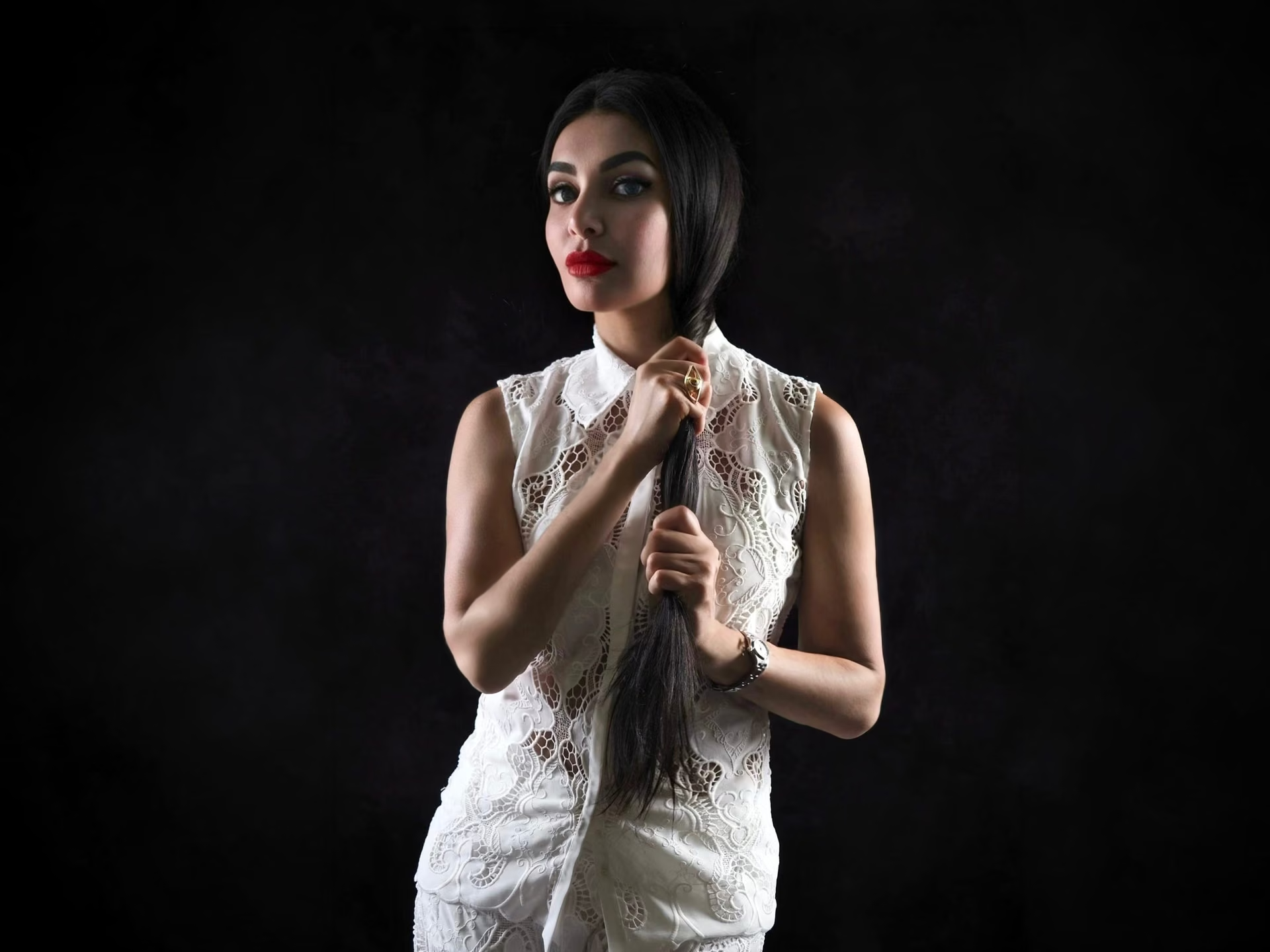
Trained as an art historian with a specialism in the Baroque, Olga Shishko has spent over three decades probing the nexus of art, technology and visual culture, allowing historical perspectives to inform her approach to emerging media and experimental artistic practices.
In 1994, she curated NewMediaLogia, a landmark international symposium in Moscow, which marked a turning point in the reception of Western theories and aesthetics of new media art and digital culture within the emerging post-Soviet contemporary art scene. In the years that followed, she established MediaArtLab, Russia’s first media art institution, alongside artist Alexey Isaev, and helped shape Media Forum, the experimental strand of the Moscow International Film Festival, which she co-directed for fifteen years. Later, as head of the Film and Media Art Department at the Pushkin Museum, she spearheaded the creation of its media art collection and, in 2021, curated the presentation of Bill Viola’s The Journey of the Soul in the museum’s main galleries.
Since moving to Venice in 2022, she has served as Chair of the Artistic Vision Council at CIFRA, a platform operating both online and offline, dedicated to fostering the ongoing presence of media art within broader cultural and curatorial contexts, bringing together artists, archives, collections and research through an evolving programme of projects and initiatives.
1883 spoke with Olga Shishko about the enduring dialogue between art and technology, the future of digital creativity, and why the ability to generate images is not the same as the ability to create meaningful work.
Thank you for making time in your schedule for 1883 Magazine. To start, could you tell us a bit about how you first got into the art world and curating? I’d also love to know how digital art became such a big part of your work.
Thank you for inviting me. What I like about 1883 is that it doesn’t insist on keeping art, cinema and fashion in separate boxes. Neither do I. Oddly enough, I came to digital art by way of the Baroque. After university, I was researching the history of Baroque art in Central and Eastern Europe. It wasn’t just the theatricality that fascinated me. It was the sense of a vast world in constant motion. Space spilling beyond the picture frame, the human figure caught up in a larger order of nature, light and the cosmos. I’m not suggesting that the Baroque was an early ecological art movement. But that feeling of interconnectedness has stayed with me. Years later, I recognised something of it in new media art.
Then I found myself at the Soros Centre for Contemporary Art in Moscow. Imagine arriving with a thoroughly classical education in art history and suddenly discovering sound art, virtual reality, experiments on the internet and artificial life. It was as though someone had unfolded a new map, only to reveal that an entire continent had been missing from the old one. In 1994, I curated an international symposium in Moscow called NewMediaLogia. Among the invited speakers was the French artist and theorist Louis Bec. I can still remember his lecture, “Artificial Life and Russian Biologists of the Early Twentieth Century”. He connected the history of scientific inquiry with a startling artistic question: what if an artist could do more than represent living things? What if they could invent new forms of life, even entire imaginary biological systems? It completely changed my sense of what art might be capable of.
Later, we arranged exchanges between Russian and French artists, and with the art school in Aix-en-Provence. Education was happening through encounters, experiments and conversations, without a ready-made textbook. Around that time I also met Peter Weibel, Jeffrey Shaw, and Woody and Steina Vasulka. What struck me was their ability to think decades ahead. They made the future seem less like a destination than a place you could start exploring immediately.
In the late 1990s, the artist Alexey Isaev and I founded MediaArtLab. From it grew an international network, a media art collection, the net.art festival Trash-Art and, in 2000, Media Forum, a special programme within the Moscow International Film Festival. For fifteen years, alongside the red carpet and the film stars, we screened experimental cinema and works that didn’t always agree to be called ‘cinema’ at all. Later came our MediaMuseum. There was a touch of provocation in the name. Media art centres, festivals and collections already existed, of course, but many institutions calling themselves museums of contemporary art still had remarkably little new media art to show.
When I became head of the Film and Media Art Department at the Pushkin Museum, one of the first things I did was build a collection. Naturally, when I left, the collection stayed there. I should probably confess that collecting media art is one of my great passions. It hardly matters to me whether the collection belongs to me, a private collector, a museum or a platform. I’m far more interested in bringing together countries, generations, artistic languages and mythologies than in owning anything. For me, a collection is another way of telling a story.
For readers who might not be familiar with CIFRA yet, how would you describe it and what it aims to do?
Try a small experiment. You can find almost any song or film in seconds. Now try finding a work of video art, experimental cinema or interactive art that won a prize at a media art festival or appeared at an international biennial. Not quite so easy, is it? But access is only part of the problem. The very language of images is changing before our eyes. What is a screen when it can become a space, a body or an environment? Who makes an image now: an artist, a machine, an industry, a user? What does the moving image mean after cinema? I’m interested not only in what we watch, but in how we will see tomorrow.
A few years ago, I was invited to become CIFRA’s Chief Art Curator and shape its artistic programme. It was an exciting challenge: how do you create something more ambitious than another shop window for digital files? How do you build an intellectually alive cultural institution? CIFRA can exist online, in a museum, at a festival and in a university, sometimes all at once. The point is not simply to find a work, but to understand who made it, why they made it, how it speaks to other artistic ideas and what it might change in the way we see. We live in a culture in which images have become one of the principal ways knowledge is made and communicated. That calls for a new kind of visual literacy. CIFRA can help cultivate it.
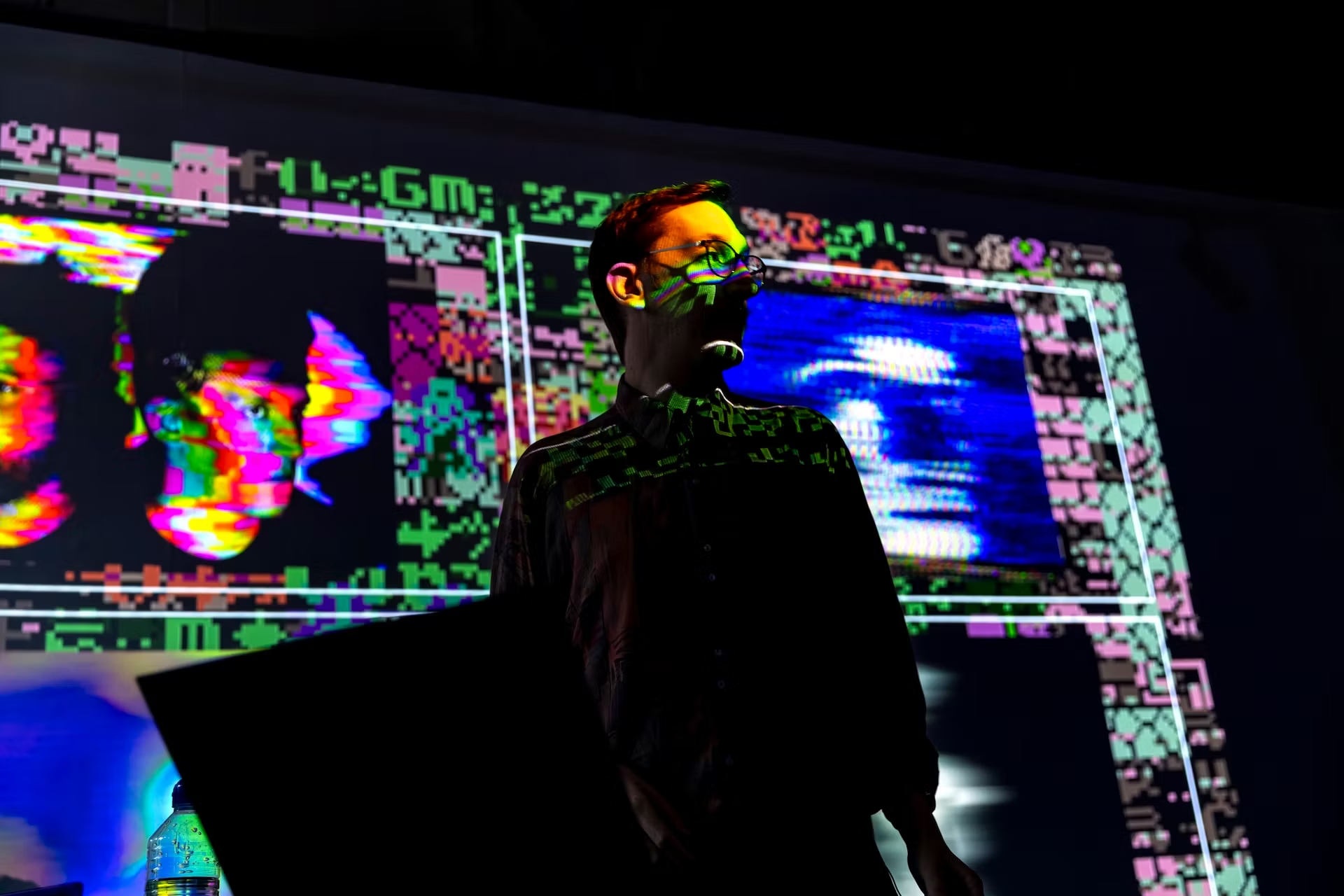
Look at the artists you can encounter on the platform. The net.art pioneer Vuk Ćosić was turning film images into ASCII characters back in the 1990s, as though asking computer code to perform the part of celluloid. In Synthetic Messenger, Tega Brain and Sam Lavigne sent bots to click on advertisements alongside climate-change stories, interfering with the economy of online attention. Christopher Joshua Benton explores the memory and language of Black dance cultures through digital methods. Try finding a single “digital style” that unites them. You can’t. And thank goodness for that: art shouldn’t have to wear a uniform.
Sometimes CIFRA steps quite literally out of the screen. At Ars Electronica in 2025, we presented two projects about food and the future. In Feeding the Future, Mónica Rikić invited participants to help construct a wearable robot that would feed her during a performance. Zane Cerpina and Stahl Stenslie staged Find the Tick, an apocalyptic brunch in which ecology, parasites and our eating habits became a rather surreal ritual. It was beautiful, funny and slightly unsettling. I love art that engages more than your eyes; it gets the whole body involved. That is also why I think of CIFRA as a form of education on the move. Not a warehouse of recorded lectures. Nor an endless content feed. Rather, a place where artists, curators, researchers and audiences can work out together how visual culture is changing. Occasionally before anyone has even found a name for the change.
We’re seeing a massive shift right now with AI and generative tech altering how digital art is produced, distributed, and experienced. Before we look at curation specifically, how do you see this tech wave reshaping the actual value and meaning of digital art today?
I’d begin by gently disagreeing with the premise: I don’t think artificial intelligence, in itself, changes the value of art. Every new technology has arrived heralded as a revolution: photography, cinema, portable video, the internet, virtual reality. Now it’s AI. That’s wonderful in one sense. Artists should experiment with new tools. But a tool is not the same thing as an artistic statement.
Today you can generate dozens of spectacular images in a minute. So what? We’ve hardly been suffering from a shortage of pictures. A great deal of what we see still feels like someone trying out a very sophisticated new Photoshop. What interests me isn’t how convincingly a machine can picture the impossible. It’s why an artist wanted to picture that particular impossible thing in the first place.
And the story certainly didn’t begin with Midjourney. Nancy Burson was exploring computer-manipulated faces in the 1980s. Long before the generative-AI boom, AES+F were constructing dazzling, deeply unsettling digital worlds — think of The Feast of Trimalchio. Mario Klingemann has worked with neural networks as artistic systems, investigating not only the resulting image but the logic of machine imagination. Sougwen Chung approaches the machine from an entirely different direction: she draws alongside robots that learn from her own gestures. On CIFRA, you can encounter both pioneers of these practices and artists taking them somewhere new.
And look at the very different questions contemporary works ask. In 2023, Boris Eldagsen declined a Sony World Photography Award for an AI-generated image and turned a single picture into an international argument about what we mean by photography. In AI Realism. Qantar 2022, Almagul Menlibayeva explores the collision between artificial images, testimony about political violence and Kazakhstan’s historical memory. In the interactive work ReCollection, Weidi Zhang and Rodger Luo take a visitor’s recollection and transform it into a new, synthetic image of the past.
We devoted an entire season at CIFRA to AI. The question that matters to me isn’t “What can the technology do now?” but “What can an artist say with it?” And why have we suddenly decided that art’s job is to certify the authenticity of what we see? Art has never been required to serve as a witness statement or a factual record. Malevich didn’t need to find a Black Square in nature before making a painting that changed the way we think about images. AI can produce a million pictures. But a million pictures do not make a million works of art.
Building on that, as a curator, what do you see as the role of human perspective in an era where software can instantly generate and sort through thousands of images?
I like to think of curating in terms of montage. Sergei Eisenstein’s idea of the “montage of attractions” was that meaning and emotional force could emerge not simply from a single shot but from the collision between different ones. Sometimes the most interesting thing you can do is put two things together that, by all conventional logic, have no business being in the same room.
An algorithm is excellent at spotting similarities, sorting vast archives and suggesting more of what you’ve already seen. These are useful tools, and I have no desire to wage war on them. But when a system says, “You liked this? Here are ten more just like it”, my instinct as a curator is to do the opposite: offer something unexpected, upset the familiar sequence, create a paradox from which a new thought might emerge.
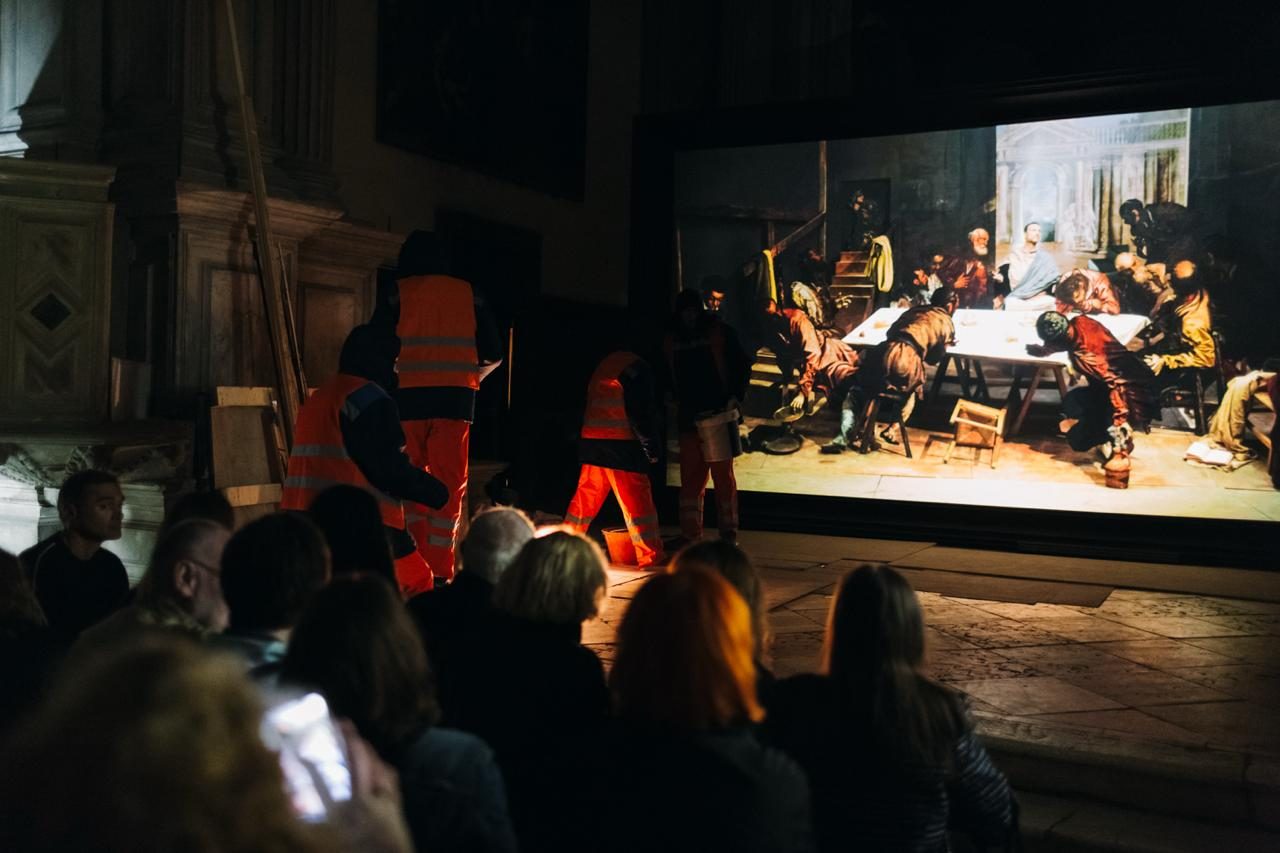
In 2019, Marina Loshak and I curated The Beginning Dwelleth in the End: The Secret Brotherhood of Tintoretto in Venice. In the church of San Fantin, Tintoretto and Emilio Vedova entered into dialogue with contemporary artists Gary Hill, Irina Nakhova and Dmitry Krymov. We conceived it not as a procession of objects with wall labels but almost as a contemporary mass: light, video, theatre, sound and architecture taking part in a single unfolding experience. Tintoretto was already turning space into a seething universe in the sixteenth century. Isn’t that what the creators of immersive environments are trying to do today? And he managed without a single VR headset.
Then came Covid, and that conversation about space and physical presence acquired a different resonance. In March 2021, Kira Perov and I opened Bill Viola: The Journey of the Soul at the Pushkin Museum, Viola’s first solo exhibition in Russia, and the first presentation of media art on that scale in the museum’s main galleries. It was one of the significant moments in the return of museum life after lockdown. Water, fire, slowed movement, birth and departure: everything felt more acute. Kira couldn’t travel to Moscow, so we worked on the installation remotely, while the digital works arrived over the network. A rather perfect image of the moment: a classical museum receiving art not just in the usual shipping crates, but through the cloud.
Curating is also about noticing what is absent from the picture. Art history hasn’t been written by everyone, or about everyone. An algorithm trained on existing collections and rankings can easily inherit their blind spots. That is why CIFRA makes a point of seeking out artists from different regions, rather than simply amassing material. The works are selected and brought into conversation through curatorial programmes. International reach alone doesn’t guarantee a plurality of perspectives. What matters is what we place in relation to what — and which stories become visible as a result.
We live in an age of a peculiar kind of visual cannibalism. We consume images at extraordinary speed, while platforms consume our attention in return. Sometimes the most radical thing a curator can do is not show a visitor another thousand pictures, but help them truly see just one. An algorithm recognises patterns. A curator can break them.
Looking ahead, how do you see the space for digital art continuing to expand and mature? As it becomes even more integrated into our cultural fabric, what does its next evolutionary phase look like to you?
I’d be wary of predicting the next technological revolution. We’ve already promised the future to VR, the metaverse, NFTs and now AI. Art has a more interesting history than the succession of fashionable technologies. What fascinates me is the way the boundaries between disciplines are dissolving. Guy Sherwin turns film itself into a live performance of light, body and sound. Riar Rizaldi brings documentary research and science fiction together to explore resource extraction and technological landscapes in Indonesia. Naomi Rincón Gallardo creates extraordinary video operas in which mythology, music, costumes and political protest inhabit the same world. They are all represented on CIFRA, although finding one neat technical label for them would be almost impossible.
There is another thread that particularly captivates me: imaginary creatures. We tend to behave as though digital art invented hybrid bodies and strange new life forms. Then you open a medieval bestiary or look at Bosch’s The Garden of Earthly Delights and realise that the future can bear a suspicious resemblance to the very distant past. In The Garden of Emoji Delights, which you can find on CIFRA, Carla Gannis repopulates Bosch’s garden with emojis, chimeras, creatures both comic and disturbing. It is a thoroughly digital world, yet also a very old conversation about human nature. Auriea Harvey and Michaël Samyn created The Endless Forest, a virtual woodland inhabited by deer with human faces. Rather than the usual competitive logic of a game, what mattered was being there together. Harvey’s work can also be found on the platform.
Another approach I feel especially close to is Sergey Kishchenko’s Duck Man. In Duck Test No. 4 (Cherry), the figure wanders through the ruins of Moscow’s former ZIL factory, like a Chekhov character who has somehow survived the end of the world. In Duck Test No. 5 (Venetian), available on CIFRA, this unlikely creature finds himself in Venice, remembering a lost home. There is something of the old grotesque about him, and something strangely futuristic too. The artist could have used AI to generate an extraordinary creature. Instead, he puts on a costume, becomes the creature and lives its life. He creates not just an image, but a way of existing. That is what I find so compelling.
Which brings me back to Louis Bec, where my story began. There is a wonderful book I would warmly recommend: Vampyroteuthis Infernalis, by the philosopher Vilém Flusser, with illustrations by Louis Bec. The first German edition appeared in 1987. It is part philosophy, part imaginary zoology, part dazzling intellectual game. Flusser asks us to look at humanity as though from the point of view of a deep-sea creature whose experience of the world is utterly unlike our own. I love that shift of perspective: to understand ourselves better, try imagining what the world is like for someone — or something — entirely different.
So I’m not convinced that the next step for art is an even more persuasive artificial image. Perhaps it lies in learning to experience the world through another body, another memory, another form of life. Sometimes that requires an astonishingly sophisticated algorithm. Sometimes it takes an artist dressed as a duck. I follow Venice Immersive at the Venice Film Festival every year. Back in 2013, I included a work by Nonny de la Peña, one of the pioneers of immersive journalism, in my Moscow exhibition Expanded Cinema 3: Reality Is Not Enough. Her name is now closely associated with the history of Venice Immersive as well. Even then, it was clear that immersion was not simply a technical effect. It could offer an entirely different way of entering someone else’s experience.
Bringing it back to your own work within that landscape, what does this next chapter look like for you and CIFRA specifically?
In 2022, I began a new life and moved to Venice. I can’t imagine a better place for someone obsessed with the transhistorical life of art. Here, the past doesn’t sit politely behind museum glass. It keeps interrupting the present. Sometimes you go out for bread and find yourself arguing with the sixteenth century. I rather like living that way.
For me, CIFRA is a chance to bring together more than thirty years of working with media art: artists, archives, collections, research and curatorial experiments. I don’t simply want to show works; I want to help build a living international environment around them. An institution doesn’t necessarily need a building. It does need a memory, a conversation and the capacity to surprise itself.
Education is taking up more and more of my thinking. I recently looked closely at programmes in seventeen art schools and universities, from Goldsmiths and the Royal College of Art to Le Fresnoy and the MIT Media Lab. In many of them, the traditional boundaries between specialisms are becoming porous. Increasingly, an artist starts not by choosing a medium but by asking a question or proposing a project, then bringing together whatever it needs: code, images, sound, performance, sometimes even biology. I find that a wonderful development.
But what happens after graduation? Who sees a young artist’s work beyond their tutors and friends? How does it come to the attention of a curator, a museum, a festival? This is where I see enormous potential for CIFRA: connecting the university studio to an international artistic community. Not replacing education, but extending it into the world of professional exchange, criticism and recognition.
Artists already entrust their work to CIFRA. We have solo programmes, curated seasons, CIFRA TV, live encounters, the CIFRA Award and an Artistic Vision Council, which I chair. It’s an unusual group: Christiane Paul, a curator of digital art at the Whitney Museum; David Elliott, a curator and former museum director; the media art scholar Oliver Grau; the digital culture theorist Lev Manovich; and Martin Honzik and Daniela Arriado, whose work has long connected international festivals and institutions. I want that experience to become more than an exchange of expert opinions. It should open up real possibilities for artists.
I’m especially excited about our fifth season, planned for 2027 and led curatorially by Christiane Paul. Its themes are Planetary Kin, Planetary Knowing and Kinship / Memory: our relationships with the planet, other ways of knowing and the persistence of memory. It asks a slightly awkward question: who appointed humanity the main character on Earth? What changes when we stop treating oceans, plants, animals and even fungal networks as scenery and begin to see them as participants in a shared world? And what happens if we place ancestral intelligence, knowledge passed through generations, cultural memory and ways of knowing that can’t be reduced to data, alongside artificial intelligence?
For me, it brings the story full circle: back to the Baroque, where I was drawn to the idea of human beings inhabiting a world vastly more complex than themselves, and to Louis Bec’s lecture on artificial life. Five centuries of art suddenly seem to be asking the same uncomfortable question: why are we so certain that everything exists for our benefit? Today, CIFRA can invite artists and audiences on different continents into that conversation. That is its extraordinary freedom. There is another direction I want to pursue: Motion After Cinema. What do we mean by cinema when moving images live simultaneously in a cinema, a museum, a video game and a virtual environment? I think we’re only beginning to discover how profoundly that might change the language of seeing itself.
As for my personal plans, they’re quite simple: to keep meeting artists who are making something for which we don’t yet have a name. That is still my favourite moment. It means everything is beginning again.
Follow CIFRA and Olga Shishko on Instagram.
More information about CIFRA can be found here.
Interview Jacopo Nuvolari
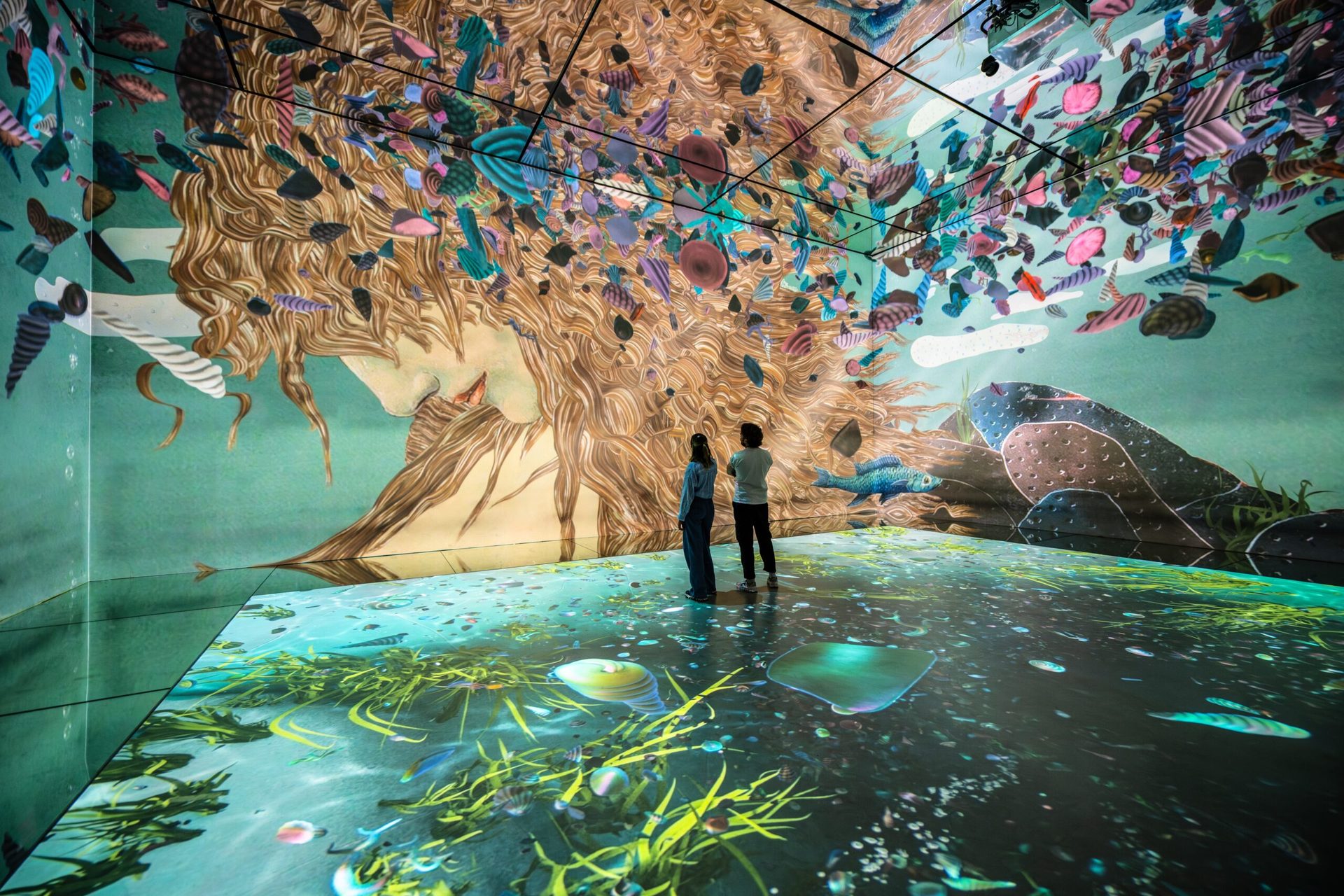
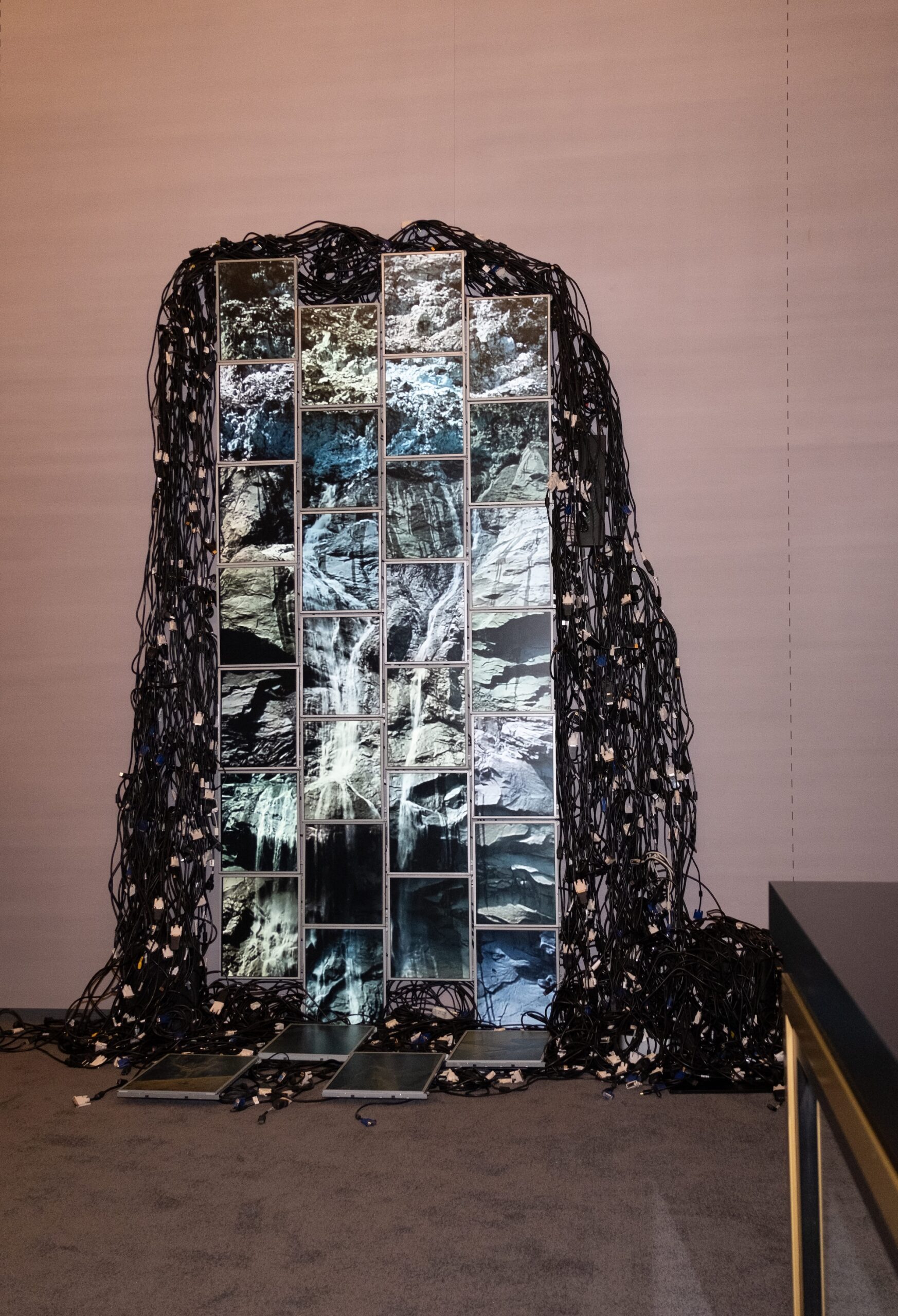
Top image credit: Jacopo Di Cera, Retreat. Image Courtesy of CIFRA