At the intersection of contemporary art and culture, the transformation and reorganisation of symbols often serve as a hidden bridge between cultural memory and physical perception. Yutong Liu’s jewellery, “Wuyou Garden”, is a bold attempt to release Chinese characters from the context of paper and return them to wearable practice. This creation does not merely use text as visual decoration, but rather allows two highly condensed cultural symbol systems, Chinese characters and jewellery, to re-engage in dialogue on a physical scale, activating a cross-media and multicultural “bodywriting”. To truly understand the intrinsic logic of this creation, we need to place the jewellery within a broader civilisational spectrum, tracing its symbolic origins and exploring the unspoken isomorphism and response between it and Chinese characters.
Where meaning takes form
Before the language system matured, humans relied on an intuitive and transmissible symbolic mechanism to organise social relations and demarcate identity boundaries. The earliest jewellery was born precisely in response to this social symbolic demand: it was not an aesthetic ornament, but a form of body inscription. The sea shell beads unearthed from the Blombos Cave in South Africa, dating back approximately 75,000 years, are widely regarded as one of the earliest ornaments whose age can be accurately determined. These early ornaments actually constituted the social grammar of the pre-linguistic era of mankind. Through wearing, displaying, and exchanging, they practised identity construction, relationship maintenance, and group identity. From the perspectives of anthropology and body perception, the essence of jewellery is a form of body-writing. Through material texture, physical weight, and dynamic movement, jewellery forms a set of embodied haptic syntax readable by society.
Chinese characters are a fully developed writing system that still retains strong physical traces. Originating from pictographs, Chinese characters use strokes, components and structures as ideographic units. Throughout their long evolution, they have consistently maintained an intuitive connection between images and concepts. This pictographic logic distinguishes Chinese characters from abstract phonetic alphabetic characters. For this reason, a deep semiotic correspondence between Chinese characters and jewellery exists: both rely on visible and tangible forms to carry meaning and organise information in composition, rhythm and blank space. Yutong Liu’s practice operates at this intersection, posing the question: When Chinese characters are removed from the paper and linear reading contexts and returned to the body, will their original attributes be awakened?
In “Wuyou Garden”, characters are integrated into the jewellery structure as imagistic clues. They no longer appear in complete sentences or as fixed semantic units, but participate in shaping form and spatial configuration. The production of meaning thus shifts from decoding language to generating sensory awareness, which is a cultural retrospection. Chinese characters have once again descended from an abstract symbol system into embodied narrative carriers.
From textual narrative to physical narrative
In Yutong Liu’s creations, the transformation from text to jewellery is essentially a transfer of narrative logic. Poetry unfolds through the linear structure and temporality of its language, carrying the flow of emotions and the elaboration of meanings. Jewellery, on the other hand, folds the narrative into the form through the existence of material space, the discontinuity of structure and the sensuality of touch. Although they belong to different media systems, they both point to a structured expression. In poetry, it is the arrangement of words and rhythm; in jewellery, it is the dialogue between form, material and the body.
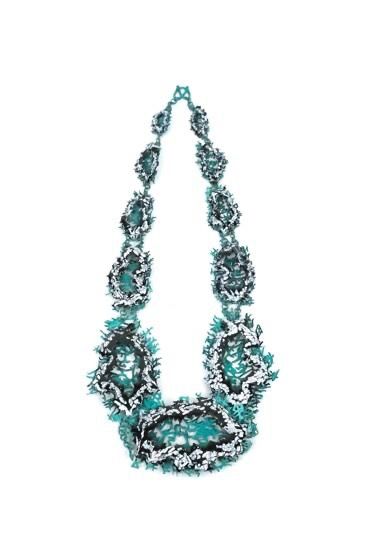
Wuyou Garden – 1
“Spiritual garden” as an intercultural context
As a creator in an intercultural context, Yutong Liu’s practice further reveals the cultural dimension behind this narrative translation. Her creations often begin with her wandering in space, whether it’s the open views of London parks or the winding paths of Oriental gardens that change with each step. Walking and observing become the starting point of a body narrative. The structure of space, the flow of light and shadow, and the change of seasons influence the formation of the form of the work.
This experience from space to the body precisely echoes the creation of the spiritual realm contained in Eastern gardens. A garden is not merely a collection of physical landscapes. The postures of rocks and mountains, the reflections on the water surface, and the framing of windows guide the body to constantly engage in dialogue with the scenery while moving, thereby evoking the viewer’s inner associations and extensions between the real and the illusory. Similarly, in Yutong Liu’s jewellery, the interweaving of structures, the staggered forms, and the contrast of materials also form a kind of “wearable garden”.
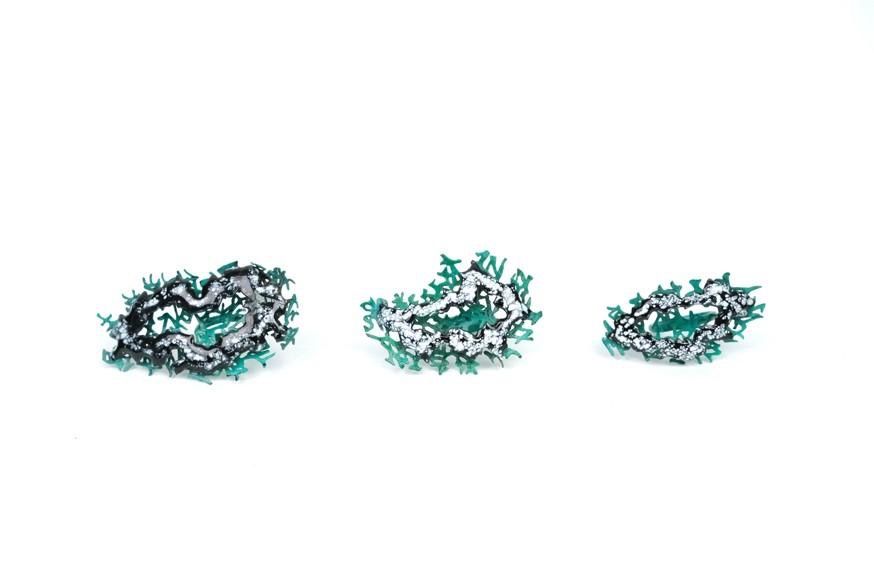
Wuyou Garden – 2
Furthermore, her creative concept is also deeply connected with the Eastern aesthetic concept of “Wuyouyuan (乌有园)”. “Wuyou” in Chinese not only refers to “emptiness and nothingness”, but also implies “infinite possibilities”. Historically, ancient people used stones as mountains and sand as water butting their ideal gardens within the limitations of material resources. This kind of “creation out of nothing” is not only a material substitution but also a spiritual transcendence, which forms a cross-cultural dialogue with the utopian imagination of the West. Yutong Liu’s process of disassembling poetry and reassembling it into contemporary jewellery with Chinese characters precisely embodies this aesthetic logic. With limited material forms, she carries infinite emotions and cultural associations, making each piece of work a “garden of ideas” that the wearer can enter.
The creative practice of “Wuyou Garden” reactivates two symbolic systems within the context of globalisation, exploring a form of “body-writing” capable of connecting diverse cultural experiences and evoking shared perceptions. It reminds us that the transmission of culture does not always rely on the translation of language, but can achieve the regeneration and resonance of meaning through a broader dimension.
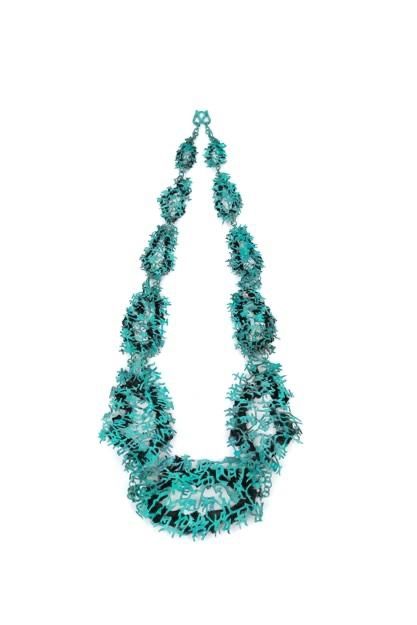
Wuyou Garden – 3
Author: Qiwen Deng