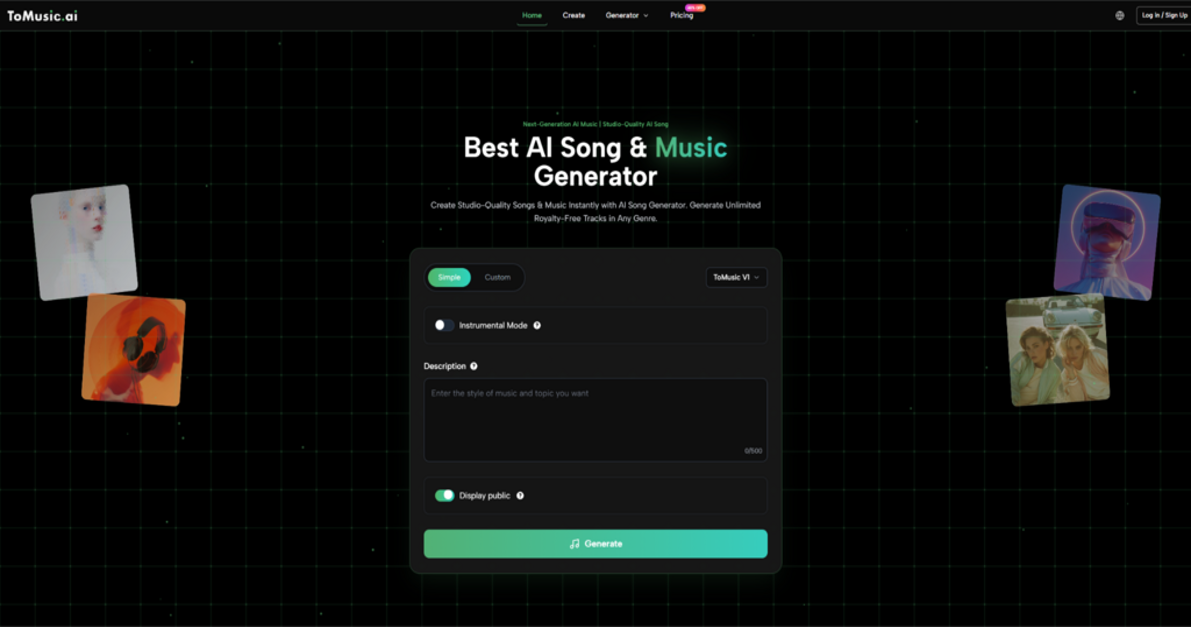
If you’ve ever had a lyric line you loved but no music to hold it, you know the frustration: your idea arrives as feeling, but your workflow demands decisions. In my own tests with Text to Music, the biggest value wasn’t “instant results.” It was getting to a first listen fast enough that my ears could guide the next step—before the emotion cooled off.
I’m not treating this as a replacement for songwriting or production. I’m treating it as a quick mirror: you write, you generate a draft, you listen, and you learn what’s true about your idea.
Why Most Song Ideas Die Quietly
A song doesn’t usually fail because you lack creativity. It fails because the path from “concept” to “audio” is too long.
The invisible gap
You can describe what you want in one sentence:
- “Soft verse, big chorus, bittersweet relief.”
But making that sentence audible can require:
- arranging instruments,
- programming drums,
- finding the right sound palette,
- sketching structure,
- then discovering the idea didn’t work.
That kind of delayed feedback makes you second-guess yourself. The idea becomes a note, not a track.
The Updated Idea: Use AI as a Listening Tool, Not a Finishing Tool
Instead of asking AI to deliver a perfect song, I’ve found a better question:
What does this idea sound like when it’s real?
When you can hear a draft, even a rough one, you immediately gain clarity:
- Does the chorus actually lift?
- Are the lyrics too dense to sing?
- Is the tempo helping or fighting the mood?
- Does the hook feel inevitable, or forced?
This reframes the tool as a feedback engine. You’re not outsourcing taste. You’re accelerating learning.
Two Lanes That Keep You Moving
I split the workflow into two lanes, depending on what I have
Lane A: Lyrics-first (test musicality fast)
If I already have words, I want to know whether they want to be sung. Reading a lyric silently can hide problems that show up immediately in performance:
- awkward syllable stress,
- lines that trip over the groove,
- emotional peaks arriving too early.
When I need that test, I’ll use a lyrics-to-song run and listen for phrasing, not perfection. That’s where Lyrics to Songstyle generation is most useful: it turns “text on a page” into “something my ear can judge.”
Lane B: Mood-first (build the world, then write into it)
When I don’t have lyrics yet, I start with atmosphere:
- tempo feel,
- harmonic color,
- drum intensity,
- space vs density.
Then I write to what I hear. This is surprisingly freeing because you stop writing into silence and start writing into a world.
A Simple Loop That Works in Real Life
Here’s the loop I keep returning to because it stays creative and doesn’t require technical thinking.
1. Write like a director
Instead of listing keywords only, I describe a scene:
- “late-night drive, rain on glass, quiet determination”
2. Add one emotional constraint
- “bittersweet but hopeful”
3. Add one structural instruction
- “clear chorus lift, short bridge, clean outro”
4. Generate once, then take notes in 20 seconds
I write down three quick observations:
- What feels right
- What feels off
- What I want to change next
5. Change only one variable per iteration
This part matters more than people expect. If you change five things at once, you won’t know what actually improved the result.
What Changes: Your Role Shifts From Builder to Editor
Traditional workflows often force you to be a builder first:
- constructing tracks,
- assembling sounds,
- arranging before you’re sure the idea works.
This approach lets you become an editor first:
- listening for truth,
- shaping the emotional arc,
- rewriting lyrics based on how they land in time.
In my experience, this is the real productivity gain: not “less work,” but “better work earlier.”
A Clear Comparison: Where This Approach Wins (and Where It Doesn’t)
| Comparison Point | AI Drafting (Text/Lyrics → Music) | Traditional DAW Workflow | Loops/Templates |
| Time to first listen | Fast in my tests | Medium to slow | Medium |
| Best for | Direction, hooks, quick structure checks | Final arrangement, nuance, mixing | Quick grooves, starting points |
| Skill required | Low | Medium to high | Low to medium |
| Consistency | Varies; may need retries | Consistent | Consistent |
| Lyric phrasing feedback | Strong (you hear stress and flow) | Requires vocal recording | Limited |
| Editing depth | Iterative control, but not surgical | Highest control | Moderate |
| Main drawback | Prompt sensitivity and variance | Time and technical overhead | Can sound generic |
Limitations That Make It More Credible
The experience is more convincing when you acknowledge what can go wrong.
Prompt quality matters
Small wording changes can create big shifts in output. When a result is off, it’s often because the instruction was too broad:
- “sad pop” is vague
- “slow, intimate pop ballad with space and restraint” is clearer
You may need multiple generations
Sometimes the first draft is close but not correct. I treat the first output as a sketch, not a verdict.
Vocals can be stylistically imperfect
Depending on the style, vocals may feel slightly synthetic or too clean. If the song needs raw vulnerability, you might prefer an instrumental draft first, then handle vocals later.
Release-ready” isn’t guaranteed
Drafts can sound polished, but if you’re aiming for professional release standards, a final DAW pass still helps for arrangement detail and mix balance.
How to Get Better Results Without Turning This Into a Technical Hobby
If you want more reliable outputs, use this structure. It’s simple, human-readable, and consistently improves alignment.
A practical prompt pattern
- Genre + era color: “modern synth-pop with subtle 80s warmth”
- Mood: “nostalgic, quietly optimistic”
- Tempo feel: “mid-tempo, steady pulse”
- Instrument palette: “warm pads, clean bass, tight drums, airy lead”
- Structure: “verse builds, chorus lifts, short bridge, satisfying outro”
- Avoid: “no harsh distortion, no chaotic drum fills”
One rule that saves time
Keep a tiny “prompt journal.” When something works, copy the line that caused it. You’ll build a personal style library without overthinking it.
A mindset that keeps you honest
Don’t ask: “Is this perfect?”
Ask: “Is this pointing in the right direction?”
A Practical Next Step You Can Do Today
Pick one of your unfinished ideas:
- a chorus line,
- a concept sentence,
- or a mood you can’t quite capture.
Generate a draft, listen once, and change one variable. That’s it.
The goal isn’t effortless magic. The goal is momentum: getting from blank page to playable audio fast enough that your taste can lead the process. When that happens, finishing a song stops feeling like a technical marathon and starts feeling like a conversation you can continue tomorrow.