

When a stealth-mode technology startup secures millions of dollars from top-tier venture capitalists, the subsequent playbook is predictable: hire an army of engineers, a specialized product management team, and a branding agency who spends months deliberating over color swatches, fonts and design proposals.
Axel Piccioni has spent the last five years proving that the entire apparatus is obsolete.
At just 25 years old, the Argentine full-stack design engineer has become one of the tech industry’s secret weapons. Working as a solo “full-stack” creator, Piccioni handles everything a modern tech company requires to exist visually and structurally: corporate branding, marketing assets, user interfaces, 3D motion graphics and the actual front-end code required to launch the product. It’s like an efficient one-stop shop for product design, engineering and web design.
The strategy has yielded staggering results. At 21, Piccioni was brought on as the sole product designer for Azura. As the initial designer, Piccioni was tasked with shaping the on-chain trading platform’s brand and product interface; he opted for an aggressively minimalist layout that utilized abstract shapes—a visual nod to the complex mental models of high-frequency traders. The platform subsequently raised $6.9 million in a round led by Initialized Capital and has since facilitated over $2 billion in trading volume. He also orchestrated the brand and product design for Rhythm, an on-chain trading platform built on the Solana blockchain. Launched out of MoonPay Labs, Rhythm was quickly acquired by its parent company, MoonPay.
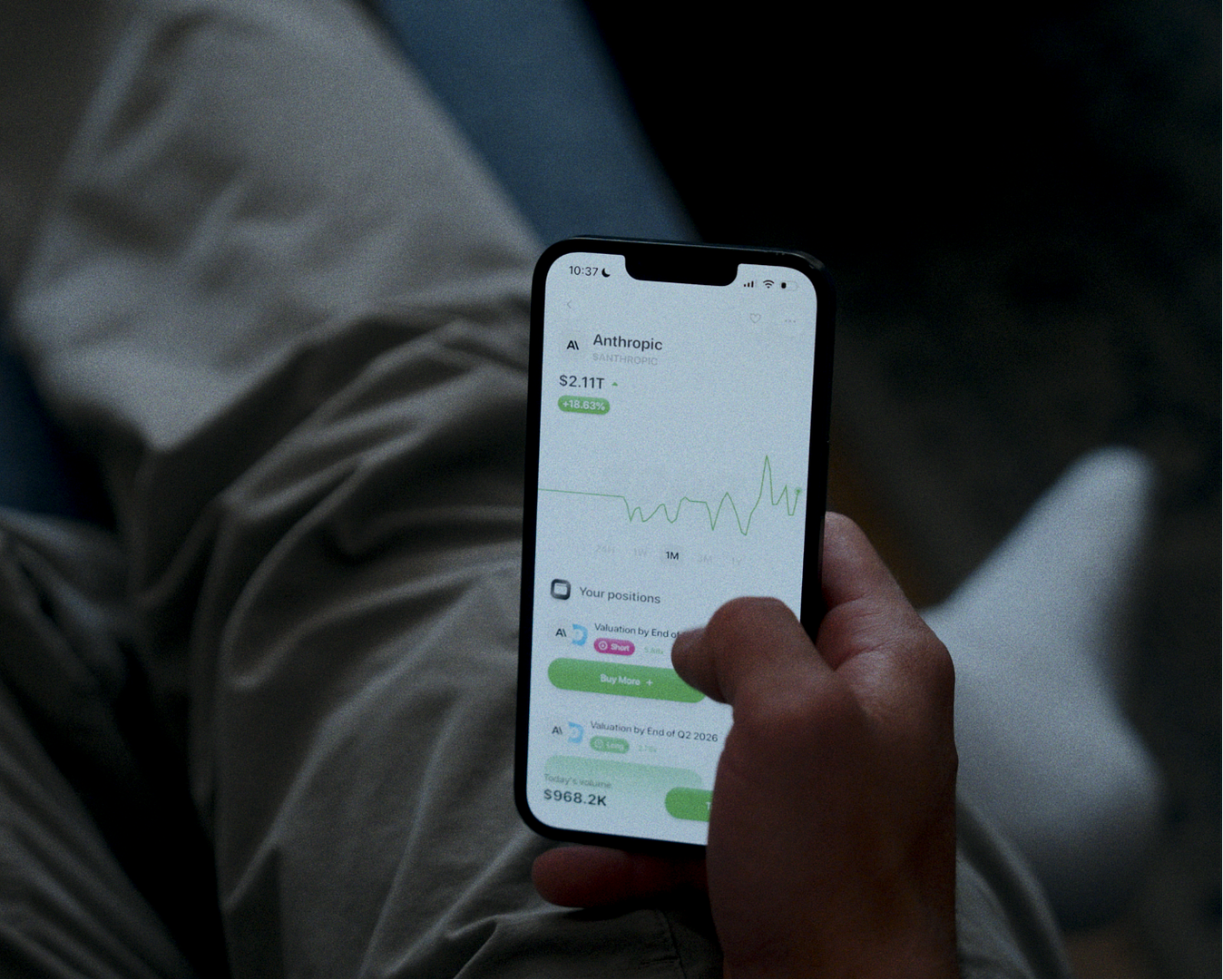
“Most financial products are designed, intentionally or not, to keep people out,” Piccioni said in an interview. “They are opaque, intimidating, and boring, with an entry barrier baked into the interface and language. Design is exactly the layer where that gets fixed.”
Now, Piccioni is applying this philosophy to SOAR, an ambitious financial platform attempting to demystify the pricing of private companies—an asset class long walled off from individual investors. As the founding designer and product lead, he eschewed the traditional, clinical aesthetic of corporate finance. He offers a refreshing look on the SOAR interface, which welcomes users with imagery reminiscent of a travel journey, complete with digital passport stamps and sunny, blue skies.
It was an unconventional risk for a website for a serious financial tool, but one that paid off. By combining this distinct creative identity with an incredibly fast development cycle—using AI tools to turn his finished designs into live code in under 48 hours—the company generated immediate social media traction, catching the attention of institutional investors.
“If all financial products look the same, you don’t stand out for anything,” Piccioni said. “And brand is one of the few things you can truly stand out with.”

This ethos extends to Filter, the independent design and engineering studio Piccioni co-founded in 2022 with Kyle Mathers, a friend he met when he was a teenager through mutuals on Discord, as Piccioni was previously designing software for sneaker resellers. Together, the duo fused forces to create Filter from their own self-taught design and engineering knowledge.
“A lot of people get bachelor’s or master’s degrees in design, which is obviously valuable, but when you are deeply passionate about something, you instinctively want to spend most of your day studying it, practicing it, and trying to understand it better,” he said.
Now, Piccioni and Mathers help venture-backed tech giants with branding, product design, identity, logos and everything in between. Operating without traditional agency bloat, Filter’s client roster reads like a directory of modern tech authority: Coinbase, Figma, Fragile and Whop. The studio’s own homepage behaves less like a static portfolio and more like an immersive cinematic experience, using fluid motion graphics to explain complex technological systems, while inviting users to contact them for an intro call.
For Piccioni, motion is not mere decoration; it is a critical tool for digital literacy. As a self-taught designer who entered the professional tech industry in 2021, he initially used animation as a personal learning mechanism. “As a kid, that’s literally how I learned,” he said. “I’d read about a topic and then create graphics that explained it. If a motion graphic doesn’t make a topic easier to understand, it’s just decoration.”
In an era where Silicon Valley is flooded with commoditized, AI-generated layouts, Piccioni argues that the ultimate competitive advantage for tech companies is no longer the underlying technology, but human taste and rigorous research. He notes that financial and AI products live or die entirely on user trust, a psychological metric that cannot be automated.
“Fifty percent of design work is research; you don’t get great ideas staring at a blank wall,” Piccioni said. “When things hide behind jargon and opacity, people rightfully assume the product isn’t for them—or worse, that it isn’t being honest with them. Transparency is how design earns trust.”
Words Nadja Sayej
Images courtesy of Axel Piccioni