
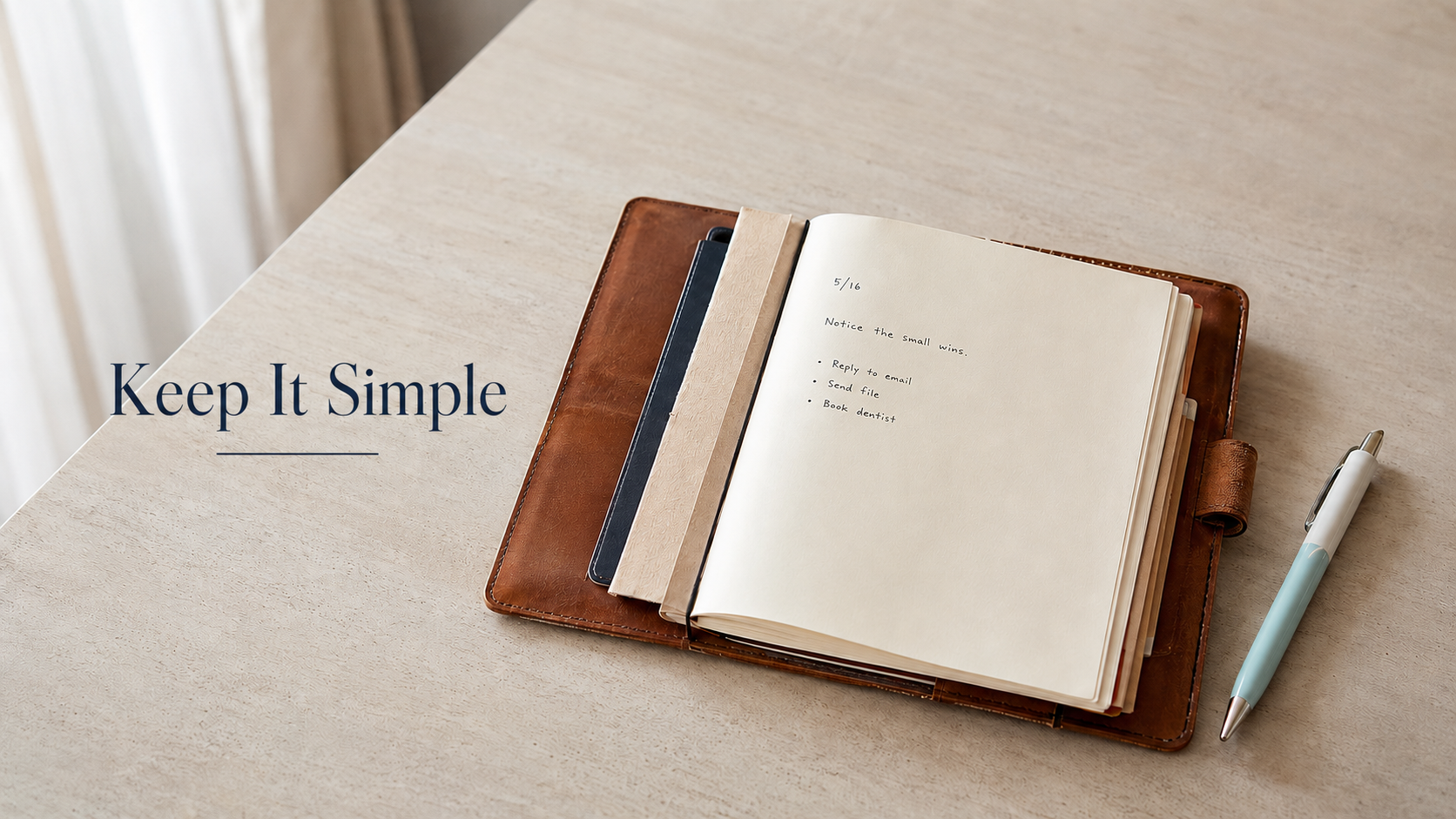
Starting a Traveler’s Notebook can feel more complicated than it needs to be. You see leather covers, refills, pockets, clips, stickers, and beautifully arranged pages online. Before long, the simple idea of keeping a notebook starts to feel like a major project.
That is usually where beginners get stuck.
The best first setup is not the most complete one. It is the one you will actually use. A good Traveler’s Notebook should help you keep track of your life, capture ideas before they disappear, and give you a place to return to when things feel busy. It does not need to organize every part of your world from day one.
Start with one real need
Before you choose a cover or refill, ask yourself one practical question: what do I want this notebook to help me remember?
Maybe you need a place for weekly priorities and appointments. Maybe you want to keep travel notes, book recommendations, and small observations in one place. Or perhaps you want to write more often but dislike the pressure of a dated journal.
Your answer does not need to be perfect. It simply gives the notebook a starting point.
Many people make the mistake of building separate sections for work, personal goals, habits, reading, fitness, travel, and creative projects before they have written their first page. A system with too many rules can feel impressive at first, but it often becomes difficult to maintain. It is better to begin with one main purpose and let the rest develop over time.
Why a modular notebook is easier to live with
Life changes faster than most notebook layouts do. A fixed planner may work well during a busy work season but feel restrictive during a holiday or a quieter month. A modular notebook gives you more room to adapt.
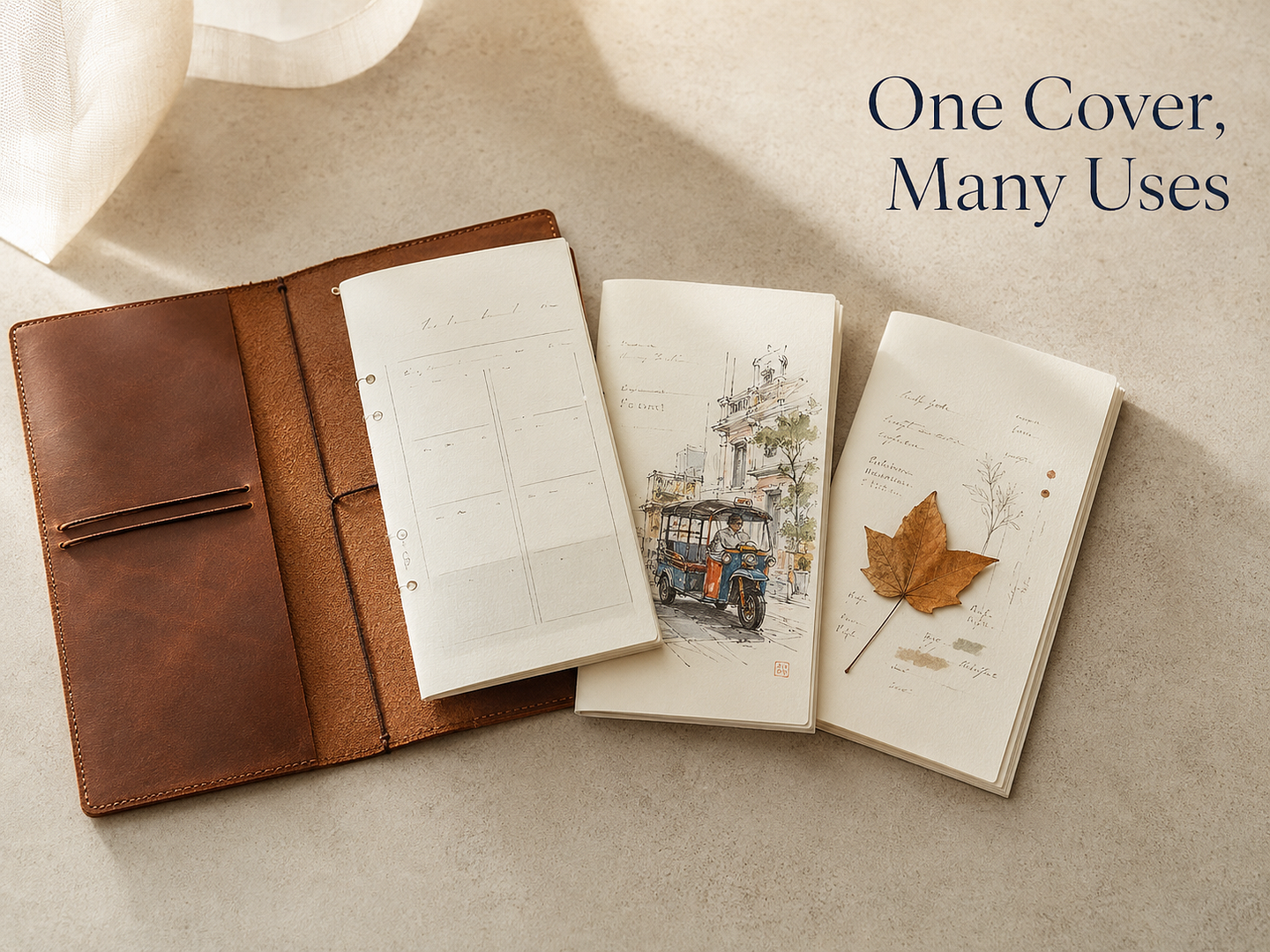
With a customizable Traveler’s Notebook, you can start with only the refills you need and change them when your routine changes. A weekly planner can support a busy schedule. A blank refill can hold travel notes or quick sketches. A lined refill may become a simple journal, reading log, or project notebook.
The point is not to collect every possible insert. It is to create a small system that can grow when there is a clear reason for it.
Think of the cover as a home for a few useful tools, not a display case that needs to be filled.
Begin with two refills
For most beginners, two refills are enough for the first month:
- A planning refill for appointments, priorities, and deadlines
- A blank, dotted, or lined refill for notes, ideas, lists, and everyday observations
This simple combination separates two kinds of thinking. The planning refill answers, “What do I need to do?” The notes refill answers, “What do I want to keep?”
That distinction matters. When every task, idea, memory, and project note goes onto the same page, it becomes harder to find what you need later. Two refills create a little order without making the system feel rigid.
After a few weeks, you may find that you want a third refill for a specific purpose. It could be a travel journal, a course notebook, a sketchbook, or a short-term work project. Add it only when it solves a real problem. If you are unsure whether you need it, you probably do not need it yet.
Let the first page be simple
The first page can feel strangely intimidating. Many people leave it empty because they want it to look perfect, or because they are waiting for an important occasion.
Do not wait.
Write the date. Write what the refill is for. Add one sentence about what you hope it will make easier. That is enough.
For example, you might write: “This notebook is for weekly plans, work notes, and things I want to remember this spring.” It does not need perfect lettering. It does not need a decorative title page. It just needs to make the notebook feel open for use.
A Traveler’s Notebook should be allowed to look lived in. Pages can be crossed out. Some weeks may have detailed plans, while others may only contain a few lines. You do not have to fill in missed days or make every spread match. A notebook is more useful when it reflects your actual life instead of an ideal version of it.
Keep your weekly planning light
A weekly page does not need to include a full timetable, a habit tracker, a mood chart, a meal plan, and a list of goals. Those tools can be helpful for some people, but they can also turn planning into another chore.
Try keeping each week focused on a few essentials:
- The appointments or deadlines you cannot miss
- Three priorities that matter most
- A small space for notes, reminders, or loose tasks
This approach leaves room for real life. If the week becomes busy, you can add more detail. If it stays quiet, you will not feel as though you have failed to complete a complicated layout.
The same rule applies to daily pages. On some days, one clear task and a short note may be all you need. On other days, you may fill a full page. Both count as using the notebook well.
Use washi tape to support the page
Washi tape can make a notebook feel more personal, but it works best when it has a purpose. A small strip at the top of a page can mark a new month. A consistent colour can help you separate work notes from personal notes. A narrow piece along the outer edge of a page can help you find an important section later.
These details are simple, but they make a difference when you return to the notebook after a few weeks.
When exploring beautiful japanese washi tape sets, it helps to choose a small group of tapes with different roles. You might use one quiet pattern for borders, one brighter colour for important notes, and one favourite design for travel pages or special memories. Repeating those choices gives your notebook a visual rhythm without making each page feel overdesigned.
The key is to write first and decorate second. If you only have five minutes, use them to record what matters. A useful page with no decoration is always better than a beautiful page that stays blank.
Adjust the system after you use it
Your first setup is only a starting point. The most useful changes will become obvious after you have lived with the notebook for a few weeks.
You may discover that you use the notes refill every day but rarely look at the planner. You may find that a monthly overview suits you better than a weekly spread. Or you may realize that your blank pages have become the place where you do your best thinking.
None of these discoveries mean that you chose the wrong system. They are exactly why a flexible notebook works so well.
At the end of the first month, take a few minutes to look back. Keep the parts that helped you. Remove the sections that felt like work. Add a refill only when it gives you a clearer place for something you already want to record.
Your first Traveler’s Notebook does not need to be finished before you begin. It only needs to give you a reliable place to write the next thing worth keeping.



