If you have spent any time browsing UK CBD flower retailers in 2026, you have almost certainly noticed that products are frequently labeled as either indoor or outdoor grown. Most product listings treat this distinction as self-explanatory, but for consumers who are new to CBD flowers UK or who have not dug into what the growing environment actually means for the finished product, the difference between indoor and outdoor cultivation is not always obvious from a label alone.
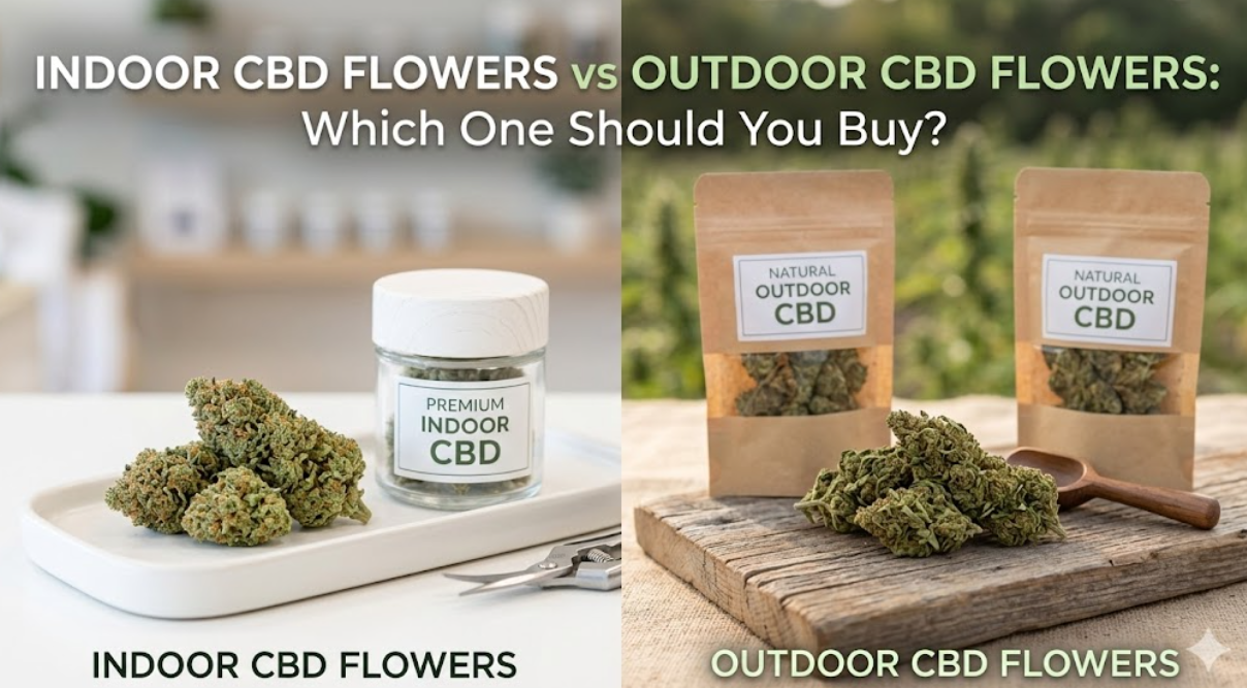
This guide breaks down exactly what separates indoor and outdoor CBD flowers, what those differences mean for quality, price, and consumer experience, and how to decide which option suits your specific needs and budget.
What Is Indoor CBD Flower?
Indoor CBD flower is cultivated in controlled growing environments where every variable affecting plant development is managed artificially. Light cycles are provided by high-powered grow lights rather than the sun. Temperature, humidity, CO2 levels, and airflow are all regulated precisely throughout every stage of the plant’s growth. Nutrient delivery is carefully measured and adjusted based on the plant’s developmental stage.
This level of environmental control allows indoor cultivators to optimize conditions specifically for cannabinoid and terpene production rather than simply for plant survival and yield. The result is typically flower with highly developed trichome coverage, complex and pronounced aromatic profiles, and dense bud structure that reflects the ideal growing conditions the plant experienced throughout its development.
Indoor cultivation is expensive. The energy costs alone for the lighting, climate control, and ventilation systems required to maintain optimal growing conditions are substantial, and those costs are reflected directly in the retail price of indoor CBD flowers.
What Is an Outdoor CBD Flower?
Outdoor CBD flower is cultivated in natural growing environments where plants are exposed to actual sunlight, natural temperature fluctuations, and the full range of environmental variables that characterize agricultural production. Outdoor hemp farming operates on seasonal cycles determined by natural light availability, with planting in spring and harvest in autumn across most European growing regions.
The outdoor environment introduces variables that indoor cultivation eliminates. Weather events, pest pressure, and natural soil conditions all influence the development of outdoor hemp in ways that cannot be fully controlled. However these same natural variables also expose plants to the full spectrum of natural sunlight, which produces broad-spectrum photosynthetic activity that many cultivators and consumers believe contributes to a more complex and complete phytochemical profile in the finished flower.
Outdoor cultivation costs significantly less than indoor growing. Lower energy requirements, larger scale production, and the absence of expensive artificial environmental control systems all reduce production costs that translate into lower retail prices for consumers.
The Key Differences at a Glance
| Factor | Indoor CBD Flower | Outdoor CBD Flower |
| Growing environment | Fully controlled artificial | Natural seasonal outdoor |
| Light source | Artificial grow lights | Natural sunlight |
| Environmental control | Full | None |
| Trichome development | Typically higher | Moderate |
| Terpene complexity | Typically more pronounced | Natural, broader spectrum |
| Bud density | Dense, compact | Often larger, less dense |
| Cannabinoid concentration | Typically higher | Moderate |
| Pest and contaminant risk | Lower | Higher without organic practices |
| Production cost | High | Low |
| Retail price | Premium | Budget to mid range |
| Yield per plant | Lower | Higher |
| Environmental impact | Higher energy consumption | Lower carbon footprint |
| Availability | Year-round | Seasonal |
Quality: Does Indoor Always Mean Better?
This is the question most consumers ask first, and the answer is more nuanced than the premium pricing of indoor flowers might suggest. Indoor cultivation consistently produces flowers with higher trichome density, more developed aromatic profiles, and greater visual appeal than outdoor flower from the same cultivar. On those specific quality metrics, indoor flower generally outperforms outdoor.
However quality in CBD flowers is not a single linear scale. Outdoor flowers from a well-managed organic farm using carefully selected cultivars and proper post-harvest handling may deliver a broader phytochemical complexity that indoor cultivation, with its artificial light spectrum and controlled nutrient delivery, does not fully replicate. The full spectrum of environmental interactions that outdoor plants experience may produce a cannabinoid and terpene profile with different characteristics rather than simply inferior ones.
The quality comparison between indoor and outdoor CBD flowers is therefore more accurately framed as a difference in character than a difference in absolute quality level. Indoor flower tends toward intensity and density. Outdoor flower tends toward breadth and naturalness. Which of those characteristics represents better quality depends on what you are looking for as a consumer.
Terpene Profiles: How Growing Environment Affects Aroma and Character
Terpenes are among the most environmentally sensitive compounds the hemp plant produces. The aromatic complexity of a CBD flower product reflects not just the genetic characteristics of the cultivar but the growing conditions the plant experienced throughout its development.
Indoor cultivation allows growers to optimize conditions specifically for terpene expression during the flowering stage, which typically produces flower with intense, concentrated aromatic profiles that are immediately apparent on opening the packaging. The specific terpenes expressed tend to reflect the cultivar’s genetic profile very clearly because the controlled environment minimizes the environmental variables that would otherwise influence terpene production.
Outdoor cultivation exposes plants to a broader range of environmental inputs including natural soil microbiomes, temperature fluctuations, UV radiation from natural sunlight, and seasonal weather patterns that may stimulate the plant to produce a wider diversity of terpenes as natural adaptive responses. The resulting aromatic profile tends to be less intensely concentrated than indoor flower but may offer greater complexity and breadth across the full terpene spectrum.
Terpene Profile Comparison
| Terpene Factor | Indoor | Outdoor |
| Aromatic intensity | High | Moderate |
| Profile complexity | Cultivar-specific | Environmentally influenced |
| Consistency batch to batch | High | Variable by season |
| Spectrum breadth | Narrower, cultivar-focused | Broader, environmentally shaped |
Price: What Are You Actually Paying For?
The price difference between indoor and outdoor CBD flower in the UK market in 2026 is significant and reflects genuine production cost differences rather than arbitrary premium positioning.
UK CBD Flower Price Comparison by Growing Method
| Growing Method | Typical Price Range Per Gram | Primary Cost Driver |
| Indoor | £8 to £15 and above | Energy, climate control, lower yield |
| Greenhouse | £6 to £10 | Partial environmental control |
| Outdoor | £3 to £7 | Low energy, high yield, seasonal |
For budget-conscious consumers, outdoor flower from a quality source with proper third party testing documentation may represent the strongest value available in the UK CBD flower market. The per-gram price difference between indoor and outdoor flower from the same retailer can be substantial, and for consumers whose primary criteria is cannabinoid and terpene content rather than visual appeal and bud density, outdoor flower frequently delivers comparable phytochemical value at a significantly lower cost.
Sustainability: Environmental Impact of Growing Methods
Indoor CBD cultivation carries a significantly higher environmental footprint than outdoor production. The energy consumption required to power artificial lighting, climate control systems, and ventilation for an indoor grow operation throughout a full cultivation cycle is substantially greater than the energy inputs for outdoor farming of comparable yield.
For UK consumers who factor environmental impact into their purchasing decisions, outdoor-grown CBD flower represents a considerably lower carbon footprint per gram of finished product than indoor equivalents. Outdoor cultivation that uses organic farming practices further reduces the environmental impact by eliminating synthetic pesticide and fertilizer inputs that carry their own production and application costs.
According to the Centre for Medicinal Cannabis, sustainability considerations are becoming an increasingly significant factor in UK CBD consumer purchasing decisions, with environmentally motivated buyers actively seeking out outdoor and organic cultivation credentials alongside the compliance documentation that responsible CBD flower retail requires.
Which Should You Choose?
The decision between indoor and outdoor CBD flower ultimately comes down to three factors: budget, quality priorities, and environmental values.
Decision Guide: Indoor vs Outdoor CBD Flower
| Consumer Priority | Recommended Choice | Reason |
| Maximum visual quality and density | Indoor | Controlled environment optimizes bud development |
| Budget value without compliance compromise | Outdoor | Lower price, same testing requirements |
| Broadest possible terpene spectrum | Outdoor from organic farm | Environmental inputs broaden terpene diversity |
| Year-round availability | Indoor | Not dependent on seasonal harvest cycles |
| Environmental sustainability | Outdoor organic | Significantly lower carbon footprint |
| First-time CBD flower purchase | Outdoor mid-range | Lower cost entry point for product exploration |
| Experienced consumer seeking intensity | Indoor premium | Concentrated cannabinoid and terpene profile |
Conclusion
Indoor and outdoor CBD flowers are not competing versions of the same product where one is simply better than the other. They are different expressions of the hemp plant shaped by fundamentally different growing philosophies, and each has genuine strengths that suit specific consumer needs and priorities.
Indoor flowers suit consumers who prioritize visual quality, aromatic intensity, and cannabinoid concentration and are willing to pay the premium that controlled environment cultivation commands. Outdoor flower suits consumers who prioritize value, environmental sustainability, and broad-spectrum phytochemical character and are comfortable with the natural variability that seasonal cultivation introduces.