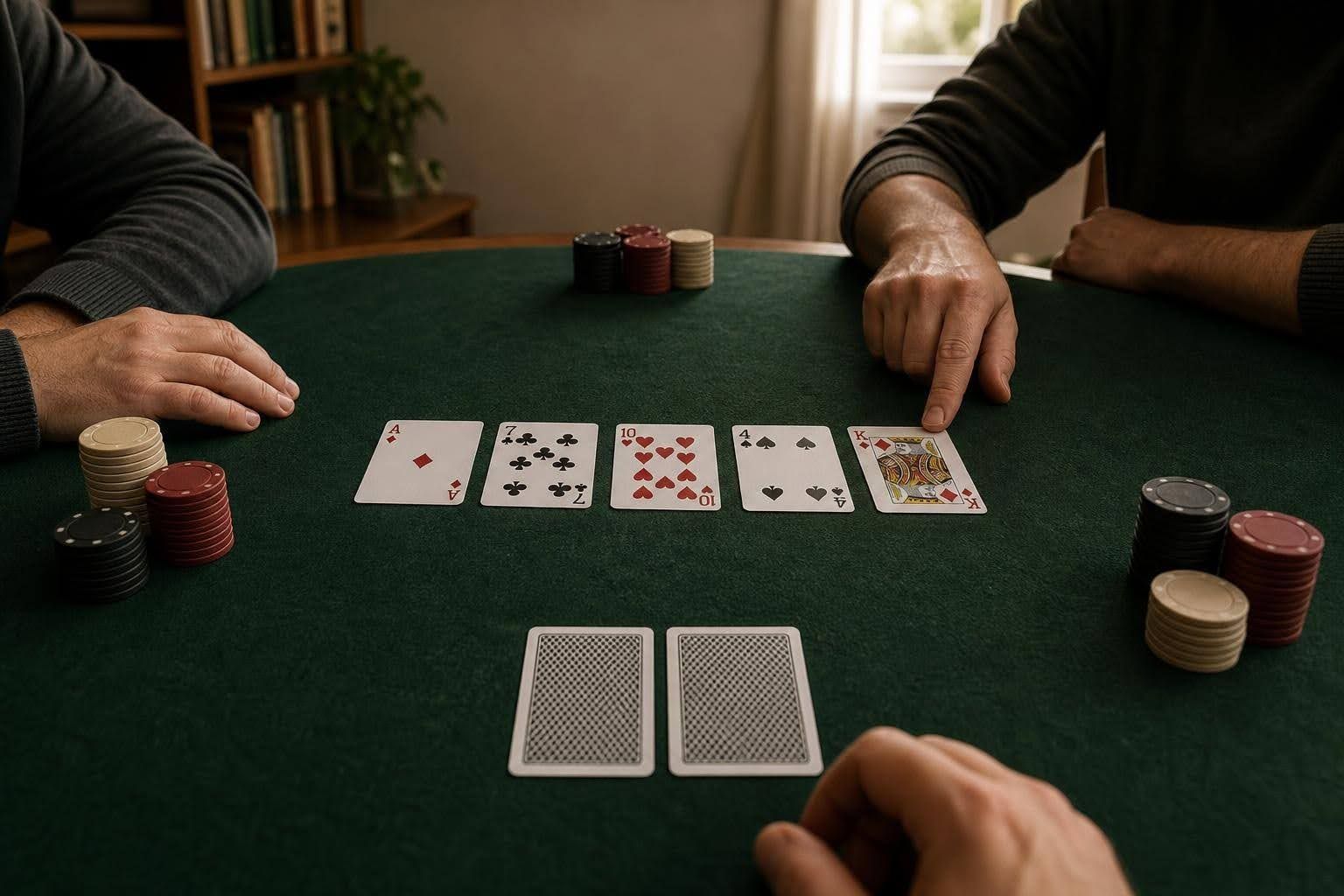
Watch a poker table for a few minutes and the small gestures start to stand out. Someone taps the table. Another player announces a raise before moving any chips. A round marker passes from seat to seat between hands. Each has a purpose, and understanding them helps a newcomer follow both the cards and the people playing them.
Following a Hand of Texas Hold’em
Texas Hold’em uses a standard 52-card deck. Each player receives two private cards, while five shared cards appear in the center over the course of a hand. For an explanation of the setup and betting actions, this beginner’s guide to poker offers a reference.
The round marker is the dealer button, which identifies the dealer position. At a table with three or more players, the next two seats clockwise put forward compulsory bets: the small blind and big blind. Before the flop, the player to the left of the big blind acts first.
Players can fold, giving up their hand; call, matching the current wager; or raise, increasing it. When there is no outstanding wager to match, a player can check, passing the action, or bet.
Next comes the flop: three shared cards dealt face up. After betting, a fourth card arrives as the turn. Another betting round follows, then the fifth card, the river, and a final round. From the flop onward, the first remaining player clockwise from the button acts first.
A player takes the pot when every opponent folds. If several remain after the final betting round, they compare their cards at showdown. The button moves clockwise for the next hand.
Knowing Which Hand Wins
Each player uses the strongest five-card combination available from their private cards and the shared cards. That combination can include either, both or neither of their private cards.
The standard order, from strongest to weakest, is:
- Royal flush: Ace, king, queen, jack and ten of one suit.
- Straight flush: Five consecutive cards of one suit.
- Four of a kind: Four cards of the same rank.
- Full house: Three cards of one rank and two of another.
- Flush: Five cards of one suit, outside a straight-flush sequence.
- Straight: Five consecutive cards with mixed suits.
- Three of a kind: Three cards of the same rank.
- Two pair: Two separate pairs.
- One pair: Two cards of the same rank.
- High card: A hand assessed by its highest cards.
An ace can sit at either end of a straight: A-2-3-4-5 or 10-J-Q-K-A.
When two players have the same pair, the remaining cards in their five-card hands can decide the winner. These are kickers. A pair of kings with an ace kicker, for instance, beats the same pair with a queen kicker. Equal five-card hands share the pot. Suits carry equal value.
Making Your Actions Clear
The cards decide the result at showdown, but players need to understand one another throughout the hand. Acting in turn and announcing decisions clearly help prevent disputes.
One useful detail concerns oversized chips. Under established tournament rules, putting forward a single oversized chip while facing a bet counts as a call unless the player announces a raise first.
Chips should stay in countable stacks. Place each wager separately from the existing pot so the dealer can check its amount, and keep private cards visible on the table with their faces concealed during play.
Decisions belong to the individual holding the cards. Advice during a hand, or discussion of cards already discarded, can affect someone else’s choice. Save those conversations until the hand is over.
The Customs Around the Cards
That tap on the table signals a check when checking is available. Other familiar habits have similarly practical roots. Placing a chip over private cards helps protect them from accidental collection.
Before dealing the flop, turn and river, the dealer sets aside one card face down. Known as burning a card, this serves a security purpose.
Written accounts also show poker’s long place in American card-playing culture. An 1868 edition of The American Hoyle includes draw and straight poker.
At home, dealer’s choice gives each dealer the opportunity to select a variant under the group’s agreed arrangements. Naming the game becomes part of the gathering, along with shuffling and dealing.
Settling the Rules Before Play
Agree on the variant, stakes and house rules beforehand. Fixed-limit games use prescribed betting amounts. Pot-limit games cap wagers according to the pot, while no-limit games allow legal wagers up to a player’s available table chips.
For anyone playing for money, set a spending limit and finishing time in advance. Keep essential expenses separate, take breaks and avoid chasing losses. An agreed ending lets everyone know when the cards will be put away.